- Prototype link (Please submit a link to a playable prototype, not a link to your design file)
- Describe your project (max 150 words)
Tiktok’s For-You page. Instagram’s Explore Page. YouTube’s Recommendations. Algorithms dictate what we watch, deciding whose lives we consume and compare ourselves to–often without questioning why. But, what if, instead of doom-scrolling, you spent that time engaging with your own story, through journaling?
You’re the most important person in your life. Time lost to curated, artificial glimpses of others could be spent learning about yourself. What’re your hot takes? What’s happening in your life? Where’s your happy place? What’s on your mind? Glimpse challenges the algorithmic trap by offering space for self-reflection/truth-finding, helping you appreciate your own mind amidst toxic content consumption.
Our goal isn’t to collect infinite entries. You choose what writing to share by uploading pictures or screenshots. Our algorithm curates a personalized feed of your journals–celebrating what makes you, you.
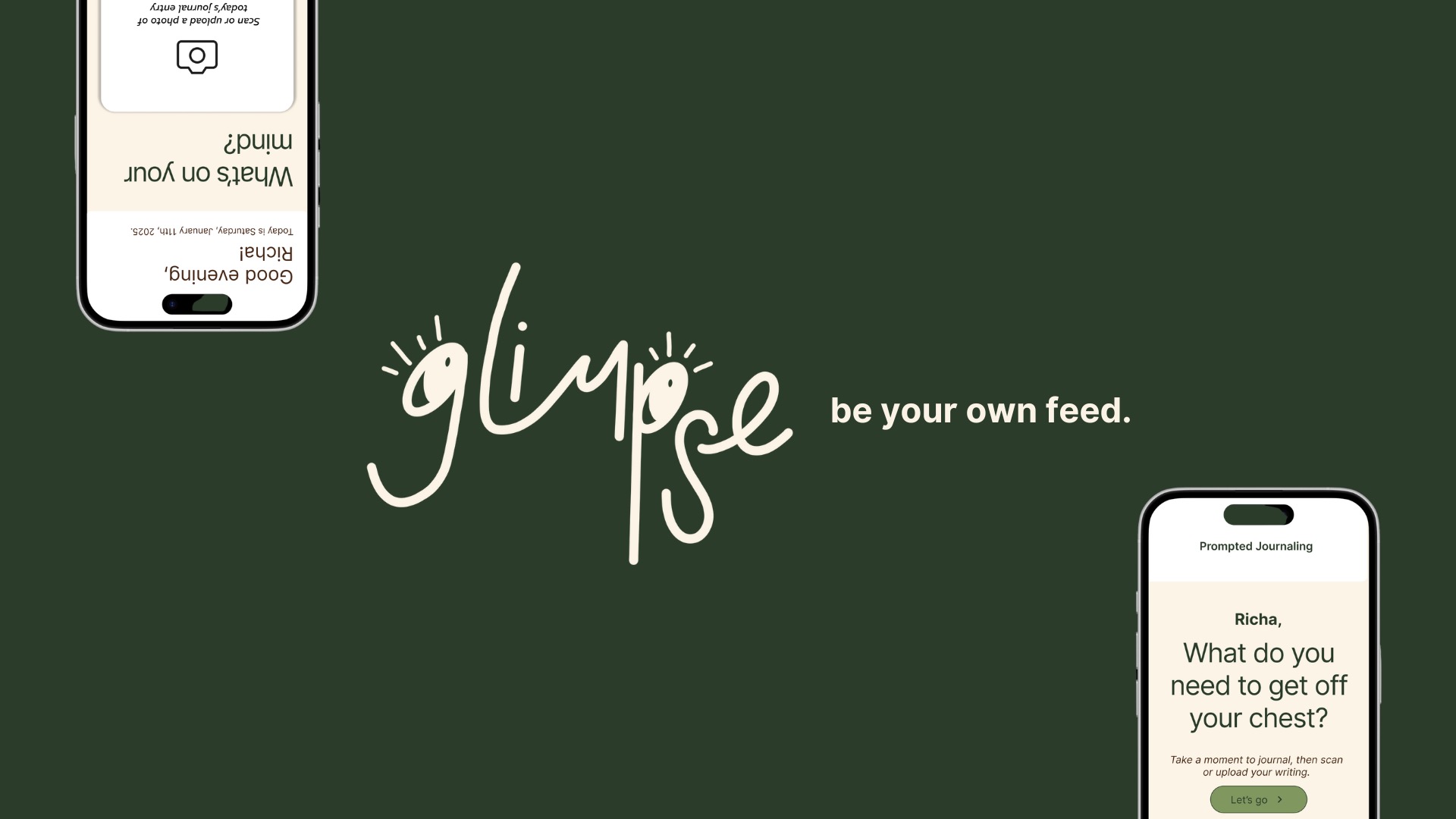
No forced prompts, no prescribed paths—document and connect with yourself your own way. Be your own feed.
- Describe your research process and findings. If you conducted any surveys or interviews, please include the survey form and/or interview questions here. If you conducted secondary research by pulling from online sources, please include a link to your sources. (Max 500 words)
Our research process involved both qualitative and quantitative methods. We conducted 6 interviews with college students — Drew, Tobi, Richa, Simrun, Hannah, and Emerson. Each interview focused on their creative backgrounds, lasting 30-60 minutes. Additionally, we sent a survey to students aged 14-24, examining their social media habits, free-time usage, and academic habits.
From Simrun, a freshman at UChicago, we learned that she values ownership in her journaling, refusing to use AI in her personal projects but welcoming it as a tool for asking questions that challenge her. She would appreciate an algorithm that would review her writing, validate her thinking, ask her questions about unclear writing, and challenge her to push her thinking to the next-level.
Drew, a freshman at Rice, shared his experience with daily journaling, where he wrote summaries of gratitude and reflection about every day throughout 2024. At the end of the year, he spent 2 hours reflecting on his entries, which provided him with a meaningful sense of emotional connection with himself. He inspired us to incorporate a feature in our app that curates excerpts of past writing every day to highlight personal growth, reflection, and passion.
Emerson, a freshman at Rice, expressed a desire to start a “junk journal” (a journal that combines artistic aesthetics with one’s reflections), but feels overwhelmed with the time and energy it would take for her artistic vision to come to fruition. She inspired our “Prompt Me” button, which lets our algorithm cycle through a user’s past journaling experiences and use data-driven reasoning to generate prompts that our user may resonate with.
Our survey found that 93% of participants sometimes or always spend more time on social media than they intended, when they wish they would spend their free time on offline activities, such as exercising, connecting with friends, reading, or writing. 83% of participants use AI for schoolwork, with 40% feeling guilty about doing so, and 44.9% of people reporting feeling more satisfied with work done without AI. Despite AI’s utility, 75% of participants expressed concerns about relying too much on it, and 42% worried that they didn’t fully earn their grades.
In secondary research, we conducted a competitive analysis of popular journaling apps, including Day One, Journey, Dailyio, Grid Diary, and LILY. We found that while apps like Journey and Dailyio offer virtual assistants, none of the competitors provide a free option for backing up journals or feature a personalized feed that tracks users' growth. Additionally, none of these apps offer metrics or encouragement to keep users engaged, which we plan to address with our own app features.
- Describe your most important design decisions. What research findings and/or user testing results led you to make these decisions? (Max 500 words)
Our research revealed a strong desire for a digital space that encourages independent thought rather than passive consumption. Interviews and survey responses shaped our core design principles: empowering users to write freely, reducing algorithmic control, and fostering mindful engagement with personal content.
Many social media platforms encourage endless scrolling, prioritizing external content over self-expression. Our algorithm counters this by generating a finite daily recap of only the user's own content, encouraging creation over consumption.
Our survey found that 13.8% of students use AI to write papers, 55.2% of students use it for idea generation for essays, and 56.9% for editing papers. However, 45.3% reported feeling guilt when relying on AI for such tasks. In Tobi’s interview, she shared that frequent AI use diminished her confidence in organizing and articulating her thoughts in academic essays, as it became a safety net for her writing. She believed that journaling could help her write more, develop her own voice, and improve her ability to think and communicate on the spot, reducing her reliance on AI to overcome writer’s block.
Therefore, our algorithm is designed to avoid doing the thinking for you. Simrun’s interview influenced this approach, emphasizing that true satisfaction comes from self-generated ideas. Your writing is entirely your own, with the algorithm simply interacting with, curating, and presenting past writings in your feed. It’s just a memory box that highlights the beauty of your work. Inspired by Drew’s insights on the value of revisiting past writing, we designed a feed where users can tag, categorize, and reflect on their journal entries. Users upload entries via a picture box, labeling them to help the algorithm organize content. 65% of surveyors stated they journal on paper, whereas 35% stated that they journal online. Therefore, we are allowing users to either upload pictures of paper journaling, or screenshots of virtual journaling. An "omit" tag allows users to exclude private or sensitive entries, ensuring that the algorithm does not interact with content they prefer not to revisit.
To enhance mindfulness, our app features a minimalist design with muted earth tones, creating a calming space for journaling. This aligns with Emerson’s feedback—journaling can feel daunting, so we aimed to create a welcoming, low-pressure environment. Emerson’s interview highlighted that many people struggle with consistency; 38% of survey respondents had journaled before but stopped, indicating retention challenges. This insight inspired the "Prompt Me" button, striking a balance between Simrun’s and Emerson’s perspectives. Simrun prefers unrestricted writing, while Emerson finds prompts helpful for getting started. By making prompts optional, we support different journaling styles while encouraging users to develop their own voice.
Built With
- figma

Log in or sign up for Devpost to join the conversation.