-
-
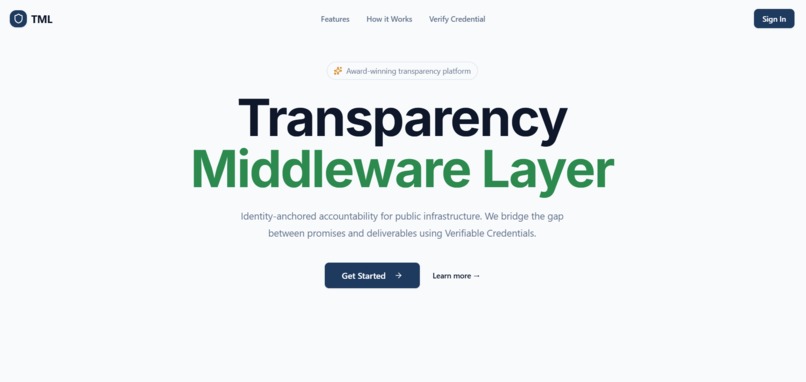
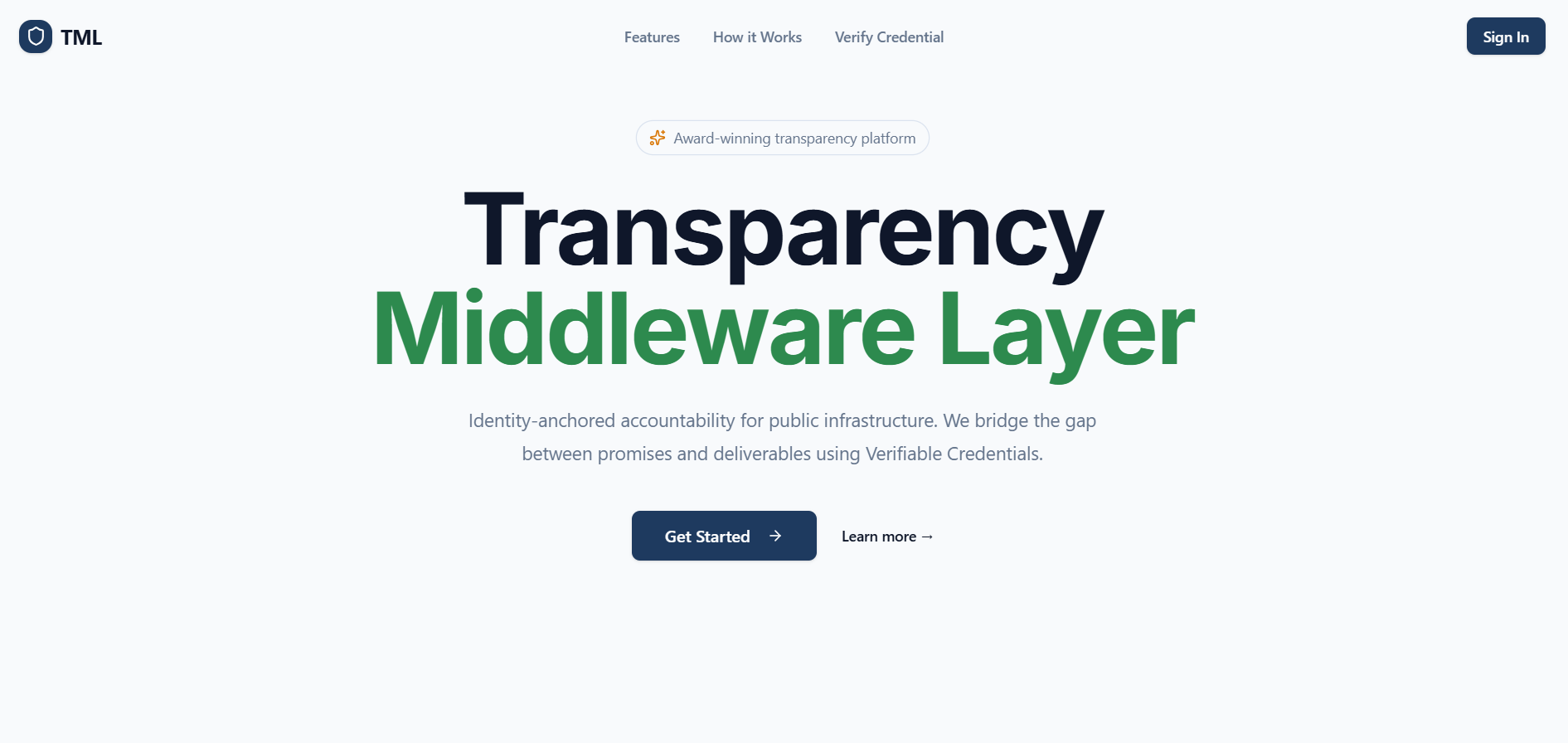
First page
-
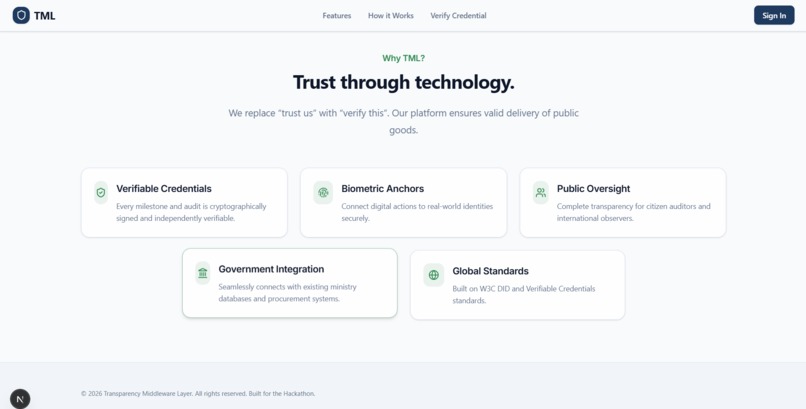
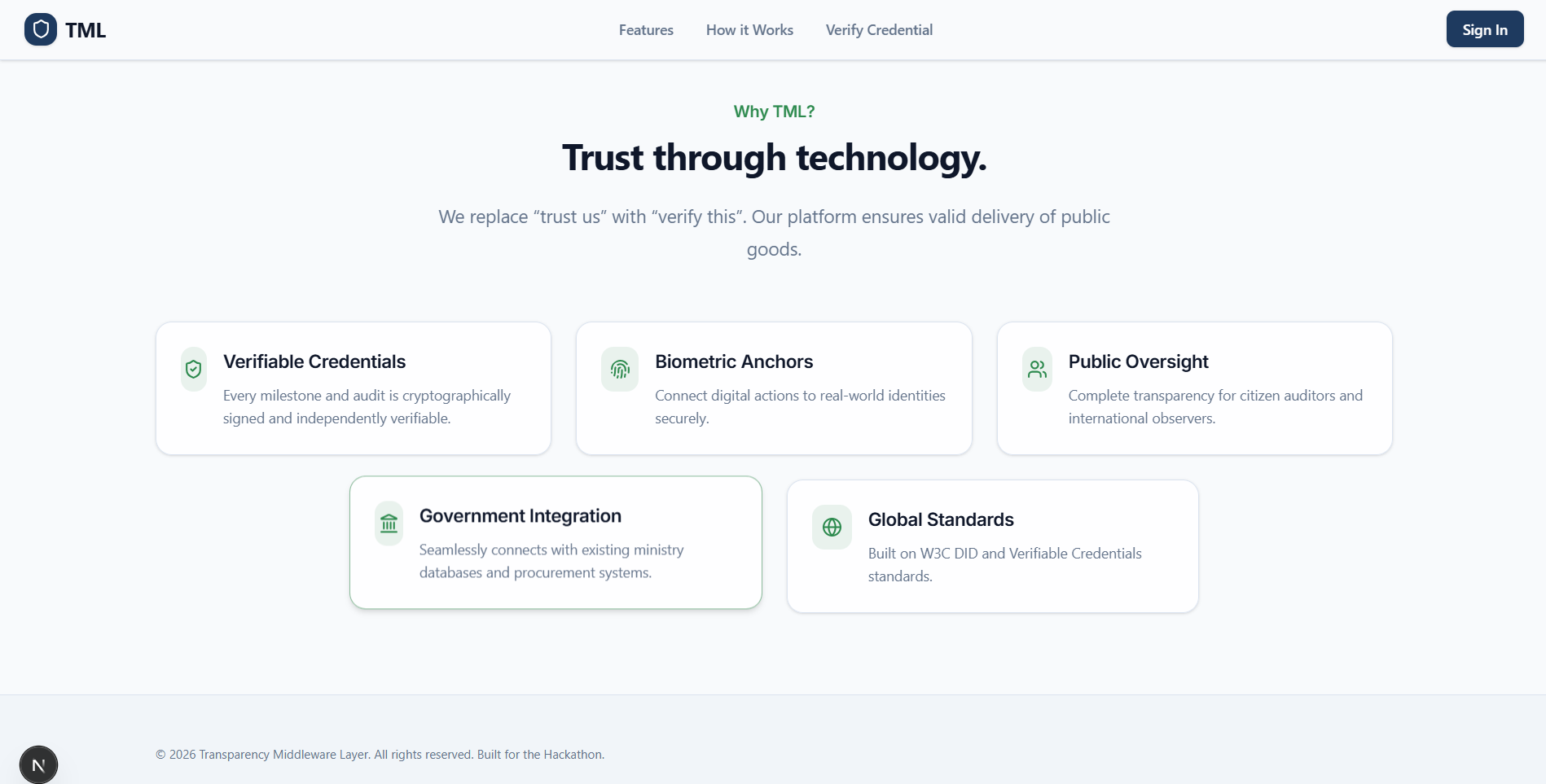
Why TML ?
-
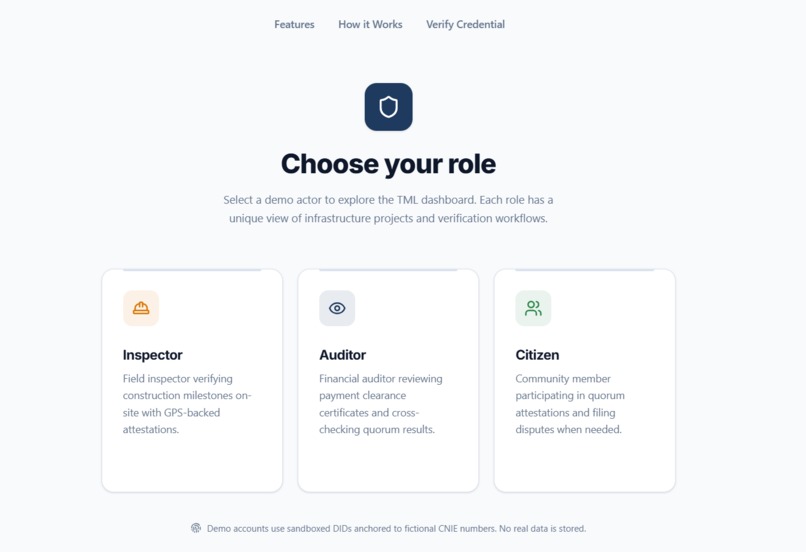
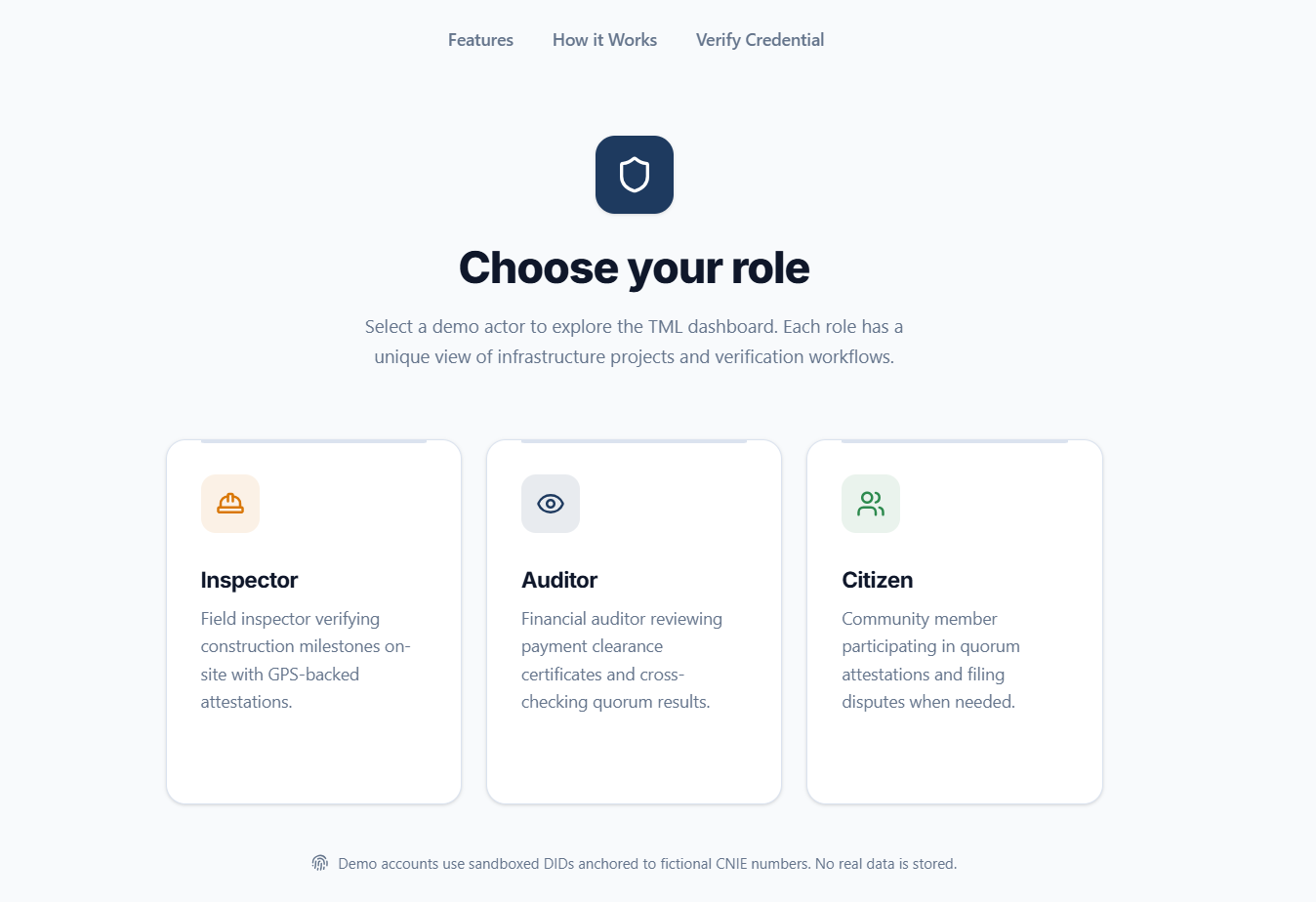
Choose your role
-

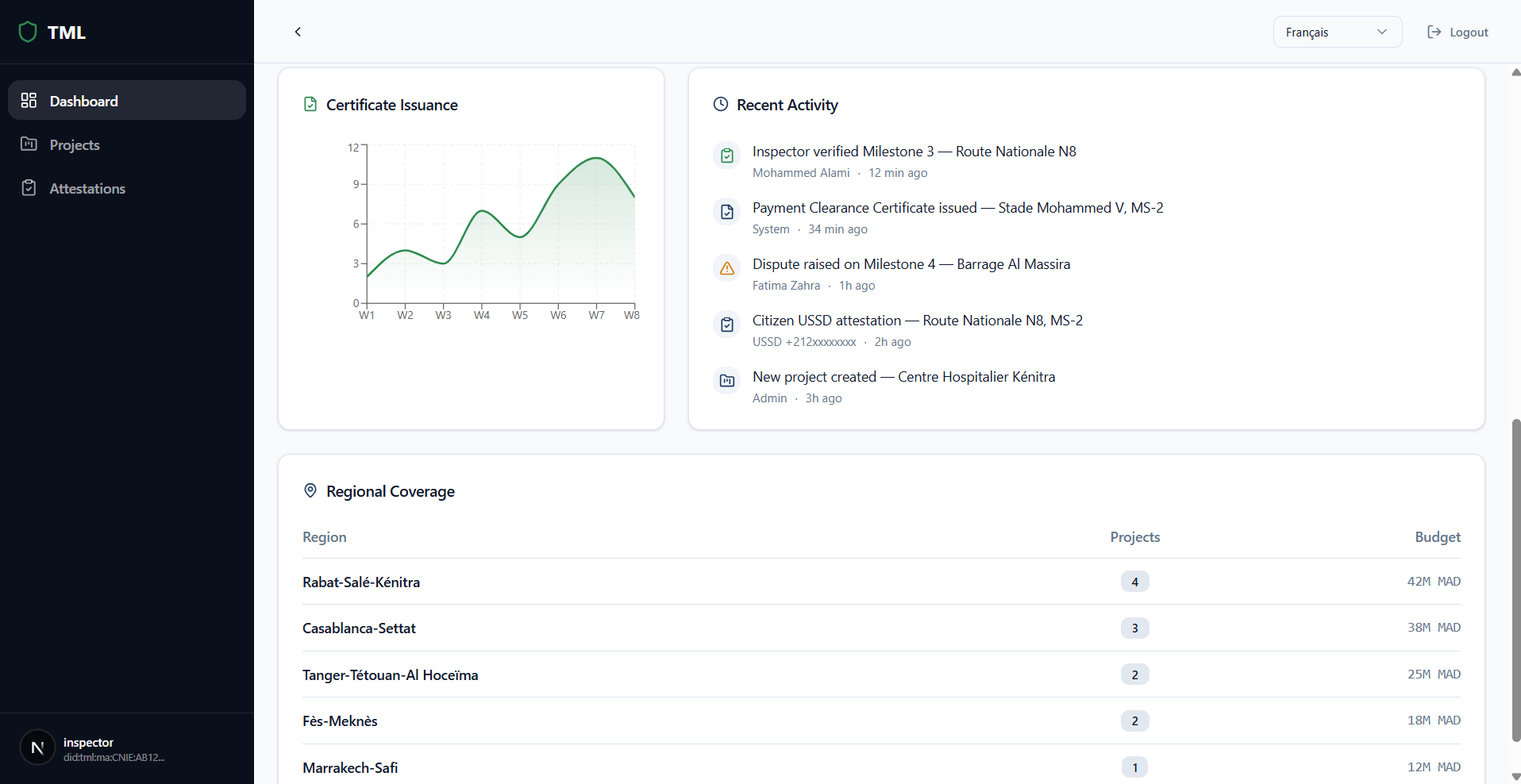
Inspector Dashboard1
-
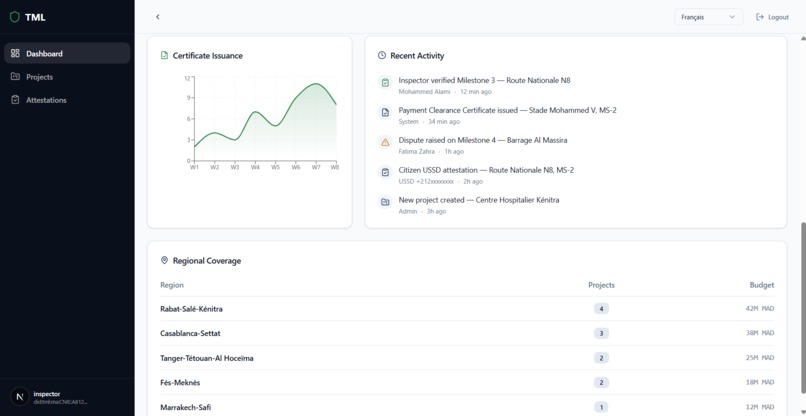
Inspector Dashboard2
-
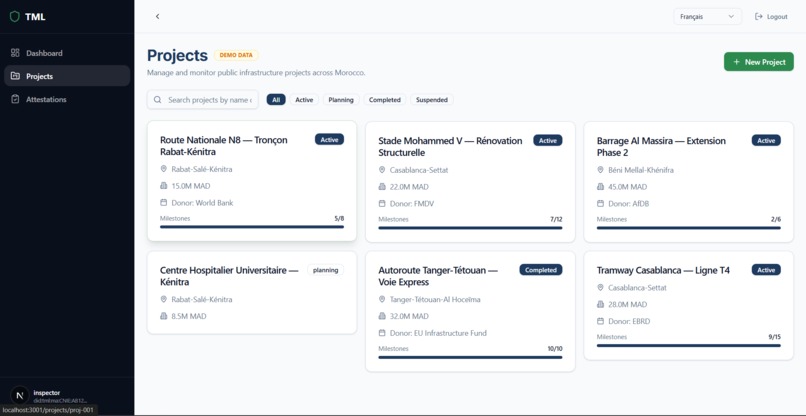
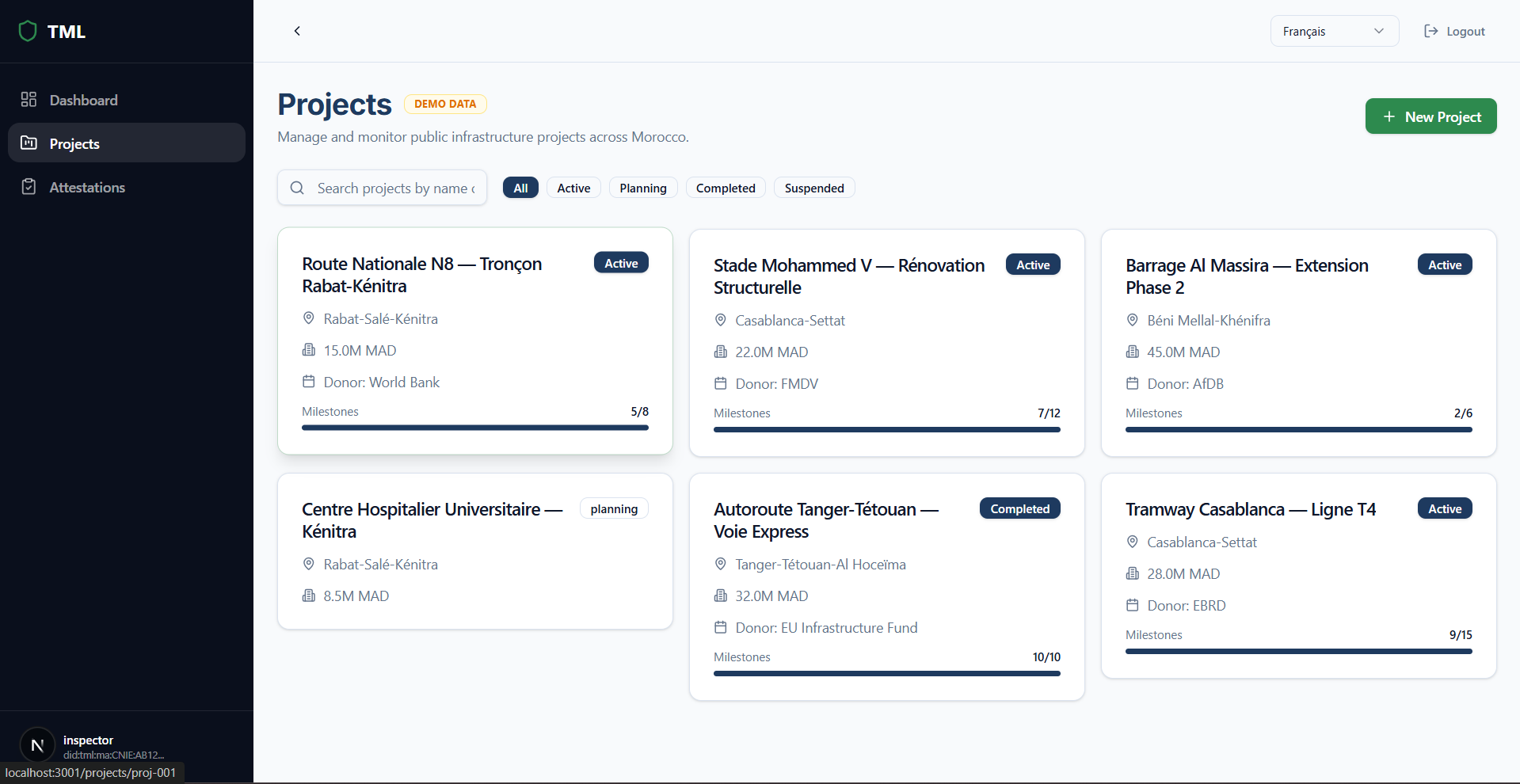
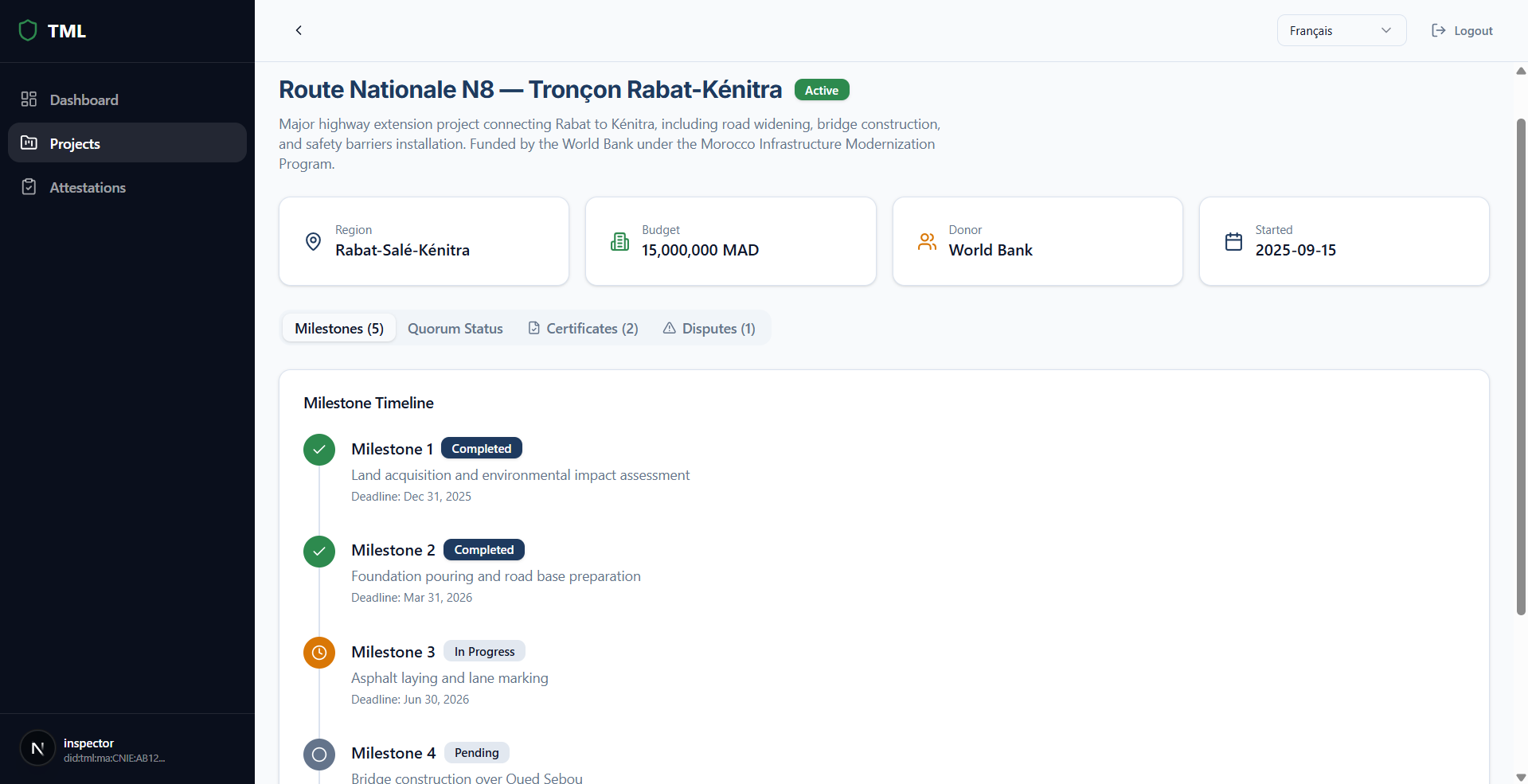
Inspector Project view
-
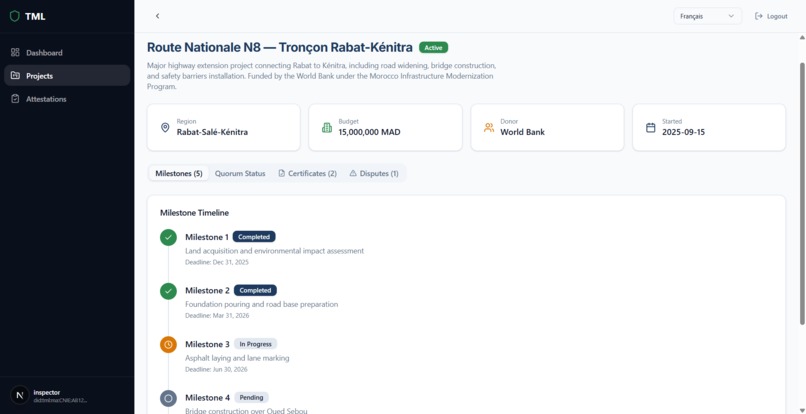
Inspector example project
-
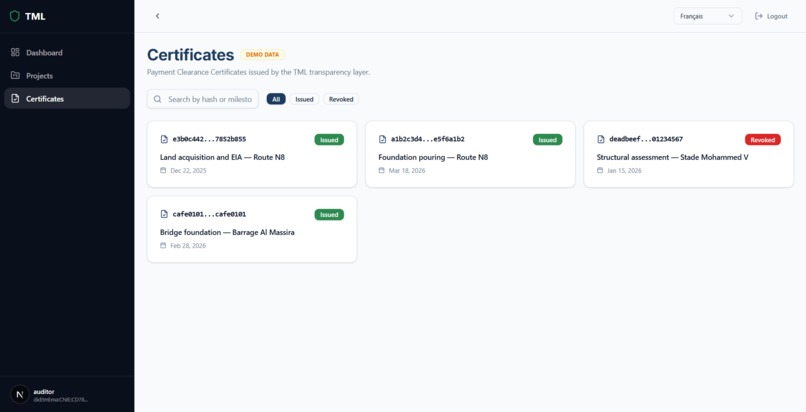
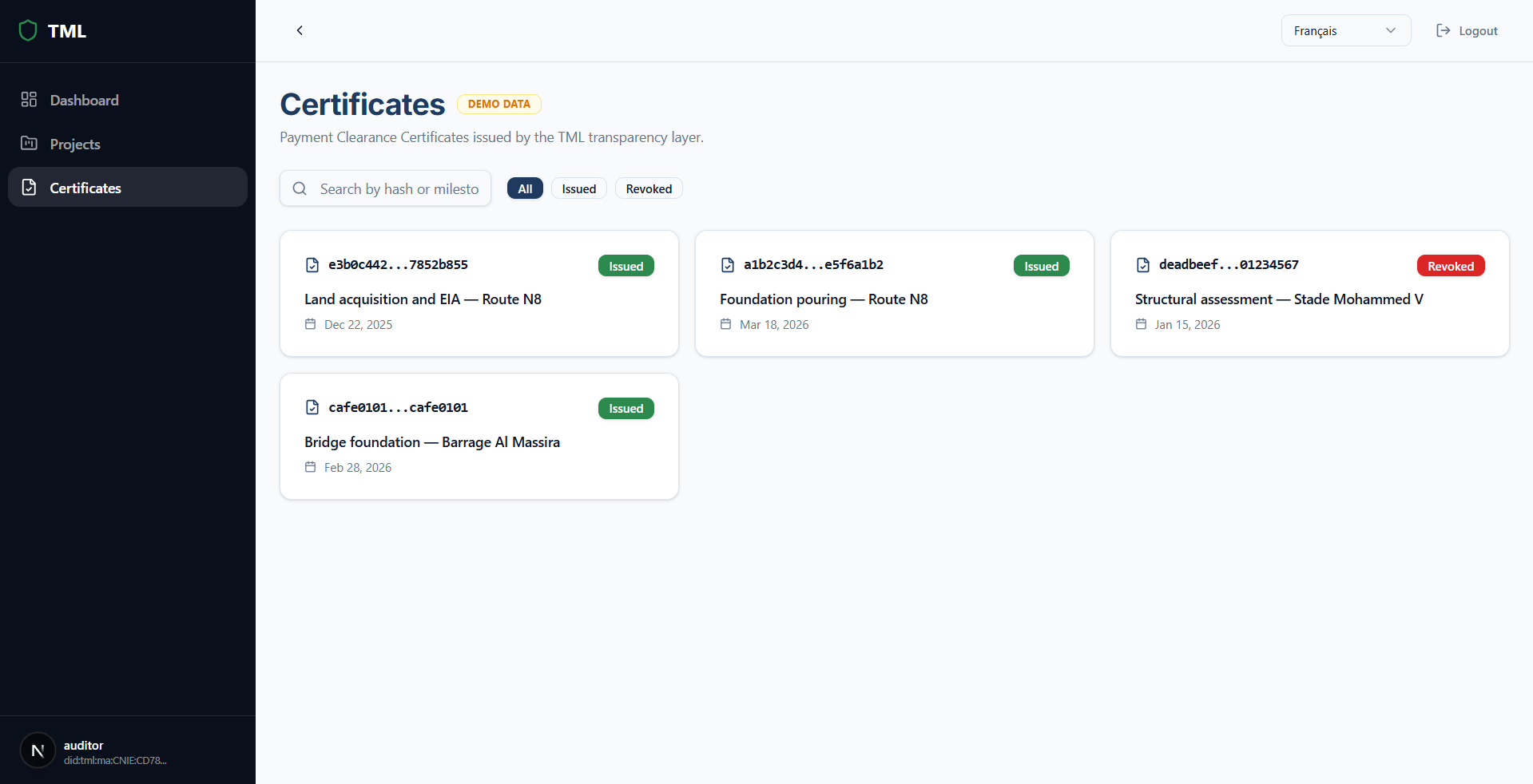
Auditors Certificate view
-
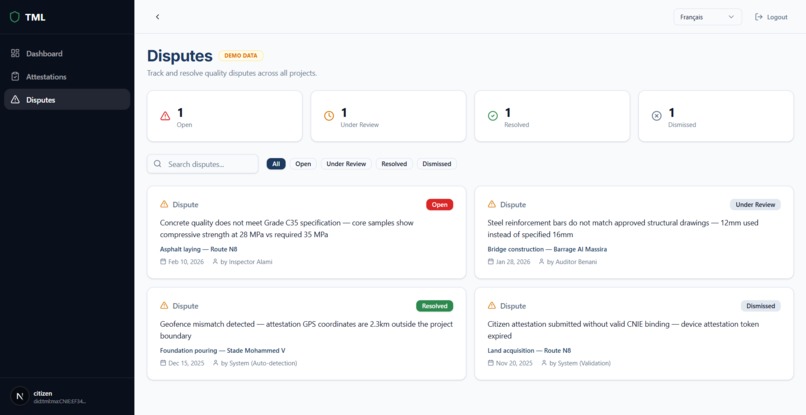
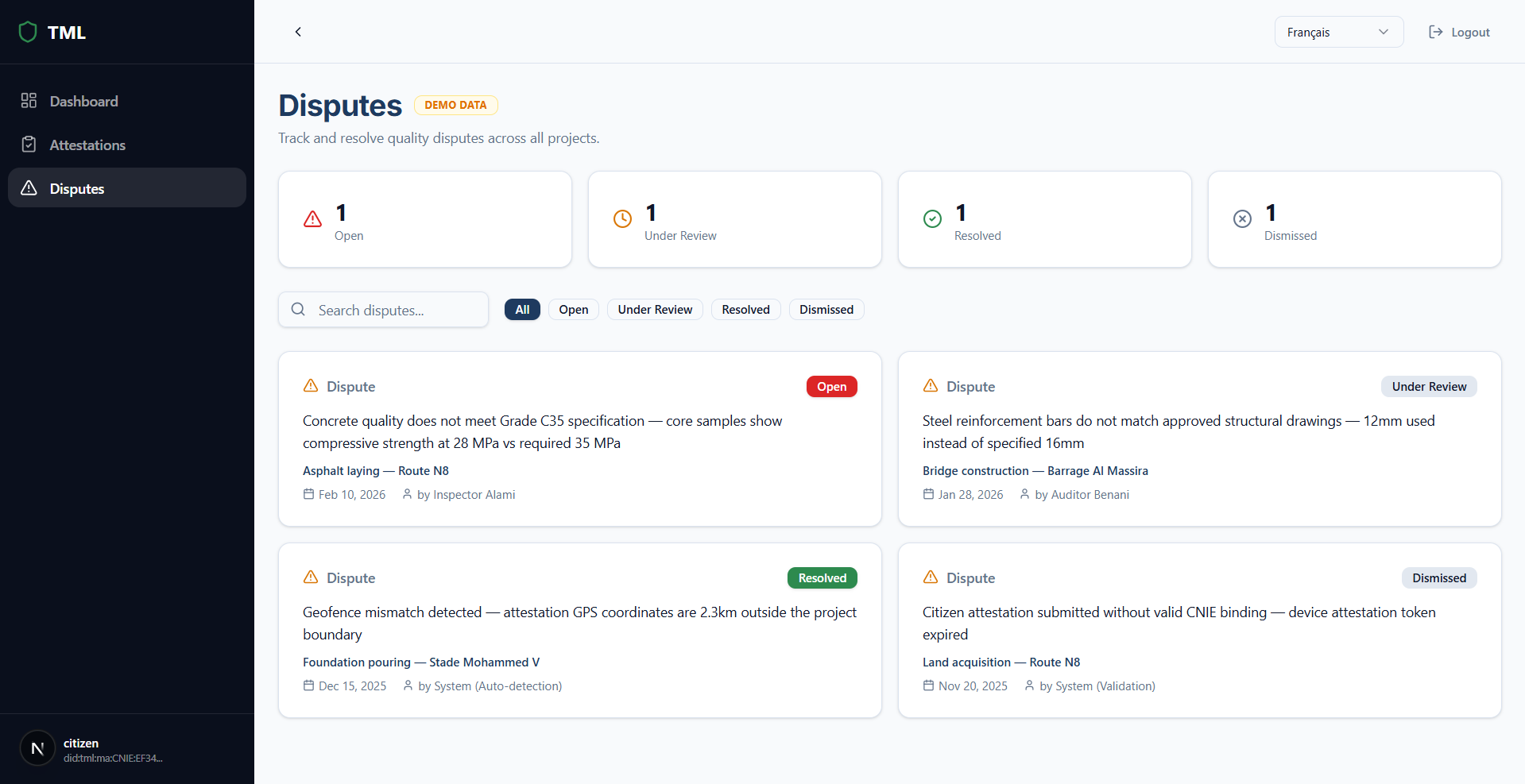
Citizen Dispute view

Project Story: TML: TrustBuild
Inspiration
Across Africa, governments are investing heavily in roads, schools, hospitals, and large-scale infrastructure. Yet in many contexts, public trust remains fragile. Projects are announced with strong political commitment, but on the ground, citizens often witness delays, quality degradation, or unclear accountability.
What inspired us was a simple observation:
Digital ID systems across Africa are becoming stronger, but they are rarely used as enforcement mechanisms.
Most digital identity initiatives focus on access: access to banking, access to public services, access to benefits. We asked a different question:
What if digital identity could also enforce accountability?
Instead of using identity only to receive services, we explored how it could be used to guarantee delivery of public goods.
That question became TrustBuild.
What We Learned
1. Accountability Fails at the Identity Layer
In public procurement, contracts are signed by companies, abstract legal entities. When failures occur, liability becomes diluted. Individuals rotate, companies dissolve, responsibility disappears.
We learned that corruption and inefficiency are not only financial problems, they are identity-binding problems.
If liability is not cryptographically tied to a verified natural person, enforcement becomes weak.
2. Digital Public Infrastructure Is Underutilized
Africa has made significant progress in Digital Public Infrastructure (DPI):
- National digital ID systems
- Biometric verification
- e-Signature frameworks
- Verifiable credential standards
However, these tools are rarely connected directly to public finance disbursement controls.
We realized that identity systems can act as a compliance oracle, not just an authentication tool.
3. Trust Requires Multi-Party Verification
Single-source approval creates structural risk. Instead, we modeled milestone validation as a quorum system:
C = f(A_c, A_a, A_z)
Where:
- ( A_c ) = Contractor attestation
- ( A_a ) = Independent auditor attestation
- ( A_z ) = Citizen quorum attestation
The compliance certificate ( C ) is issued only if all required attestations meet verification thresholds.
This transforms trust from a hierarchical decision into a distributed verification process.
How We Built TrustBuild
1. Identity-Anchored Architecture
We designed TrustBuild as a middleware layer that integrates with national digital ID systems using:
- W3C Verifiable Credentials
- OpenID for Verifiable Credential Issuance
- Cryptographic signature verification
Each actor, contractor, engineer, auditor, or citizen, signs milestone attestations using identity-linked credentials.
Rather than storing personal data on-chain, we adopted a:
- Hash-on-chain
- Encrypted evidence off-chain
model to ensure privacy compliance and data sovereignty.
2. The Payment Clearance Mechanism
The core innovation is the Payment Clearance Certificate (PCC).
Instead of building a monitoring dashboard, we designed an enforcement trigger:
= \begin{cases} 1 & \text{if } C = \text{valid} \ 0 & \text{otherwise} \end{cases}
If the certificate is not issued, the payment workflow halts.
This reframes transparency from passive reporting to active financial control.
3. Inclusive Citizen Participation
A major challenge was designing a system that works beyond smartphones and urban environments.
We created tiered participation:
- Smartphone-based zero-knowledge proximity proofs
- USSD-based verification for feature phones
- Civil society aggregation options
Thresholds ensure resilience against SIM-farm attacks and coercion.
Challenges We Faced
1. Balancing Privacy and Enforcement
One of our hardest design questions was:
How do you increase accountability without increasing surveillance?
We resolved this by:
- Avoiding storage of personally identifiable data on immutable ledgers
- Using zero-knowledge techniques where possible
- Limiting credential scope and duration
Privacy-by-design became non-negotiable.
2. Preventing Collusion
Rotating auditors per milestone and linking professional credentials to revocation mechanisms was essential. However, designing a governance model that remains independent and resistant to capture required careful thought.
We had to think adversarially:
System Security = Incentive Alignment + Technical Controls
Both components are necessary.
3. Designing for Scale Across Africa
Our hackathon context required thinking beyond one country.
African states have different:
- ID maturity levels
- Regulatory frameworks
- Institutional capacities
We therefore designed TrustBuild as reusable identity middleware, not country-specific software. Any nation with digital ID rails can integrate the compliance layer without replacing its financial sovereignty systems.
What This Project Means to Us
TrustBuild is not just a technical solution. It reflects a belief:
Digital identity should not only help citizens prove who they are,
it should help societies prove that promises are kept.
If Africa is investing in digital identity, then that identity infrastructure should strengthen public trust, protect public funds, and empower citizens to participate in governance.
TrustBuild is our attempt to turn digital ID from an access tool into an accountability engine.
Built With
- docker
- fastify
- github
- mapbox
- mosip
- next
- node.js
- postgresql
- prisma
- react
- sha-256
- tailwind
- typescript
- ussd
- vitest


Log in or sign up for Devpost to join the conversation.