-
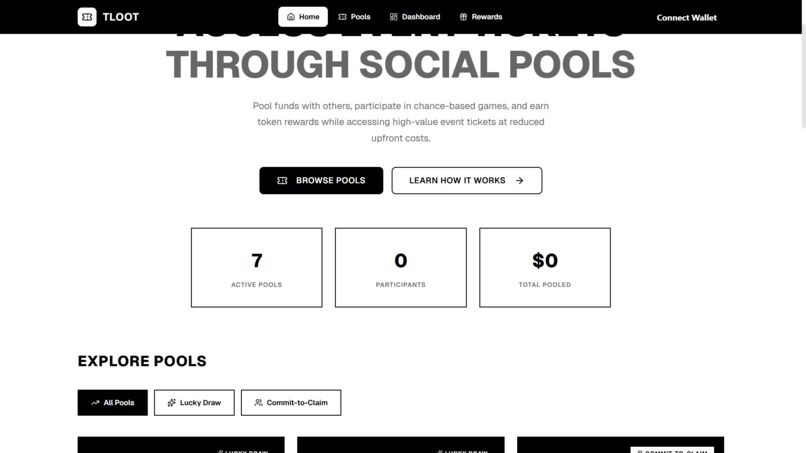
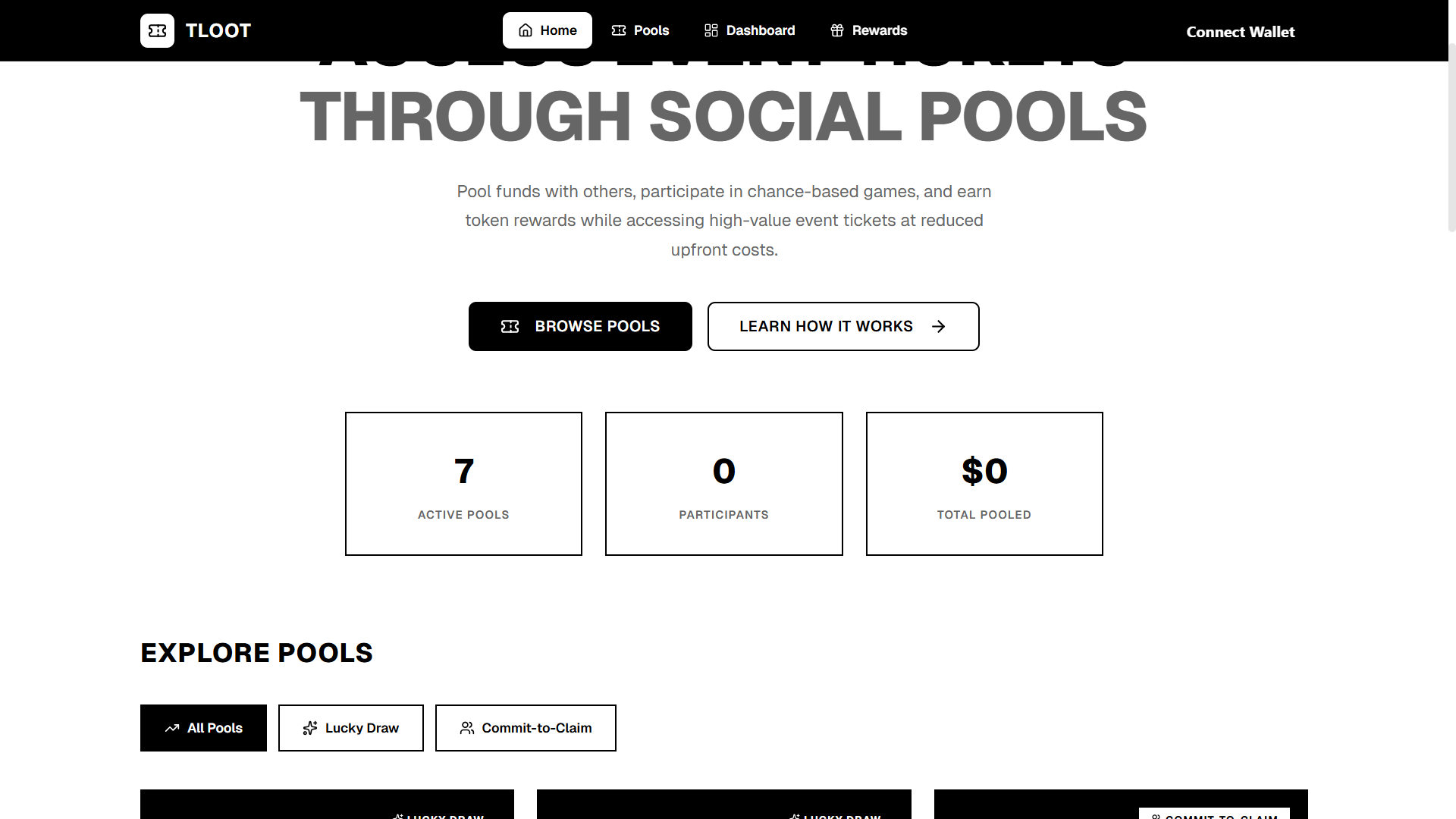
Tloot a gamify trustless social pooling for event access and shared rewards powered by smart contracts.
Inspiration
Traditional group funding and shared access systems (like event ticket pooling or community funds) rely heavily on centralized control and trust between participants. This creates problems such as lack of transparency, fund misuse risk, and manual coordination overhead.
We wanted to build a trustless system where users can pool funds transparently and access shared experiences without intermediaries. The vision was to use blockchain smart contracts to automate fund management, enforce rules, and ensure fairness.
Additionally, we wanted to explore consumer Web3 applications that combine social participation, reward distribution, and decentralized finance mechanisms.
What We Built
TLOOT is a decentralized social pooling platform that enables users to:
pool funds with others
access high-value event tickets
participate in chance-based reward systems
automatically distribute rewards using smart contracts
coordinate funds transparently on-chain
The system removes centralized control and ensures all operations are executed by smart contracts.
Users create pools, contribute tokens, and receive rewards based on predefined rules stored on-chain.
How We Built It Smart Contract Layer
We built Solidity smart contracts to manage:
pool creation
participant contributions
fund locking
reward distribution
pool lifecycle management
All rules are enforced automatically on-chain.
Blockchain Infrastructure
The project was originally built on Mantle and later migrated to Etherlink, an EVM-compatible blockchain in the Tezos ecosystem.
Migration steps included:
updating network RPC configuration
redeploying smart contracts to Etherlink testnet
updating frontend contract addresses
adapting network interaction logic
Because Etherlink supports EVM, the migration required minimal code changes.
Frontend Application
The frontend allows users to:
create pools
connect wallets
contribute funds
view pool status
interact with smart contracts
User actions trigger blockchain transactions and update on-chain state.
Architecture Overview Frontend → Wallet Provider → Etherlink RPC → Smart Contracts → On-chain State
All transactions are transparent and verifiable.
What We Learned
During development we learned:
EVM-compatible blockchain deployment workflows
smart contract security and fund management patterns
wallet provider integration challenges
RPC configuration and network migration
building consumer-focused Web3 applications
decentralized system architecture design
We also gained experience migrating blockchain infrastructure across networks.
Challenges We Faced Network Migration
Migrating from Mantle to Etherlink required:
redeploying contracts
updating RPC endpoints
reconfiguring network settings
ensuring frontend compatibility
Wallet Integration
Handling wallet detection and provider initialization required debugging provider injection and network connection issues.
RPC Reliability
We encountered RPC connectivity issues during contract interaction and improved error handling and configuration.
User Experience
Making blockchain interactions simple for non-technical users required careful UI and transaction flow design.
Impact
TLOOT enables transparent financial coordination and shared access systems without centralized control. Potential use cases include:
event ticket pooling
community funding
GameFi reward systems
decentralized savings groups
shared digital asset access
The platform demonstrates how Web3 can enable trustless collaboration.
Built With
- blockchain)
- contracts
- ecosystem
- etherlink
- hardhat
- infrastructure
- integration
- javascript
- react
- rpc
- smart
- solidity
- tezos
- typescript
- wallet
- web3


Log in or sign up for Devpost to join the conversation.