-
-
Banner
-
Content loading architecture
-
Content Q&A architecture
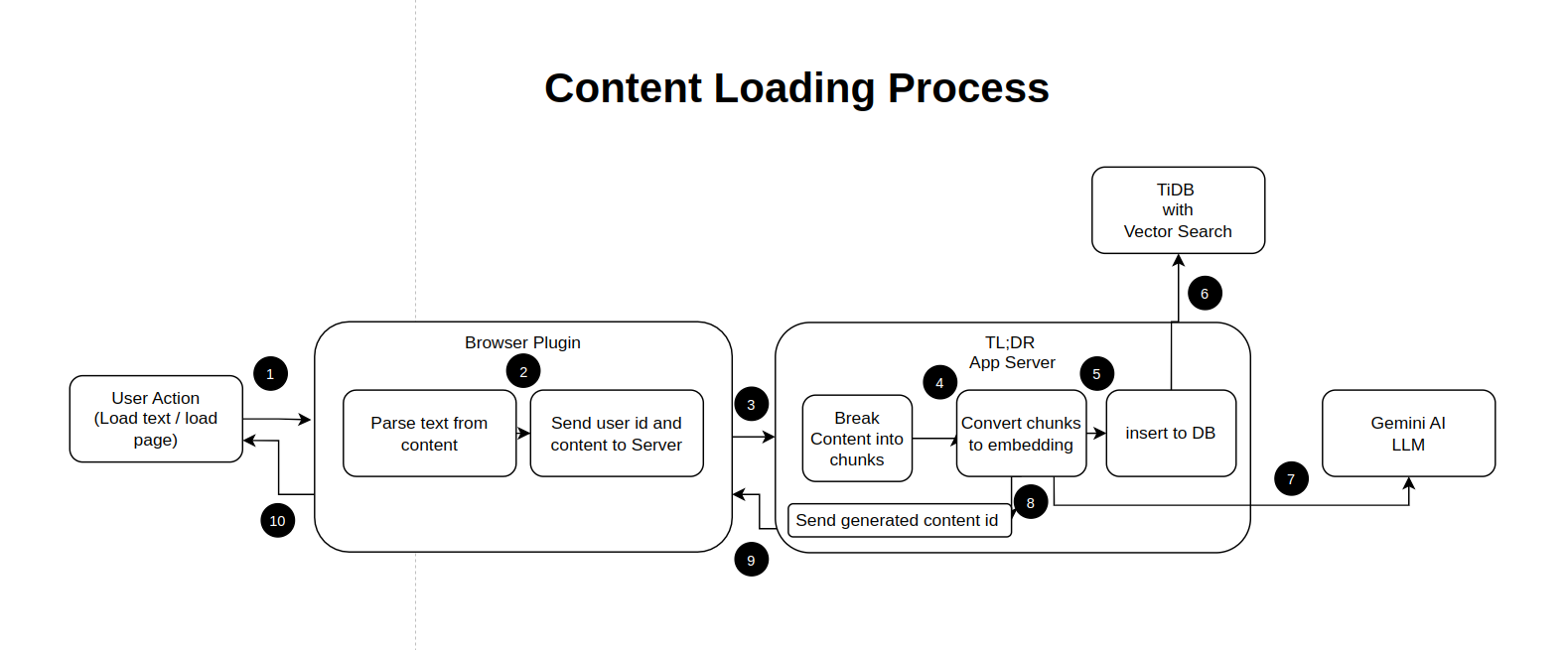
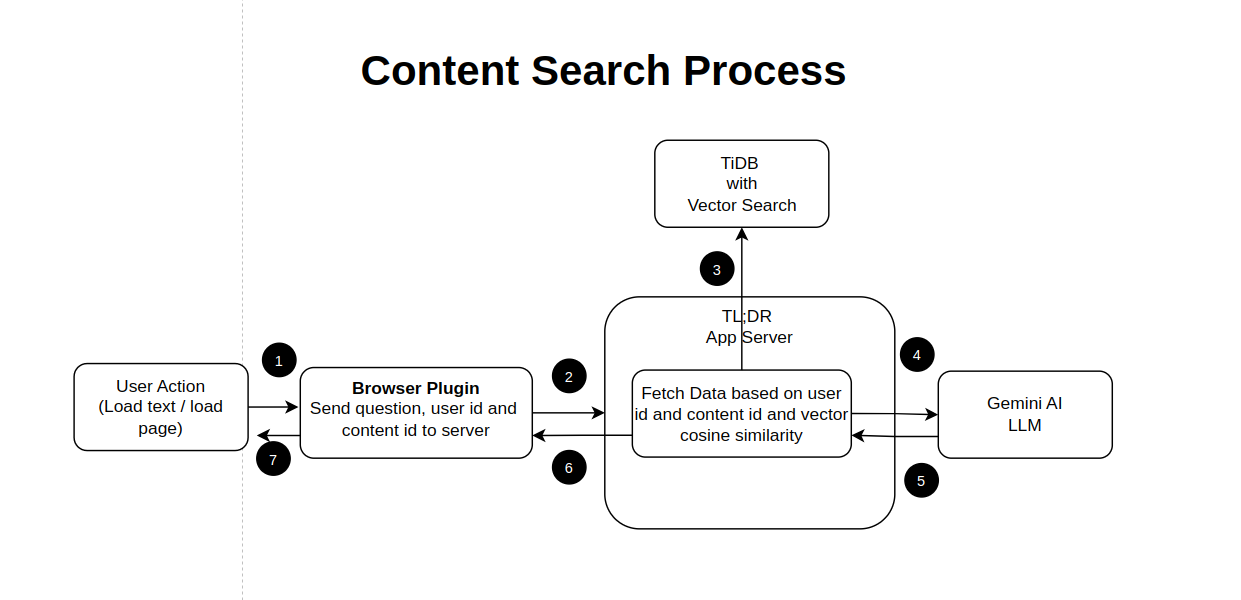
Inspiration
While many solutions exist for web page Q&A (using Retrieval-Augmented Generation -RAG), most are limited to open URLs (accessible without authentication) or require heavy integration, making implementation challenging. A significant issue is that many valuable pages sit behind authenticated logins, preventing servers from scraping them as per user-specific logins. Furthermore, many custom applications have not been modernised, making integration difficult.
Secondly, for private content many employees often copy paste these contents on open GPT's, leaving your data available to be trained by the GPT engine, which is a major data security concern.
Another situation is wherein many organisations, AI tools are restricted due to above security concerns.
Organisations want to have an AI ready workforce. Then how do we solve this problem statement?
TL;DR.ai addresses this challenge by providing controlled access for employees, enhancing their productivity and convenience while ensuring data security. This Chrome extension allows organisations to harness AI's power without compromising sensitive information.
What it does
TL;DR.ai is a Chrome extension that empowers employees within organisations to easily interact with web content (even private content). Users can select text, visit specific web pages, or ask questions related to multiple web-pages (for related data / comparison) simultaneously. The extension captures the selected content / Load full page, processes it, and provides concise summaries or relevant information, all while ensuring compliance with organisational security policies.
How we built it
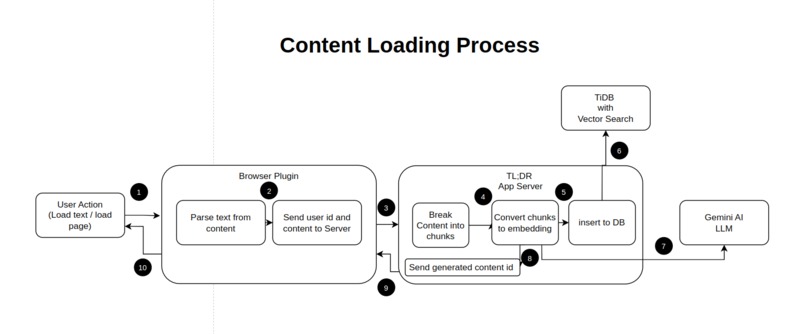
TL;DR.ai is built using a combination of modern web technologies and AI capabilities. The extension operates primarily on the client side to ensure security and compliance, extracting content directly from the user's browser (thereby keep integration efforts to make data available for processing, ZERO). This design choice allows it to work with web pages that require authentication, making it highly versatile and user-friendly. We used a combination of JavaScript, browser APIs, and AI integration to handle text extraction, processing, and generating summaries or responses.
TiDB's roles in TL;DR.ai is extremely vital. Some of the reasons are listed below;
- Superficial increase in context length: GenAI context length is often limited. Storing the parsed information into sections and feeding related chunks with TiDB's vector search capability allowed us to expand search beyond context length
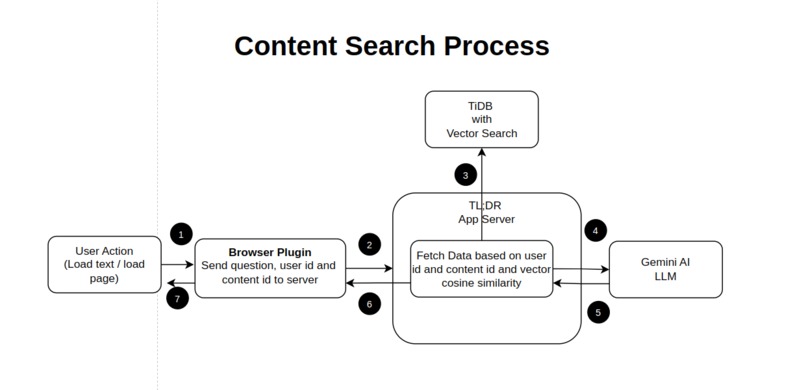
- Historic information retrieval: For TL;DR.ai's features that require comparison, storing and retrieving information is of utmost importance. Additionally with the capability to filter records by regular columns. TiDB's RDMS and vector search in one product allows to access data with a mix of similarity search and the traditional database querying capability under one roof.
- Future Analytics ready: TiDB being a multi functional database, allows to derive real time analytics. Means whether we want to know how are people using the system, setting limits on per user search, etc. One can have real-time analytics, all in one database
Challenges we ran into
Scraping and Text Conversion: One of the major challenges was deciding whether to parse the content on the server side or the client side. Currently, we chose to handle this on the client side due to easy implementation. This approach would be reworked with other GenAI HTML parser (like scrapegraph) in future
Handling Diverse Web Content: Different web pages have different structures, making it challenging to consistently extract relevant content. We needed to implement robust parsing techniques to handle various HTML structures effectively.
Ensuring Security: Since the extension can access authenticated content, it was crucial to ensure that no sensitive data is sent to external servers. All the user loaded data is stored on TiDB secured database + the LLM / GenAI part is your own hosted private model ensuring user and organisational privacy.
Accomplishments that we're proud of
Enhanced Usability: During development, we discovered several additional benefits of the plugin. For example, it can ease comparison shopping on e-commerce sites by allowing users to highlight and compare product details directly.
Efficient Information Retrieval: The extension offers a more efficient way to find information than using traditional methods like CTRL + F. It allows users to quickly locate and summarise relevant content.
Efficient GPT Alternative UX: For those using current GPT. UX is; Select->Copy->Switch tab->Paste->Ask. With TL;DR.ai it is Select/load->Ask. now its just reduces to 2 steps instead of 5.
Integration with Organisational Data: The most significant achievement is providing a GenAI tool that works with an organisation's own data, even if it is protected behind authentication walls. This feature safeguards sensitive information while still delivering AI-powered insights.
What we learned
We learned that there is a strong demand for AI tools that respect organisational security policies while still providing powerful, convenient features. We also gained valuable insights into the challenges of text extraction and processing in a secure and compliant manner. Understanding user needs and iterating based on feedback was crucial for developing a tool that genuinely adds value.
What's next for TLDR.ai
The future of TL;DR.ai includes:
- Enhanced Q&A Capabilities: We plan to evolve the tool from simple Q&A functionalities to more complex chat completions.
- Enhanced scrapping: Like mentioned we would like to integrate with extraction engines like Scrape graph or similar for more meaningful text extraction.
- Broader Application: Text Summarization, Video summarization / Q&A are some of the future capabilities planned.
- User Experience Enhancements: Further refining the user interface and experience will make the tool even more intuitive and seamless to use, encouraging broader adoption within organisations.
- Authentication of TL;DR.ai: Currently its internal API integration is open format, we would like to use SAML based assertion / auth, since that is the most widely used auth in organisation.


Log in or sign up for Devpost to join the conversation.