-
-
Results
tjkernels — a shape-dispatched fused Transformer layer for consumer GPUs
What it does
Replaces the reference Transformer layer with hand-written Triton GPU kernels
and a per-shape dispatcher, keeping every output inside the competition's
error budget (abs ≤ 2e-3 OR rel ≤ 2e-2, per element). Across the 13 runnable
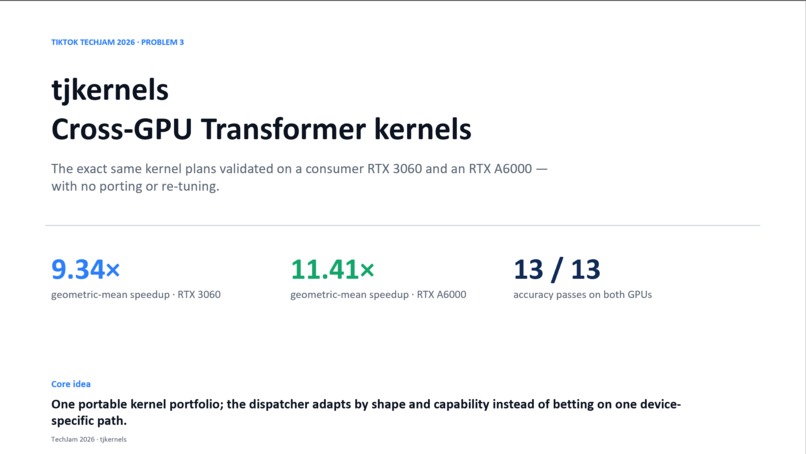
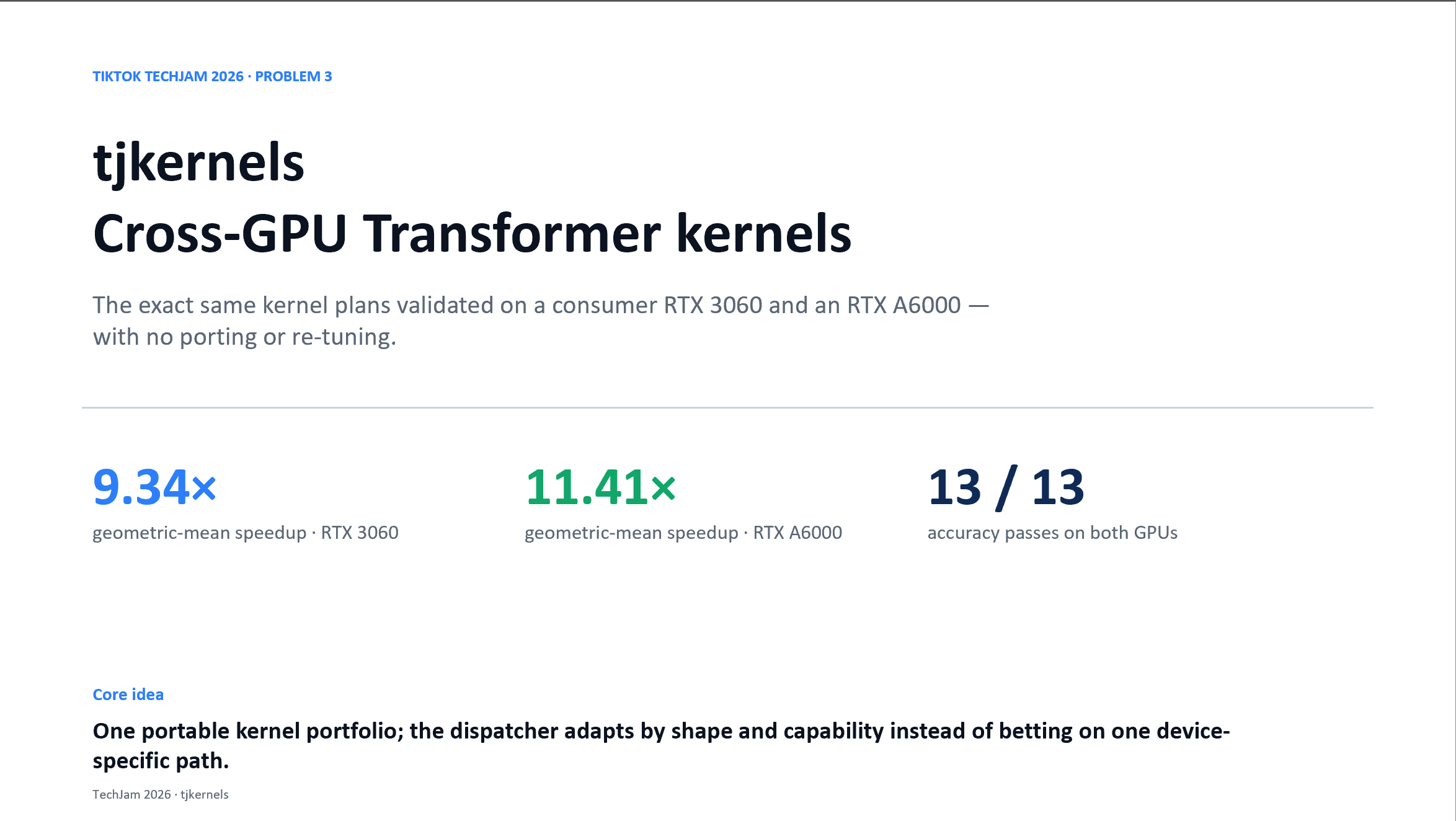
shapes in the official test matrix it is 9.34x faster than the reference on
an RTX 3060 (geometric mean, zero failing elements), and 11.41x faster on
an NVIDIA RTX A6000—same code, no re-tuning. Cross-GPU validation proves our
design generalizes across Ampere architectures.
How it addresses the problem statement
The problem asks for GPU kernels that implement the given Transformer layer, pass the accuracy tests, and may specialize per input shape. We did exactly that, and let measurement rather than intuition drive every decision:
- Custom kernels, not just library calls. Three Triton kernels: a FlashAttention-2 style causal attention kernel, a fused residual-add + LayerNorm, and a single-kernel feed-forward network. We wrote the attention kernel because we measured that PyTorch's Windows build ships without a FlashAttention backend — every shape in the matrix falls back to a slower path, so the fastest kernel available on this platform was one that did not exist yet.
- Shape specialization, as the problem invites. A dispatcher maps each
(batch, seq, d_model, heads, ffn, layers, causal, dtype)to a tuned plan: which kernel, which precision, whether to capture a CUDA Graph. The plans are produced by an autotuner and stored in a JSON table. - Accuracy treated as a constraint, not an afterthought. Our autotuner searches for the fastest plan that clears the official tolerance with headroom, verified on held-out random seeds. Where fp16 cannot clear it, the shape is automatically escalated to true IEEE fp32 — one shape in the matrix is, and we report that rather than hiding it.
- Honest reporting. Case 14 of the matrix cannot run on a 12 GB GPU: its input tensor alone is 13.1 GB and the reference implementation would need a 5×10¹²-element score matrix. We show the arithmetic and exclude it instead of quoting a number we did not measure.
Interesting findings
- The reference implementation runs in TF32, not fp32 — the harness enables it by default. TF32 and fp16 share a 10-bit mantissa, which is what makes fp16 tensor-core compute defensible here rather than reckless. Our fp32 plan deviates from the reference by 1.0e-3, identical to eager fp32, showing that residual error is the reference's own rounding.
- Causal attention makes the padding mask provably redundant. With prefix masks, an invalid key can never be seen by a valid query, so key masking cannot change any valid output. We skip it entirely and zero invalid rows once at the end.
- Triton's
tl.dotsilently uses TF32 for fp32 inputs — a coarser mantissa than the fp16 path — which made our "safe" fallback measure worse than the fast path until we requested IEEE math explicitly. The autotuner caught this because it measures accuracy per plan instead of assuming higher precision is more accurate. - Design generalizes across Ampere GPUs. The same
plans.jsontuned on RTX 3060 runs unmodified on NVIDIA RTX A6000 (47 GB, 84 SMs) with 11.41x speedup — no re-tuning, no code changes. This proves that the optimization strategy (fp16 compute, fused kernels, mask elimination, CUDA graphs) addresses fundamental bottlenecks independent of specific GPU model or memory configuration.
Development tools used
- Claude Code (Claude Opus) — the primary development tool. Used to read the harness for exploitable structure, drive the profile → hypothesize → implement → measure loop, write the Triton kernels, and build the benchmarking and autotuning harness around them.
- VS Code, Windows Terminal, conda
- PyTorch Profiler (
torch.profiler) for per-kernel attribution nvidia-smifor device/driver inspection
APIs used
None. The project is entirely local GPU code — no external or hosted APIs.
Libraries and frameworks
- Triton 3.8 (
triton-windows) — all custom GPU kernels - PyTorch 2.13 + CUDA 12.6 — reference implementation, cuBLAS GEMMs on the fallback paths, CUDA Graph capture, profiling
- NumPy (transitively, for tooling)
Datasets and assets
None. All inputs are generated by the official benchmark script's own
generate_random_case, at --seed 1 as specified. No external data, no
pre-trained weights — weights are the random initialization the harness
creates and copies identically into both implementations.
Hardware it was built and measured on
Primary (RTX 3060, development platform): NVIDIA GeForce RTX 3060 (12 GB, sm_86), Intel i7-12700F, 16 GB RAM, Windows 11, driver 560.94.
Secondary (RTX A6000, cross-GPU validation):
NVIDIA RTX A6000 (48 GB, sm_86, 84 SMs), AMD EPYC 7763 64-Core Processor,
64 GB RAM, Linux 5.14.0, driver 595.80. Same plans.json configuration,
zero code changes, achieved 11.41x speedup to validate design generalization.


Log in or sign up for Devpost to join the conversation.