-
-
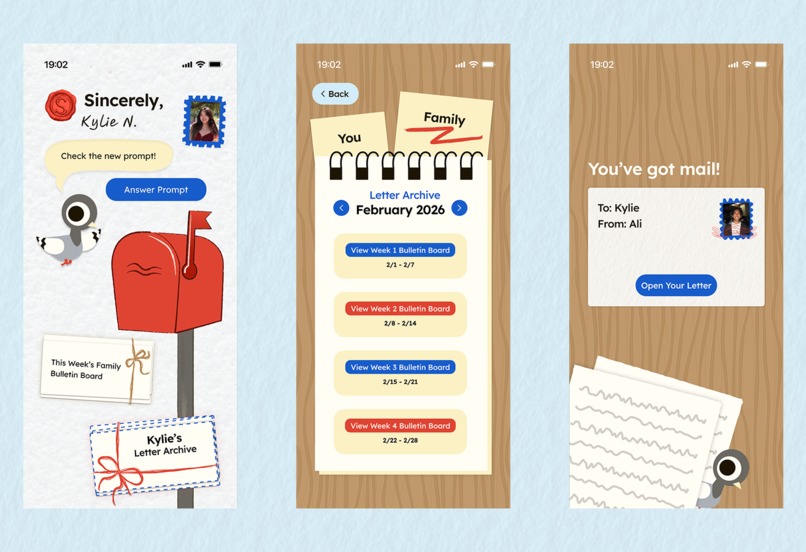
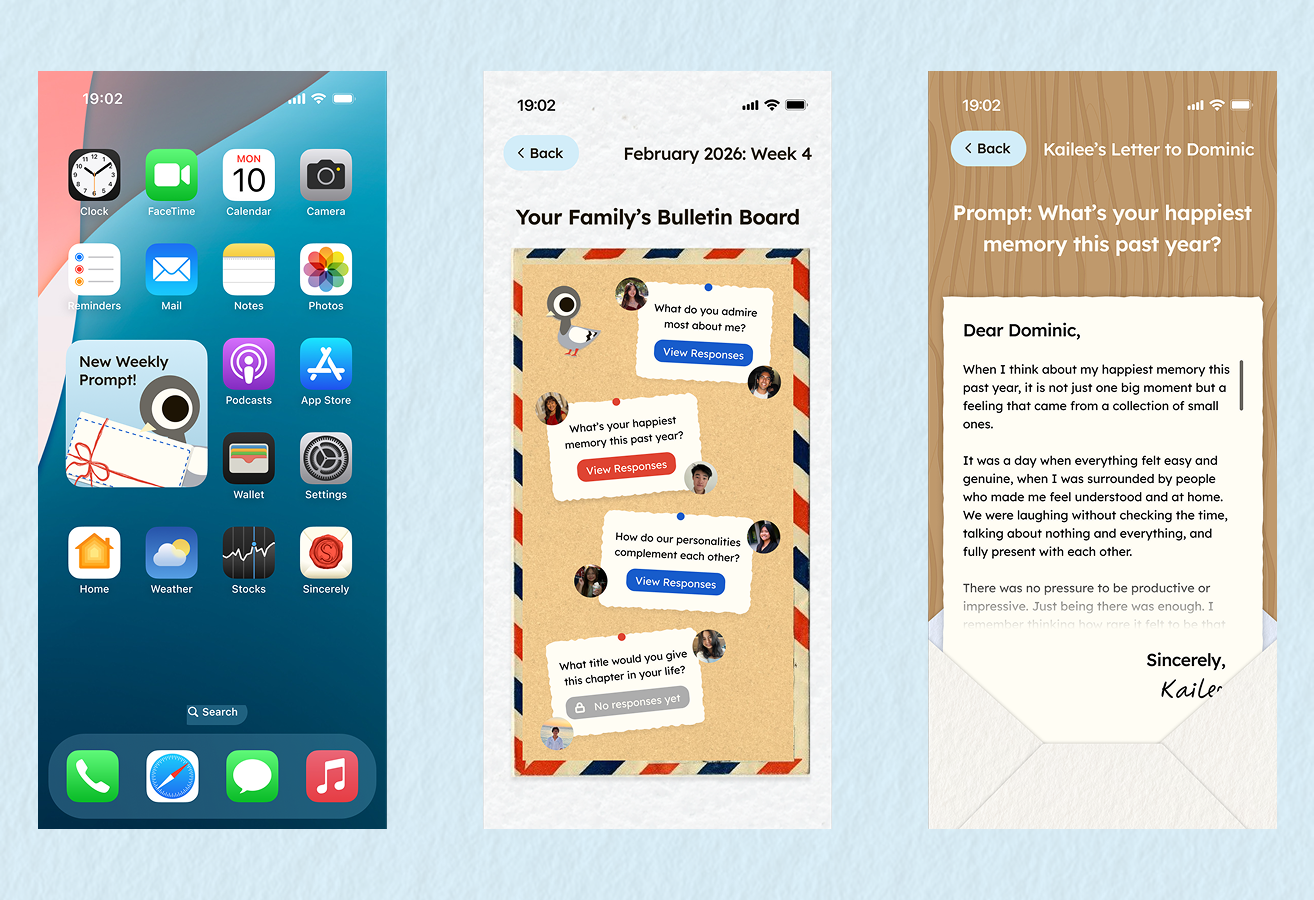
homepage, family letter exchange archive, response preview
-
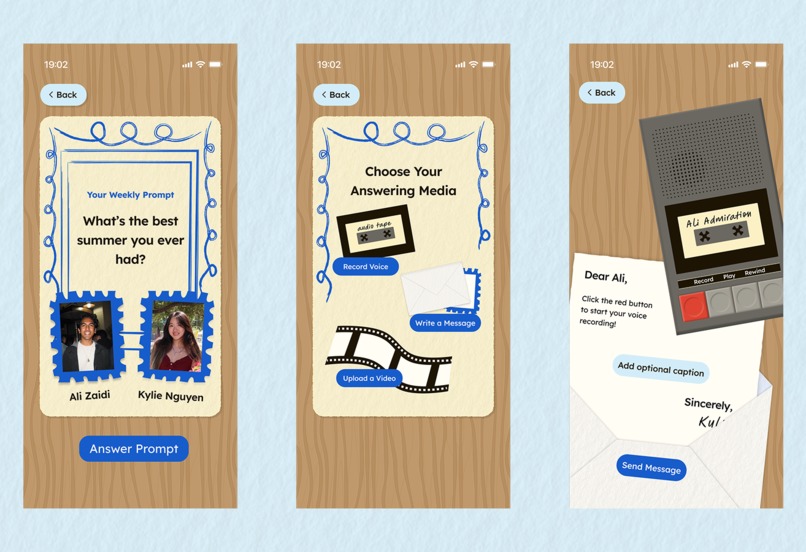
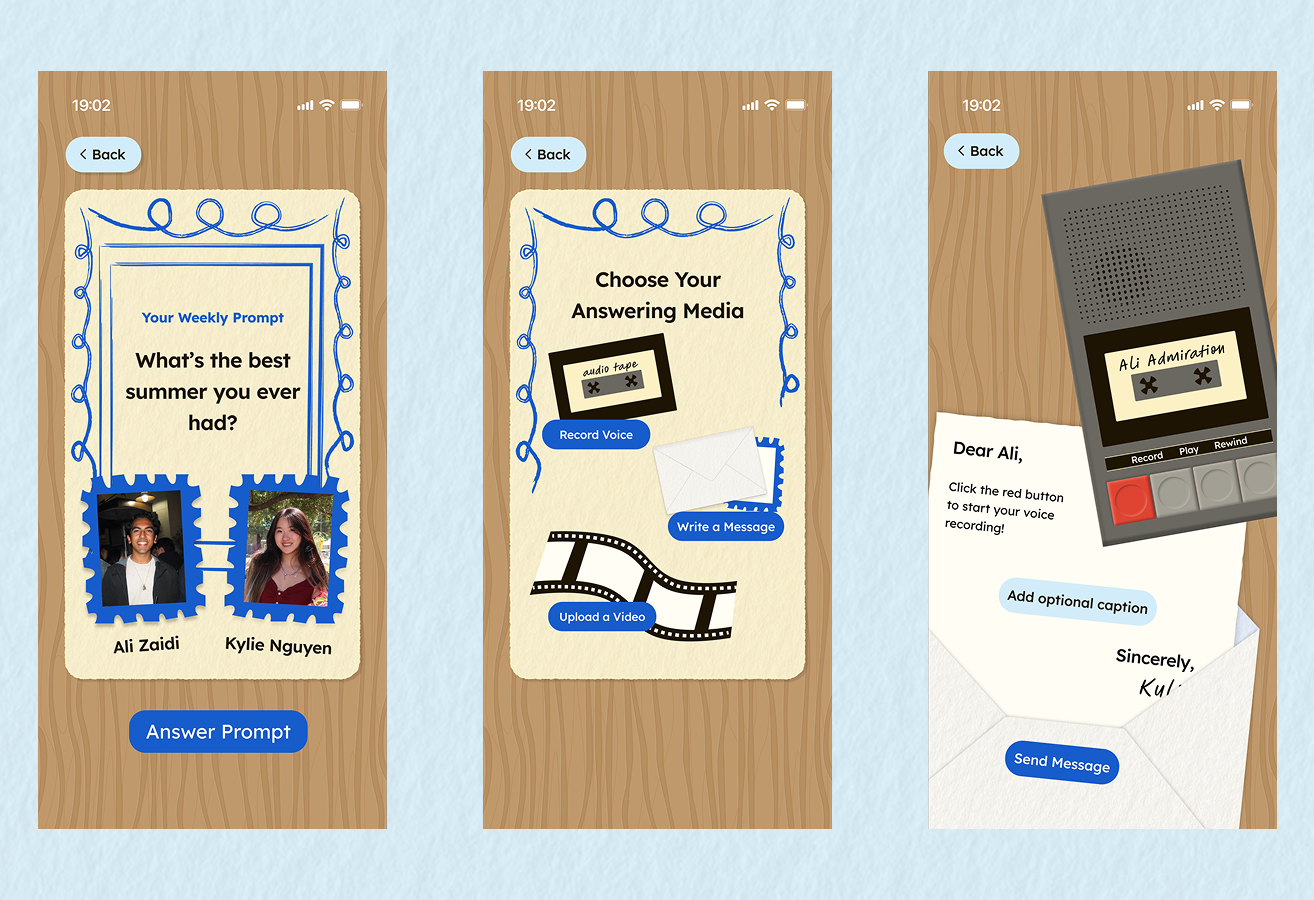
prompt card, answering modes, audio recording
-
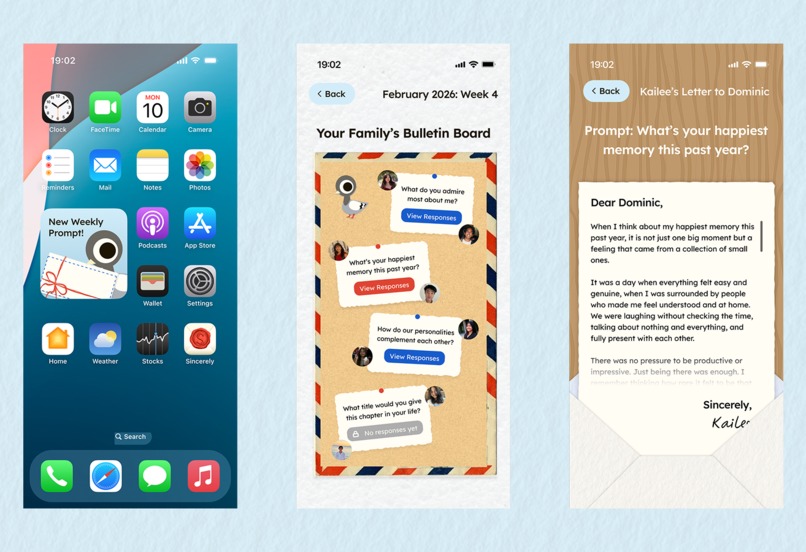
widget & app view, family bulletin board, open letter
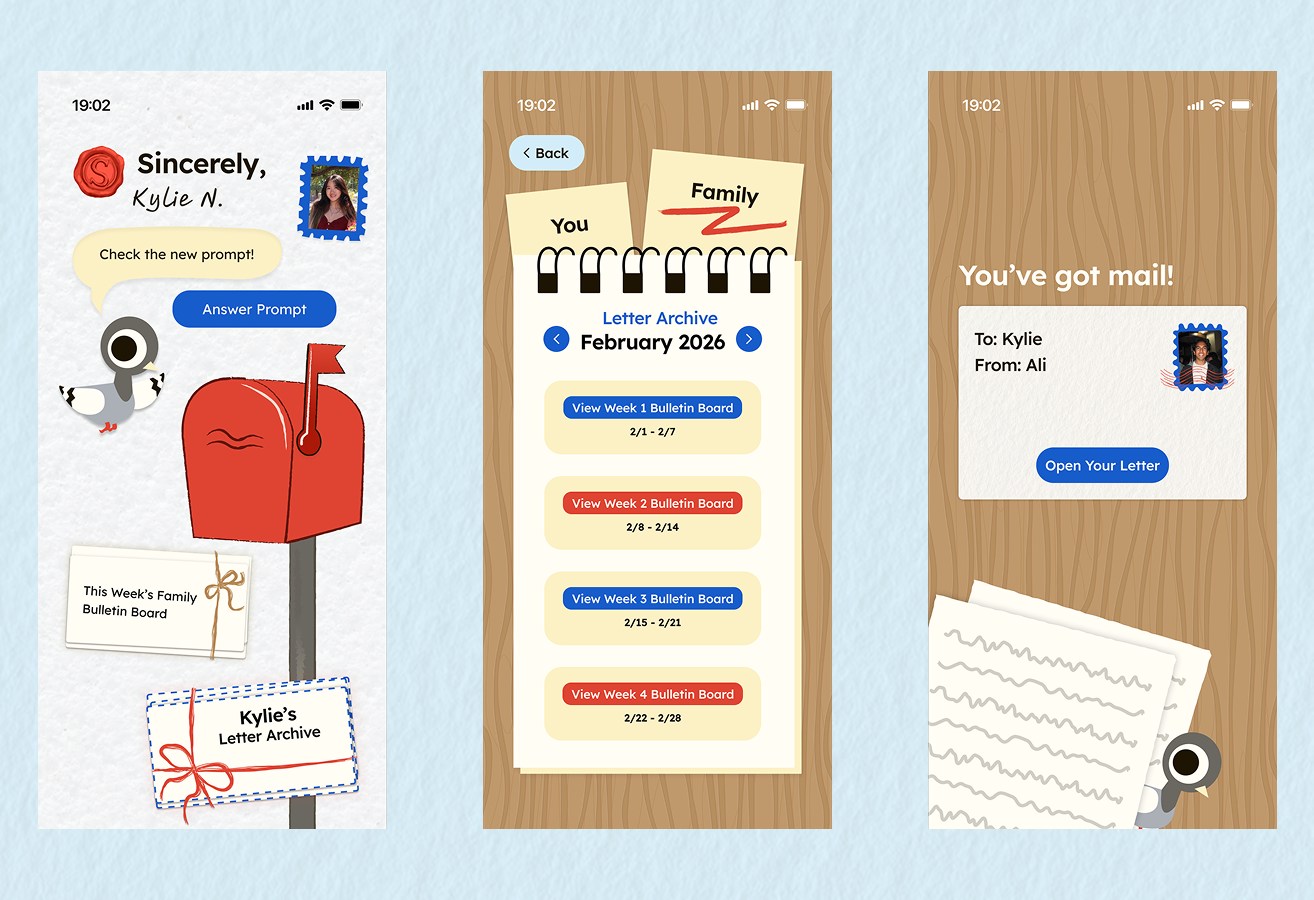
Prototype link: Link
Describe your project
When was the last time you had a conversation with an extended family member that went deeper than “How are you?” or a surface-level check-in?
As technology continues to evolve, the connection between generations of family members weakens as individuals become increasingly more digitally divided and physically distant. Sincerely bridges this gap by making it easier to initiate deeper one-on-one conversations among family members across generations.
Our solution, Sincerely, provides intentional weekly prompts that encourage open communication and vulnerability. Within a group of your immediate, extended, or chosen family, rotating 1:1 pairings share responses to the prompt via audio, video, or typed message every week, catering to the different ages and communication styles within the group.
By lowering the barrier to starting real, meaningful conversations, Sincerely helps you stay emotionally connected across distances and generations to grow meaningful relationships.
Describe your research process and findings.
Quantitative Findings: Our primary research was conducted via a Google Form with 52 respondents and provided a clear roadmap for the features within our product idea.
80% of respondents reported primarily using messaging and audio to communicate with their immediate and extended family. This preference validated our decision to "niche down" the response mediums into messaging, audio, and video.
We moved away from complex social features like music sharing and film to focus exclusively on high-fidelity audio and text, ensuring we met users where they already are.
Qualitative Insights: We conducted three user interviews across generations X and Z and found two key barriers:
The "Human" Element: Gen X interviewees said text messaging can be "misleading" and that they crave the human voice for clarity. An 18-year-old college freshman echoed this, noting that he primarily uses video calls to stay connected with his grandmother and other extended family because they feel more personal than a text.
The Initiation Barrier: Our Gen Z interviewee also shared that he desires closer relationships with his stepfather and siblings but lacks the reason to pursue or initiate them. This confirmed the need for a model that would "get the ball rolling" for open communication through structured prompts.
Key Research Summary:
80% Preference: Audio/Digital Messaging is the dominant communication mode.
Physical Distance: In today's age, digital tools are a necessity for relationship growth.
Safety in Nostalgia: Both generations expressed a need for a space that feels less performative and more focused on genuine connection.
Describe your most important design decisions.
Decision: Prioritizing Audio and Video (The "Human" Interface) From 80% of our 52 survey respondents and from our user interviews, we found that many believe text messaging can be misleading. Therefore, when it came to different prompt-response mediums, we prioritized audio and video. While still including a third option to respond in typed text. Two out of three of our user interviews cited preserving the human voice as essential, so we ensured it remained the focal point of in-app interaction.
Decision: One-on-One, Rotating Pairs With 61% of our 52 users expressing a need to improve family connections, we moved away from multi-group-based media to intentional one-on-one rotations. This shift encourages deeper connections by providing a space that fosters vulnerability while advancing intergenerational relationships.
Decision: Vintage Brand Identity and Mail Metaphor Through our user interviews, we found that older generations often feel less interested in modern, sleek apps because they perceive them as gimmicky or hard to navigate. A more analog visual language helps reduce intimidation and lowers the barrier to engagement for these users.
At the same time, younger generations are experiencing a renewed interest in analog and pre-digital experiences. "About 60% of Gen Z adults said they wished they could return to a time before everyone was plugged in, which signals a desire for slower, more intentional forms of connection" (The New York Times, 2025).
If applicable, describe how you utilized AI in your design process in detail.
We strategically integrated AI as a supportive tool throughout our research and planning phases, while intentionally preserving human creativity for our visual and interaction design decisions.
Early in our process, we used AI (ChatGPT) to refine the wording of our "How Might We" statement. By iterating with AI, we worked through multiple variations that emphasized our app's role as a catalyst rather than a destination for deeper conversations.
During our research phase, we used AI to provide feedback and suggestions for the wording of our Google Form survey questions. We ensured zero AI use during the design stage and that all subsequent choices were based on our team's creativity and the application of design principles.
Additionally, we believed our design decisions required human empathy, cultural awareness, and aesthetic judgment that AI couldn't authentically provide.
Built With
- figma


Log in or sign up for Devpost to join the conversation.