-
-
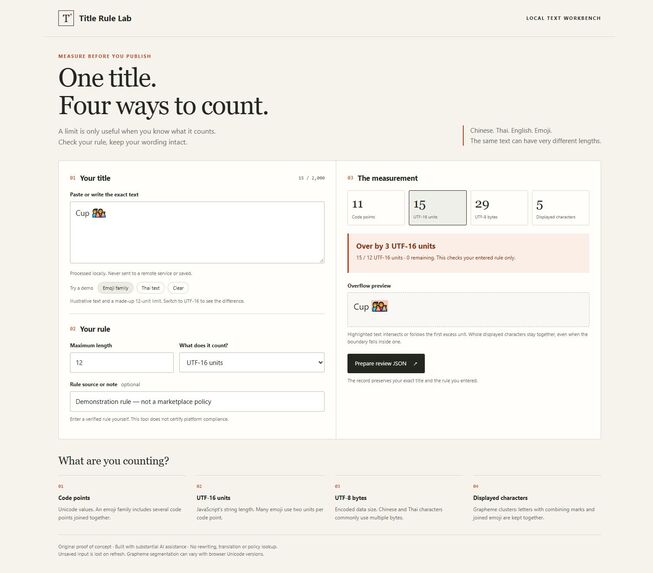
Actual browser capture: an unchanged emoji title evaluated against an illustrative UTF-16 rule.
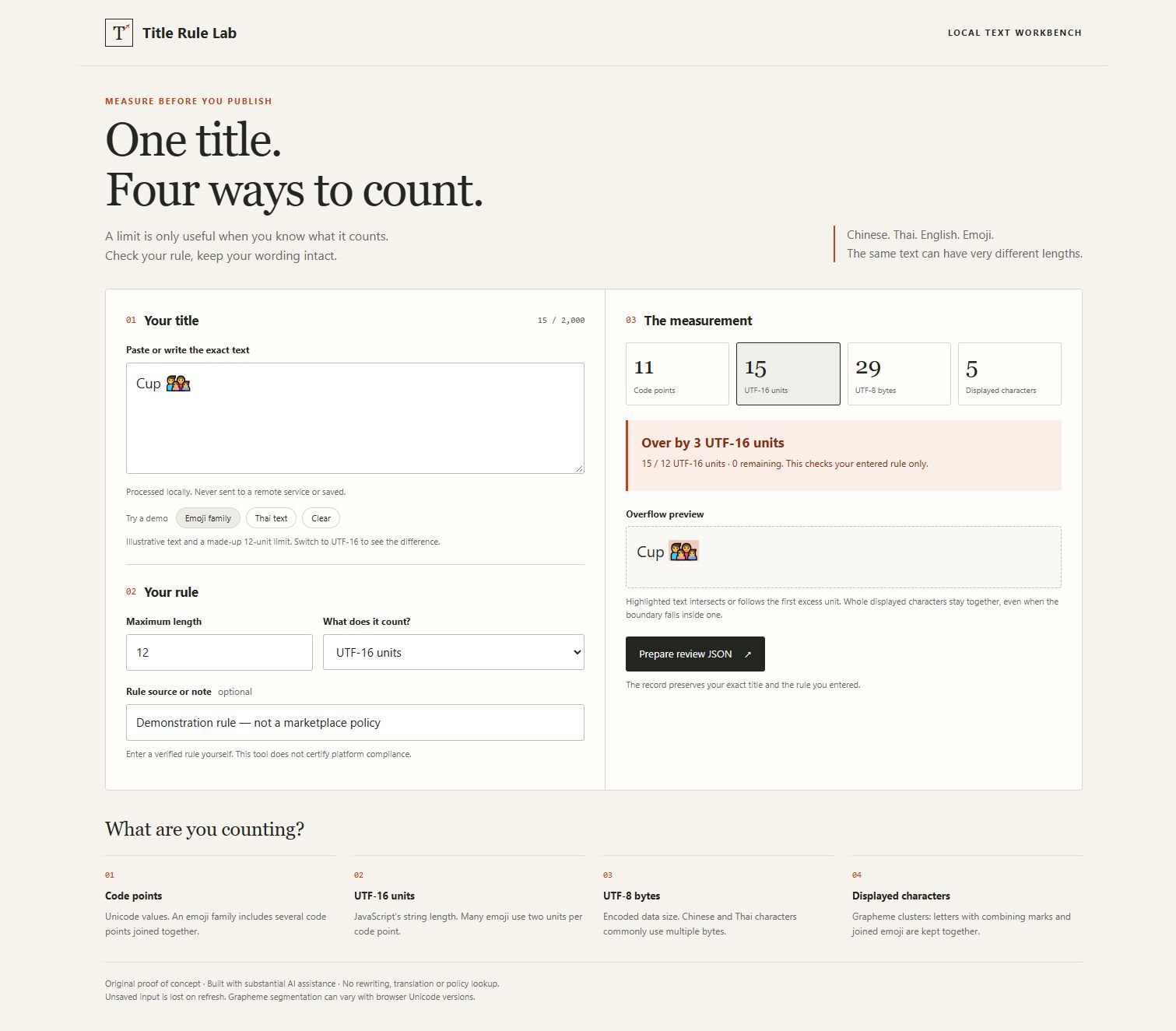
Project description
Title Rule Lab is a small local browser workbench for listing editors who need to check multilingual text against a known field rule. The reviewer enters the title, numerical limit, measurement unit and optional source reference. The app shows code points, UTF-16 units, UTF-8 bytes and grapheme clusters together, evaluates the selected rule, highlights overflow without visually splitting a grapheme, and exports a JSON review record.
The same unchanged title can have different results under different definitions of length. In the demo, Cup 👨👩👧👦 is 11 code points but 15 UTF-16 units. Against an illustrative limit of 12, switching the unit changes the result. The family emoji remains intact in the overflow preview. A Thai example demonstrates combining characters. Direct edits invalidate an earlier prepared report so it cannot be downloaded as the current result.
How it was built
This new application began in a fresh folder on October 14, 2026. The official Devpost Learn Skill Pack was used locally as the planning and build scaffold. Public scope, PRD, specification, checklist and source guide are included in the repository. The app uses original HTML, CSS and JavaScript modules, native Intl.Segmenter and TextEncoder, and a bounded Node.js loopback server for static files and JSON attachment downloads. It needs no external API key, package installation or remote data service.
Verification and challenges
Eleven automated tests cover supplementary emoji, Chinese byte counts, Thai combining marks, decomposed accents, whole-grapheme overflow, changed-unit outcomes, exact boundaries, invalid rules, blank text and literal markup. Actual browser checks covered the editing-to-export journey, stale report invalidation, safe text rendering and native downloaded JSON bytes. A 2,000-character Chinese title and 300-character reference were also downloaded successfully. The published repository was cloned without authentication and all 15 files matched the reviewed package, allowing normal text line-ending differences.
Making the export behave like a real browser attachment required a bounded local download endpoint. Another important implementation distinction is that a grapheme highlight and a numerical byte or UTF-16 limit describe different boundaries; the app keeps exact totals and highlights whole graphemes rather than claiming exact automatic truncation.
Scope and disclosure
Sample rules are illustrative and are not marketplace policy. A passing result does not certify platform compliance, product facts or translation quality. The app does not rewrite titles, save inputs, fetch platform rules or claim measured productivity gains. HTML text areas normalize line endings to LF, and grapheme segmentation depends on the browser's Unicode implementation.
Product direction, code, technical documentation, visual identity and this objective description were substantially AI-assisted under the human participant's instruction to select and complete a task. The demo is an edited sequence of actual browser captures. Personal learning outcomes and specific human hands-on actions have not been established and are not claimed. Planning documents preserve that distinction rather than inventing completed learner interviews.
