Inspiration
An account owner can pass every identity check and still be getting scammed.
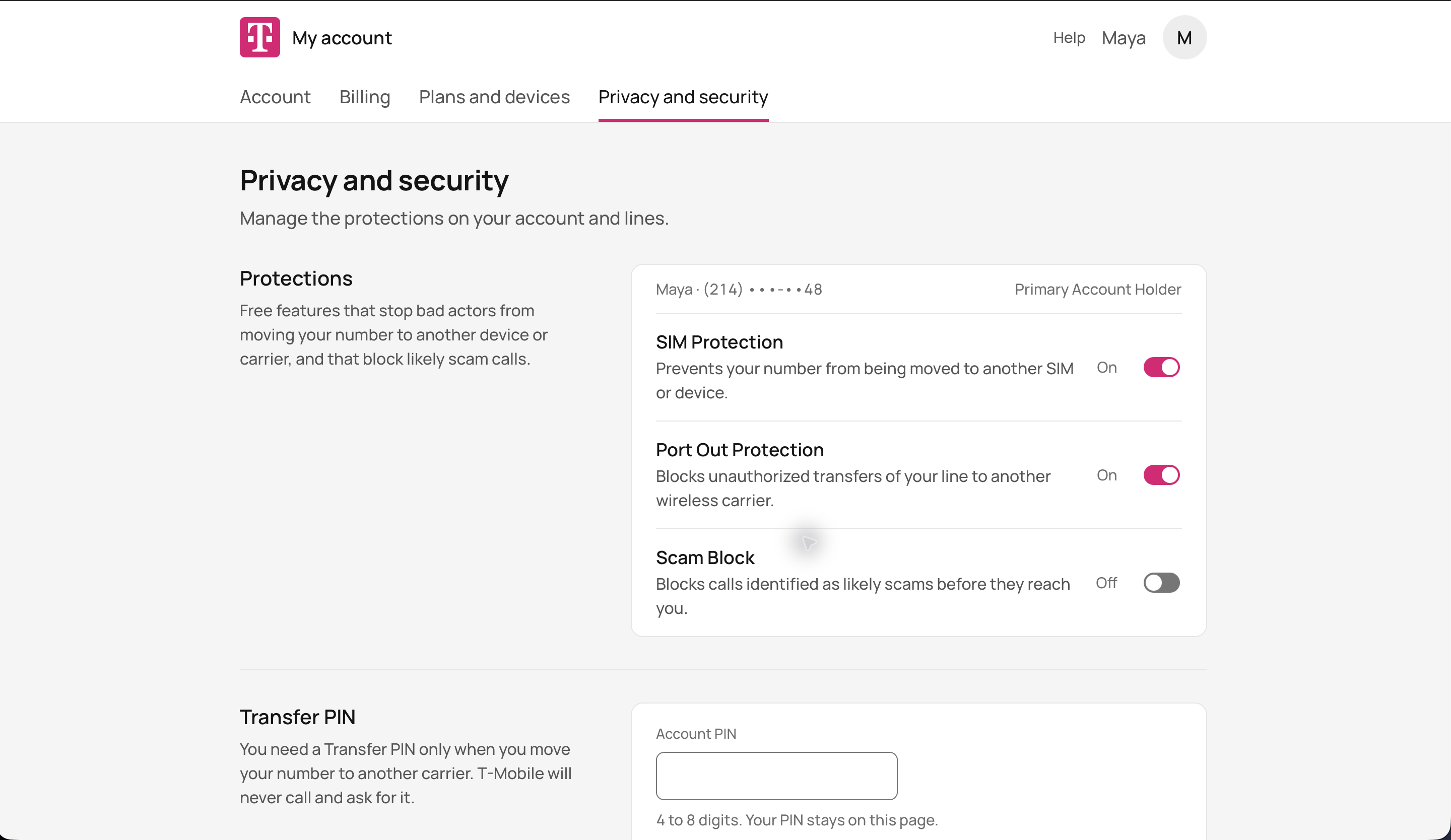
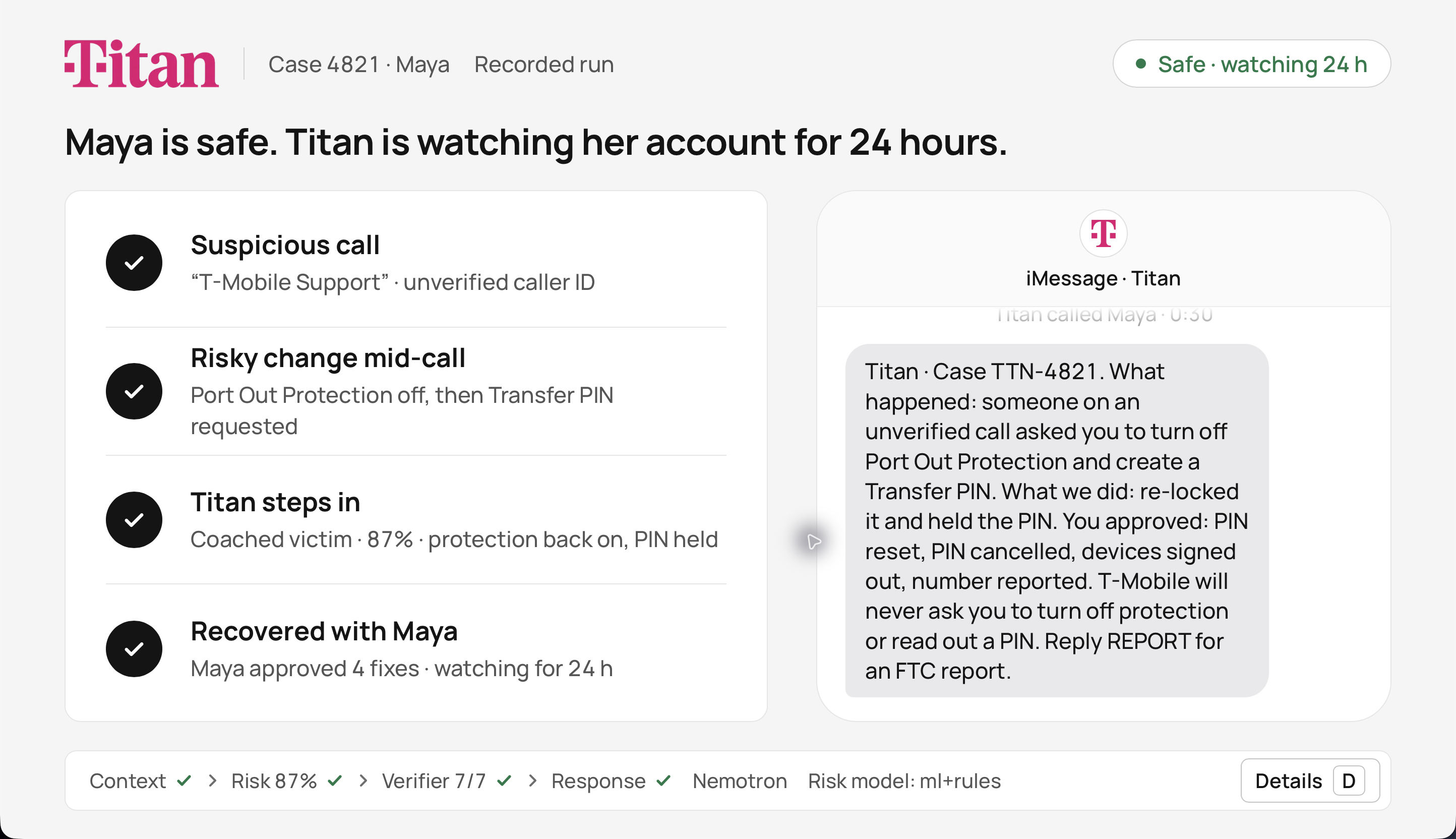
Our scenario follows Maya, a synthetic customer on a call with someone pretending to be carrier support. The caller walks her through turning off Port Out Protection and requesting a transfer PIN. It is her phone, her account, and her authenticated session. The problem is who is guiding her.
We built Titan to recognize that sequence and intervene while she can still stop it. Your protections know it's you. Titan asks whether you're being coached.
What it does
Titan is a scam-intervention prototype built around a simulated carrier account. It connects suspicious call metadata, account changes, and derived session signals to a customer-facing recovery workflow.
- Pause the risky action. A deterministic gate can hold a transfer PIN or pause a protection change before waiting for an LLM.
- Investigate the context. Context, Risk, Verifier, and Response agents gather relevant evidence, assess the sequence, check claims against tool results, and coordinate the response.
- Reach the customer. Photon delivers plain-language iMessages. The voice integration connects a Photon line through LiveKit SIP to a Pipecat conversation.
- Recover one step at a time. Each approval applies to one pending protective recovery action. Voice approvals require the current question to finish playing; transcripts remain audit records, not independent approvals.
- Explain what happened. The Guardian dashboard streams agent steps, evidence, messages, and recovery status. The customer incident page explains actions and next steps.
Customers can also text STATUS, LOCK, or HELP. Text commands can strengthen protection; they cannot disable it or generate a transfer PIN.
Carrier controls, account histories, and network signals are simulated. Titan does not access or change real T-Mobile accounts.
How we built it
The backend uses Python and FastAPI, with explicit JSON Schema contracts, generated TypeScript types, and shared fixtures connecting the services. The Next.js/React/TypeScript portal checks sensitive actions with the backend. The Guardian dashboard uses Server-Sent Events, sequence-based deduplication, coalesced refreshes, and stale-response handling.
The investigation separates four responsibilities:
- Context: gather relevant account, device, call, and session evidence.
- Risk: combine the model/rules score with the event sequence.
- Verifier: check proposed claims against the available tool evidence.
- Response: coordinate protective actions, outreach, recovery, and summaries.
Our ML component uses XGBoost, isotonic calibration artifacts, and feature explanations, with exported pure-Python inference and a rules fallback. Forwarded messages use the rules scorer under the final routing policy.
NVIDIA Nemotron models support context gathering, risk reasoning, verification, customer responses, and speech interpretation. Safety Guard and deterministic checks screen outbound content. The project also includes policy retrieval, deliberately forwarded screenshot analysis, and support for a self-hosted fast model endpoint on Brev with hosted fallback.
Photon 2.0 carries iMessages through an authenticated WebSocket receiver. Provider-message deduplication, replay checkpoints, and idempotent reply events keep retries from becoming extra customer decisions. Voice uses Photon, LiveKit SIP, Pipecat, Nemotron ASR, and ElevenLabs TTS. Case-bound conversation state, pending-action checks, completed-action tracking, and interruption handling keep voice responses tied to the current recovery step.
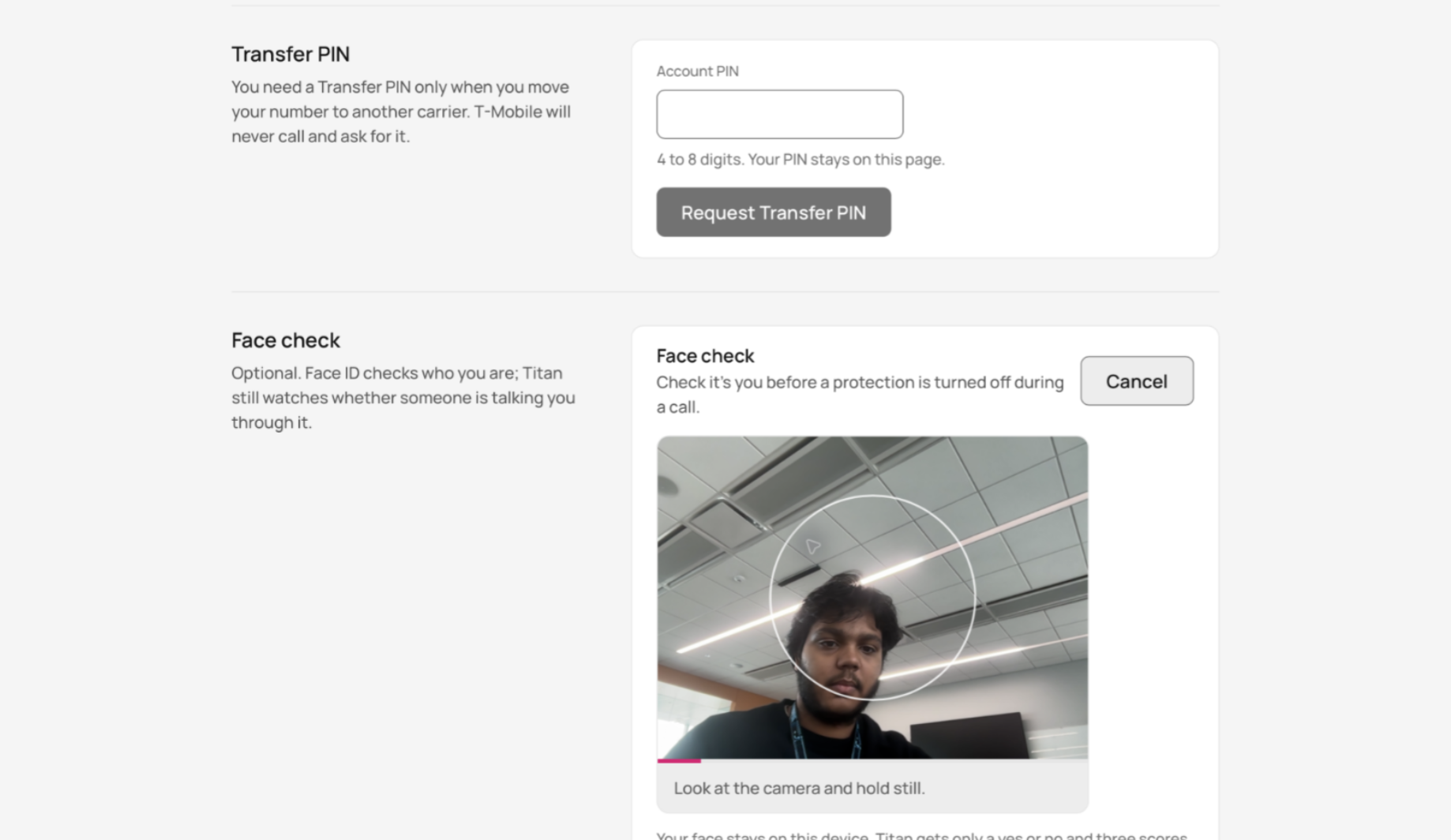
We minimize input collection: behavioral features use derived measurements, and typing rhythm uses timestamps rather than key values. The optional, disabled-by-default browser face check illustrates why identity alone cannot establish that an action is uncoached.
Challenges we ran into
One YES must not become two approvals. Text and voice arrive asynchronously. We separated transcript logging from explicit voice decisions, tied consent to an action ID, and added integration checks for uncorrelated replies.
Natural conversations do not wait for scripts. Early answers and interruptions initially prevented the full-question gate from arming. We moved the prompt's answer point to its natural question ending and tested interrupted playback, repeated answers, and stale actions.
A generated explanation can outrun its evidence. We introduced a distinct verification pass, fact-grounded voice responses, secret redaction, and guarded fallbacks. An unavailable check remains unavailable.
Provider integration has real constraints. Photon messaging credentials and voice credentials were not interchangeable, and voice needed an eligible line. We integrated LiveKit SIP, sanitized diagnostics, and bounded call tests while keeping text recovery available.
A more complex model is not automatically better. Our frozen evaluation exposed different strengths for rules and ML, so we report the component results and their weaknesses rather than claiming universal improvement.
Accomplishments that we're proud of
- Verified live Photon iMessage delivery, incoming replies, and sequential recovery with the brain in real-model mode on an allowlisted teammate phone. One YES applied only the synthetic PIN-reset step, and the next question followed.
- Connected a Photon voice line through LiveKit and demonstrated live speech exchange. Full voice recovery approvals remain verified in isolated tests rather than claimed as completed over a live phone call.
- Built a connected customer portal, protective pause flow, live investigation dashboard, and customer incident summary.
- Added tests for interrupted questions, early and repeated answers, unsupported actions, model failures, and transcript/approval separation. The recorded D-063 voice checkpoint reports 75 passing tests.
- Ran a frozen, one-attempt evaluation on 138 synthetic cases. The hybrid caught 30/30 coached cases, compared with 21/30 for rules, and 12/12 bots, compared with 0/12 for rules. Rules caught 28/30 scam texts, while the hybrid caught 6/30. Overall exact-class accuracy was 76.1% hybrid versus 83.3% rules, and the hybrid falsely alerted on 9/33 legitimate hard negatives. Final routing was selected after these results; it has no independently measured combined sealed score.
These are prototype and synthetic-evaluation results, not real-customer fraud-detection performance. Reproducible results and provenance are in our repository's evals/ directory.
What we learned
The hardest part was keeping the whole interaction consistent: the explanation must match the evidence, the spoken question must match the pending action, and a replayed event must not become another approval.
We also learned to distinguish identity from intent, protective intervention from unrestricted automation, and an impressive demo from independently validated detection quality.
What's next for Titan
Next we would evaluate the final routing on new independently designed scenarios, reduce false alerts on legitimate account changes, and complete a fresh end-to-end live voice approval test. We would also validate screenshot and repeat-call workflows together with the complete customer journey.
Durable case storage, authentication, tenant isolation, accessibility testing, and authorized carrier integration are future work. The current case store is in memory.
Build disclosure
We reused a pre-event starter kit containing a generic agent loop, public-data tools, and development scaffolding. The Titan-specific synthetic carrier workflow, contracts, ML component, customer interfaces, messaging/voice integrations, and intervention behavior were built on that foundation during the event, with AI coding assistance.
Hackathon prototype built for the T-Mobile track; not affiliated with or endorsed by T-Mobile.
Built With
- elevenlabs
- fastapi
- livekit
- next.js
- nvidia
- photon
- pipecat
- python
- react
- typescript
- xgboost


