Inspiration
Scientific films have a unique trust problem.
A film can be visually compelling and still misrepresent the science: a theoretical model can look like an observation, uncertainty can disappear during scripting, a reconstruction can appear to be recorded reality, or a cinematic decision can imply more certainty than the evidence supports.
Most research tools stop at sources and summaries. Most filmmaking tools start from story, script, or visuals.
Tital connects the two with an agentic, evidence-governed filmmaking workflow.
Its central principle is:
Evidence → Story, not Story → Evidence.
What it does
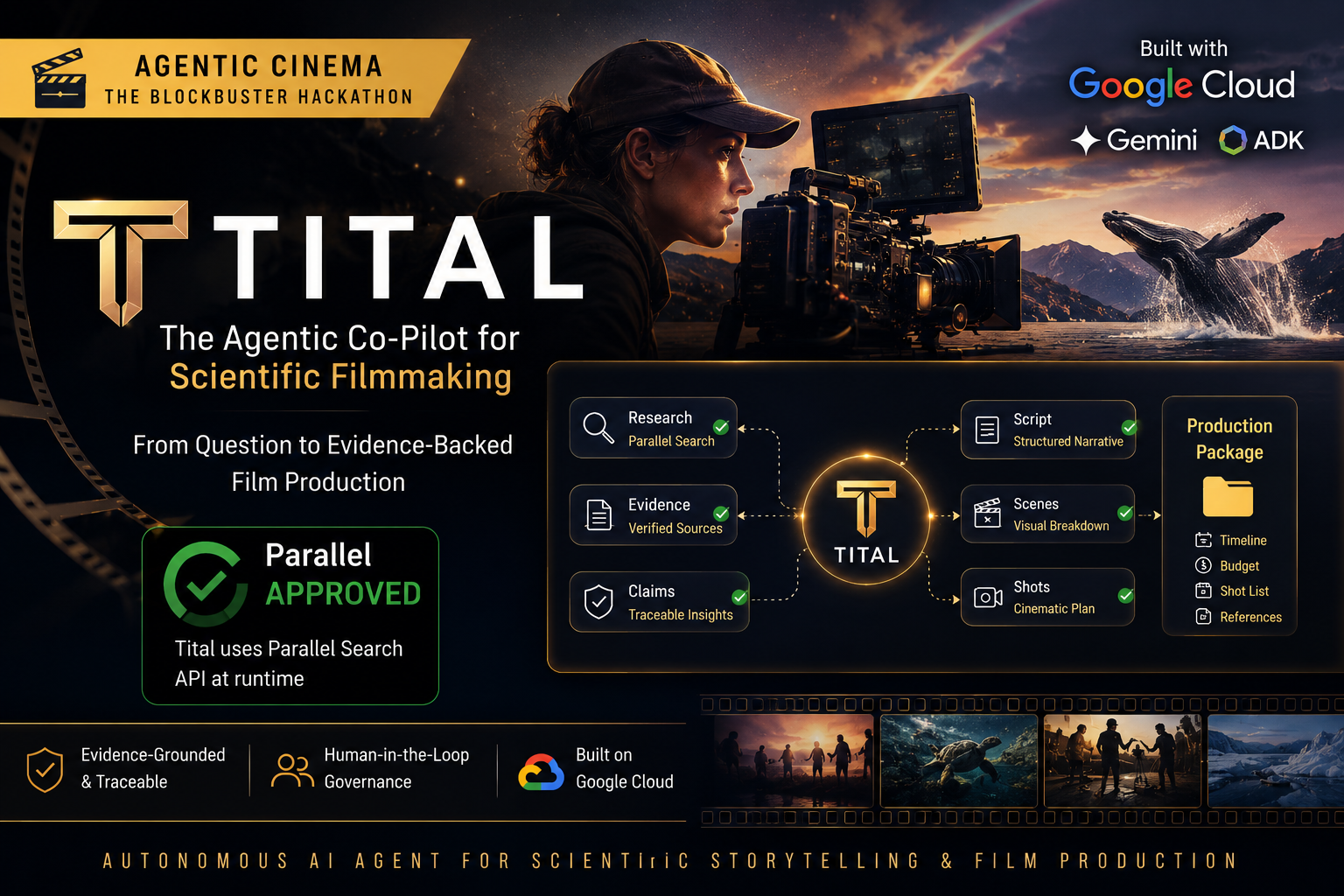
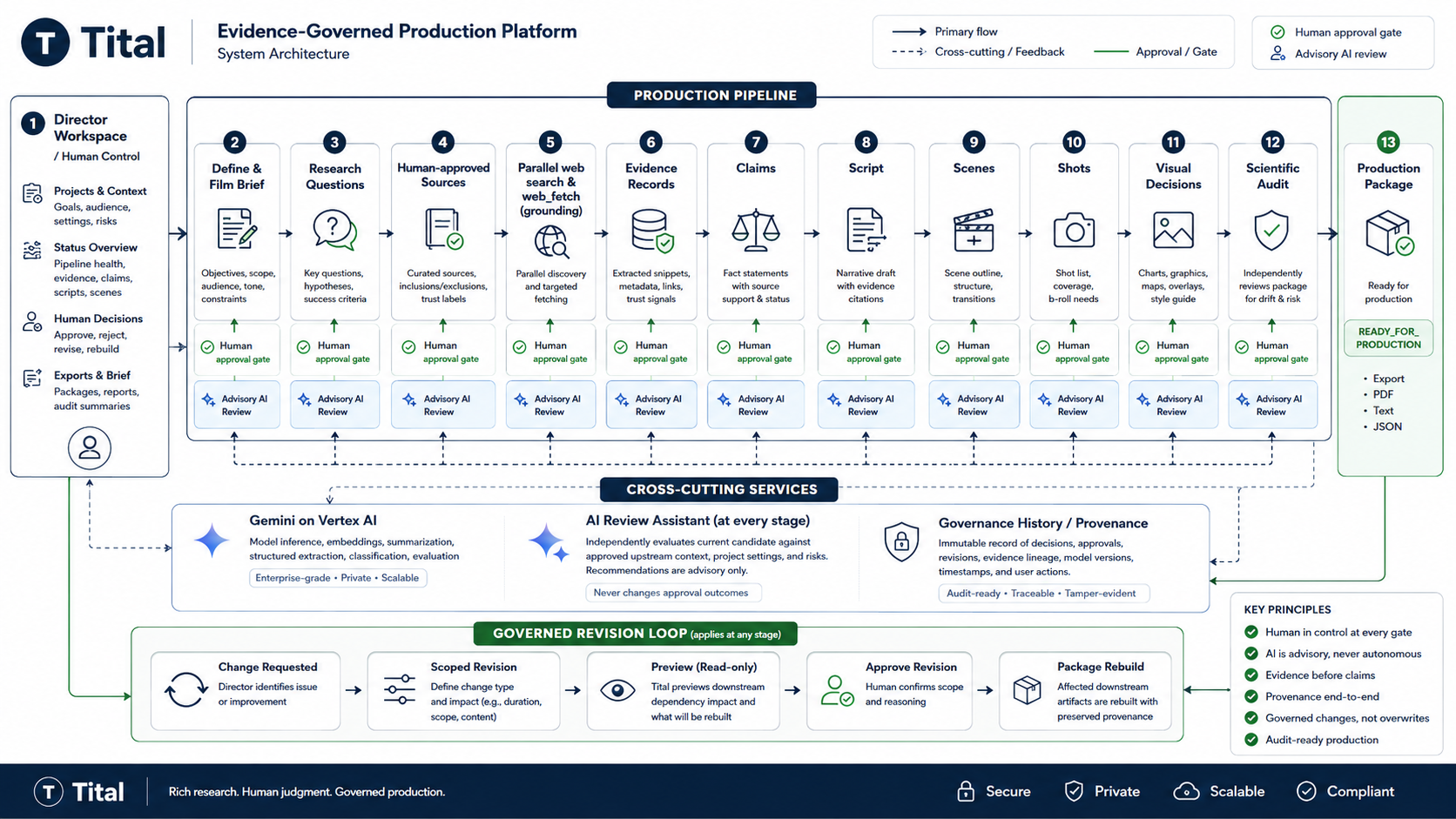
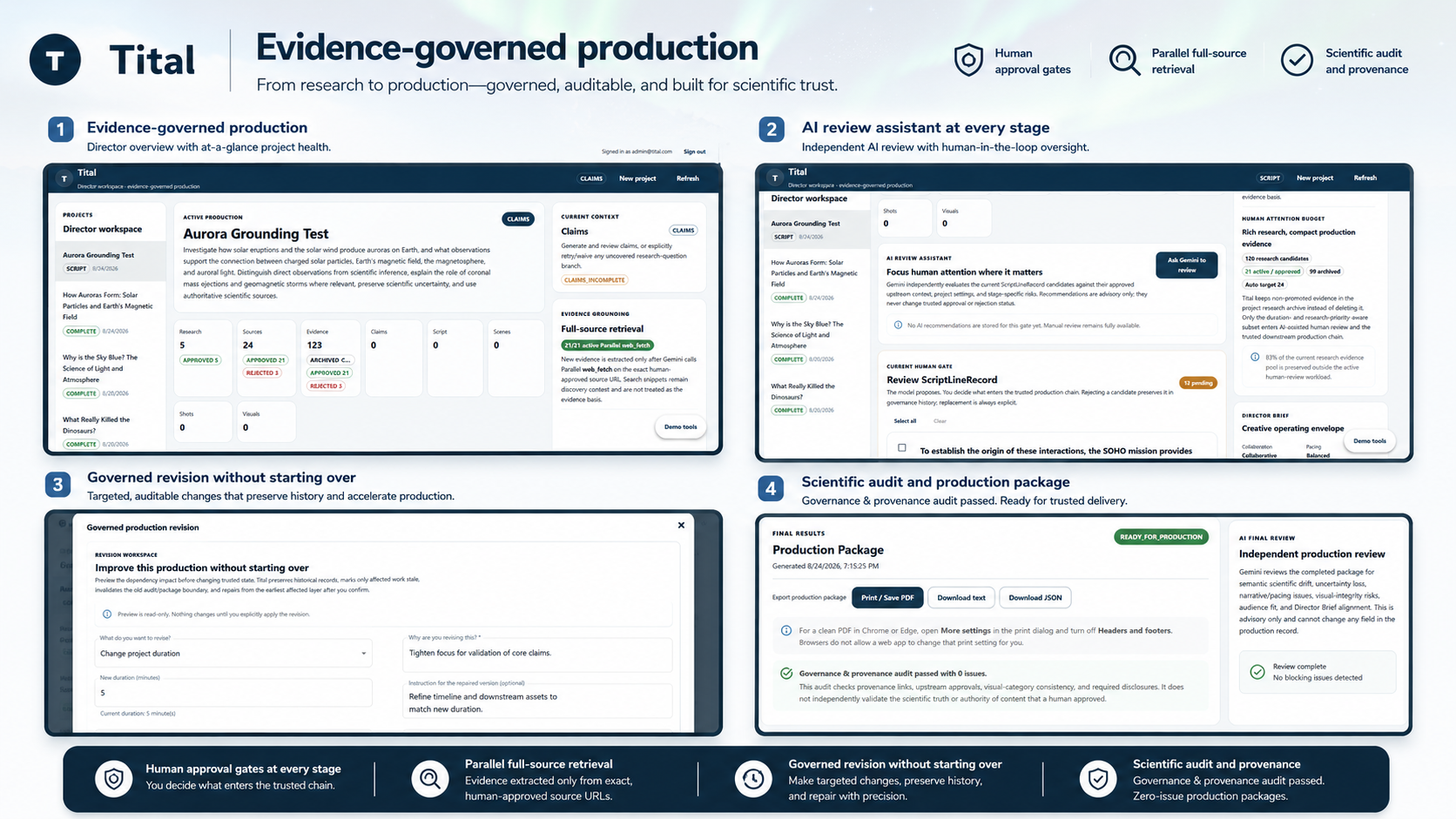
Tital is an agentic scientific filmmaking system that transforms research into a governed production plan while keeping the human director in control.
It turns a scientific question or film idea into a structured production package while preserving scientific provenance through the filmmaking process.
The workflow moves through:
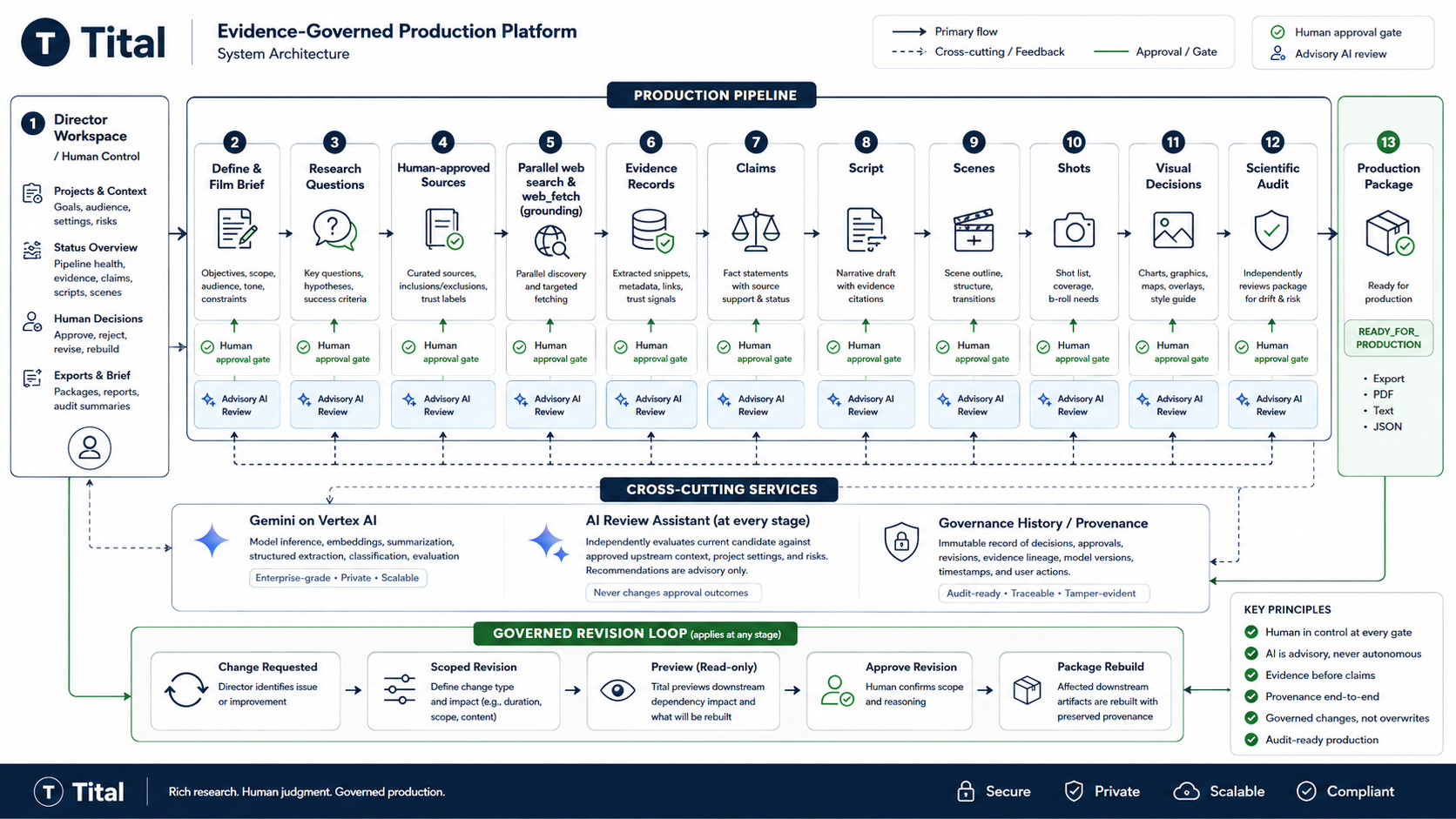
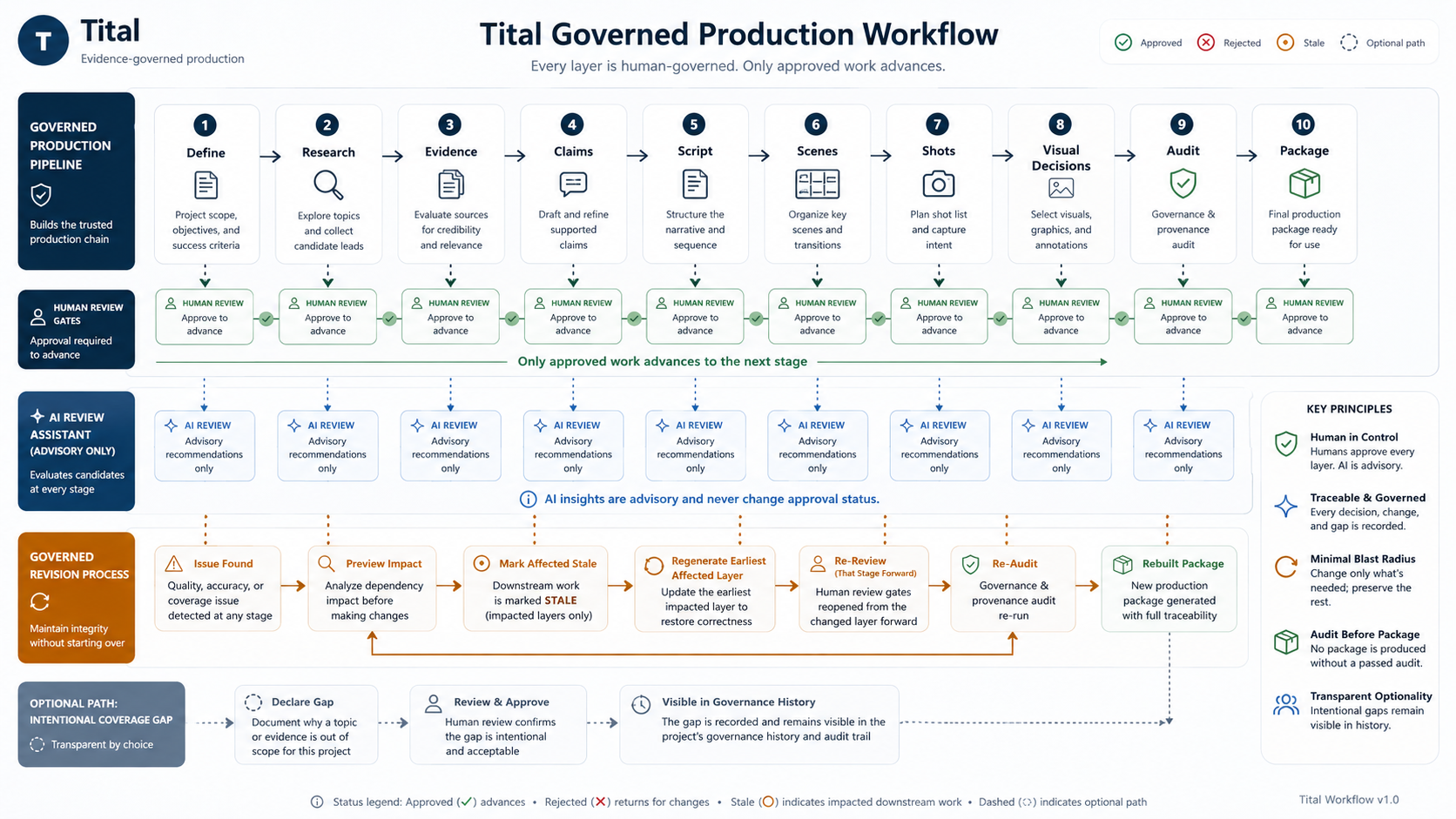
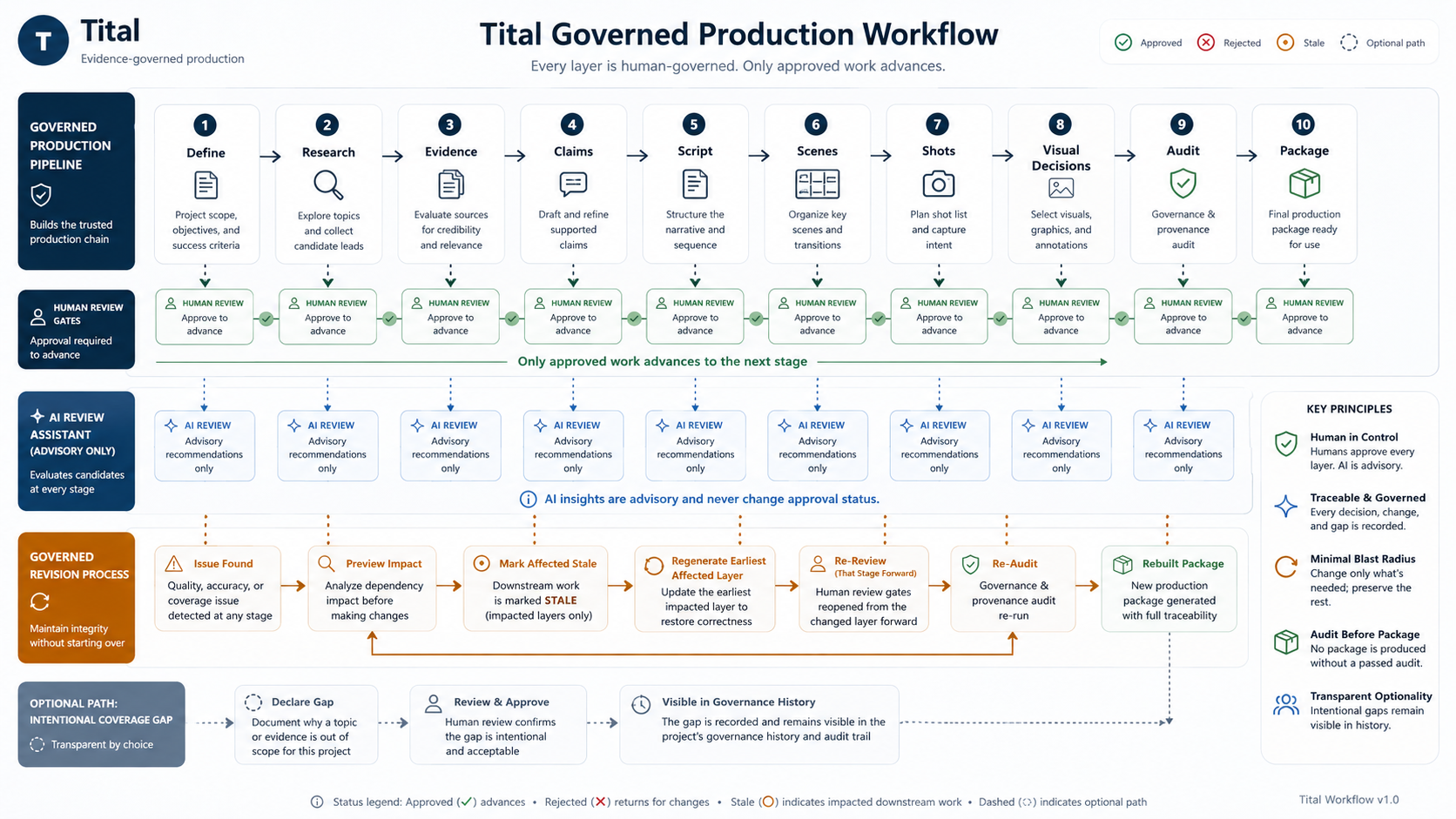
Film Brief → Research Questions → Sources → Evidence → Claims → Script → Scenes → Shots → Visual Decisions → Audit → Production Package
Tital makes it possible to ask, at any point:
Why are we saying or showing this?
A final visual decision can be traced backwards through:
Shot → Scene → Script Line → Claim → Evidence → Source
The filmmaking workflow
The director begins with a scientific-film idea and production constraints.
Tital then:
- creates a structured Film Brief;
- formulates research questions;
- discovers relevant public sources;
- extracts evidence;
- generates claims from approved evidence;
- pauses for human review;
- develops scientific script lines from approved claims;
- proposes scenes, shots, camera and representation decisions;
- applies persistent Director Brief preferences;
- creates scientific visual-integrity constraints;
- audits the governed production chain;
- releases a structured Production Package when the project is ready.
Tital does not render the final film. Its purpose is to make the research-to-direction stage more traceable, controllable, and scientifically defensible.
Human director control
Tital is not a one-shot autonomous generator.
At each generative stage, the human director can review proposed work.
The director can:
- approve a proposal;
- reject it;
- request a targeted replacement;
- provide scoped cinematic guidance;
- intentionally continue with a governed gap when allowed;
- maintain a persistent Director Brief;
- optionally reuse selected feedback in later cinematic decisions.
Creative preferences do not override scientific constraints.
Tital uses the following precedence:
**scientific evidence and uncertainty
approved production constraints
human director guidance
AI cinematic preference**
This allows the director to control the film's style while preserving scientific integrity.
Scientific visual integrity
One of Tital's main goals is to protect the meaning communicated by an image, not just the words in a script.
A shot can distinguish between representations such as:
- observation;
- simulation;
- scientific reconstruction;
- schematic;
- illustration;
- conceptual visualization.
The system can also carry constraints related to uncertainty, representation, disclosure, and what must not be implied visually.
For example, a scientific reconstruction should not be presented in a way that makes the audience believe it was directly observed.
How we built it
Tital is a TypeScript application with a React director workspace and Node.js backend.
Its production stack includes:
- Gemini 3.5 Flash
- Google Agent Development Kit (ADK), TypeScript
- Vertex AI
- Google Cloud Run
- Google Cloud Storage
- Firebase Authentication
- Parallel Search API
- React
- Node.js
- TypeScript
- Zod
Gemini agents propose semantic content, while deterministic application code owns trusted IDs, provenance, review state, coverage rules, and phase progression.
The core control pattern is:
model/tool proposal
→ schema validation
→ trusted application provenance
→ human review
→ deterministic coverage evaluation
→ next production stage
This prevents the model from approving itself or silently moving rejected material into the production chain.
Parallel integration
Tital uses Parallel Search at runtime for public-web source discovery during the research stage.
The research workflow invokes Parallel rather than relying only on Gemini's model memory. Parallel discovers candidate sources from the public web, after which Tital validates and converts those candidates into application-owned source records before they can participate in the governed evidence chain.
This separation is intentional:
Parallel discovers candidate sources → Tital governs evidence derived from those sources.
Source discovery is not treated as equivalent to scientific verification. Evidence still passes through Tital's provenance and human-review workflow before it can support claims or downstream filmmaking decisions.
Challenges we faced
Human rejection must actually change the workflow
An early implementation could regenerate semantically similar content after a rejection under a new ID.
We changed the workflow so rejected content remains terminal history unless the director explicitly requests a replacement.
Trusted IDs should not depend on model copying
Live testing exposed reference drift when models were asked to reproduce opaque IDs.
Trusted parent relationships and provenance mapping were moved into deterministic application code.
Cinematic freedom and scientific integrity need different authority levels
Scientific evidence rarely dictates one specific visual style.
The challenge was allowing meaningful artistic direction without allowing creative preference to weaken the scientific meaning of a shot.
External agent calls introduced latency
Independent calls within an authorized stage were originally serialized.
Tital now uses bounded concurrency where appropriate while keeping genuine stage dependencies and human-review boundaries intact.
What we learned
Agentic filmmaking is not simply about giving an AI more autonomy.
For this kind of system, the stronger design is often the opposite: give the agent bounded creative responsibility and make human authority, provenance, and scientific constraints explicit.
We also learned that scientific integrity has to survive the entire filmmaking chain.
Citation at the research stage is not enough if uncertainty disappears in the script or a visual decision later implies unsupported certainty.
Production readiness
Tital is deployed on Google Cloud Run and runs its Gemini agents through Vertex AI using Google ADK.
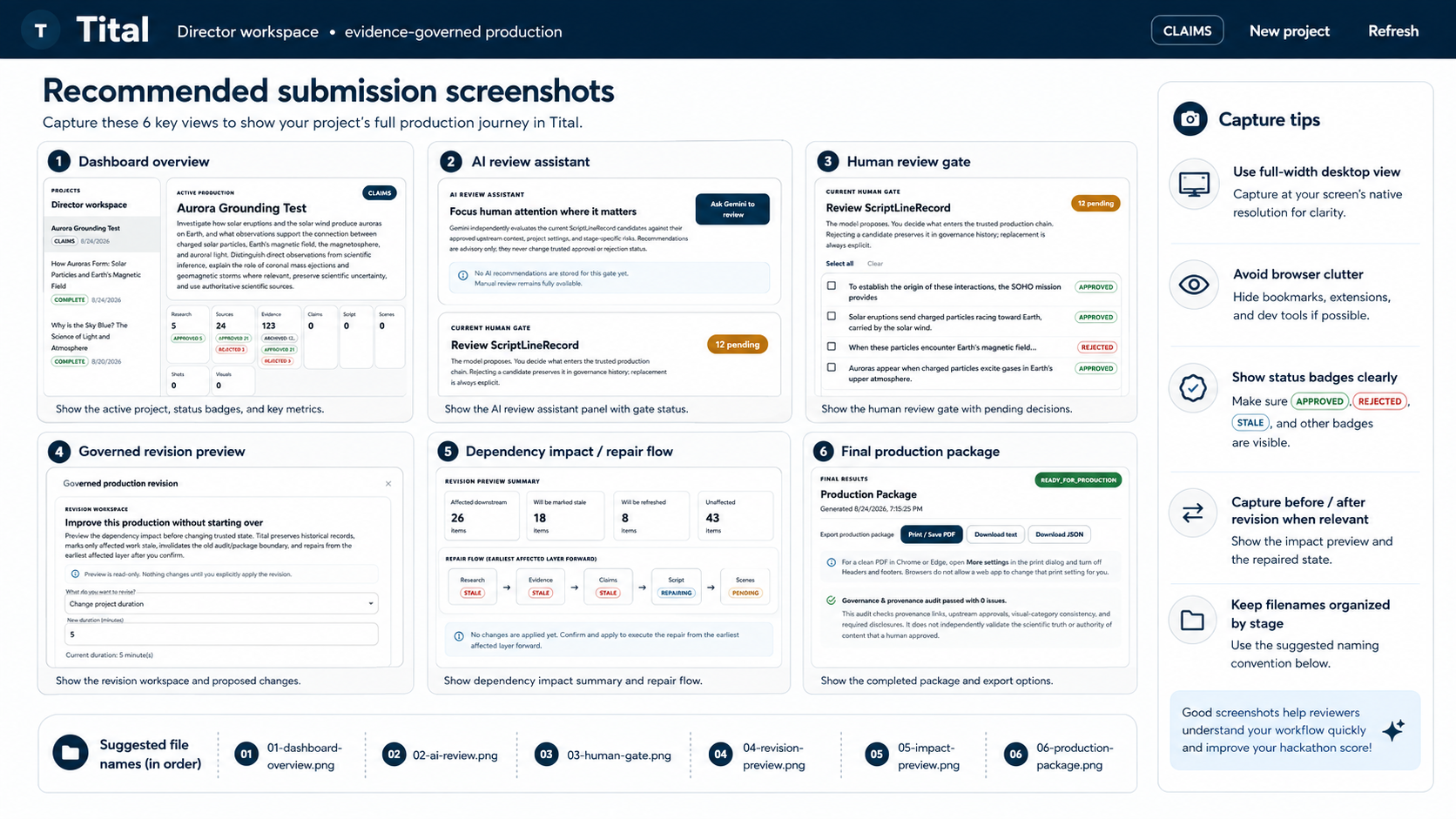
A deployed authenticated Aurora project, “How Auroras Form: Solar Particles and Earth's Magnetic Field,” completed the governed workflow using Gemini 3.5 Flash on Vertex AI and reached:
READY_FOR_PRODUCTION
The final package passed Tital's provenance/governance audit with zero issues and remained persisted after browser refresh.
Tital also provides a detached read-only public demo so evaluators can inspect a completed production package without accessing a private user session.
What's next
Tital currently focuses on directing and planning the scientifically governed production process.
Future development could connect the approved Production Package to downstream asset-generation, simulation, editing, and video-production systems while preserving the same evidence and human-governance chain.
Built With
- firebase
- gemini-3.5-flash
- github
- google-adk
- google-cloud
- google-cloud-run
- mcp
- node.js
- parallel
- react
- typescript
- vertex-ai
- vite
- vitest
- zod


Log in or sign up for Devpost to join the conversation.