Inspiration
Scientific filmmaking has a structural trust problem: research, narration, and cinematic decisions are often created in separate tools. As a result, it can become surprisingly difficult to answer a simple but important question:
Why are we saying or showing this?
A scientific film can look convincing while overstating evidence, hiding uncertainty, losing provenance, or presenting a reconstruction as if it were a direct observation.
Tital was created to make scientific evidence part of the filmmaking workflow itself.
The central idea became:
Evidence → Story, not Story → Evidence.
Instead of asking an AI to write a story first and then searching for supporting material, Tital starts with research questions, sources, and evidence, and carries those relationships forward into claims, script lines, scenes, shots, and visual decisions.
What it does
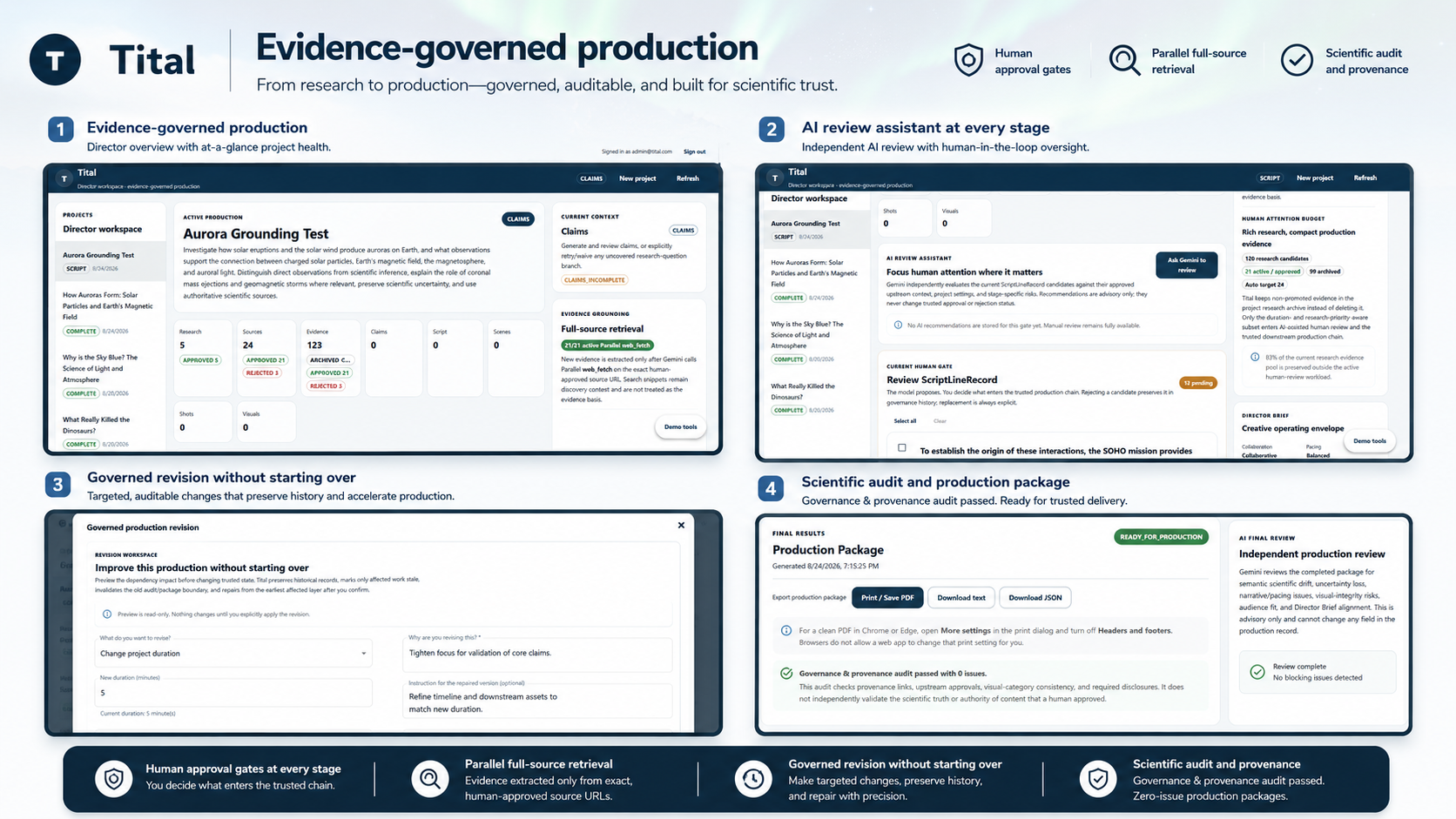
Tital is an evidence-governed scientific film director.
It turns a scientific question or film idea into a human-governed, evidence-traceable production package.
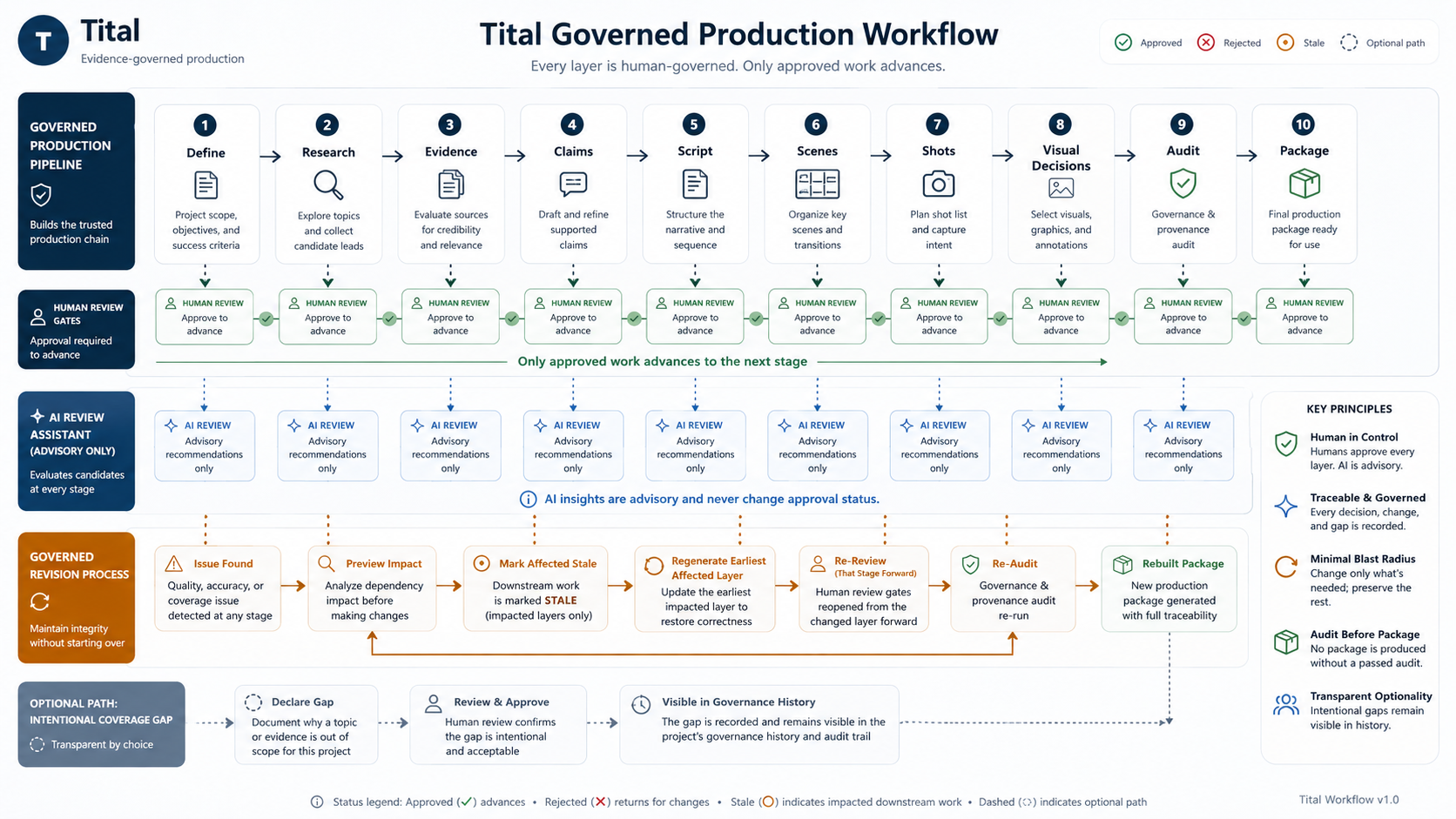
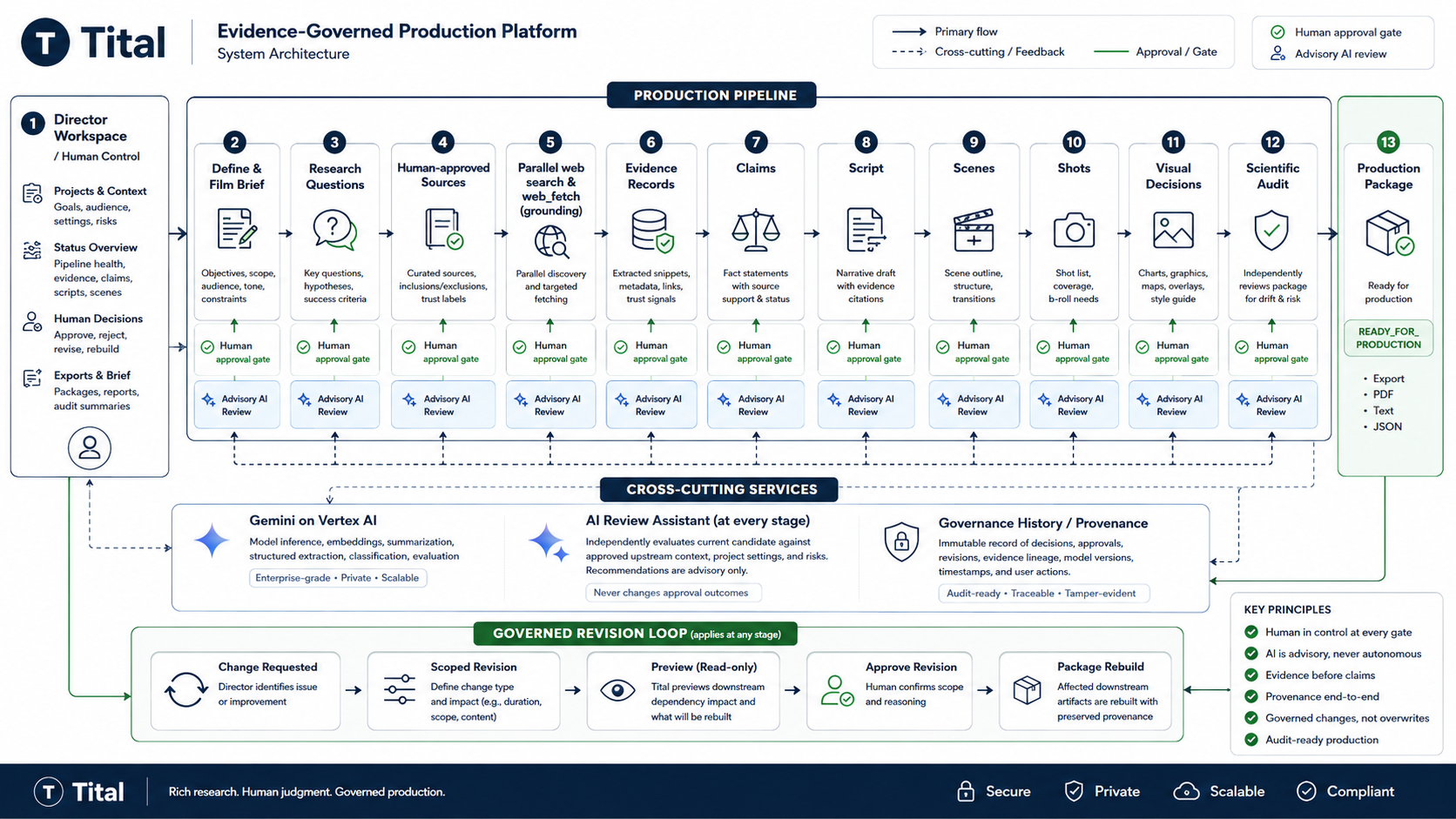
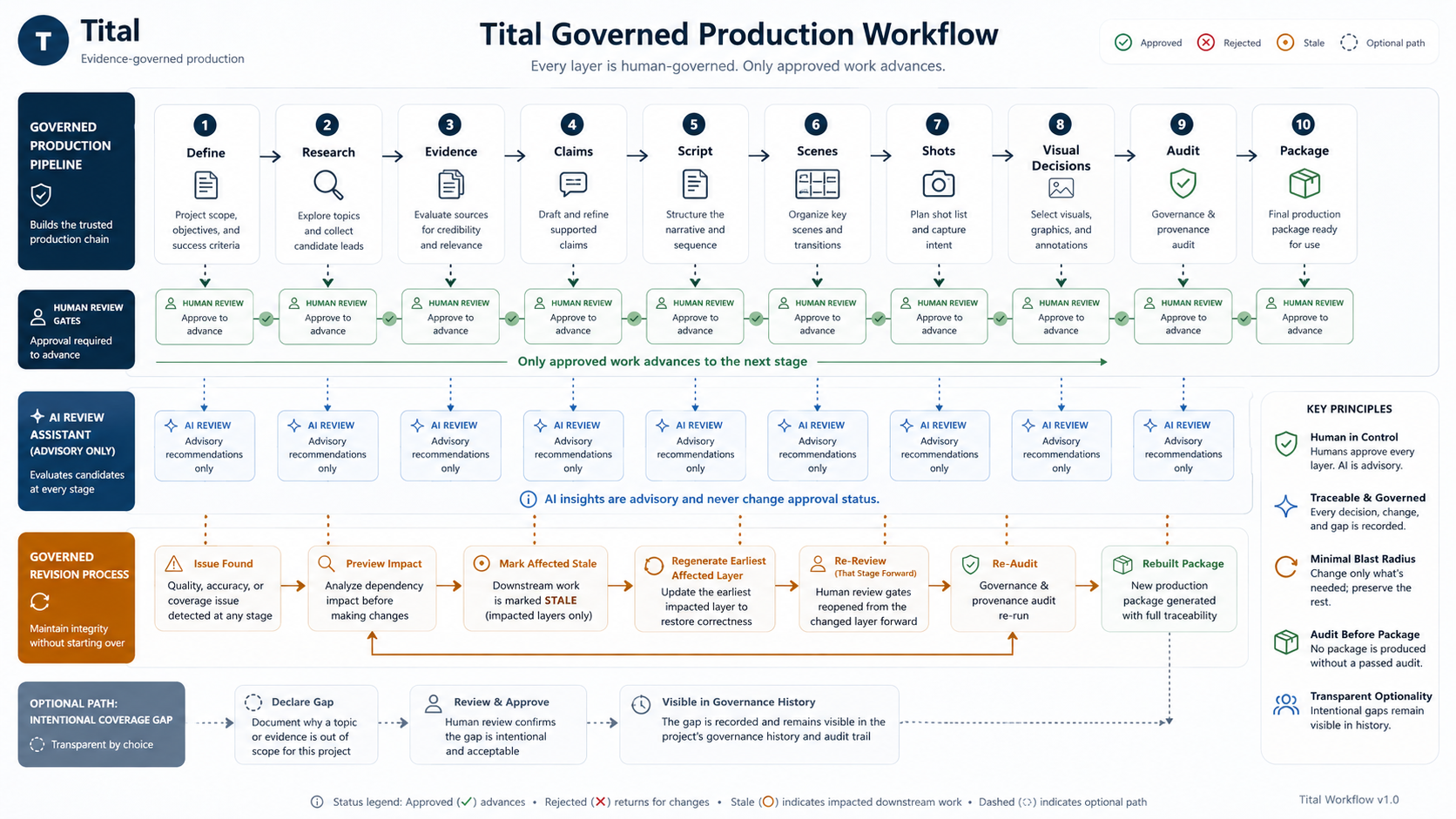
The workflow is:
Film Brief
→ Research Questions
→ Sources
→ Evidence
→ Claims
→ Script
→ Scenes
→ Shots
→ Visual Decisions
→ Governance & Provenance Audit
→ READY_FOR_PRODUCTION Package
Tital is not a generic chatbot and it is not a final video generator.
Its purpose is to govern the reasoning and production decisions that happen before final rendering.
Every generative stage stops at a human review boundary.
The AI can propose content and provide a second opinion, but it cannot approve its own work.
The human director can approve, reject, retry, revise, or intentionally manage a supported coverage gap.
This gives us a simple collaboration rule:
AI proposes. Evidence constrains. Directors decide.
Evidence-to-Story traceability
One of the most important features is the Evidence-to-Story trace.
Tital preserves relationships such as:
Source → Evidence → Claim → Script → Scene → Shot → Visual Decision
This means the director can inspect a downstream cinematic choice and ask:
What evidence ultimately supports this?
Source discovery uses Parallel web search.
Search results remain discovery context and are not automatically treated as scientific evidence.
After a human approves a source, Tital uses Parallel web fetch on that exact approved URL for full-source retrieval. Gemini then extracts structured Evidence proposals from the retrieved source.
This distinction between source discovery and full-source grounding became an important part of the architecture.
Human-governed AI review
Tital includes a stage-aware Gemini Review Evaluator.
At a human review gate, the director can ask Gemini for an independent second opinion.
The reviewer can identify:
- scientific overstatement;
- weak evidence support;
- lost uncertainty;
- audience mismatch;
- narrative problems;
- visual-integrity risks;
- representation problems.
But its result is advisory.
An AI recommendation never changes trusted approval state.
Only an explicit human action can approve or reject a record.
This was important because we did not want to build a system where one AI agent generates something and another AI agent silently declares it correct.
Adaptive Evidence Budget
During a real end-to-end production test, research depth created a new problem.
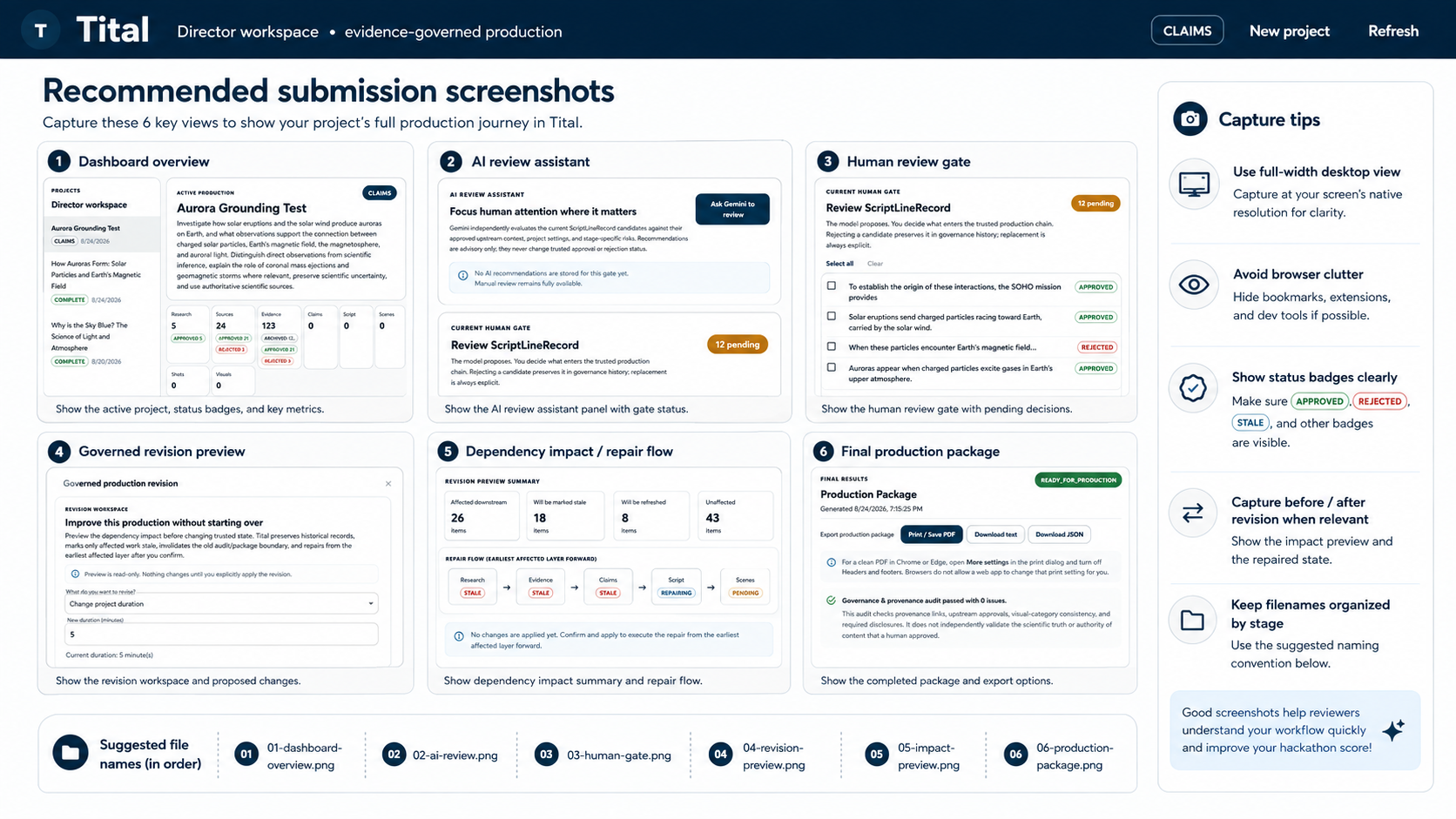
Twenty-one approved sources produced 123 full-source Evidence candidates.
Passing every candidate through human review and every downstream production stage would create unnecessary latency, model context, and human workload.
Tital therefore separates broad research from active production evidence.
In the live Aurora test:
21 approved Sources
→ 123 Evidence candidates
→ 24 active for review
→ 99 preserved as archived research candidates
→ 21 human-approved and 3 human-rejected active Evidence records
The archived records are not deleted and are not treated as approved evidence. They remain part of the project's research history.
This allowed Tital to preserve research breadth while controlling the amount of information that enters the active production workflow.
How we built it
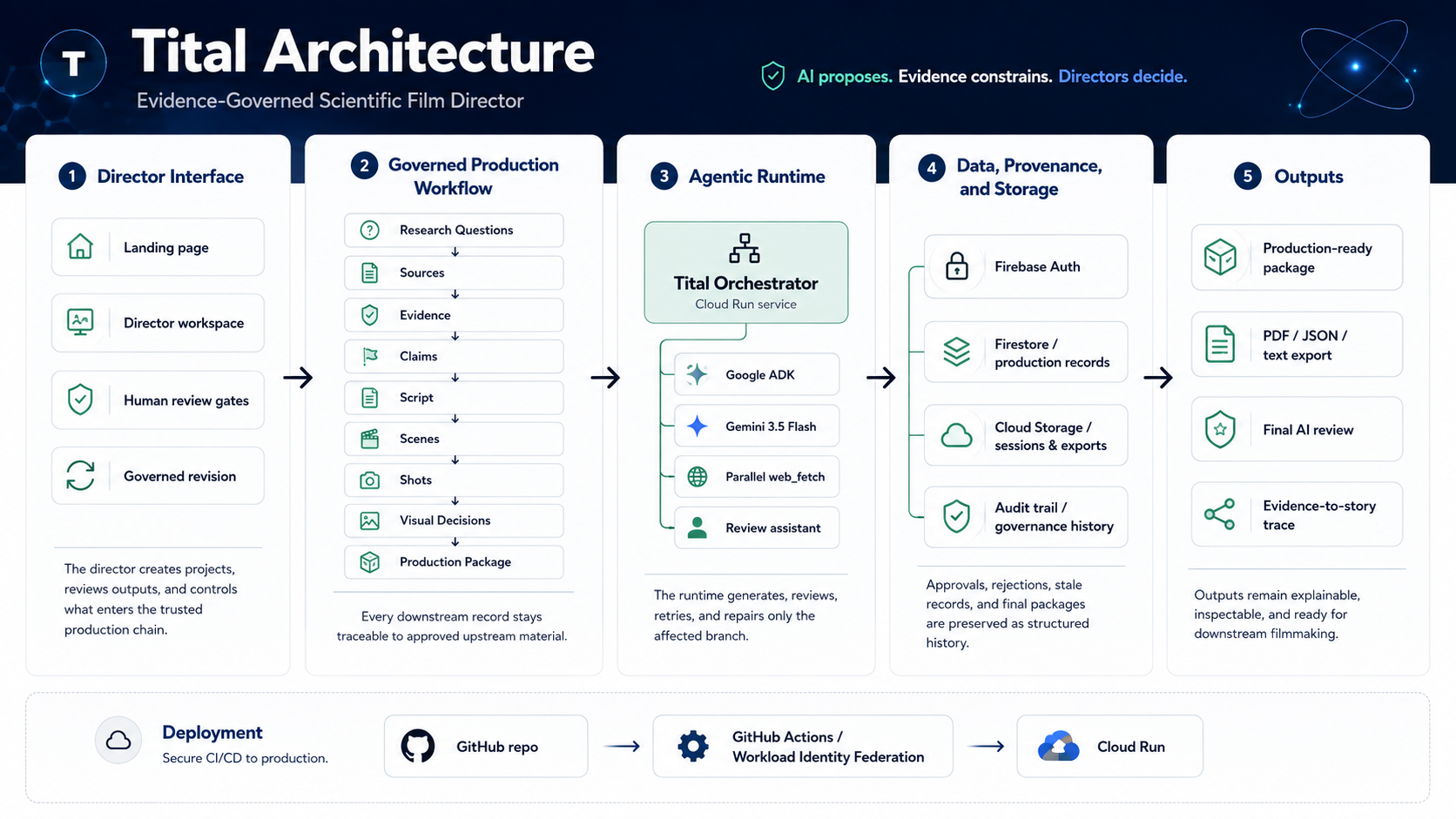
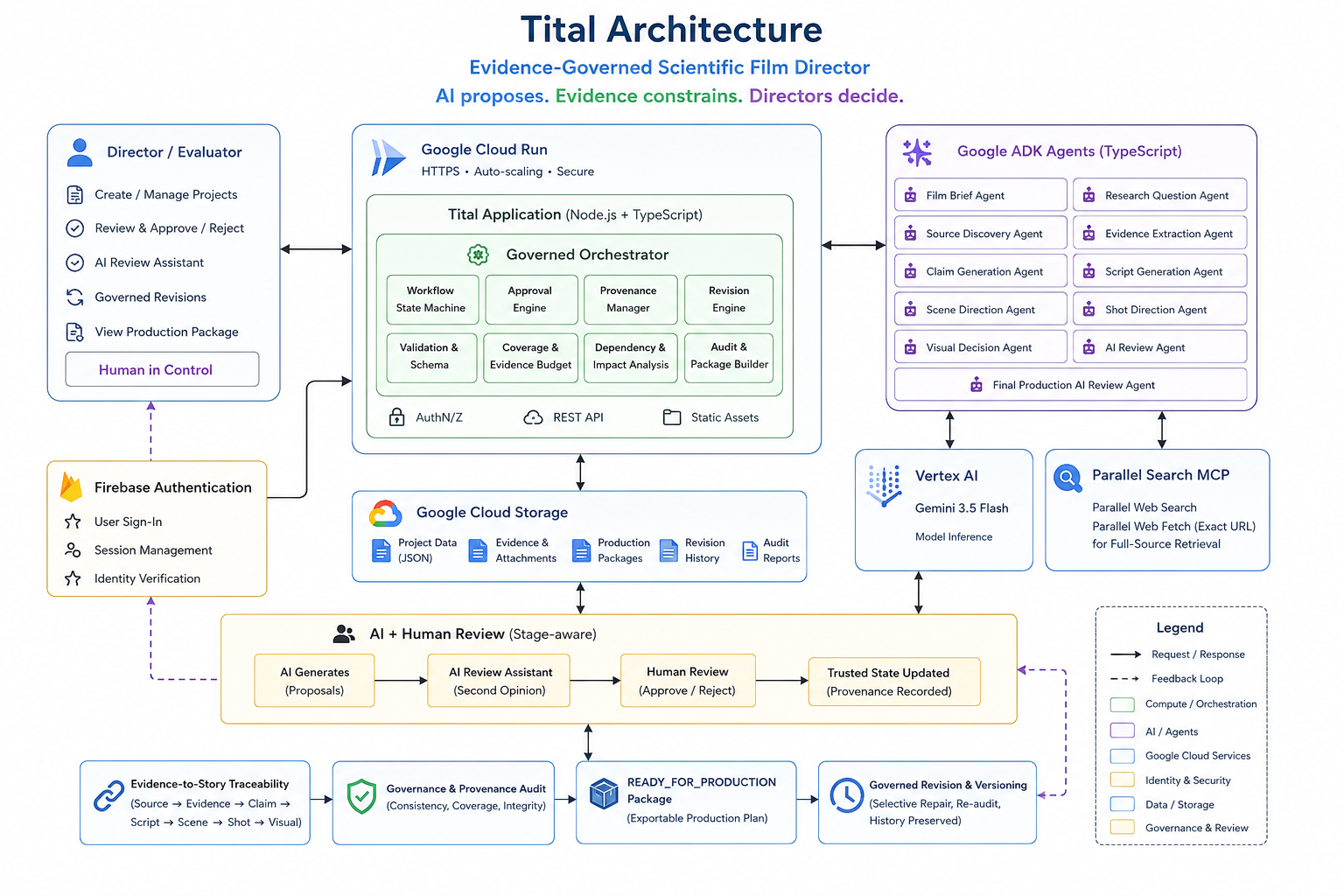
Tital uses a hybrid architecture in which AI performs semantic work while deterministic application code controls trusted production state.
AI and agent runtime
We use:
- Gemini 3.5 Flash
- Google Agent Development Kit, TypeScript
- Vertex AI
- Parallel Search MCP
Specialized agents handle tasks including:
- Film Brief generation
- Research Question generation
- Source discovery
- Evidence extraction
- Claim generation
- Scientific script generation
- Scene direction
- Shot direction
- Visual decision generation
- Stage-aware AI review
- Final Production AI Review
Deterministic governance
We deliberately keep trusted workflow authority outside the model.
Application code owns:
- trusted IDs;
- provenance links;
- approval status;
- schema validation;
- workflow transitions;
- coverage policies;
- Adaptive Evidence Budgeting;
- revision impact calculation;
- STALE propagation;
- governance and provenance audit;
- production package construction;
- version history.
This separation became one of the most important design decisions in Tital.
The model proposes semantic content.
The application validates and maps trusted state.
The human makes the decision.
Google Cloud architecture
The production application runs on Google Cloud.
The stack includes:
- Google Cloud Run
- Vertex AI
- Google ADK
- Gemini 3.5 Flash
- Google Cloud Storage
- Firebase Authentication
- Firebase Admin
- Workload Identity Federation
- GitHub Actions
The frontend is built with React, Vite, and Material UI.
The backend uses Node.js and TypeScript.
Firebase Authentication protects the director workspace, while Firebase Admin verifies user identity on the backend.
Google Cloud Storage persists governed project sessions, review state, revision history, and production state.
The repository is deployed through GitHub Actions using Google Workload Identity Federation instead of storing a long-lived Google Cloud service-account key in the repository.
Challenges we faced
1. Preventing AI output from becoming trusted state automatically
The easiest architecture would have been to let an agent generate records and immediately move the workflow forward.
We deliberately rejected that approach.
Every generative stage needed an explicit human decision boundary, while IDs, provenance, status, and dependency rules remained deterministic.
2. Distinguishing search from evidence
A search snippet is useful for discovering a source, but it is not the same as reading the source.
We therefore separated Parallel web search from exact-URL web fetch and required full-source retrieval after human Source approval.
3. Managing large evidence pools
The Aurora production generated 123 Evidence candidates.
That exposed the need for an Adaptive Evidence Budget that could preserve research breadth without forcing every candidate through the complete production pipeline.
4. Safe revision after production completion
Reaching READY_FOR_PRODUCTION introduced another question:
What happens when the director changes one approved decision?
Restarting the entire project would be wasteful.
Tital therefore calculates deterministic revision impact, marks affected descendants as STALE, preserves unaffected science, repairs only the affected branch, requires human re-review, re-runs the audit, and rebuilds the production package.
A live Script revision affected:
1 Script Line
→ 1 Scene
→ 2 Shots
→ 2 Visual Decisions
while Research Questions, Sources, Evidence, and Claims remained preserved.
5. Latency and external model work
Real Gemini and full-source retrieval calls introduced latency and rate-limit challenges.
We added bounded concurrency, conservative Evidence concurrency, retry/backoff for transient provider failures, and separated HTTP serving capacity from long-running model work.
Testing the deployed application rather than only local mocks was essential for finding these issues.
What we learned
The project changed how we think about agentic systems.
First, human review must affect control flow. A reject button is meaningless if the system quietly continues anyway.
Second, AI assistance does not require AI authority. A model can help a human review complex work without receiving permission to approve itself.
Third, research breadth and production evidence are different things. Preserving many research candidates is useful, but not every candidate needs to consume human attention and downstream computation.
Fourth, structural correctness and semantic quality are different. Tital can pass a deterministic governance and provenance audit while a separate Gemini Final Production Review still finds narrative, scientific, or audience-level risks.
Finally, completed agentic work needs governed revision. Production systems need to understand what changed, what remains valid, and what must be reviewed again.
Accomplishments
The final hosted system now supports:
- a complete evidence-to-production workflow;
- real Gemini 3.5 Flash agents through Google ADK and Vertex AI;
- live Parallel source discovery and full-source retrieval;
- stage-aware AI-assisted human review;
- explicit approval and rejection;
- persistent provenance;
- Adaptive Evidence Budgeting;
- deterministic governance auditing;
- Final Production AI Review;
- dependency-aware revisions;
- selective repair;
- re-audit and package rebuilding;
- preserved production and revision history;
- a public read-only completed demo;
- an authenticated director workspace;
- automated GitHub-to-Google-Cloud deployment.
Most importantly, Tital can answer the question that motivated the project:
Why are we saying or showing this, what evidence supports it, and what changes if we revise it?
What's next
Tital currently ends at a governed READY_FOR_PRODUCTION package rather than generating the final film.
The next direction is to make that production package interoperable with downstream cinematic tools while preserving the same provenance, scientific integrity, and director-control principles.
We also want to continue improving evidence prioritization, review ergonomics, collaborative director controls, and performance for larger scientific productions.
The long-term goal is not to remove the filmmaker from scientific filmmaking.
It is to give the filmmaker a better way to collaborate with AI without losing evidence, uncertainty, authorship, or control.
Built With
- firebase
- gemini-3.5-flash
- google-adk
- google-cloud
- google-cloud-run
- node.js
- parallel-search-mcp
- react
- typescript
- vite
- vitest
- zod


Log in or sign up for Devpost to join the conversation.