-
-
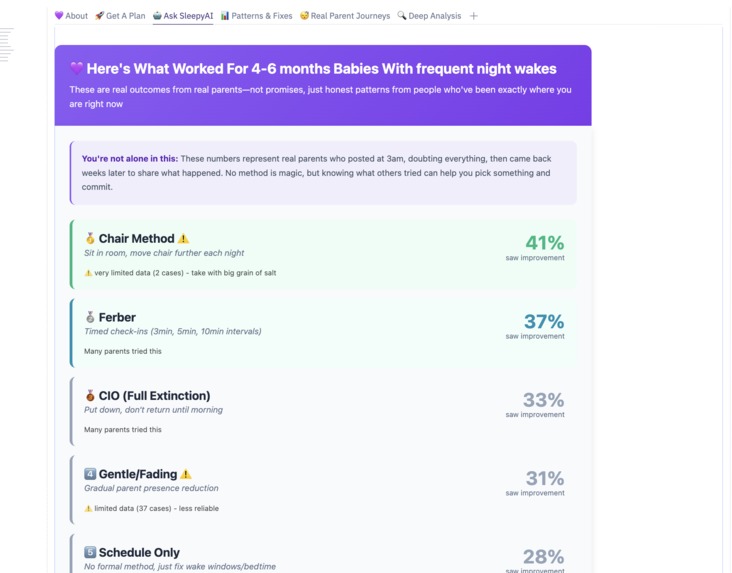
What has worked for the community
-
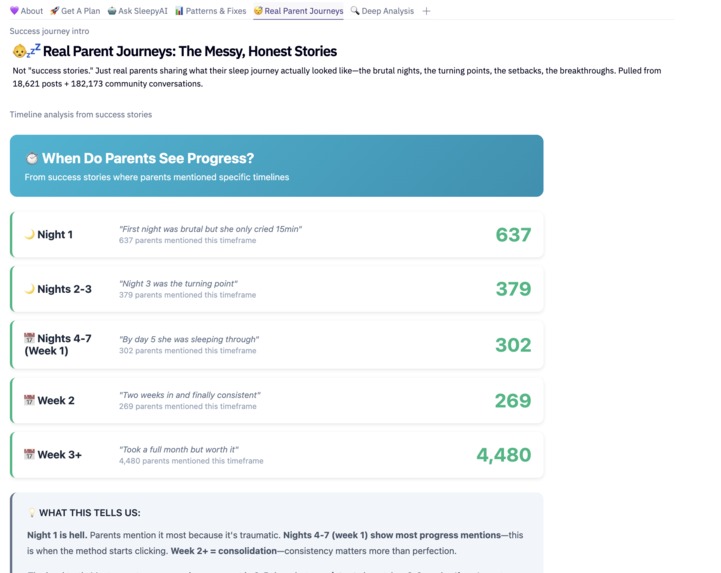
Parent's Journey
-
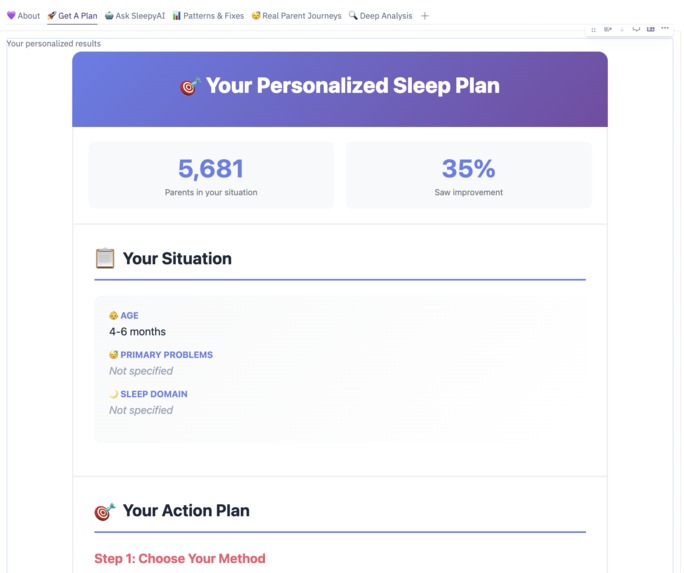
Personalized Plan
-
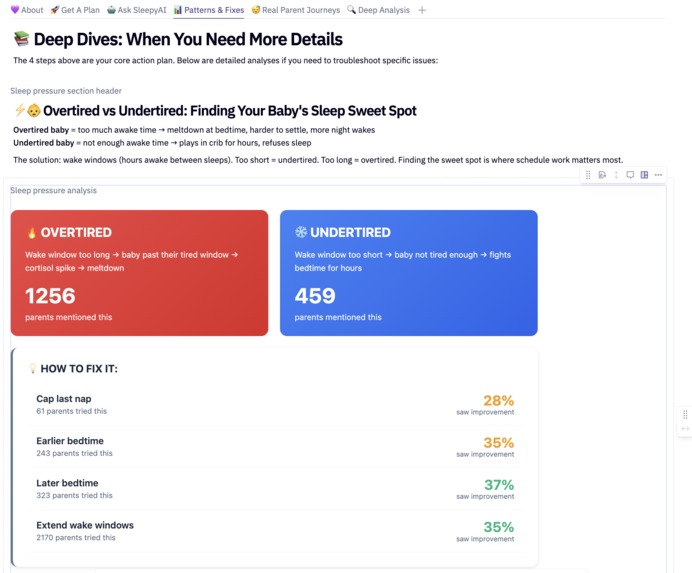
Deep Dive Learning
-
About
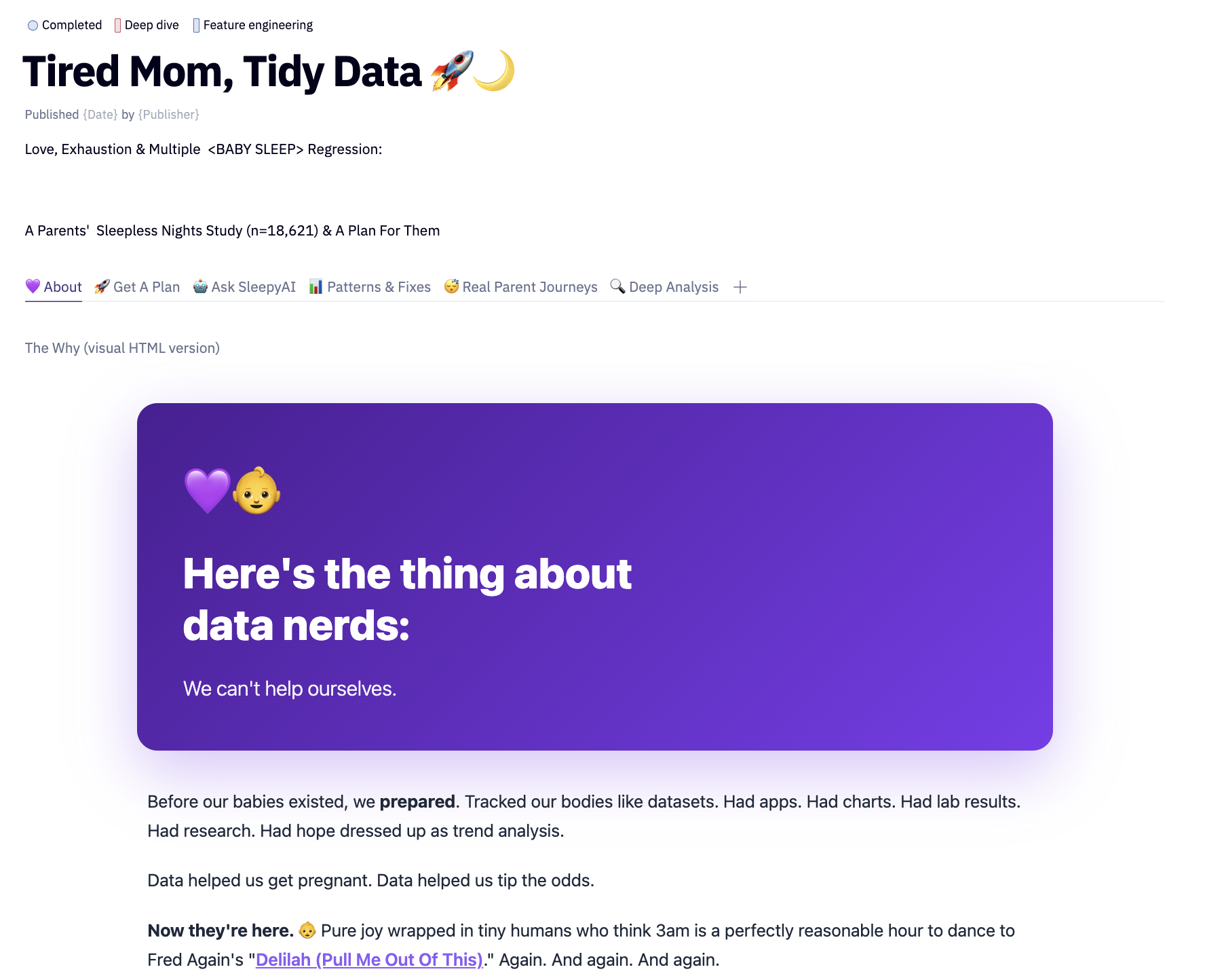
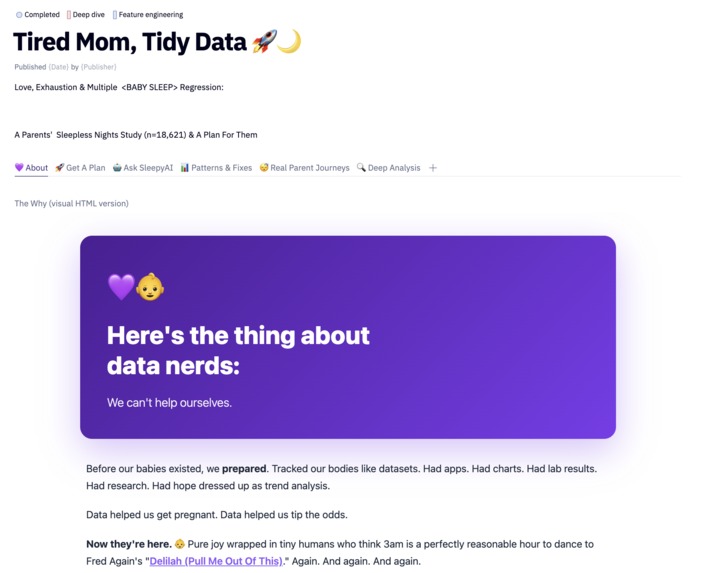
Here's the thing about data nerds:
We can't help ourselves.
Before our babies existed, we prepared. Tracked our bodies like datasets. Had apps. Had charts. Had lab results. Had research. Had hope dressed up as trend analysis.
Data helped us get pregnant. Data helped us tip the odds.
Now they're here. Pure joy wrapped in tiny humans who think 3am is a perfectly reasonable hour to dance to Fred Again's "Delilah (Pull Me Out Of This)." Again. And again. And again.
The happiest babies. Giggles at shadows. Ceiling fans are peak comedy. Dog sneezes are hilarious.
And we are so, so tired.
Words stolen mid-sentence. Bones heavy like a winter in Chicago. A confidence interval for "will I remember my own name today" that's embarrassingly wide. No longer sure if sleep deprivation causes bad decisions or if they're just highly correlated. n=1 cup of coffee no longer a statistically significant intervention.
We show up anyway. Every wake. Tomorrow's calendar is full. Client calls, performance reviews, deadlines that don't care how little we slept. But babies don't know about calendars. They just know who comes when they cry. So we show up. White noise humming. Nightlight glowing in red. Heart full. Eyes barely open. That's what love looks like at 2am.
But love doesn't make them sleep.
Data nerds don't want to "train" tiny humans like machine learning models. We want to understand them first and work with and for them to fall and stay asleep independently.
Books and research give generic advice. Sleep consultants charge thousands for "personalized" plans that aren't. Apps that just have data don't understand the hows. But at 3am, exhausted parents tell the how. On Reddit. For free.
*18k of them did. Community showed up 108k times * This is what they said. This is what there is to learn.
Why does any of this matter?
Because most new parents are drowning in the same boat — and we keep gatekeeping common knowledge. The most public & organized information is just too generic.
| Stat | What it means | Source |
|---|---|---|
| 61% | of parents report exhaustion as their #1 emotion in baby's first year | Owlet State of Parenting Report, 2024 |
| 3 hours | of sleep lost per night, on average, during baby's first year | Owlet State of Parenting Report, 2024 |
| 86% | of parents wake up to 8 times per night to check on their baby | Owlet State of Parenting Report, 2024 |
| $2,500 | what a sleep consultant charges for a comprehensive package | Bornbir, Washington Post, 2024 |
| $6.5B | global baby sleep product market in 2023 (projected $10B+ by 2032) | Data Intelo Market Research, 2024 |
| 30% | of parents report significant sleep issues during their infant's early years | Data Intelo Market Research, 2024 |
The Dataset
18,621 Reddit posts + 182,173 comments from 6 parenting subreddits (r/sleeptrain, r/beyondthebump, r/NewParents, r/Mommit, r/daddit, r/ScienceBasedParenting) spanning 2018-2025, plus peer-reviewed research on infant sleep training outcomes, developmental sleep patterns, and extinction burst timelines.
What it does
Tired Mom, Tidy Data turns 200,794 pieces of Reddit wisdom (18,621 posts + 182,173 comments) into an interactive sleep plan generator for exhausted parents who are too tired to read one more blog post.
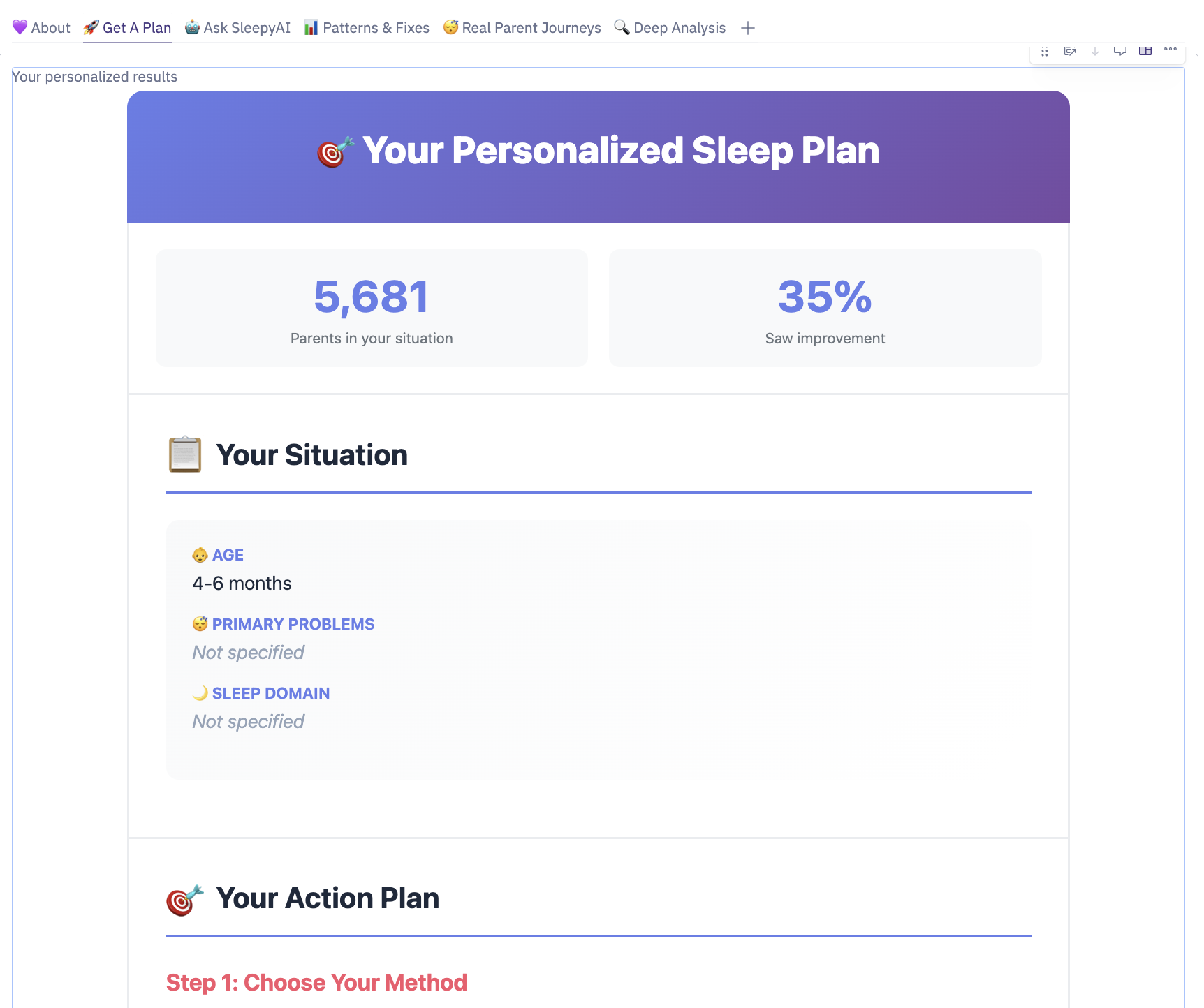
🚀 Get A Plan - The main tool. Filter by age/problems/sleep domain → get a personalized 3-step action plan with dynamic wake window schedules ranked by success rate, method effectiveness bar charts showing what worked for similar babies, and real parent stories from your exact situation. Everything updates in real-time as you adjust filters.
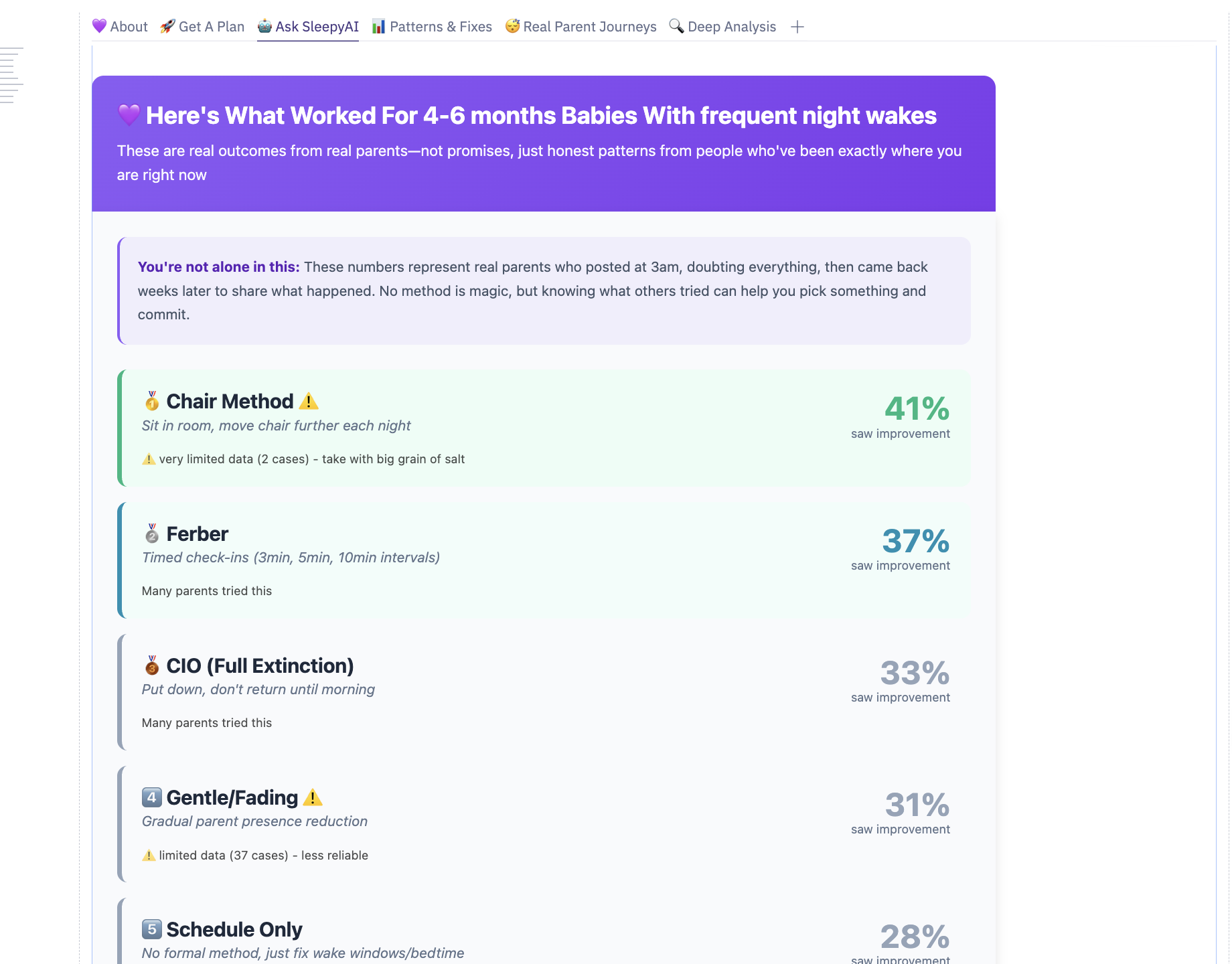
🤖 Ask SleepyAI - ML-powered scenario testing. Pick age + problem → see improvement odds for every method ranked from best to worst. Gradient boosting model trained on 13,550 parents. Compare two approaches side-by-side before committing. Empathetic framing: "patterns, not promises" + "A word before you commit" compassionate messaging.
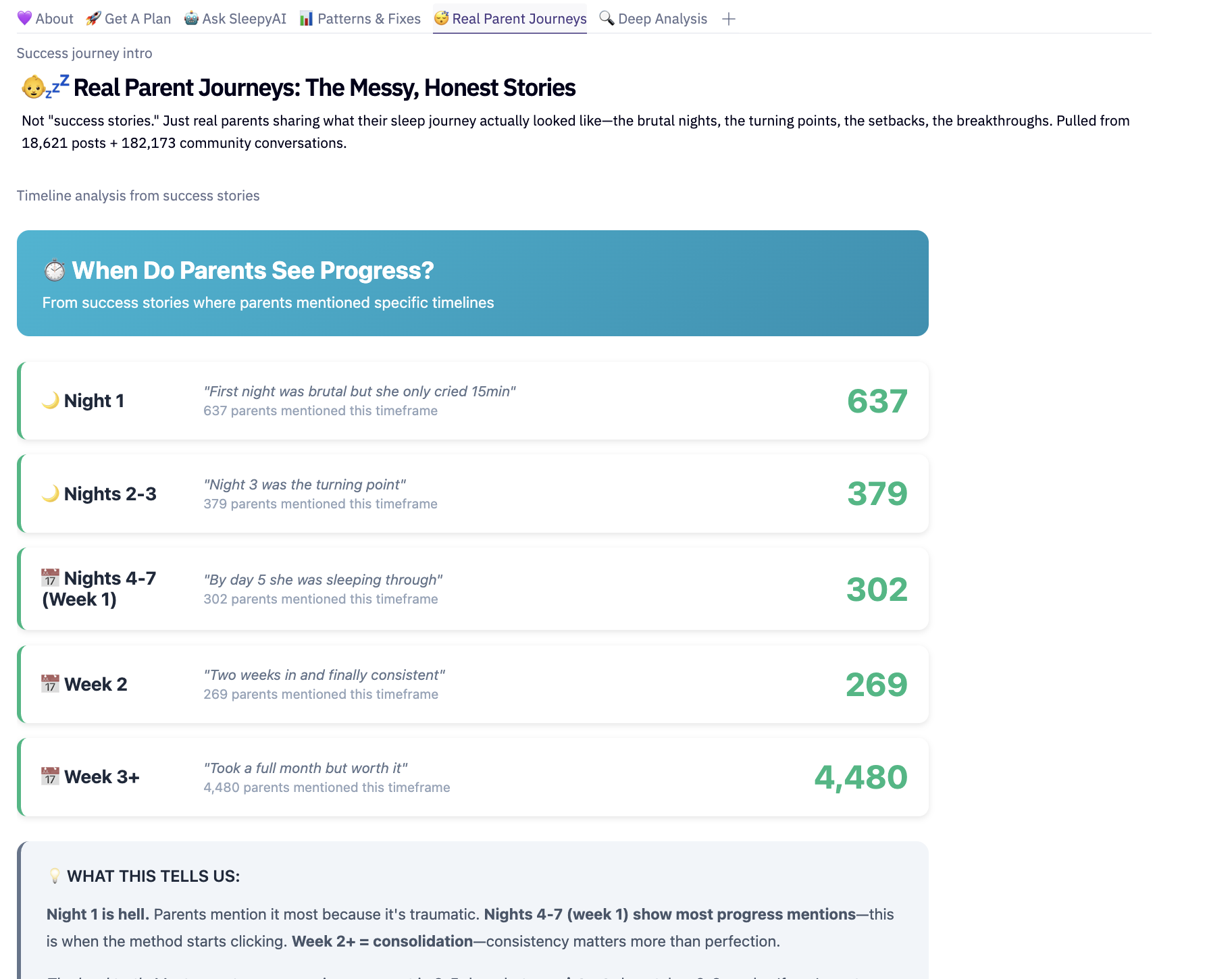
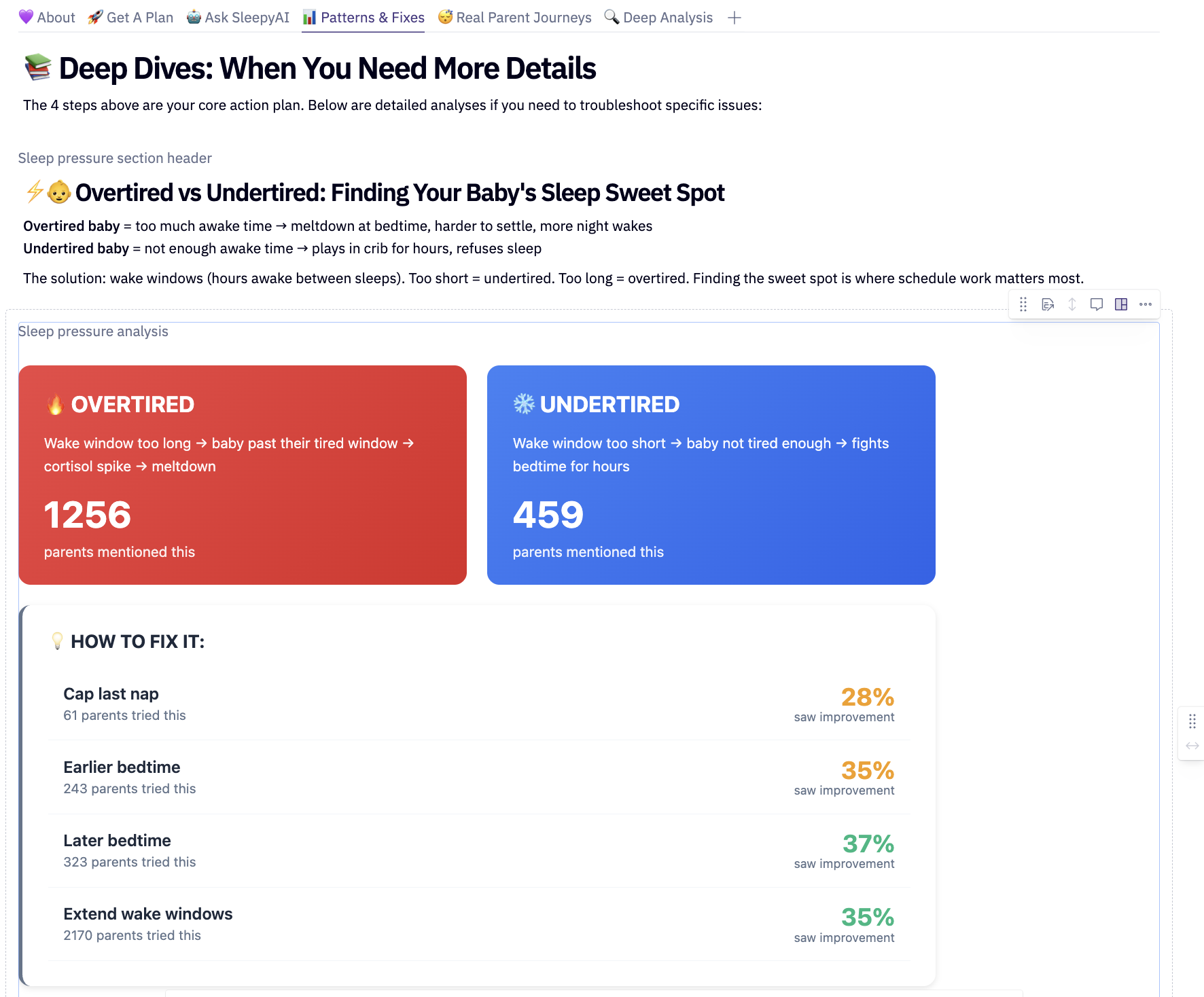
📊 Patterns & Fixes - Deep tactical dives on what actually works: nap extension strategies, overtired vs undertired diagnostics, night weaning patterns, timeline expectations (when parents see progress vs when they quit), trigger-problem combinations (specificity = 77-96% success), success journey examples showing messy, non-linear improvement.
😴 Real Parent Journeys - Curated success stories with progression markers. Not Instagram-perfect narratives—real posts showing setbacks, doubt, extinction bursts, then breakthroughs. Proof that 31% improvement isn't clean or guaranteed.
🔍 Deep Analysis - For the analytically curious: Community engagement patterns (comment volume ≠ success), top helper analysis (who gives the best advice?), upvote quality vs actionability, TF-IDF language differential (success posts say "consistency," struggle posts say "help"), advice patterns from 182k comments (naps 60%, wake windows 24%).
Core philosophy: No paywall. No fake predictions. No pretending algorithms know your baby. Just collaborative filtering from real parents + gradient-boosted ML + custom empathetic design + honest patterns to help you make a decision when you're running on empty.
💡 Key Findings
The truths that matter (ages 4+ months):
No magic method: Chair (45%), Gentle (42%), Ferber (42%), CIO (36%) cluster 36-45%. Consistency + timing + fit matter more than which Instagram influencer you follow.
Schedule + Method = the formula: 41.7% improvement (both) vs 32.4% (method only) vs 30.0% (schedule only). You need both. Neither works alone.
Age is biology: 34.6% improvement at 4-5mo → 36% by 12+ months. Older babies respond better. 0-3mo excluded (too young to train, survival mode only).
Partnership matters: 45% improvement (partnered) vs 38% (solo). The data is unambiguous.
Single-method focus wins: Mentioning 1 method = 31% success. Multiple methods = 25-28% (signals struggle, not optimization).
Comment volume ≠ success: 44% of posts got zero responses. High-engagement posts (50+ comments) show same 31% improvement as low-engagement. Getting advice doesn't guarantee outcomes.
What helpers actually say: Top advice from 182k comments: naps (60%), bedtime routines (34%), wake windows (24%), schedules (24%). "Consistency" appears 3x more in success posts than struggle posts.
Plus: Retraining is normal (4.9% of posts), baby's sex irrelevant (boys 32.9% vs girls 33.5%).
Emotional toll: 2,017 posts mention crying, 1,614 exhaustion, 214 reconsidering family size. Desperation increases with baby age (regression grief is real).
🛠️ How I built it
The real story: Hex AI agent + Claude = 4 weeks → 6 hours. 150+ cells, 5,000+ lines of code.
Data: PullPush API → 18,621 posts + 182,173 comments (2018-2025). Full bodies + threads.
NLP: Multi-label regex classification (age, methods, problems, triggers, success markers, emotions). TF-IDF on posts + comments.
Stack: Snowflake + Python + scikit-learn gradient boosting + collaborative filtering.
Interactive: 6 dynamic filters → real-time plans with wake windows + ML scenario testing. Design: Custom HTML/CSS gradient visualizations. 6 sections with empathetic messaging.
😅 Challenges I ran into
Defining "success" from chaos - Parents write "omg he slept 11 hours I CRIED," not structured reports. Built NLP classifiers understanding real language: "it clicked" vs "gave up."
Age-appropriate rigor - Split 0-3mo (survival only) from 4+mo (training metrics). Early versions were misleading.
Threading 182k comments - Matched comments → outcomes, then discovered: comment volume ≠ success (44% got zero responses).
Sample transparency - Gentle (45% success, 53-381 uses) vs Ferber/CIO (2,800+ uses). Framed honestly.
Performance - 90s loads → 20s via Snowflake migration + vectorized operations.
Data + empathy - 2,017 parents mentioned crying. Every visualization paired stats with compassion.
Design - Custom HTML/CSS gradients. Supportive friend, not clinical dashboard.
🏆 Accomplishments I'm proud of
Bridged data + lived experience + design - Specificity breakthrough (trigger + problem = 77-96%) came from understanding baby sleep as biology, not just regressions.
Democratized $2,500 sleep consultant access - Free. No paywall. ML testing + dynamic wake windows + trigger guidance for everyone.
Mined 182k comments - Comment volume ≠ success. Upvotes ≠ quality. TF-IDF revealed success vs struggle use different languages.
Built for empathy AND accuracy - Every stat with context. 2,017 parents mentioned crying—that shaped design.
Shipped via Hex AI - 4 weeks → 6 hours.
🔮 What's next
Short-term:
Short-term: Mobile optimization, temporal mapping (track "Night 3 updates"), expert helper surfacing.
Long-term: Work with a baby sleep scientist, and cross-platform information following a similar methodology. (BabyCenter, forums), international cultures, longitudinal tracking, early warning system.
Vision: Create an app with real-time community insights. Living wisdom for 4am parents. Because 44% got zero responses and are struggling. Good sleep matters!
Built with love, data, and way too little coffee.
For every parent who Googled "is this normal" at 4am.
— By a fellow sleep-deprived data nerd, for the community that got me through it.
The fine print: This analysis was made by a highly informed data nerd mom during contact naps. Uses publicly available Reddit posts + comments from parenting communities, collected via PullPush API (2018-2025). The intent is pattern-finding from someone who understands regression analysis (both kinds), not medical advice. Please don't sue me. I'm too tired for litigation.
App: https://app.hex.tech/virtual-hackathon/app/Tired-Mom-Tidy-Data-032B7cCB6kfBrLYUCFM6Aj/latest
Project: https://app.hex.tech/virtual-hackathon/hex/Tired-Mom-Tidy-Data-032B7cCB6kfBrLYUCFM6Aj/draft/logic

Log in or sign up for Devpost to join the conversation.