Inspiration
New parents often find themselves checking on their baby throughout the night, worried about whether they are breathing comfortably or sleeping safely. While traditional baby monitors provide video and audio, they still require parents to constantly watch the screen and interpret what they are seeing themselves. We wanted to explore how embedded systems, computer vision, and AI could work together to create a smarter baby monitor. Our goal was to build a prototype that not only streams live video, but also understands what's happening in the crib by combining contactless vital sign estimation, sleep position monitoring, and intelligent summaries into a single easy-to-use dashboard. Inspired by research showing that unsafe sleep positions are one of the leading preventable risk factors for sudden infant sleep-related deaths, we wanted TinyVitals to notify parents when meaningful changes occur instead of forcing them to constantly watch a video feed.
What it does
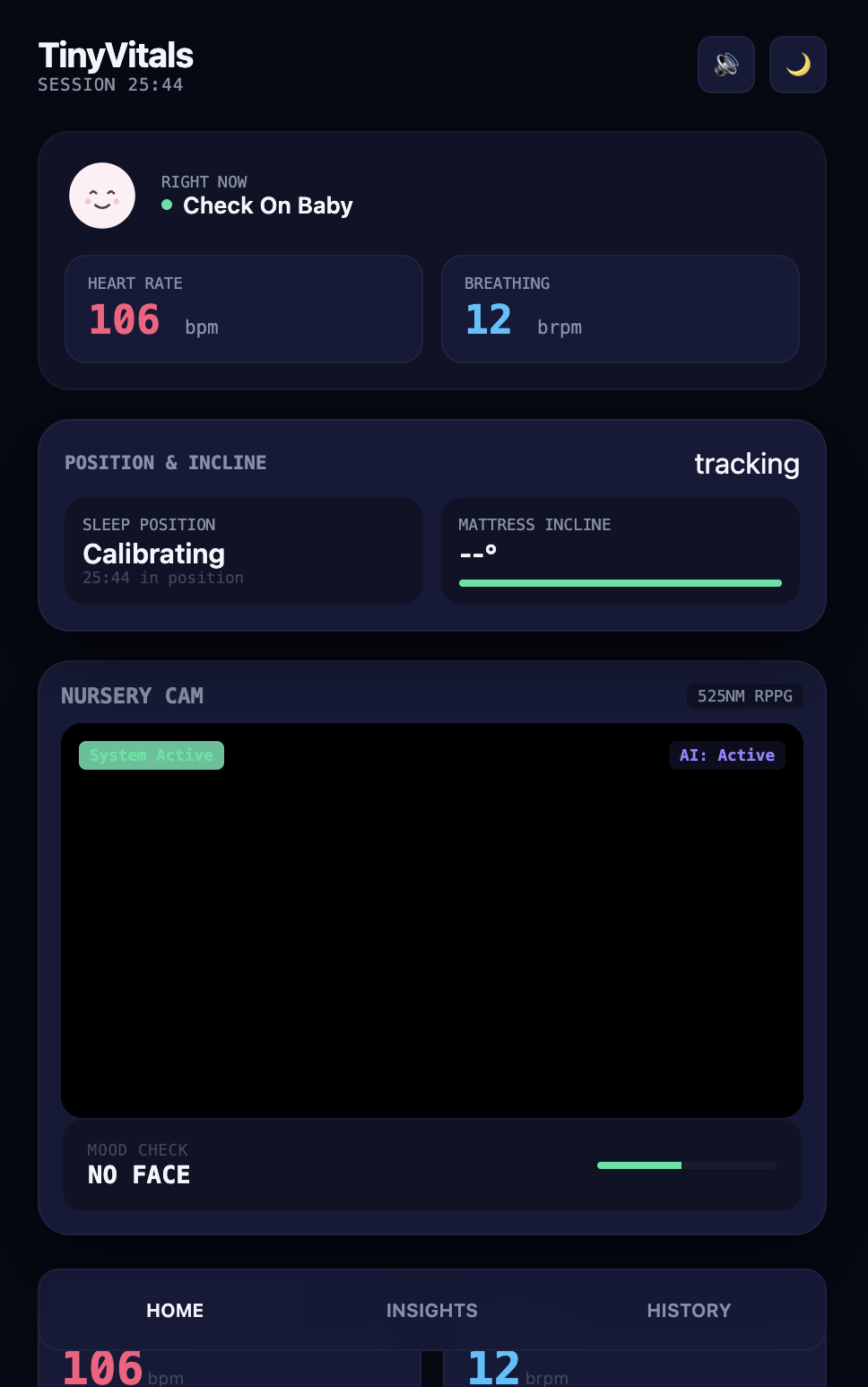
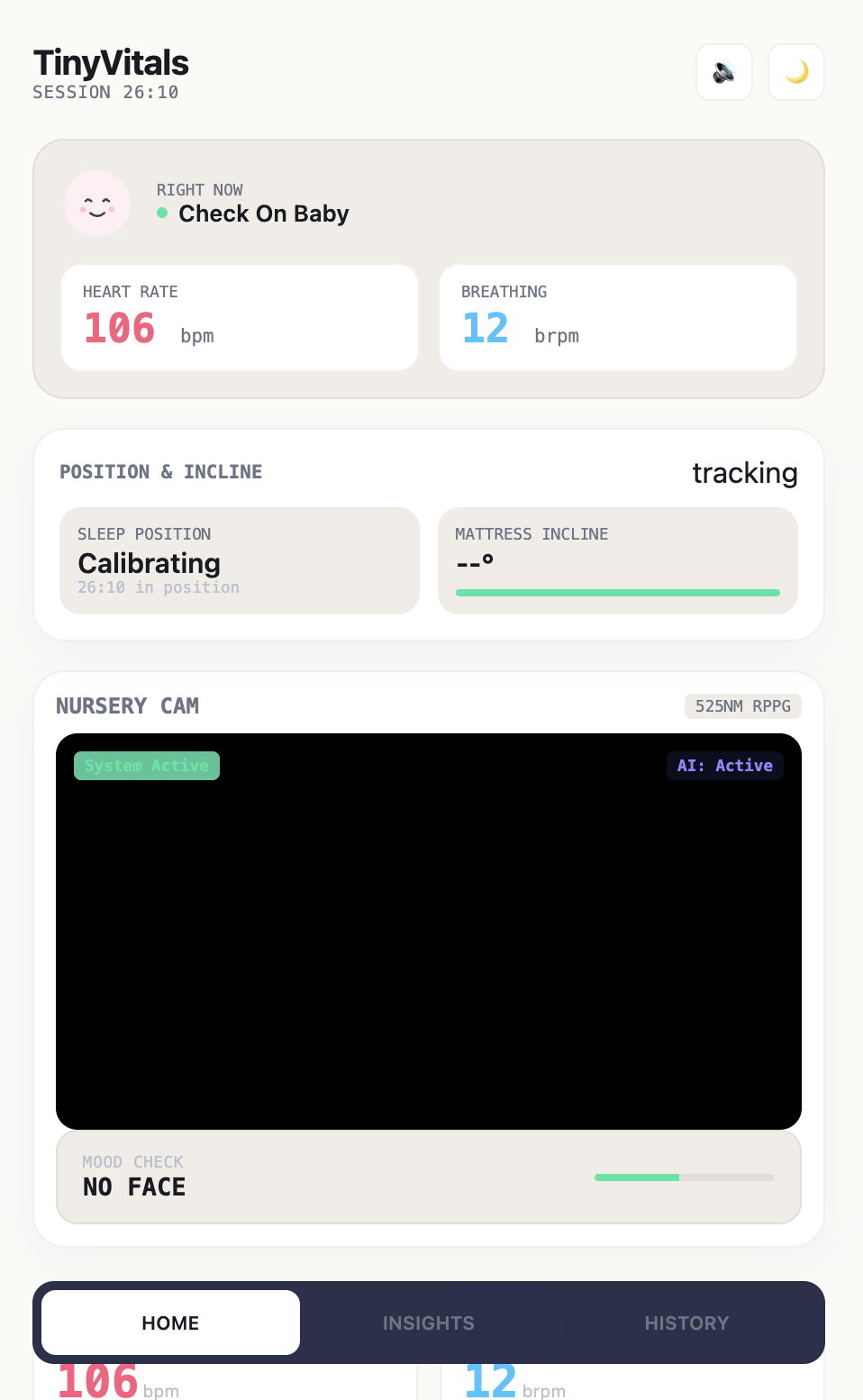
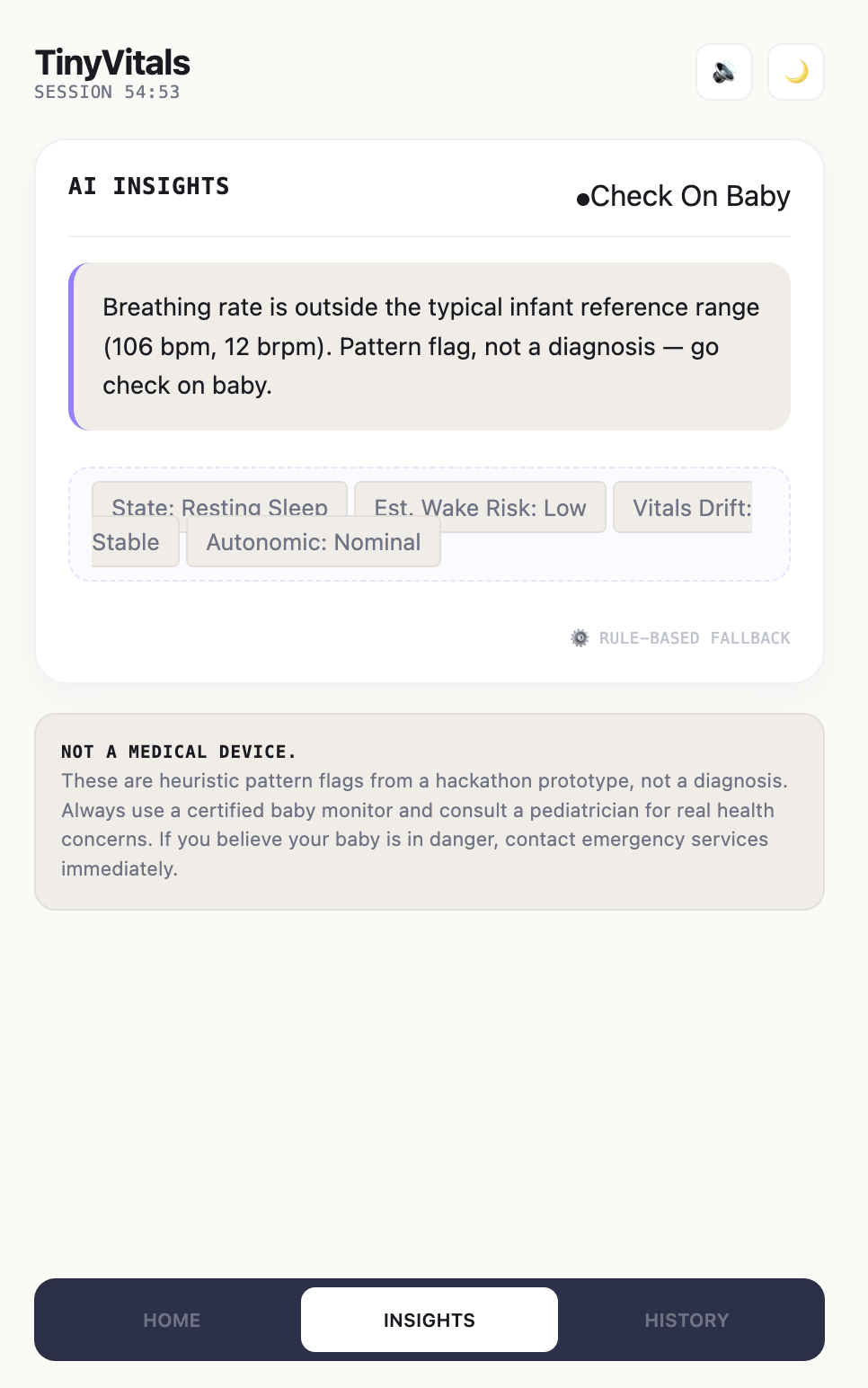
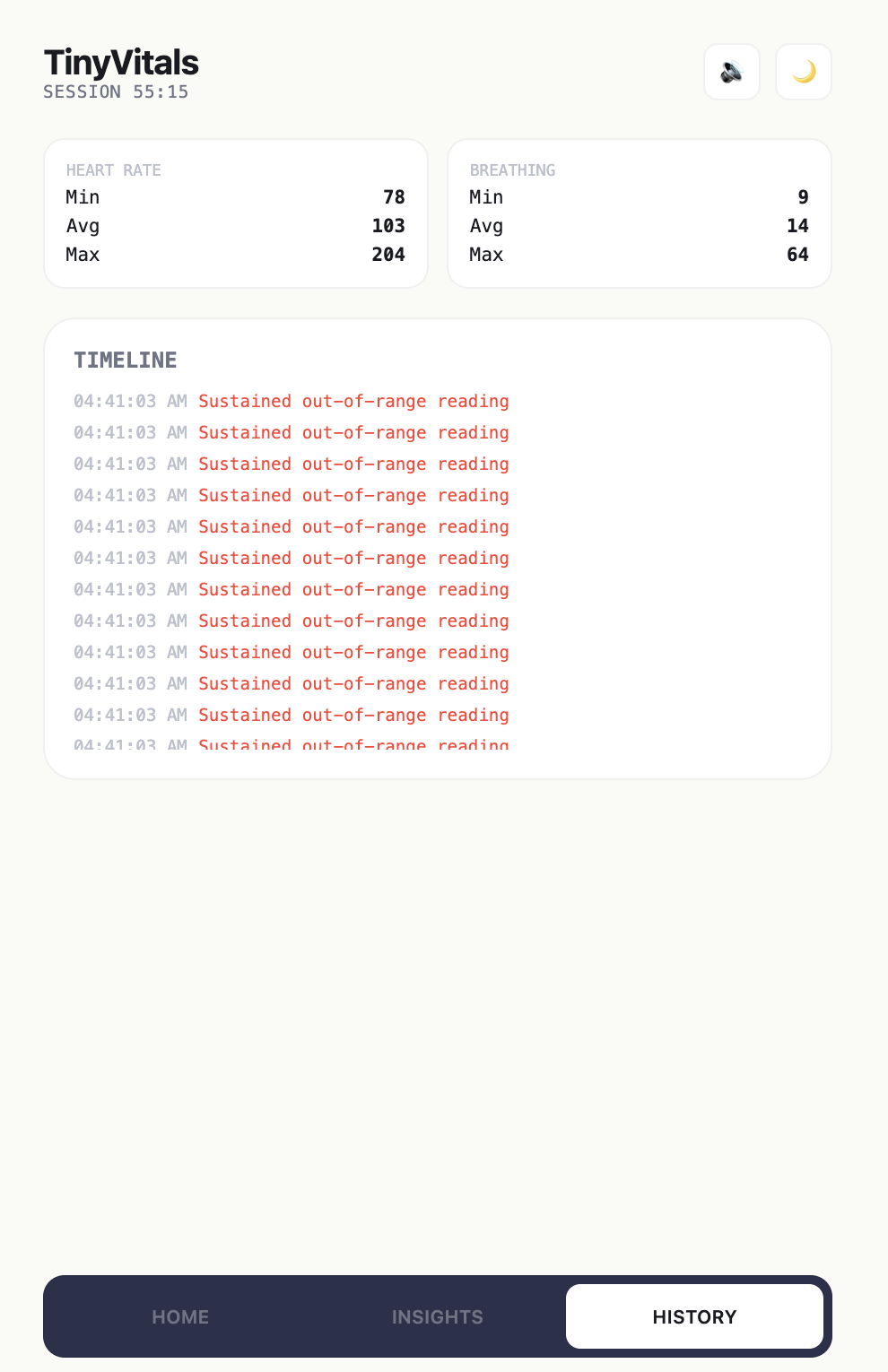
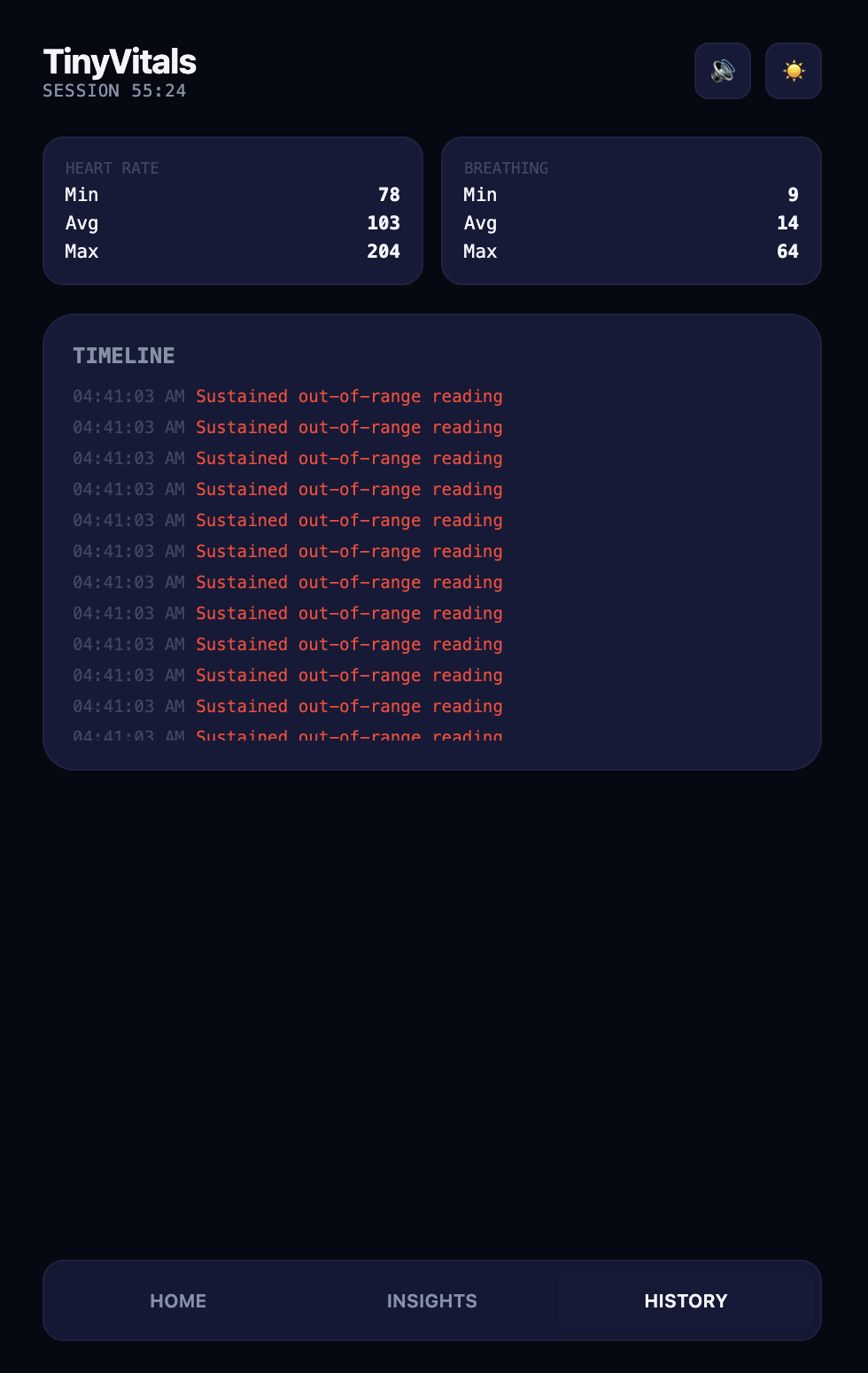
TinyVitals is an AI-assisted baby monitoring system that combines embedded hardware, computer vision, and AI to provide parents with a more complete picture of their baby's well-being while they sleep. Features include; contactless heart rate and breathing estimation using the Presage SmartSpectra SDK. Live nursery camera feed, AI-generated wellness summaries based on trends rather than isolated readings, sleep position monitoring using an IMU to detect back, side, or stomach sleeping. Furthermore, incline monitoring to identify potentially unsafe sleeping angles, session history and event timeline, real-time communication between a Raspberry Pi 5 running QNX and a responsive web dashboard. Instead of overwhelming parents with raw numbers, TinyVitals translates sensor data into simple updates such as "Baby has been resting calmly" while providing alerts if significant changes in sleep position or vital signs are detected.
How we built it
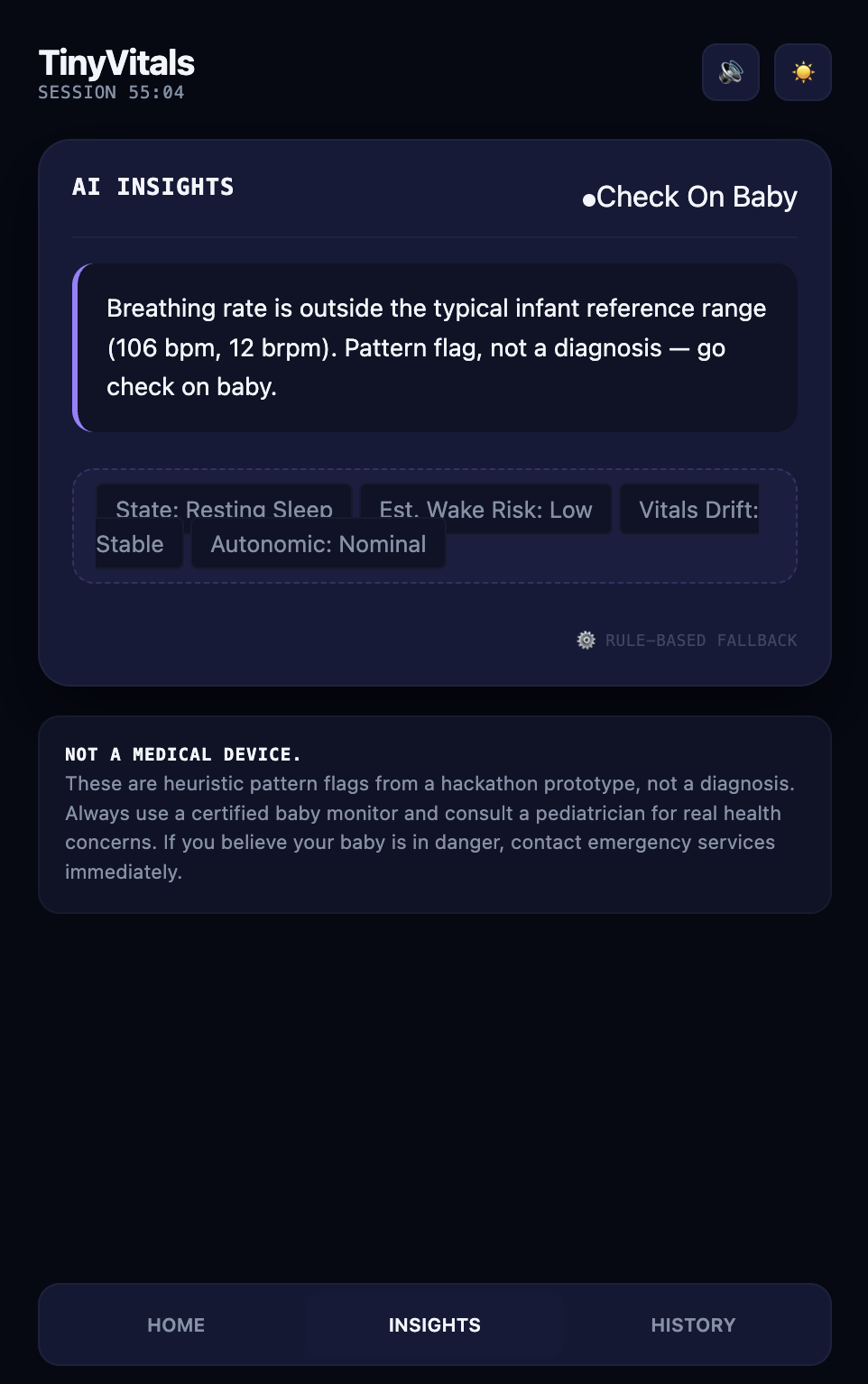
TinyVitals combines embedded systems, computer vision, AI, and modern web technologies into a single real-time monitoring platform.Our hardware consists of a Raspberry Pi 5 running QNX connected to an ABX000101 IMU sensor, which continuously measures pitch, roll, and yaw to determine the baby's sleeping position and mattress incline. A camera connected to the Raspberry Pi captures a live nursery feed. For contactless vital monitoring, we integrated the Presage SmartSpectra SDK, which analyzes the live video stream using remote photoplethysmography (rPPG) to estimate heart rate and breathing rate without requiring the baby to wear any sensors. The backend was developed in Python using Flask, Flask-SocketIO, and OpenCV. Sensor data from the QNX application is transmitted over UDP to the Python web server, while Socket.IO pushes live updates to the browser with minimal latency. Our frontend was built with HTML, CSS, and JavaScript, providing a mobile-first dashboard that displays live video, vital signs, AI wellness insights, sleep position, mattress incline, and historical trends in real time. Finally, Gemini is used to transform raw sensor measurements into natural-language wellness summaries, allowing parents to quickly understand how their baby is doing without interpreting graphs or numerical data themselves.
Challenges we ran into
One of our biggest challenges was integrating multiple hardware and software components into a reliable real-time system. On the hardware side, configuring communication between the Raspberry Pi 5 running QNX and the IMU required setting up additional serial interfaces, configuring UART communication, and ensuring reliable data transmission between the embedded application and the web server. Debugging communication issues across multiple devices consumed a significant portion of development time. Another challenge was synchronizing several real-time processes simultaneously. The system had to capture live camera frames, estimate contactless vital signs, receive orientation data from the embedded system, stream live video, update the dashboard through WebSockets, and generate AI summaries; all while maintaining low latency and a responsive user experience. We also spent considerable time designing a dashboard that communicated health information in a reassuring and understandable way. Rather than presenting parents with engineering metrics, we focused on clear status indicators, concise AI summaries, and meaningful alerts that could be understood at a glance.
Accomplishments that we're proud of
We're especially proud of successfully integrating embedded hardware, AI, and a modern web application into one cohesive system. Some of our favorite accomplishments include; Building a real-time dashboard that simultaneously displays live video, vital signs, sleep position, and AI insights. Integrating the Presage SmartSpectra SDK for contactless physiological monitoring. Detecting potentially unsafe sleep positions using IMU orientation data. Creating AI-generated wellness summaries that transform technical sensor readings into easy-to-understand updates for parents. Designing an interface that feels like a polished consumer application rather than an engineering prototype.
What we learned
This project gave us valuable experience building a complete embedded AI system from hardware to user interface. Throughout the project we learned how to: Develop applications on QNX for embedded systems, build real-time communication pipelines using UDP and Socket.IO, process live video with OpenCV, integrate computer vision with contactless physiological sensing, design interfaces for non-technical users in health-related applications, combine multiple sensor streams into a unified real-time dashboard. Perhaps our biggest takeaway was that AI should simplify information instead of adding complexity. Parents don't necessarily need dozens of sensor readings, they need clear, trustworthy insights that help them understand when their baby is sleeping safely.
What's next for TinyVitals
TinyVitals is currently a hackathon prototype, but we see significant opportunities for future development. Future improvements include:
- Integrating production-ready medical-grade physiological sensors for validation.
- Improving contactless vital-sign estimation accuracy.
- Mobile applications for iOS and Android.
- Push notifications for caregivers.
- Secure cloud synchronization for sleep history and long-term trends.
- Personalized baseline learning for each infant.
- AI models capable of recognizing longer-term sleep patterns.
- Environmental monitoring including temperature, humidity, air quality, and noise levels.
- End-to-end encrypted remote monitoring for privacy-conscious families. Our long-term vision is to create a privacy-focused smart nursery assistant that combines embedded intelligence and AI to give parents greater peace of mind while reducing the need to constantly monitor a video feed.


Log in or sign up for Devpost to join the conversation.