-
-
01-tinyslot-landing.png
-
02-adaptive-call-wave.png
-
03-evidence-matches.png
-
04-tour-approval.png
TinySlot: Verified Childcare Openings, by Phone
Inspiration
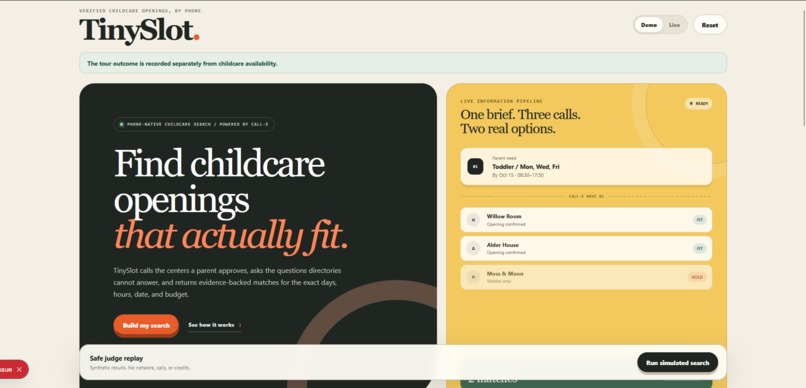
Finding childcare looks like a search problem, but it usually ends as hours of phone work.
Directories can show which childcare centers exist, but they rarely contain the information a parent actually needs: Is there a current opening for the right age group? Does it cover the required weekdays and working hours? What is the current tuition? Is a tour available?
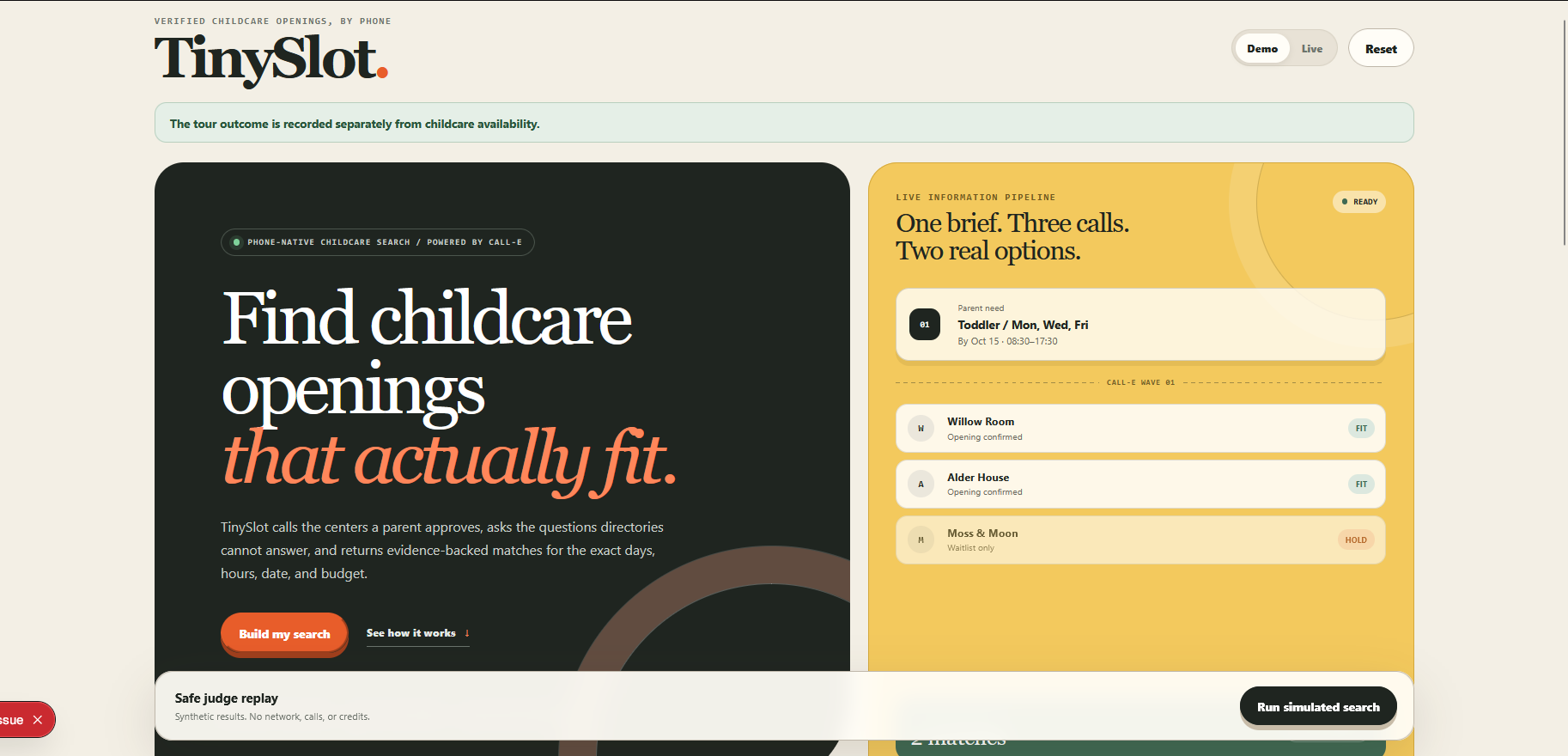
Parents repeatedly call centers, explain the same constraints, wait on hold, and manually compare incomplete answers. TinySlot turns that fragmented process into a bounded, evidence-backed phone workflow powered by CALL-E.
What TinySlot Does
TinySlot starts with a privacy-minimized childcare brief:
- Age band
- Desired start date
- Required weekdays
- Drop-off and pickup times
- Monthly budget
- Optional subsidy requirement
- Number of matches needed
The parent reviews the candidate centers before any call begins.
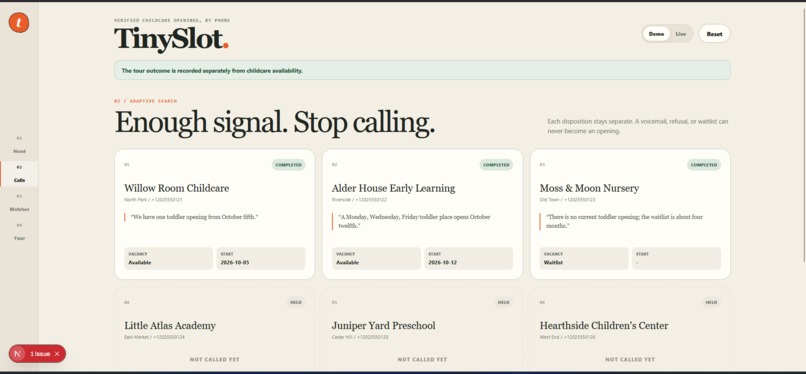
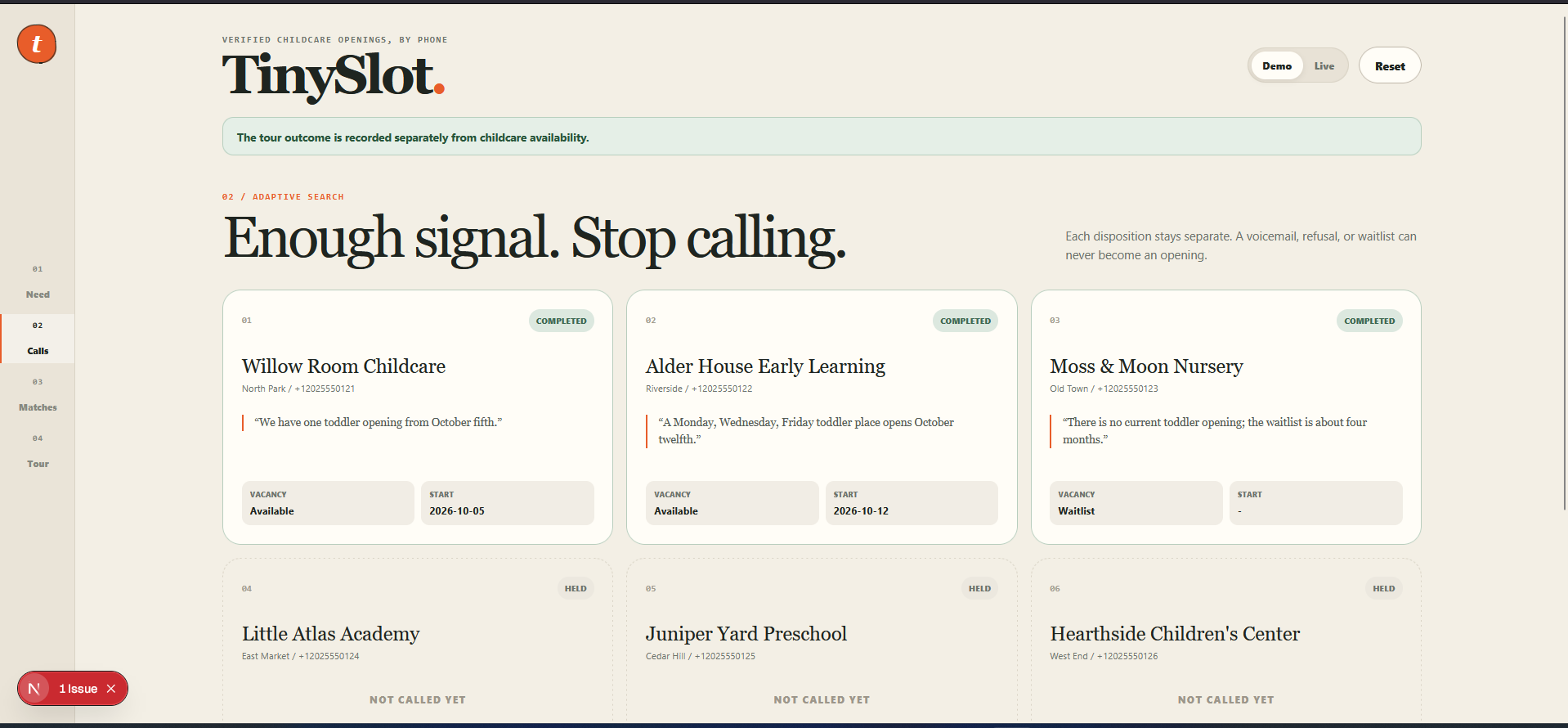
TinySlot then calls a maximum of three approved centers in one wave. CALL-E conducts the natural conversations and returns a strict structured result for every recipient, including:
- Business identity
- Age-band acceptance
- Current vacancy status
- Earliest start date
- Available weekdays
- Operating hours
- Monthly tuition
- Registration fee
- Subsidy acceptance
- Tour availability
- Evidence quotations
TinySlot does not blindly call the entire list. It evaluates each result and stops when the requested number of qualified matches has been found.
In the demonstration, two centers match the parent's requirements, one center has only a waitlist, and three unnecessary calls are avoided.
Evidence-Backed Matching
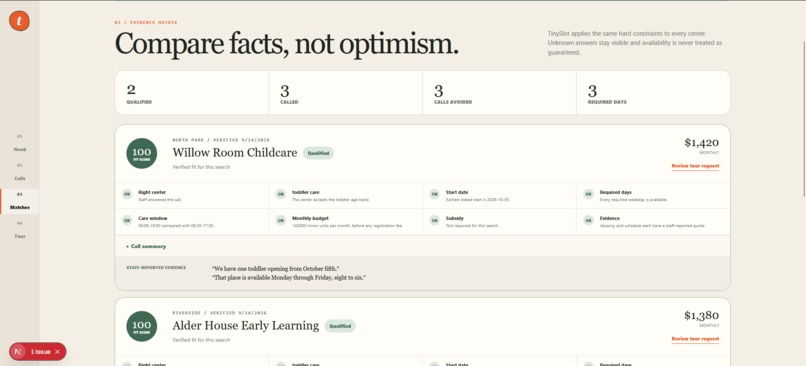
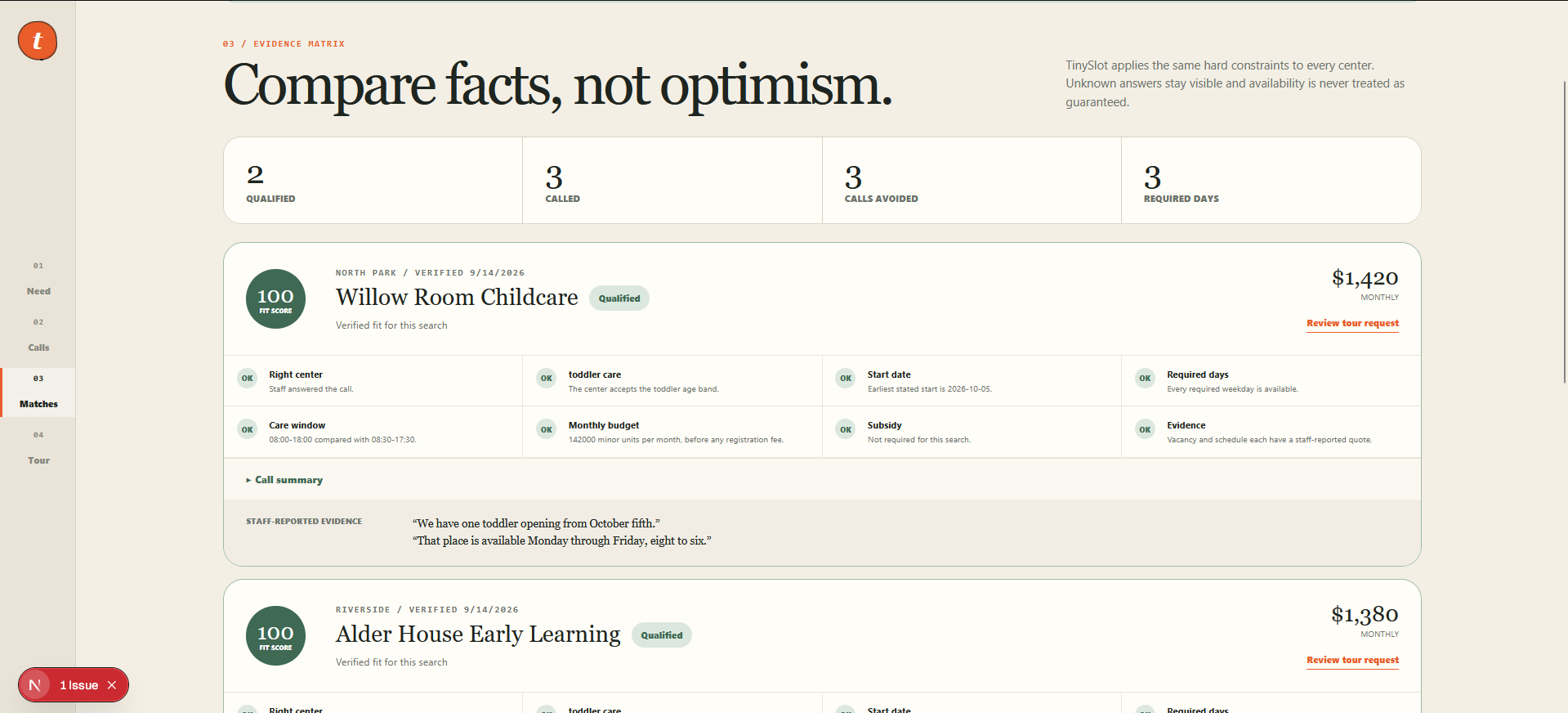
CALL-E handles the conversation, but an AI summary does not decide whether a center qualifies.
TinySlot uses deterministic application code to check:
- Whether the intended business answered
- Whether it serves the required age band
- Whether a real opening exists
- Whether the opening is available by the requested date
- Whether all required weekdays are available
- Whether operating hours cover the care window
- Whether the cost fits the stated budget
- Whether required evidence is present
A waitlist is never classified as an opening. Voicemail, refusal, wrong entity, and unknown answers remain separate outcomes. Missing hard evidence routes the result to human review instead of becoming a convenient guess.
Call Summaries and Conversation Reports
Each completed center result includes CALL-E's post-call summary, structured outcome, deterministic checks, transcript-turn count, and evidence.
The operator can export:
- Machine-readable JSON
- A privacy-masked conversation PDF
The PDF includes the care brief, call summaries, structured results, deterministic checks, available transcript turns, and evidence quotations. Phone-like values are masked before the document is rendered.
Human-Approved Tour Requests
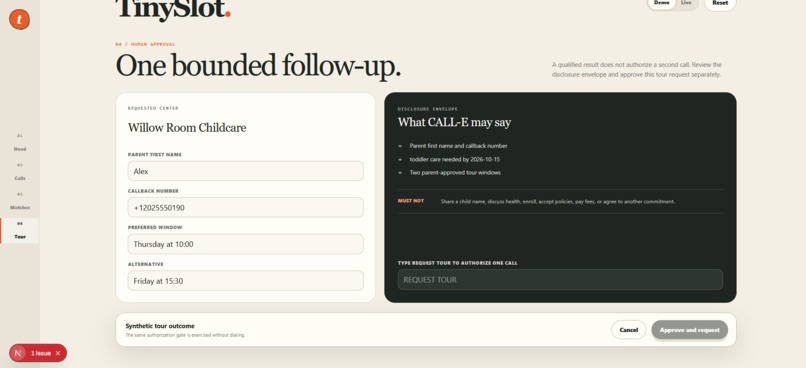
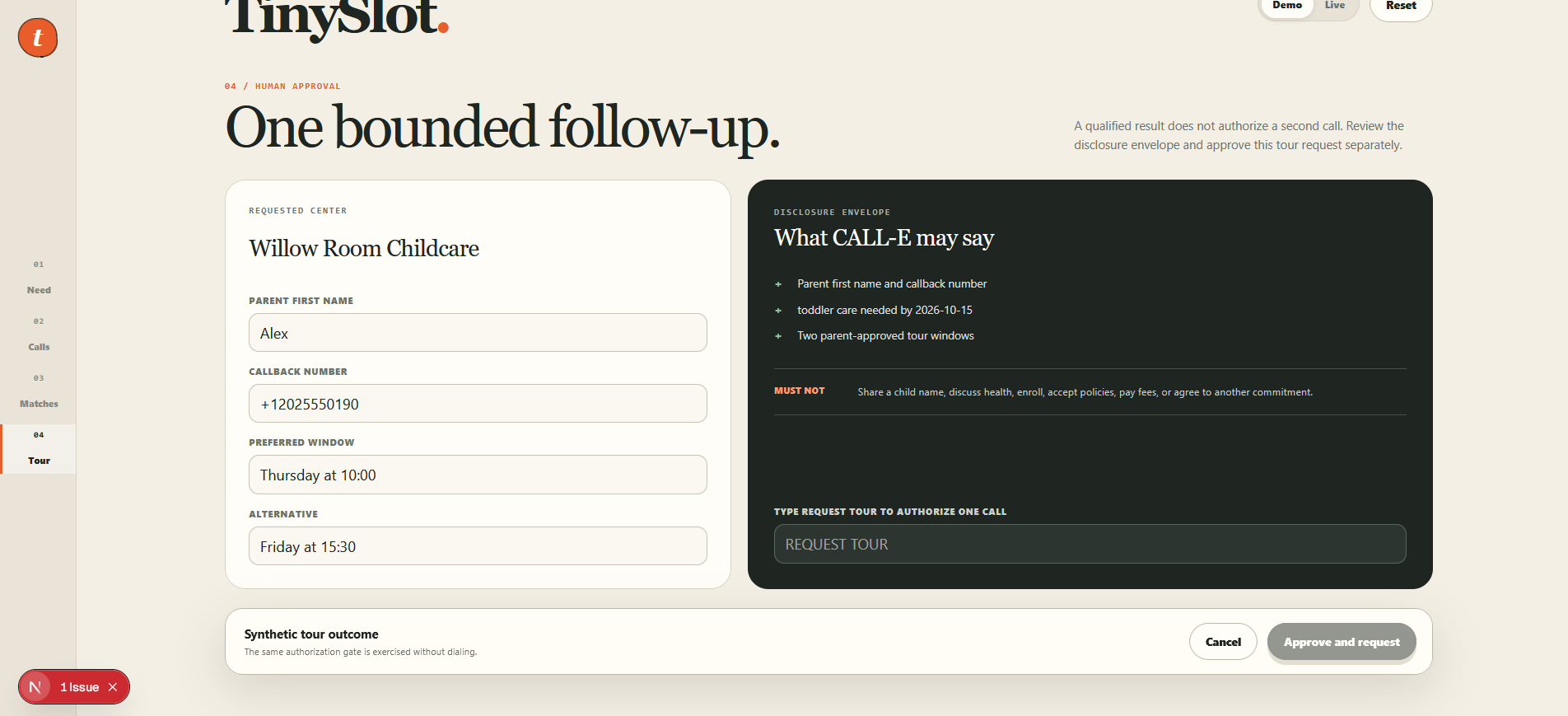
Finding an opening does not automatically authorize another call.
The parent must select a qualified center, review a separate disclosure envelope, and type REQUEST TOUR before TinySlot can place a follow-up call.
The tour call may use only:
- Parent's first name
- Callback number
- Care age band
- Requested start date
- Parent-approved tour windows
TinySlot cannot enroll a child, accept policies, make payments, agree to charges, or disclose the child's identity or medical information.
How We Built It
TinySlot is built with Next.js, React, TypeScript, and the CALL-E TypeScript SDK.
The server imports @call-e/calle and uses client.calls.create() and client.calls.get() at runtime.
The implementation includes:
- CALL-E batch recipients
- Strict per-recipient JSON Schema
- Separate tour-result schema
- Zod result validation
- Deterministic matching
- Adaptive wave stopping
- Stable idempotency keys
- HMAC recipient bindings
- E.164 phone validation
- Server-side destination allowlists
- Operator authentication
- Rate limiting
- Transcript and summary reconciliation
- Privacy-masked PDF generation
- Synthetic no-call mode by default
The public demo is a static, synthetic build that cannot place calls or expose credentials. Live calls run only through the protected Next.js server routes.
Real CALL-E Validation
TinySlot completed an authorized live CALL-E call.
The read-only validation returned:
- Status:
completed - Task completed:
true - Confidence:
high (0.86) - Structured result: schema-valid
- TinySlot checks: 8 passed, 0 failed, 0 unknown
- Transcript turns: 58
- Proof result:
PASS
The proof command retrieves the existing call through the CALL-E SDK without creating another call or printing the phone number or transcript.
Challenges
The hardest challenge was treating a phone call as a real-world side effect rather than a normal API request.
A client can lose connectivity after CALL-E has accepted a call. TinySlot therefore keeps stable operation identifiers, uses idempotency keys, preserves accepted call IDs, and never interprets a polling failure as proof that no call occurred.
Another challenge was preventing plausible AI output from becoming a false match. We separated CALL-E's conversational role from deterministic eligibility checks and made unknown a valid, visible outcome.
We also designed the public demonstration so judges can explore the complete experience without credentials, credits, or the ability to call real people.
Accomplishments
- Completed an authorized real CALL-E call
- Built a complete no-call public demonstration
- Added adaptive call waves that stop after enough matches
- Preserved voicemail, waitlist, refusal, wrong entity, and unknown outcomes
- Added deterministic constraint evaluation
- Added post-call summaries and transcript handling
- Added privacy-masked conversation PDF export
- Added a separate approval boundary for tour requests
- Added 18 focused tests
- Passed lint, TypeScript, production build, dependency audit, and repository validation
What We Learned
The most important voice-agent capability is not dialing. It is safely connecting a natural conversation to a controlled workflow.
Structured results, evidence, idempotency, durable call IDs, explicit uncertainty, and human approval make phone automation trustworthy and reusable.
We also learned that public demos should not expose live-call credentials. TinySlot separates the safe public experience from the protected live execution path.
What's Next
- Licensed childcare-directory integrations
- Parent-controlled freshness and recheck workflows
- Field-level transcript evidence
- Multilingual center enquiries
- Calendar integration for approved tours
- Employer and relocation-service childcare navigation
- Durable multi-user campaign storage
- Production-grade distributed rate limiting
TinySlot lets CALL-E handle the conversation while people keep control of who gets called, what counts as evidence, and what happens next.
Built With
- api
- call-e
- github
- jspdf
- nextjs
- node.js
- pages
- react
- rest
- schema
- typescript
- vite
- voice
- zod

Log in or sign up for Devpost to join the conversation.