Inspiration
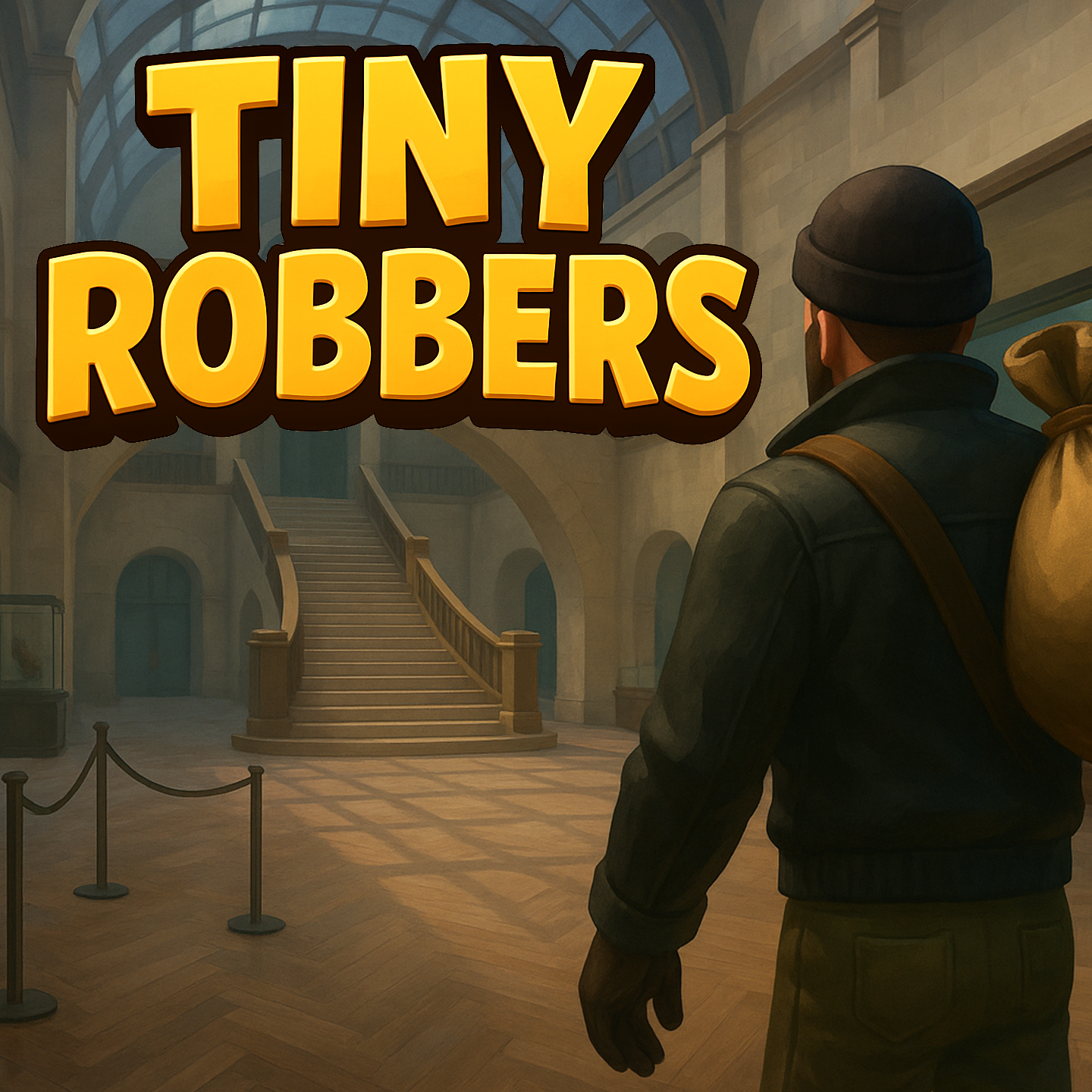
Tiny Robbers was inspired by the idea of creating a large, dynamic, mobile-friendly world centered around a multi-room museum filled with ancient artifacts.
We wanted to explore how Horizon could support complex systems such as NPC guards, rotating cameras, laser sensors, randomized environments, and fast minigames inside a single cohesive experience.
The project also included a lobby, a thieves’ house, a wardrobe area, class selection, and a miniature mode, showing how different gameplay layers can coexist in a mobile experience.
What it does
Tiny Robbers is a cooperative mobile experience where up to four players work together to recover ancient artifacts inside a dynamically generated museum.
The system includes:
- Selectable classes (Hacker, Demolition Expert, Engineer, Lockpicker), switchable at any moment.
- Fast modular minigames with dynamic configurations that change every run.
- Random walls, randomized object placement, and a fully random room-selection system for unique layouts.
- Cooperative logic: if a player fails a minigame, a teammate can retry immediately, unlocking progress for the whole group.
- NPC guards, rotating security cameras, and laser systems that block access to certain areas.
- A wardrobe with multiple outfits for character customization.
- Custom music per area, minigame sound effects, and VFX to enhance immersion.
- A miniature mode that allows players to shrink and explore the museum as tiny characters.
The result is a fast, reactive, replayable experience optimized for mobile devices.
How we built it
We built Tiny Robbers entirely in Horizon Worlds using advanced scripting, dynamic UI, modular systems, and optimized logic distribution.
A central controller manages:
- Random generation of rooms, walls, objects, and minigames.
- Sync logic for four-player cooperative interactions.
- Modular minigames built as independent components.
- Class-selection logic that updates interaction capabilities.
- NPC guard behavior through waypoint systems and dynamic detection.
- Camera and laser systems using triggers, raycasts, and conditional activation.
- A wardrobe UI system that handles outfit changes across all connected players.
- Dynamic audio and VFX systems for feedback and atmosphere.
We optimized the world for mobile by reducing collider complexity, minimizing draw calls, reusing assets, and distributing logic between local and shared scripts.
Challenges we ran into
One of the biggest challenges was ensuring that all random elements—rooms, walls, objects, and minigame layouts—remained stable and synchronized for four players.
We also initially planned to build all minigames using Noesis GUI to create fast, reactive, visually polished touch experiences.
However, after two full weeks of testing, the limitations became clear: we were only able to produce a clickable button, a background image, and minimal visual effects.
This forced us to abandon the Noesis-based approach and rebuild all minigames using traditional systems to ensure stability and performance on mobile devices.
Additional challenges included:
- Designing cooperative logic where a teammate can retry failed minigames.
- Balancing NPC guard behavior, security cameras, and laser systems.
- Wardrobe issues on mobile: UI buttons initially were not clickable, and outfit images still do not display due to a platform bug.
- Ensuring outfit logic worked flawlessly across all players despite visual limitations.
- Maintaining performance in a large environment, requiring heavy optimization and long development days (up to 10 hours).
Accomplishments that we're proud of
We successfully built a large, dynamic, randomized museum experience optimized for mobile gameplay.
We are proud of:
- A complete multi-room museum with random layouts and strong replayability.
- Full four-player cooperative gameplay with shared progression.
- Fast, modular minigames rebuilt without Noesis and fully stable.
- An advanced surveillance system with guards, cameras, and lasers.
- Instant class switching (Hacker, Demolition Expert, Engineer, Lockpicker).
- A functional wardrobe system with fully stable outfit logic across players.
- Dynamic music per area, minigame-specific sound effects, and VFX-enhanced interactions.
- A miniature mode that adds a unique visual and gameplay identity.
- A stable world refined through countless tests and iterations.
What we learned
We learned the importance of modular design when working with dynamic multi-room environments.
We discovered the practical limitations of Noesis on mobile and gained experience in evaluating feasibility early in development.
We improved our skills in four-player synchronization, cooperative logic, NPC systems, environmental randomization, audio design, and VFX optimization.
We also learned how to manage player scaling and collision behavior through the miniature mode.
Overall, we learned how to adapt quickly, iterate efficiently, and turn setbacks into stable solutions.
What's next for Tiny Robbers
Future development will focus on expanding the experience with:
- New museum rooms and themes.
- Entirely new museums with unique security systems.
- More complex cooperative minigames.
- Additional player classes with special interactions.
- Procedural missions and new collectible systems.
- Expanded UI using Noesis for HUD and menus.
- Improved NPC behavior and more advanced AI patterns.
- More VFX, more audio layers, and a deeper miniature mode.
Our goal is to make Tiny Robbers a richer, more varied, and even more replayable cooperative adventure.
Built With
- architecture
- audio
- components
- design
- dynamic
- generation
- horizon
- logic
- minigame
- mobile
- modular
- music)
- noesis
- npc
- optimization
- patrol
- procedural/random
- raycasting
- scripting
- sfx
- trigger
- vfx
- worlds


Log in or sign up for Devpost to join the conversation.