Inspiration
Google’s Vertex AI allows for an efficient method of building and deploying chatbots, which we thought would have the best application in E-commerce.
Tints Streetwear is an international designer brand started by a team of high schoolers in order to help women in Bangladesh and India to receive vocational and educational training. Each Tints garment is embroidered in Bangladesh and then handmade in Sen’s hometown of Kolkata. In addition to being socially conscious, the clothing is organic, eco-friendly, and biodegradable. Tints, which won seed funding from Taco Bell and Disney Dreamers, is currently carried in eight high-end boutiques across Portland, LA, NYC, Seattle, and San Francisco. Our team reached out to Simmi has she was struggling with optimizing her customer service and lead generation from her website. We wanted to create a solution that could have a a real world impact to support fellow high schoolers.
We decided to implement many features in this Ecommerce chatbot including multiple integrations, such as a phone call to the chatbot number, as well as on different platforms, such as slack.
What it does
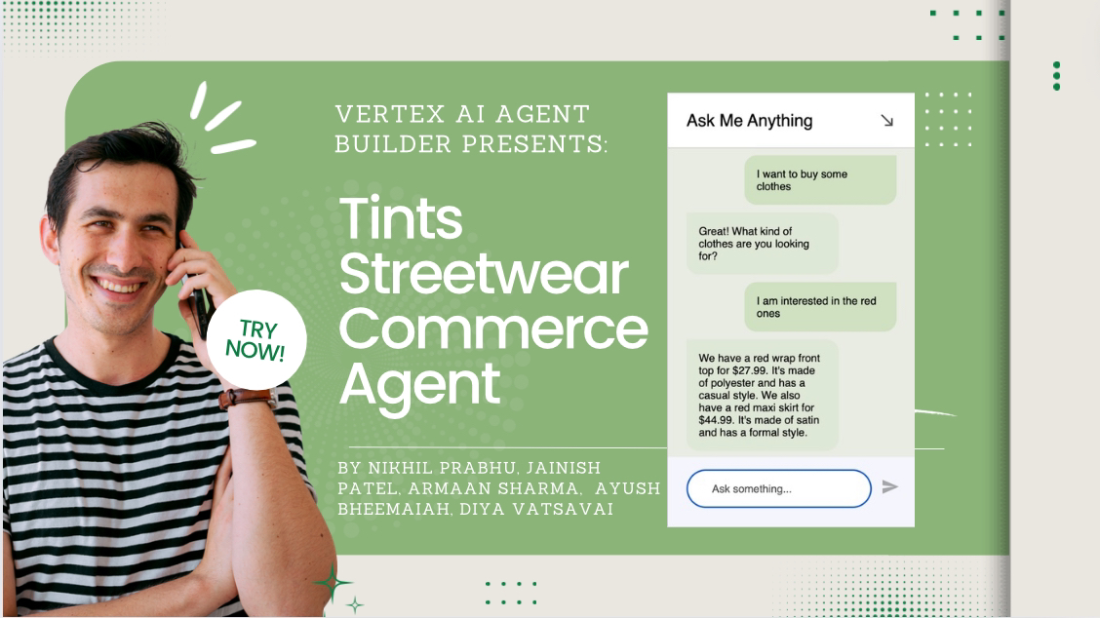
The agent allows the user to efficiently search for specific products they are looking for rather than trying to navigate the website, which may be time taking. They are able to see exactly what type of products are available and important characteristics of the product, such as price, just by asking. This unique implementation of the chatbot allows the user to look for specific products they want to buy. Additionally, when the chatbot recognizes that the user is interested in a certain product, it immediately asks for their email and name in order to send them further information about a certain product and improve the business for the company as well. The chatbot can also answer customer service inquiries regarding shipping, logistics, and more.
How we built it
We started off by using Google's Vertex AI Agent builder in order to build an app, that is global, which has specific trained agents that the app can redirect the user to in order for smooth running. For example, when building the knowledge base agent, we partnered with a company in order to get access to real time product information that the chatbot can then use to communicate with the user. The chatbot uses this knowledge base to help the user find different products, and potentially get more business for the company. For extra features such as phone integration, we used Diagflow CX’s phone gateway, which worked since our agent was global, and allowed for the chatbot to have a phone number that the user can call. Additionally, we were able to use a new email intent for the chatbot to pick up whenever the user enters their email and store it in a database for further usage.
Challenges we ran into
Some challenges we ran into were implementing the chatbot onto the company’s actual shopify page, since it was difficult to get the script tag for the chatbot and get access to the codebase for the website. However, we resolved this by looking into a couple documents in order to figure out how shopify integrates chatbots onto their websites. Additionally, another issue we encountered was adding the phone gateway, since our agent was not global at first. We resolved this by creating a new global agent and copying all the instructions over, along with the actual product information.
Accomplishments that we're proud of
Some accomplishments we are proud of is connecting the email intent and picking up on emails, since it was difficult at first to learn how webflow and fulfillment worked. Additionally, we are proud of being able to deploy the chatbot onto an actual company website, so we can actually benefit a real company and aid actual customers in buying products to prove how useful the chatbot can be in real world scenarios.
What we learned
We learned that we could make a customer service tool to help a small business even with minimal coding through Vertex AI’s tools. In addition, we were able to add many functionalities within our chatbot that we didn’t even think possible, like phone/Slack integration. We were able to learn how to integrate knowledge bases through datastores, and using webflow and fulfillment in order to connect databases to the chatbot as well for the optimal customer and store owner experience. Finally, through this project, we were able to develop our collaboration and teamwork skills while working remotely with team members all over the country, all while exploring the exciting potential of the Agent Builder to boost business performance and productivity greatly in the e-commerce industry.


Log in or sign up for Devpost to join the conversation.