-
-
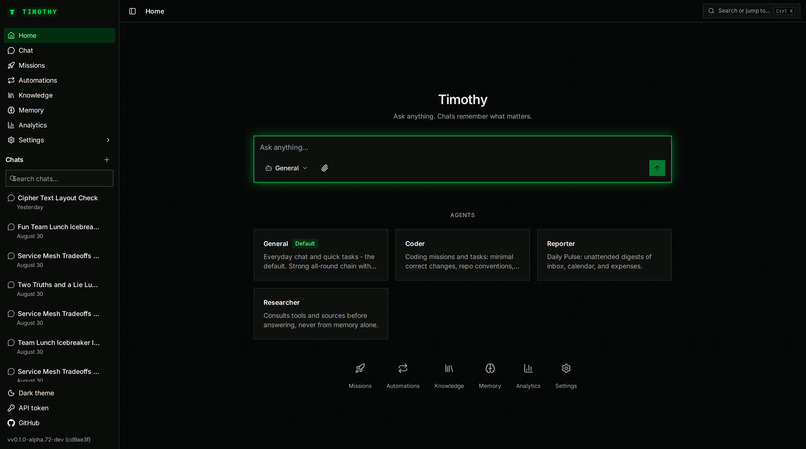
Timothy: Self-Hosted Personal AI Control Plane powered by Nebius Token Factory & NVIDIA Nemotron
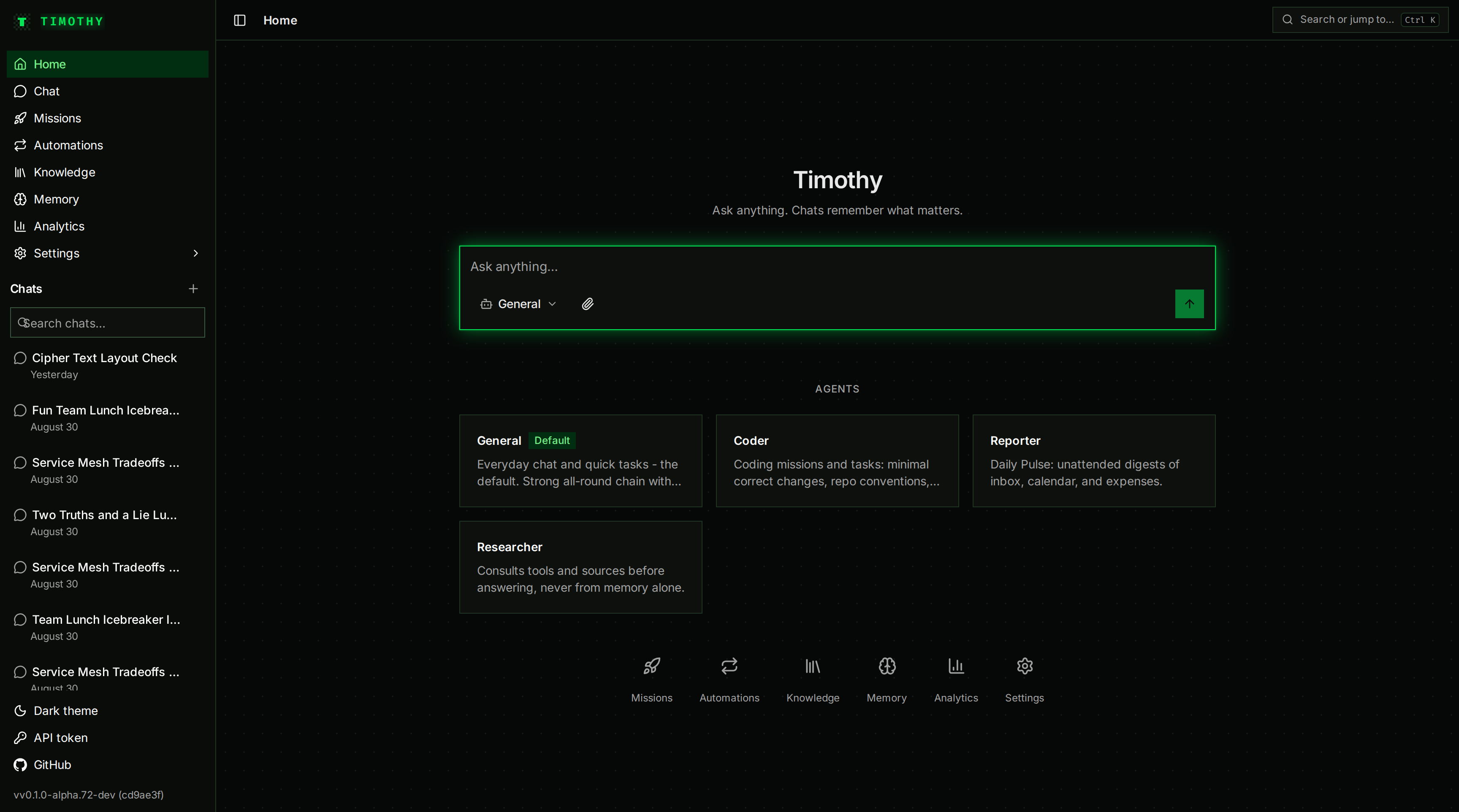
A personal AI workforce you can run yourself
Most personal AI tools force a difficult choice. You either send private emails, documents, code, and memories to a closed SaaS product, or build local scripts that lose context and cannot check their own work.
Timothy is an open-source, self-hosted control plane for a personal AI workforce. It runs on infrastructure you control. It combines persistent memory, personal tools, and a mission harness that checks the result before reporting success.
Timothy uses open-weight NVIDIA Nemotron models through Nebius Token Factory. You can use it for interactive chat, web research, coding tasks, scheduled briefings, and longer missions that need several steps.
What Timothy does
Give it real work
Timothy can write a cited research report and export it as a PDF. It can clone a Git repository into an isolated container or Kubernetes pod, then fix a failing test.
You give it a goal. Timothy discovers the context, plans the work, builds the result, and proves that the expected outcome exists before reporting back.
Use the right model for each task
Different tasks need different levels of reasoning. Timothy routes each system role to the most suitable NVIDIA Nemotron model on Nebius Token Factory:
| Role | Workload | Model | Active / total parameters |
|---|---|---|---|
decide |
Selects mission kind, light or full mode, and chat route | nvidia/NVIDIA-Nemotron-3-Nano-30B-A3B |
3B / 30B |
summarize |
Extracts memory facts, classifies Knowledge Base collections, and compacts sessions | nvidia/NVIDIA-Nemotron-3-Nano-30B-A3B |
3B / 30B |
default |
Handles interactive chat, web research, and tool calls | nvidia/nemotron-3-super-120b-a12b |
12B / 120B |
coding |
Plans, builds, and verifies multi-phase coding and research missions | nvidia/Nemotron-3-Ultra-550b-a55b |
55B / 550B |
This keeps routine background work fast and affordable while giving complex missions more reasoning depth.
Keep memory and documents under your control
Timothy stores facts, preferences, and recurring insights in PostgreSQL 18 with pgvector. It uses Reciprocal Rank Fusion (RRF) to combine vector similarity with full-text search.
You can add PDFs, images, audio, and URLs to the Knowledge Base. Timothy transcribes, captions, classifies, and cites the content.
Automate briefings and deliver the result
Timothy can run scheduled briefings using your inbox, calendar, and spending data. It can deliver results and attached artefacts to Telegram, email, webhooks, or GitHub pull requests.
It also tracks token costs for each turn, mission, and role. You can set budget limits and configure an ordered provider failover list.
How verification works
Models can claim that tests passed or files exist when they do not. Timothy does not accept that claim as proof.
Its Go mission harness runs CheckArtifacts and executes check_cmd inside the sandbox. A mission can move to done only after the harness verifies the expected result.
The mission state machine is:
discover → plan → build → prove
The harness owns the final success decision. This keeps the model useful without making it the only judge of its own work.
Built with Nebius and NVIDIA
Timothy uses a modular Go 1.26 backend behind one public API. The web interface uses React 19, TypeScript 7, and Tailwind v4. PostgreSQL 18 with pgvector stores sessions, memory, and retrieval data.
- gateway: An OpenAI-compatible adapter for Nebius Token Factory. It discovers models, matches catalogue prices, routes by role, and records costs.
- brain: The event-sourced session log, tool loop, web search, OAuth and stdio-to-HTTP MCP bridge, personal connectors, and mission state machine.
- memoryd: Source-aware fact extraction, audit history, and hybrid retrieval.
- sandboxd: Isolated Docker containers and rootless Kubernetes pods. Sandboxes use a read-only root filesystem, dropped capabilities, and UID 65534.
- Document, search, and voice sidecars: markitdown, pdfgen, Tesseract OCR, Whisper, SearXNG, and the Tavily Search API.
What we built during the hackathon
Timothy is an actively developed open-source project. More than 60% of its repository history was built and shipped during the hackathon period: over 515 of 840+ commits, from 26 August to 30 October 2026.
The main work included:
- Nebius Token Factory and NVIDIA Nemotron integration, including the provider preset, model discovery, connection probing, and LiteLLM catalogue price matching.
- Typed mission and chat routing through the low-latency
deciderole. - Native Tavily web search for grounded research and citation verification.
- Autonomous missions with the discover → plan → build → prove state machine, light missions, follow-up missions, sentinel end-turn execution, and harness-owned verification.
- Kubernetes and Docker sandboxes, a shared mise toolchain cache, a Helm chart, and MCP bridge service containers.
- Knowledge Base collections, Typst PDF generation, first-run onboarding, and token and cost analytics.
Why this matters
A personal assistant should remember your context without taking ownership of your data. It should use the tools you already depend on. For longer work, it should show that the result exists instead of simply saying that it is finished.
Timothy brings these parts together in a self-hosted system. It gives developers, researchers, and other users a way to run a personal AI workforce while keeping the infrastructure and data under their control.
What we are proud of
Timothy includes a 60-second curl | sh installer, guided Nebius Token Factory onboarding, autonomous Git branch coding missions, and Telegram briefings. Its core footprint is about 300–500 MiB.
It keeps user data under the user's control while using cloud-scale NVIDIA Nemotron mixture-of-experts models through Nebius Token Factory.
What we learned
Sparse Mixture-of-Experts (MoE) models such as NVIDIA Nemotron-3 Nano and Super work well for agent loops. Their active parameter count keeps inference efficient. Tool-call latency often matters more than raw model size in the user experience.
What's next
- Edge and physical AI connectors for home automation and local camera and sensor data.
- Local-to-cloud tiering on Jetson Orin Nano.
- Federated workflows across trusted Timothy instances.
- Deeper integration with Nebius Serverless Jobs for asynchronous batch evaluations.
Built With
- docker
- go
- kubernetes
- mcp
- nebius
- nvidia-nemotron
- pgvector
- postgresql
- react
- tailwind-css
- tavily
- typescript
- typst

Log in or sign up for Devpost to join the conversation.