-
-
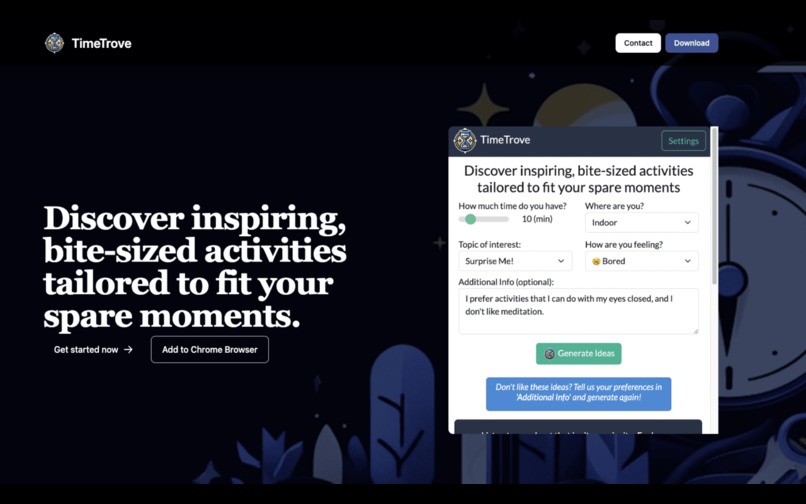
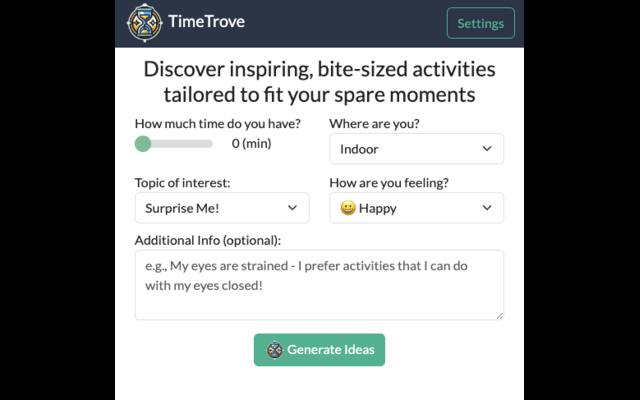
TimeTrove homepage
-
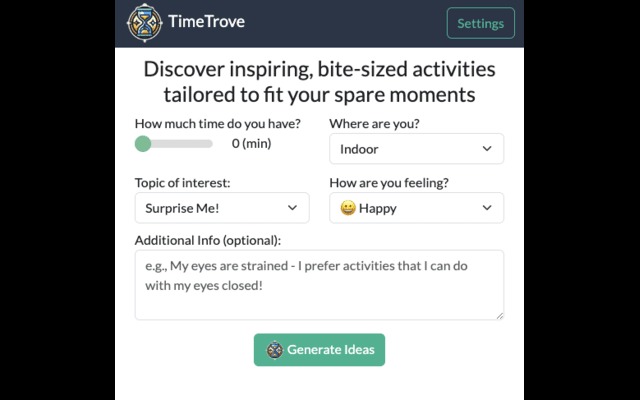
TimeTrove Demo
-
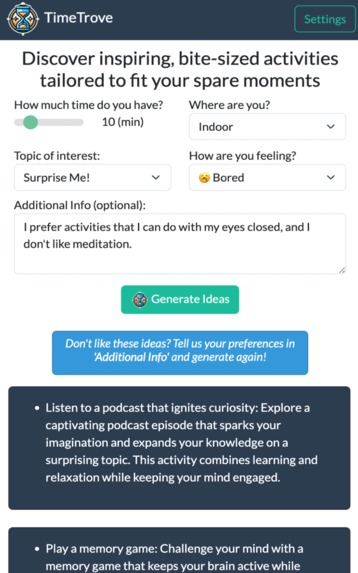
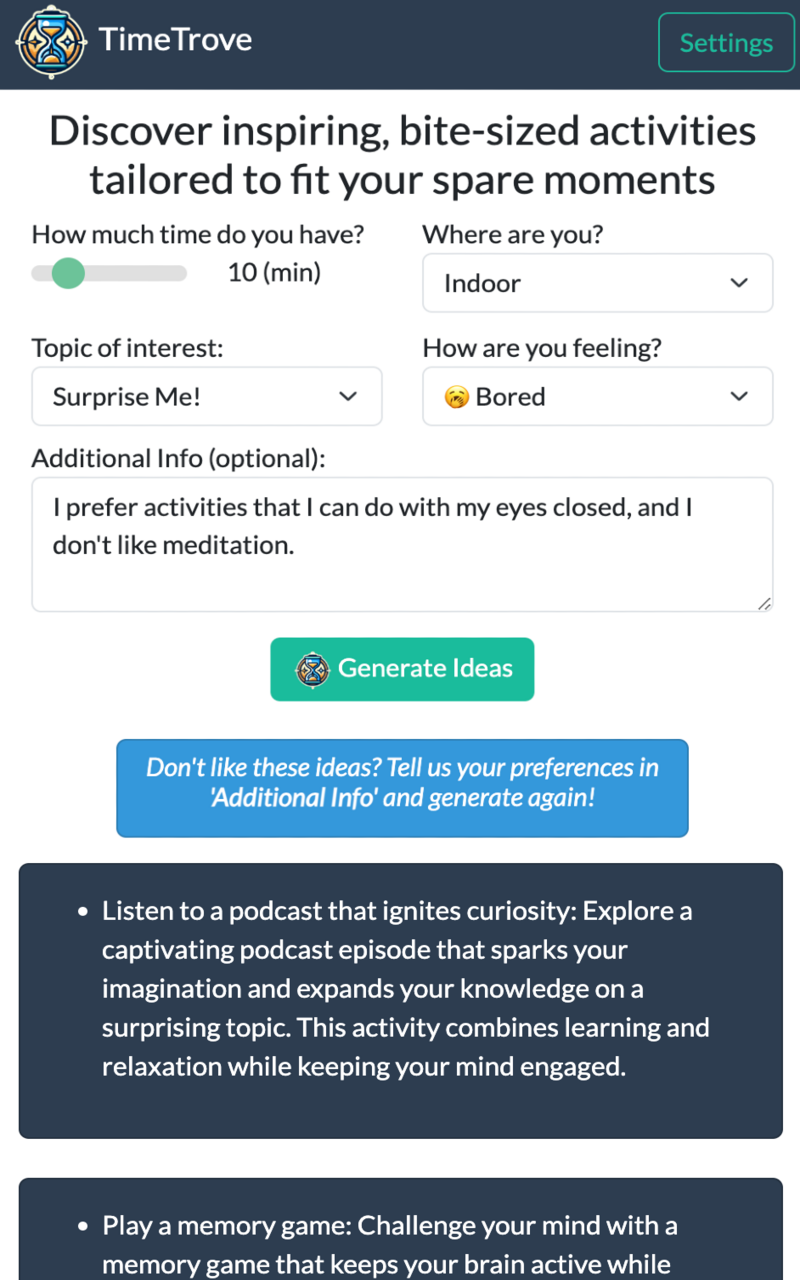
TimeTrove Demo - with responses
Inspiration
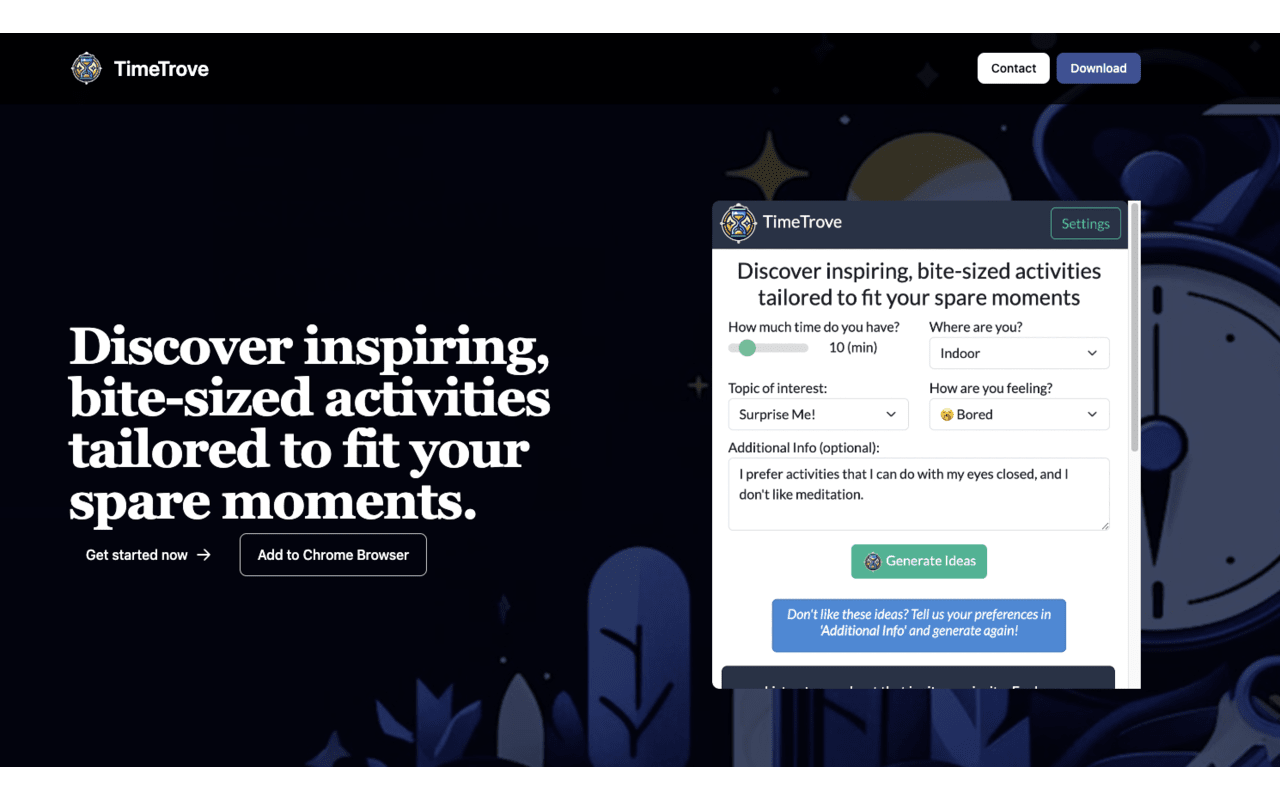
The inspiration for TimeTrove came from observing the modern struggle with time management, particularly the way small pockets of time are often wasted on mindless activities like scrolling through social media. The realization that these moments, though brief, could be transformed into opportunities for personal growth and joy sparked the concept of TimeTrove. It's about harnessing the power of GenAI technology to make every minute count towards enhancing one's knowledge, skills, and well-being.
What it does
TimeTrove is a Chrome extension that helps users turn short breaks into chances to learn and enjoy something new. Whether you have five minutes or fifteen, TimeTrove suggests quick, personalized activities like learning a language, meditating, or exploring a new topic. It’s about making the most of your time, easily and enjoyably.
How we built it
We used Gemini to guide the prompt writing phase. To start, we shared the idea and the goals we were trying to achieve with TimeTrove, and asked TimeTrove to write an appropriate prompt for achieving this. The main prompt was embedded within the API call to Gemini and used as a basis for generating ideas. We then tried to refine the prompt by augmenting it with user inputs that describe the user’s current situation, such as available time, location, mood, and topic of interest. This info was added to the system prompt during API call to personalize the ideas. We also started with the conceptualization of the app on a low-code web-dev platform (Bubble.io) to visualize the UI.
We then developed the Chrome extension with web development languages - HTML/CSS and Javascript. Neither of us is a full-stack engineer, so we leveraged online resources including the tutorials and code examples from Chrome for Developers guide (https://developer.chrome.com/docs/extensions) and Gemini for increasing efficiency in coding. We also utilized CSS libraries such as Bootrstrap and Tailwind to style the app and homepage. We then used Gemini API guide to include API calls into the app.
Challenges we ran into
One major challenge we ran into was to further improve user experience by citing sources for generated ideas. This is because currently the app only generates text-based descriptions of an idea; if the user would like to actually do what is being suggested, they will still have to look for the contents online. As TimeTrove is designed to be used in fragmented idle time, it is important to provide direct resources that users can use to execute a suggested idea. This can be achieved in many ways: one most straightforward way could be to add a module (after idea generation) that includes API calls to search sites / YouTube and append the most relevant result back with each generated idea. However, this is limiting as it requires different API calls across different sites and filtering of the most useful resource (if we want to append content search beyond YouTube videos). In addition, if the generated idea includes watching a podcast/book, then the recommendation must include true book titles and links. We are currently looking into additional resources and ideas (different RAG frameworks and/or search APIs) to achieve this feature in the future.
Accomplishments that we're proud of
- We developed the app (and its homepage) within 2 weeks during our free time! With limited experience with web development, we first were thinking of using Bubble.io and considering the low-code development route. But we wanted to challenge ourselves and utilize the resources around us (the diverse AI tools) to learn a new skill and realize an idea.
- We utilized different AI tools (from Gemini to ElevenLabs' AI voice) to create the app and the promotion video. It was a fun aspect of the hackathon :)
- We let our friends play with the app to gather their feedback. Many were interested in the ideas, and gave us valuable feedback. It allowed us to consolidate the next steps for enhancing user experience, prioritizing content linking to ideas as a step.
What we learned
- Chrome extension apps are convenient ways to prototype an idea. It could be developed simply with standard web-dev frameworks.
- Current AI tools are very useful resources for learning to code (especially if you have had experience with other languages and you’re just less familiar with another framework). They should be better utilized.
- It is important to build an initial version of the prototype fast, and then iterate upon it. From having the initial prototype, we were able to distribute it to friends and gather valuable feedback to prioritize planned features.
What's next for TimeTrove
Looking ahead, we're excited to further refine TimeTrove’s capabilities. We plan to augment the suggested ideas with sources and content, such as linking YouTube tutorial videos and GoodReads book suggestion links. We can also integrate with Google services such as Google Maps and Calendar to suggest even more personalized ideas. Furthermore, we can introduce data analytics to provide insights into how users spend their time. Gamification will make engagement fun, rewarding users with badges for milestones reached. We’re also enhancing community features, allowing users to share how they maximize their time, turning every moment into an opportunity for growth and connection.
Built With
- bootstrap
- css
- gemini-1.0-pro
- html
- javascript
- tailwind-css


Log in or sign up for Devpost to join the conversation.