-
preview
Inspiration
We were inspired by the Black Mirror episode featuring the "Brain" implant, where people could record and replay their memories. The idea of preserving life’s most important moments—and being able to relive them at will—felt both intriguing and profoundly human. We wanted to bring that concept to life in a wearable device, making it accessible to anyone who wants to capture and rediscover their memories.
What it does
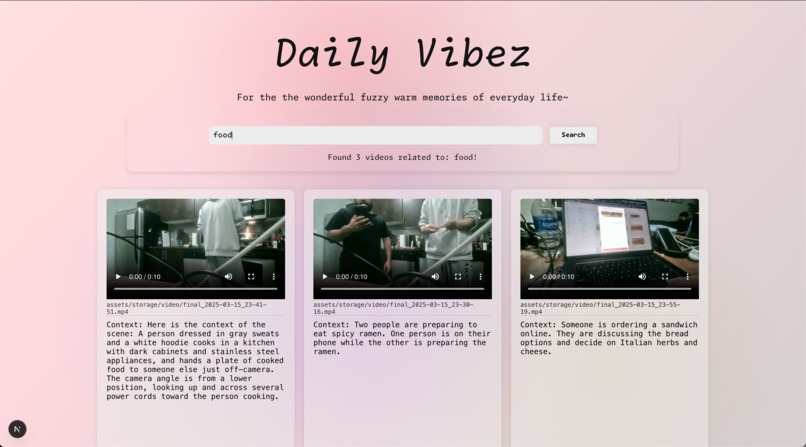
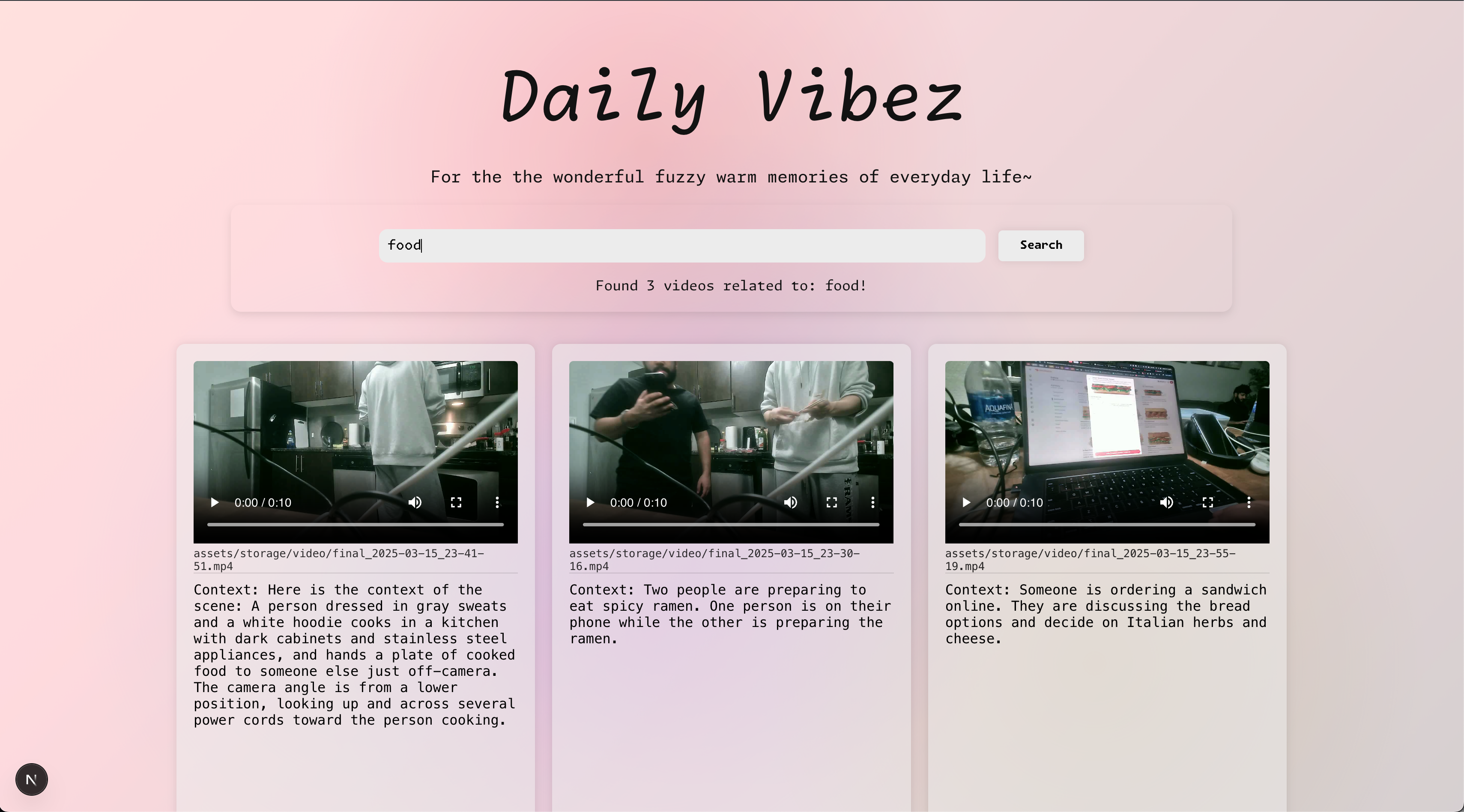
Daily Vibez is a wearable device that records your day in real-time, capturing moments through a camera and microphone. It organizes and sorts these memories using AI, allowing users to easily search, relive, and rediscover meaningful moments from their lives whenever they want. By combining continuous recording with intelligent contextualization, Daily Vibez makes searching for specific memories seamless and intuitive.
How we built it
We built Daily Vibez using QNX 8.0, a powerful real-time operating system, along with a Raspberry Pi, camera, microphone, and battery. We integrated Gemini AI to contextualize the videos and handle search queries. To ensure smooth performance on the Raspberry Pi, we developed a custom caching algorithm that greatly enhances speed and efficiency.
Here's how it works:
As soon as a video finishes recording (while the next one is being captured), Gemini processes and contextualizes it immediately. We store this contextual data locally in a cache, making it readily available for future searches. When a user initiates a search, Daily Vibez quickly filters the cached contextualizations to narrow down potential matches. Then, we make a smaller, highly targeted Gemini call to ensure accurate and efficient results. This hybrid approach allows us to balance performance and accuracy while maintaining real-time responsiveness on resource-constrained hardware.
Challenges we ran into
One of our biggest challenges was optimizing performance on embedded devices, particularly meeting strict timing requirements. Ensuring smooth memory capture and AI processing in real time was crucial. We had to balance the Raspberry Pi’s hardware limitations with the need for high-speed AI-driven performance. QNX 8.0’s real-time capabilities were instrumental in achieving this balance. Additionally, designing and fine-tuning our caching algorithm was key to making Gemini’s contextualization viable on such a lightweight device.
Accomplishments that we’re proud of
We’re proud of creating a functional, wearable prototype that can seamlessly record and process memories in real time. Overcoming the technical challenges of working with embedded systems and real-time processing was a huge accomplishment. Our caching system and efficient AI integration demonstrate that this kind of technology is feasible even on small, low-power devices.
What we learned
We gained deep experience working with embedded systems and real-time operating systems like QNX 8.0. Timing and performance optimization were critical, and we learned how to balance hardware and software to ensure flawless operation. Developing the caching algorithm taught us how to leverage AI more efficiently, especially when working within the constraints of limited computing resources.
What’s next for Daily Vibez
Next, we plan to improve the device’s usability by refining the memory-sorting AI and enhancing battery life. We’re also exploring more intuitive user interactions, so people can effortlessly capture and relive their most precious memories. Additionally, we’re looking into ways to make our caching and AI pipeline even more efficient, potentially expanding to other hardware platforms in the future.


Log in or sign up for Devpost to join the conversation.