-
-
-
-
Analytics
TimeLeak - Measure Your Real Focus
Inspiration
Most days feel productive because we are busy for hours. We sit in front of our laptops all day, switching between tasks, tabs, and thoughts - and assume that means we worked the whole day.
In reality, that isn’t true.
I noticed that even on long study or work days, my actual deep focus happened in short, broken stretches. Large parts of the day were spent distracted, context-switching, or mentally disengaged - yet the day still felt “productive” because time passed.
There was no simple way to see this gap between perceived productivity and actual focused work. No clear signal showing how much of the day was real, uninterrupted focus and how much quietly leaked away.
TimeLeak was built to make this invisible pattern visible.le.
What the project does
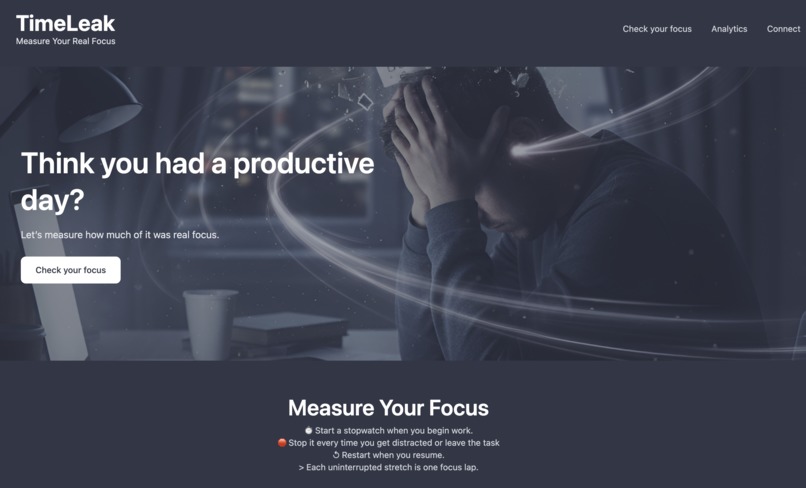
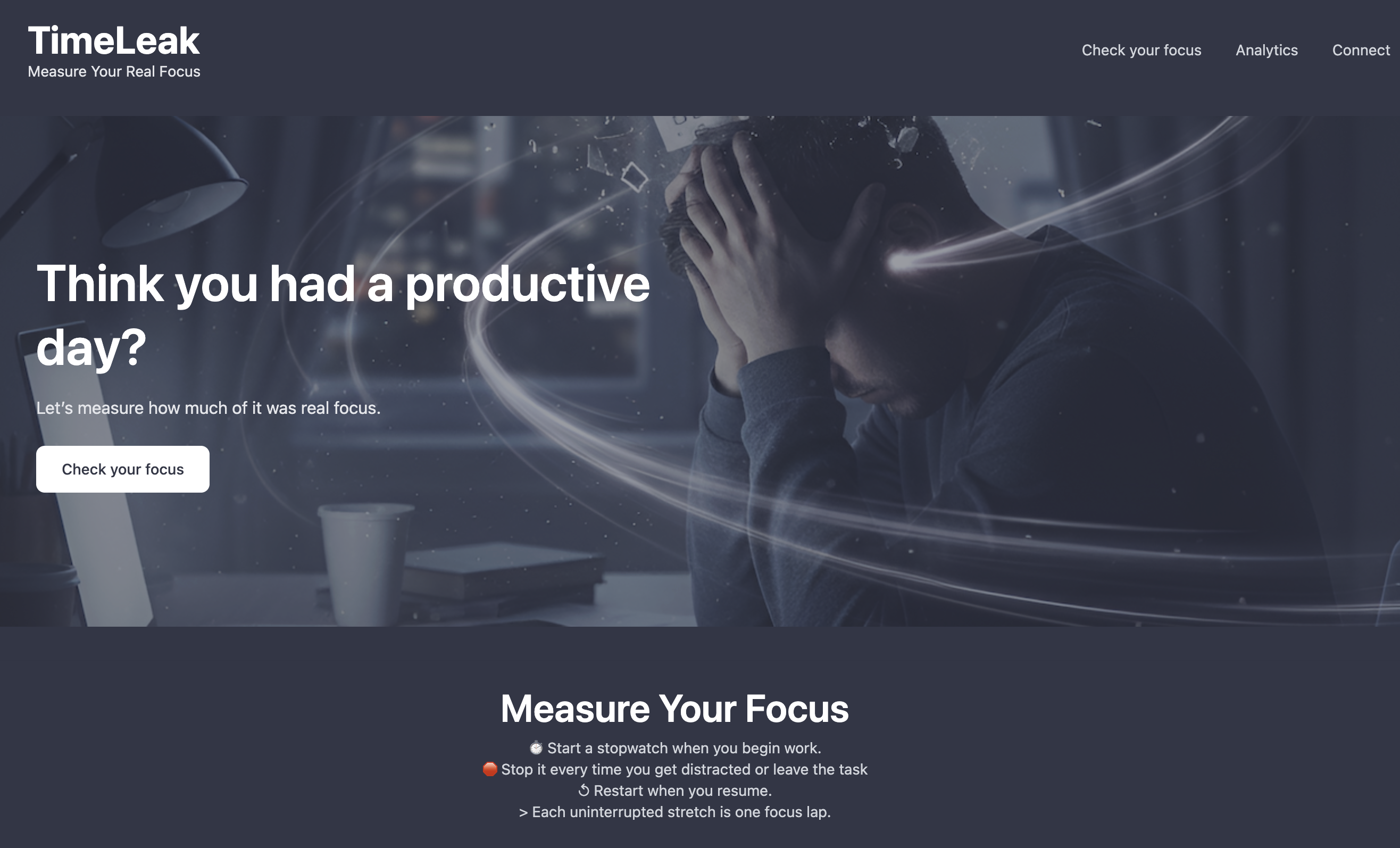
TimeLeak measures real focus, not total time spent staring at work.
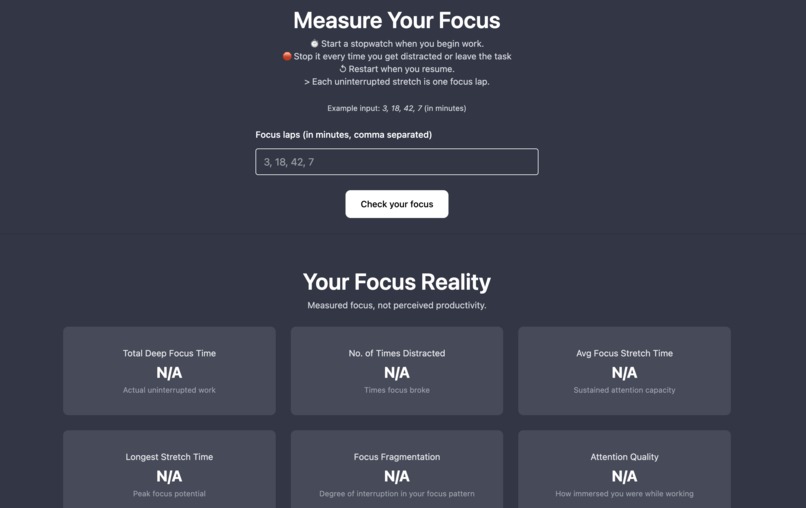
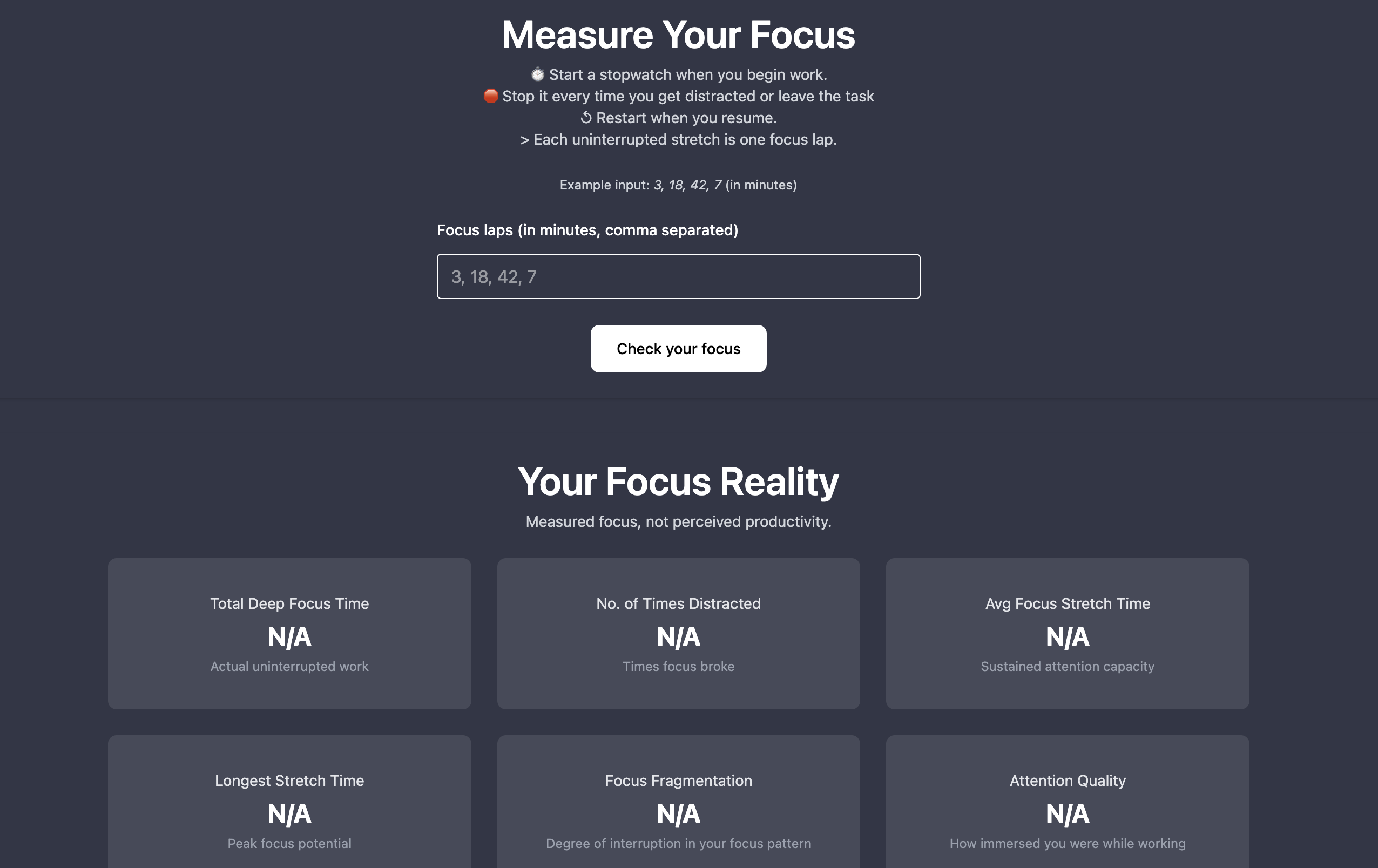
Users track their work using a simple stopwatch:
- Start when working
- Stop when distracted or leaving the task
- Each uninterrupted stretch becomes one focus lap
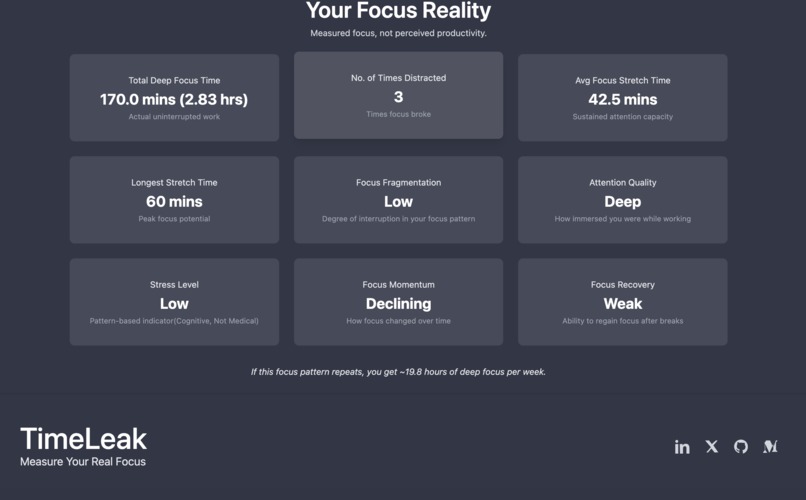
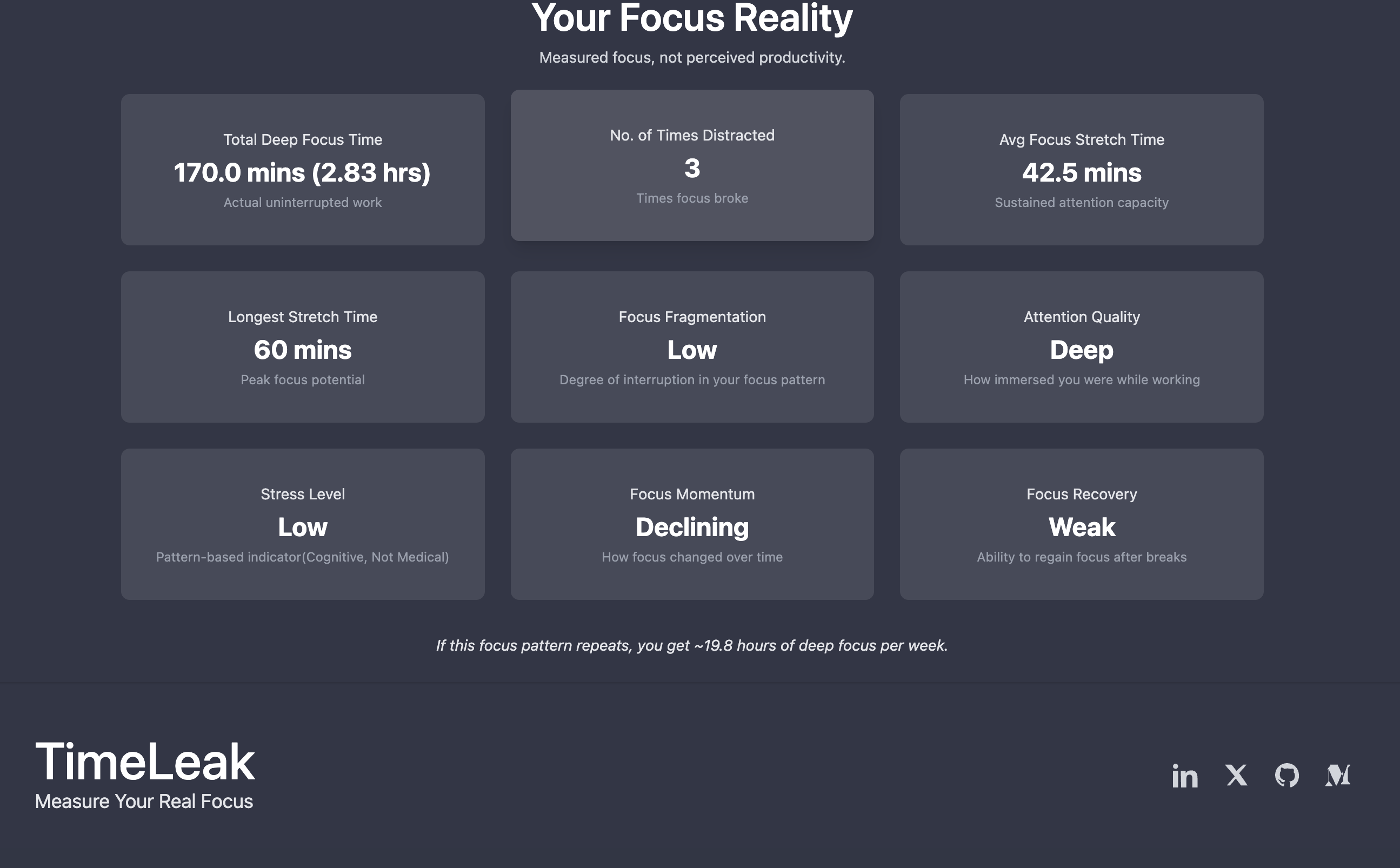
From only these focus laps, TimeLeak analyzes focus patterns such as:
- Total deep focus time
- Number of distractions
- Average and longest focus stretch
- Focus fragmentation
- Attention quality
- Cognitive strain (pattern-based)
- Focus momentum over time
- Ability to recover focus after breaks
The goal is not to score productivity, but to build awareness of how focus actually behaves.
How it works
The user tracks their work using a stopwatch (digital or physical, such as a phone or laptop clock).
Each uninterrupted period of work is recorded as a focus lap in minutes.
Every distraction or break separates one lap from the next.These focus laps are entered as comma-separated values
(for example:3, 18, 42, 7).All calculations run locally in the browser.
No data is stored, tracked, or sent to any server.Insights are generated using clear, rule-based logic derived from the recorded focus patterns.
The interface presents results as simple insight cards instead of raw statistics, making interpretation transparent and easy to understand.
How I built it
TimeLeak is a client-side web application built with:
- HTML
- Tailwind CSS
- JavaScript
- future scope: add Chart.js (planned for visualizations)
The UI is designed to:
- Separate perception (“I was productive”) from measurement
- Avoid judgmental or gamified language
- Keep cognitive load low
What I learned
- Small behavioral signals, when captured and framed correctly, can reveal surprisingly rich patterns about how we actually work.
- Clear problem framing often matters more than complex models or advanced techniques. A well-defined question leads to more meaningful insights.
- Not all metrics are useful or honest. Choosing what not to measure or display is as important as choosing what to include.
- UX decisions strongly influence how data is perceived and interpreted; the same data can feel motivating, neutral, or discouraging depending on presentation.
- Simplicity and transparency build more trust than opaque scoring systems or over-optimized metrics.
Challenges faced
- Avoiding misleading metrics like productivity scores
- Designing insights without knowing user goals or targets
- Balancing clarity with simplicity
- Keeping the tool non-intrusive and non-judgmental
Try it out
- Live Demo: https://time-leak.vercel.app/
- GitHub Repository: https://github.com/saumyayadav25/TimeLeak
Notes
TimeLeak reflects focus patterns, not productivity, motivation, or mental health.
All insights are behavior-based and non-diagnostic.
Built With
- css
- html
- javascript
- tailwind
