-
-
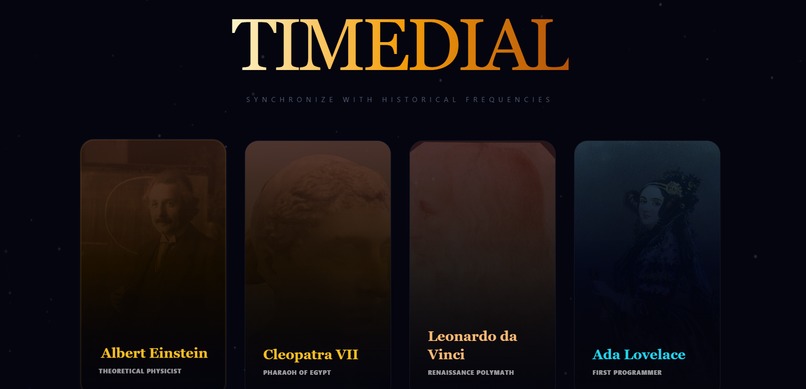
Main page
-
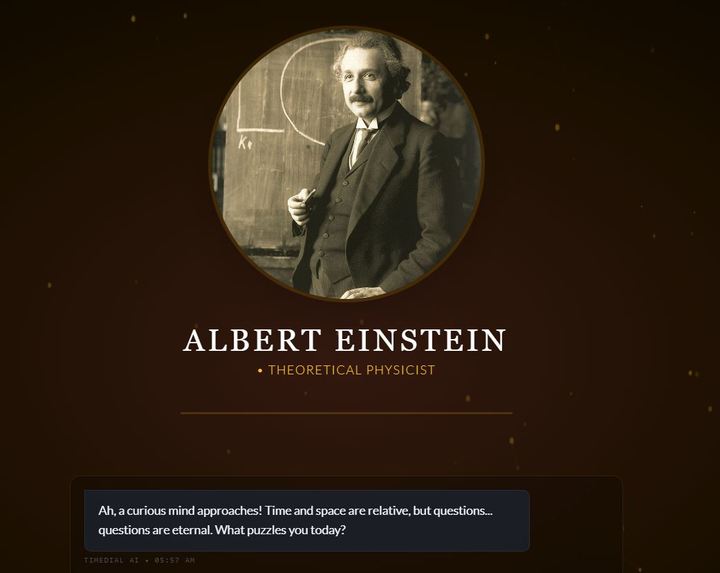
Einstein
-
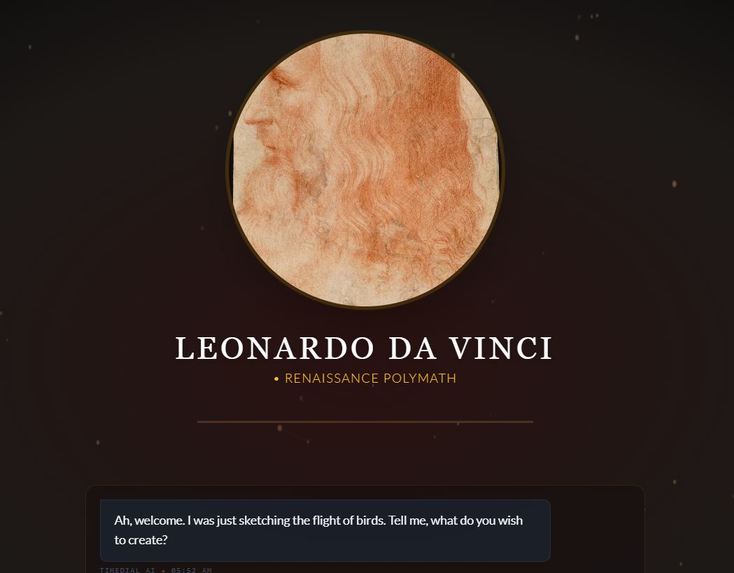
Leonardo
-
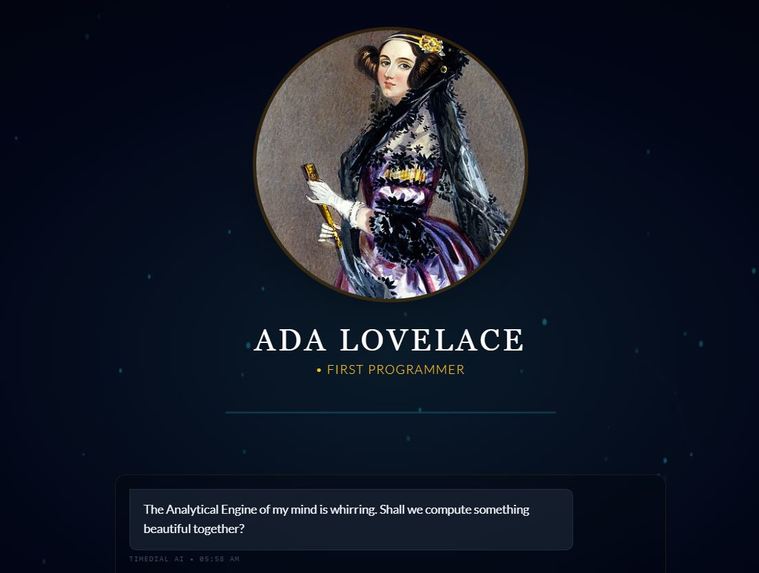
ADA
Inspiration
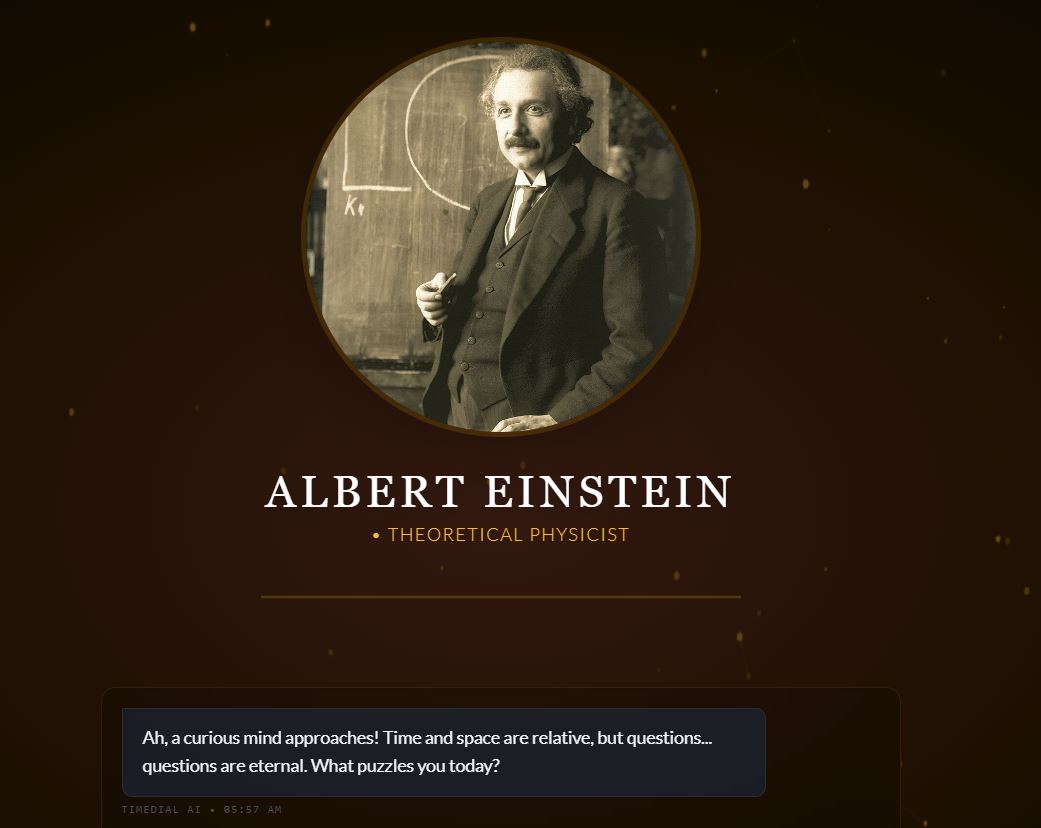
History has always been a collection of silent stories—textbooks and museums can tell us about a person, but they can't let us talk to them. Being based in Chicago, a city with deep historical roots, I wanted to create a bridge between the digital future and the human past [cite: 2025-08-04]. The inspiration for TimeDial came from a simple question: What if the greatest minds in history could hear us today? I wanted to move beyond text-only chatbots and create an immersive, vocal experience where you could actually hear the wisdom of figures like Albert Einstein or the command of Cleopatra VII.
What it does
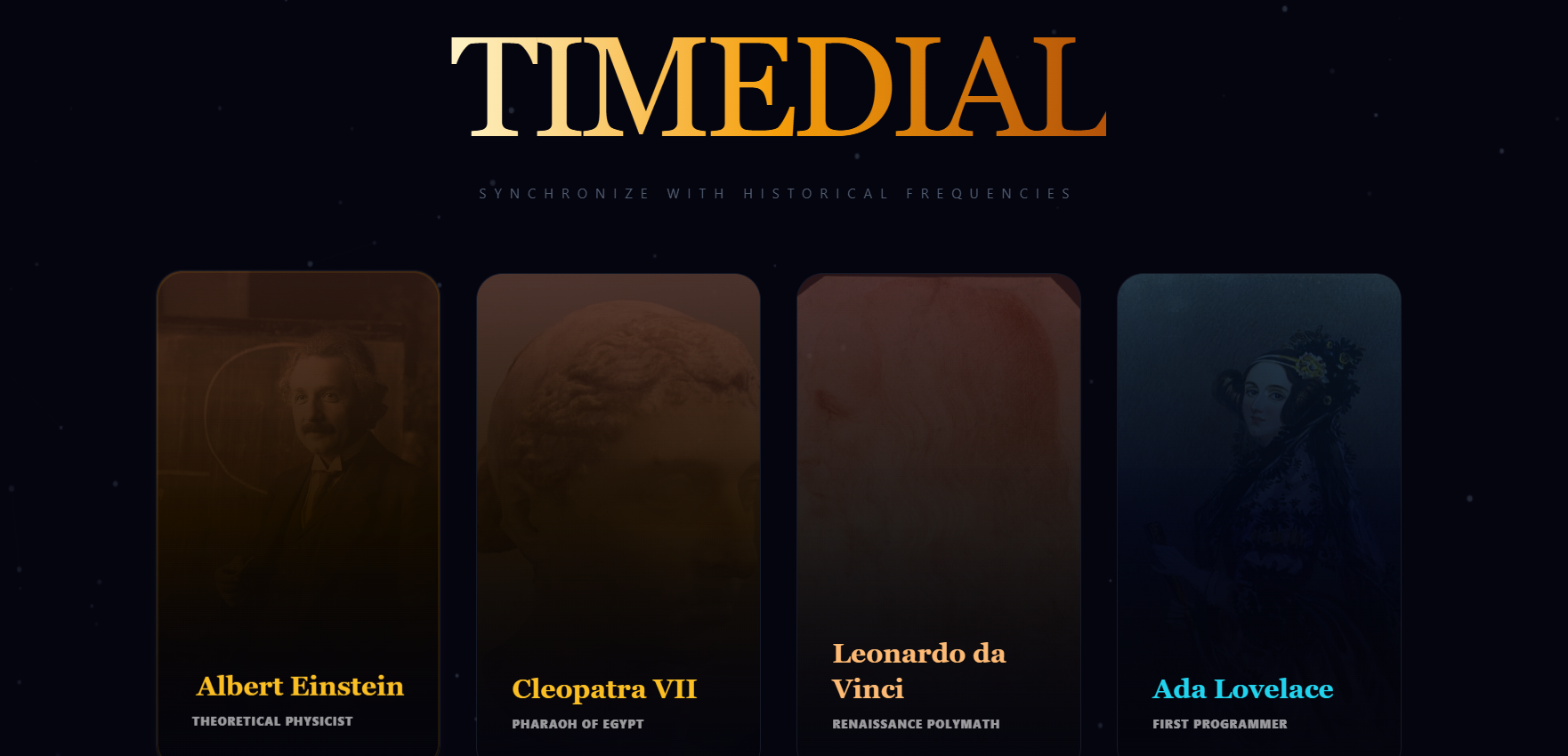
TimeDial is a multimodal AI platform that transforms historical education into an immersive, real-time vocal experience. Instead of just reading about the past, users enter a digital "Time Dial" to speak directly with history's greatest minds.
Dynamic Conversations: It allows users to ask open-ended questions to historical figures, receiving contextually accurate and philosophically consistent responses generated by Google Gemini.
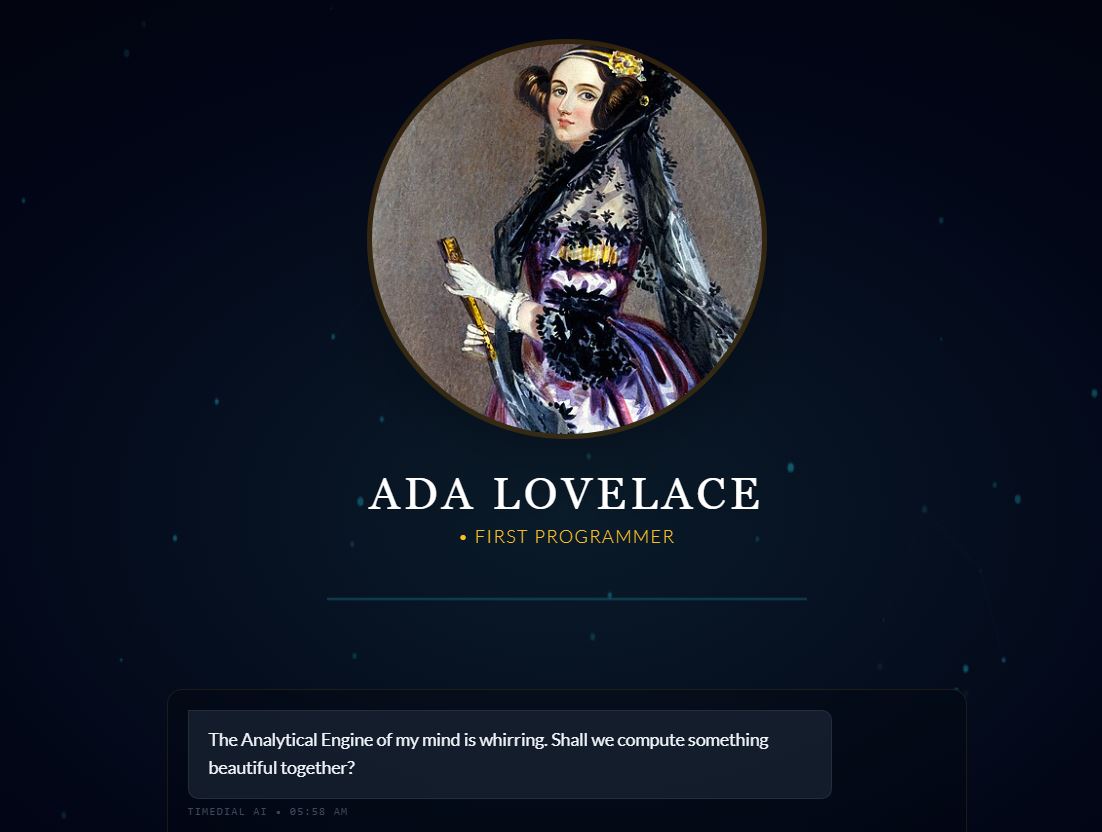
Lifelike Vocal Realism: Each character is powered by a high-fidelity ElevenLabs voice model specifically mapped to their persona—such as Einstein’s mature tone or Ada Lovelace’s sharp British intellect—moving beyond generic text-to-speech.
Low-Latency Streaming: The app features a custom-built audio engine that streams binary data from the server to the browser, ensuring that the historical figure's voice begins to speak almost immediately after the user finishes their question.
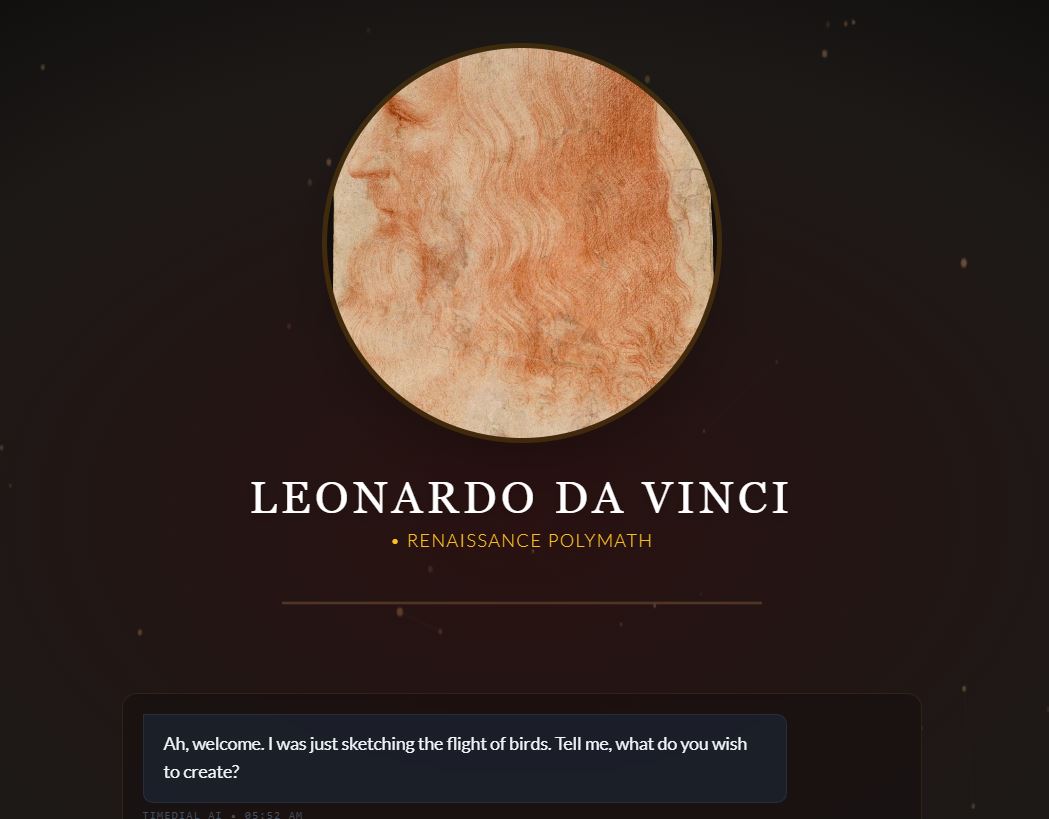
Character Diversity: Users can switch between a curated roster of figures, including Albert Einstein, Cleopatra VII, Ada Lovelace, and Leonardo da Vinci, each with their own unique worldview and vocal identity.
How I built it
Building TimeDial as a solo developer (I did use Google AntiGravity with Gemini Pro 3.0 as my main IDE) was an intense journey of debugging and architectural refinement. Because I was working alone, every technical hurdle required deep-diving into documentation and logs to find a solution.
The "Voice of a Pharaoh" Glitch: One of the most surprising challenges was when Cleopatra VII began responding with a default male voice. This required me to overhaul the backend character mapping system to ensure that every historical figure was strictly bound to their correct, gender-accurate ElevenLabs Voice ID.
Deployment & Port Conflicts: During the move to Google Cloud Run, the application repeatedly crashed with a "Startup TCP probe failed" error. I had to learn how Cloud Run manages the $PORT environment variable and rewrite the main.py entry point to dynamically listen on Port 8080 instead of the local hardcoded port.
The Authentication Wall: I faced persistent 401 Unauthorized errors that stalled progress for hours. By meticulously analyzing the network logs, I realized the server wasn't receiving the API keys correctly, leading me to implement a secure environment orchestration using gcloud CLI to sync ElevenLabs and Google Cloud secrets.
Binary Streaming Stability: Handling real-time audio delivery without saving temporary files was a major hurdle. I had to solve 500 Internal Server Errors related to data delivery by fine-tuning HTTP headers and ensuring the Python backend delivered explicit Content-Length headers so the browser would play the audio without buffering.
Challenges I ran into
Building TimeDial as a solo developer was a journey of technical evolution that required navigating multiple platforms and solving complex synchronization hurdles.
Platform Migration & Configuration: I initially began development in Google AI Studio, where I successfully prototyped the core logic. However, I encountered significant difficulties managing local configurations and securing the .env file within that environment. To overcome this, I transitioned my workflow: exporting the codebase to GitHub and then cloning it into the Antigravity IDE. This move provided the necessary environment control to properly implement secret management and iterative code improvements that eventually brought the app to completion.
The "Cleopatra" Voice Glitch: One of the earliest functional challenges was a gender-mismatch in the vocal output; specifically, Cleopatra VII was initially responding with a default male voice. This required a deep-dive into the backend mapping to ensure that every historical figure was explicitly bound to their correct, gender-accurate ElevenLabs Voice ID.
The "401 Unauthorized" Wall: I faced persistent 401 errors during the authentication phase with ElevenLabs. This confirmed that the server was not correctly receiving the API keys. I had to manually synchronize the secrets using the gcloud CLI to ensure the Google Cloud Run environment could securely talk to the ElevenLabs API.
Port & Startup Probe Failures: Deploying a containerized app to Cloud Run introduced a "Startup TCP probe" error because my local environment was hardcoded to Port 8000, whereas Cloud Run expects traffic on the dynamic $PORT (defaulting to 8080). I had to rewrite the main.py entry point to dynamically detect the server's port variable to pass the health checks.
Binary Streaming Stability: Handling real-time audio delivery without saving temporary files was a major hurdle. I had to optimize the Python code to use standard urllib for direct byte-streaming, providing an explicit Content-Length header so the browser could recognize the incoming audio stream immediately without crashing.
Accomplishments that I'm proud of
As a solo developer working within the Antigravity IDE, I am incredibly proud of several milestones that turned a complex vision into a functional reality.
Mastering the Full-Stack Loop: Successfully integrating Google Gemini for intelligence and ElevenLabs for voice while managing the deployment on Google Cloud Run entirely on my own.
Real-Time Audio Delivery: Developing a robust binary streaming engine that provides near-instant voice responses, creating a truly immersive "live" conversation feel.
Antigravity IDE Integration: Effectively leveraging the Antigravity IDE to streamline the development process, which allowed me to iterate quickly and manage complex cloud configurations without a team.
Zero-Latency Character Swapping: Engineering a stable frontend-to-backend handshake that allows users to switch between historical figures—like jumping from Einstein to Cleopatra—without the system crashing or losing its authentication state.
Technical Resilience: Overcoming a series of critical authentication and deployment errors (401, 500, and Port mismatches) through persistent debugging and server logs analysis.
What I learned
My journey developing TimeDial as a solo developer was as much a lesson in technical resilience as it was in the future of multimodal AI.
The Power of Agentic Development: Transitioning to the Antigravity IDE taught me how to effectively leverage agentic workflows to handle complex tasks—like environment orchestration and cloud deployment—that typically require a full team.
Multimodal Integration: I gained deep expertise in bridging disparate AI services, learning how to synchronize Google Gemini’s cognitive reasoning with ElevenLabs’ neural vocal synthesis to create a cohesive human-machine interface.
Full-Stack Cloud Architecture: I mastered the nuances of deploying containerized applications on Google Cloud Run, specifically understanding how to manage dynamic networking requirements like the $PORT variable and secure secret management for production-grade apps.
Audio Data Engineering: I learned the intricacies of low-level data streaming, specifically how to bypass high-level SDK limitations by using standard Python libraries to deliver binary audio data directly to the browser for a zero-latency user experience.
The Importance of "Vocal Persona": I realized that for an AI to be truly immersive, the voice is just as important as the logic. Fine-tuning stability and similarity settings taught me how subtle auditory cues can make a historical figure feel authentic rather than robotic.
What's next for TimeDial
What's next for TimeDial We envision TimeDial evolving from a conversation platform into a fully immersive historical metaverse. Our roadmap focuses on deepening the educational impact and expanding the multimodal experience:
Visual Avatars & Lip-Sync: Currently, we use static imagery. The next immediate step is to integrate video generation models (like Google Vids or D-ID) to animate the historical figures, syncing their lip movements to the ElevenLabs audio stream for a face-to-face conversation experience.
Global Classroom Integration: We plan to leverage Google Gemini’s multilingual capabilities to allow students to speak to these figures in their native languages—imagine a student in Tokyo asking Einstein about relativity in Japanese, while preserving his distinctive vocal tone.
VR/AR "Time Travel" Mode: We aim to bring TimeDial to VR headsets, allowing users to step into a 3D recreation of Da Vinci's workshop or Cleopatra's palace while conversing with them, transforming the app into a spatial computing experience.
"Debate Mode": Enabling multi-agent conversations where a user can host a roundtable discussion between two historical figures—like facilitating a debate between Ada Lovelace and Steve Jobs on the future of computing.
Educator Dashboard: Building a backend portal for teachers to generate quizzes and study guides based on the transcripts of their students' conversations, turning every chat into a verifiable learning outcome.

Log in or sign up for Devpost to join the conversation.