-
-
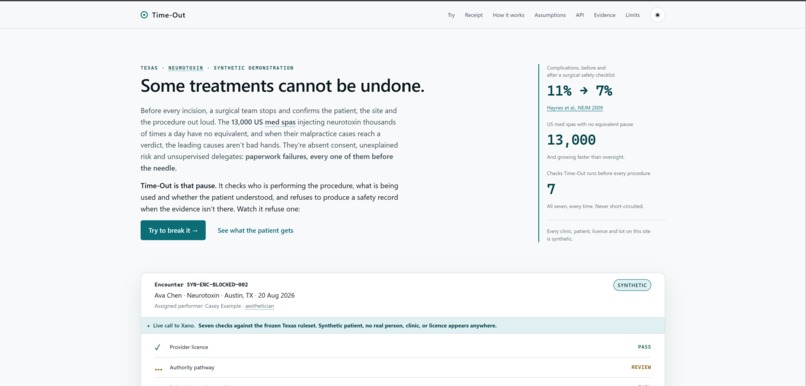
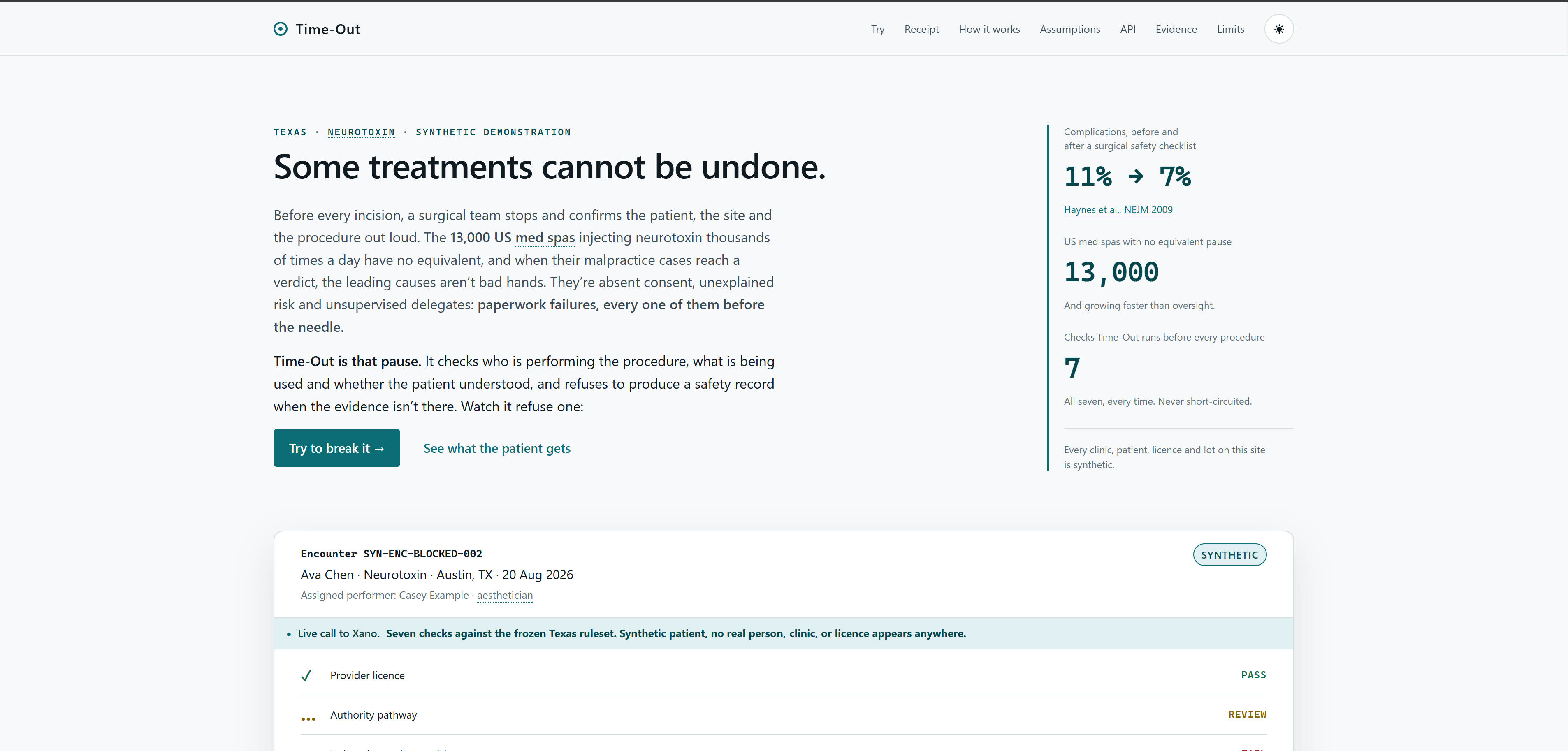
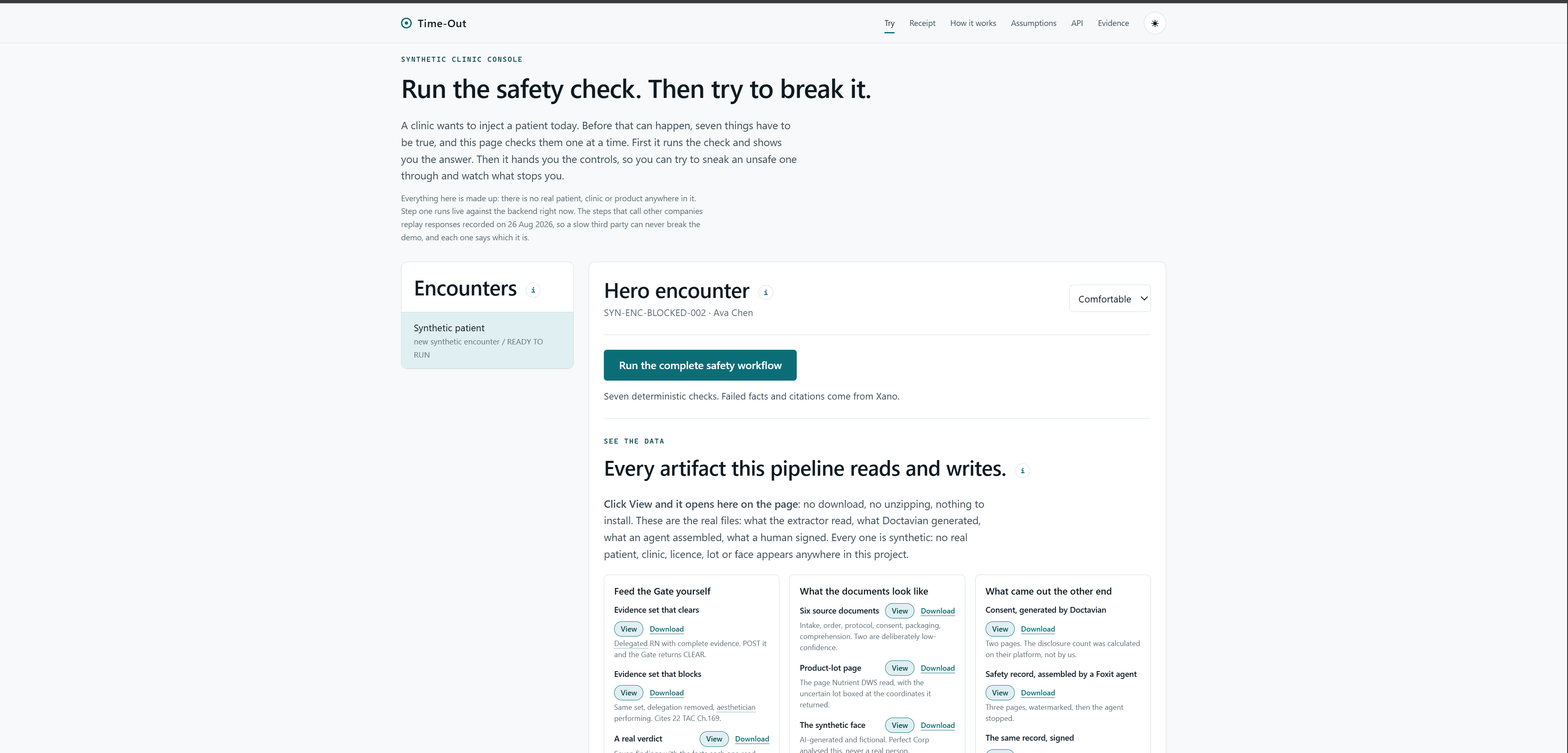
Surgery pauses before every incision. Med spas have no equivalent. This is that pause, running on an invented Texas patient.
-
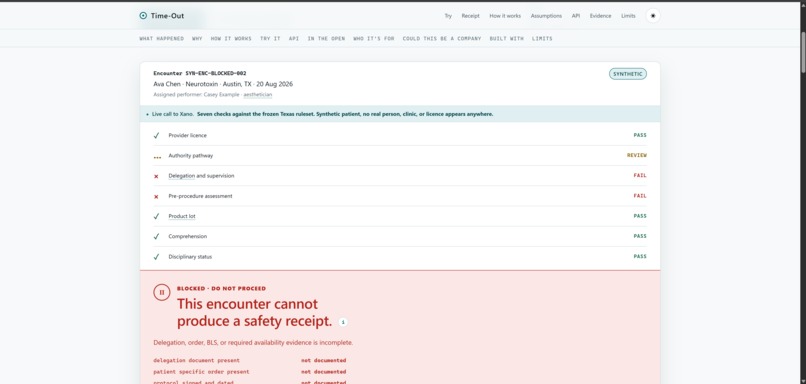
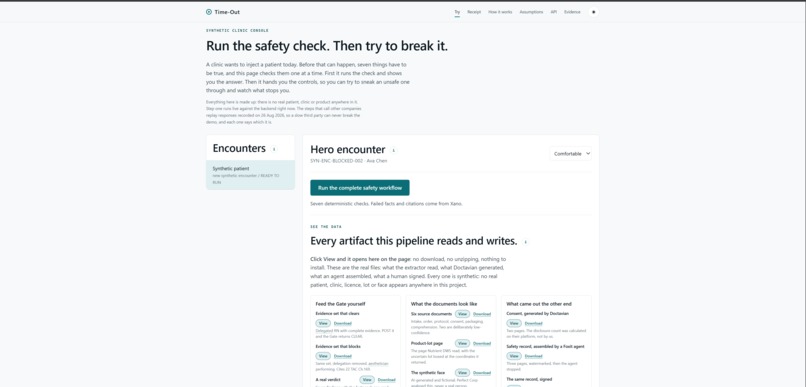
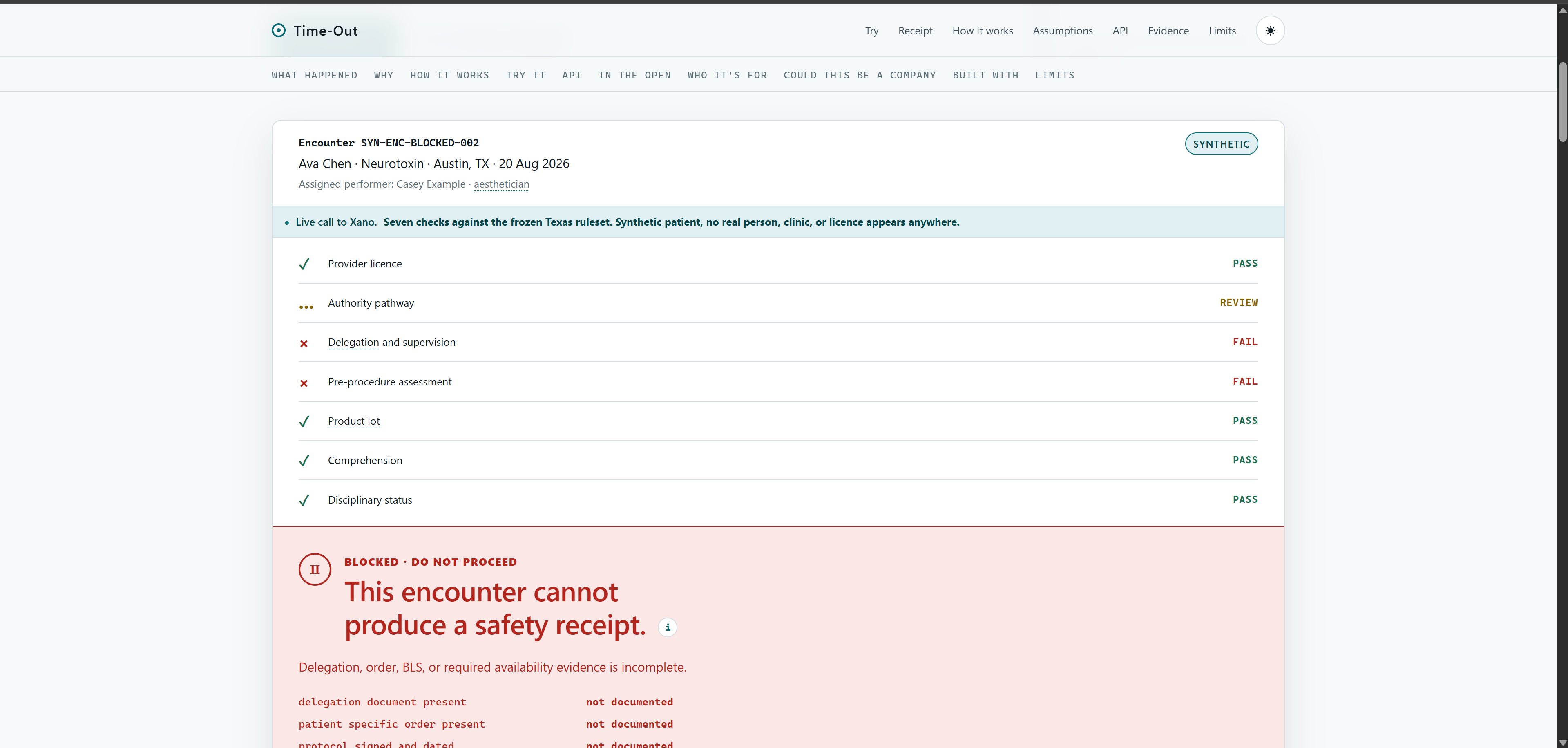
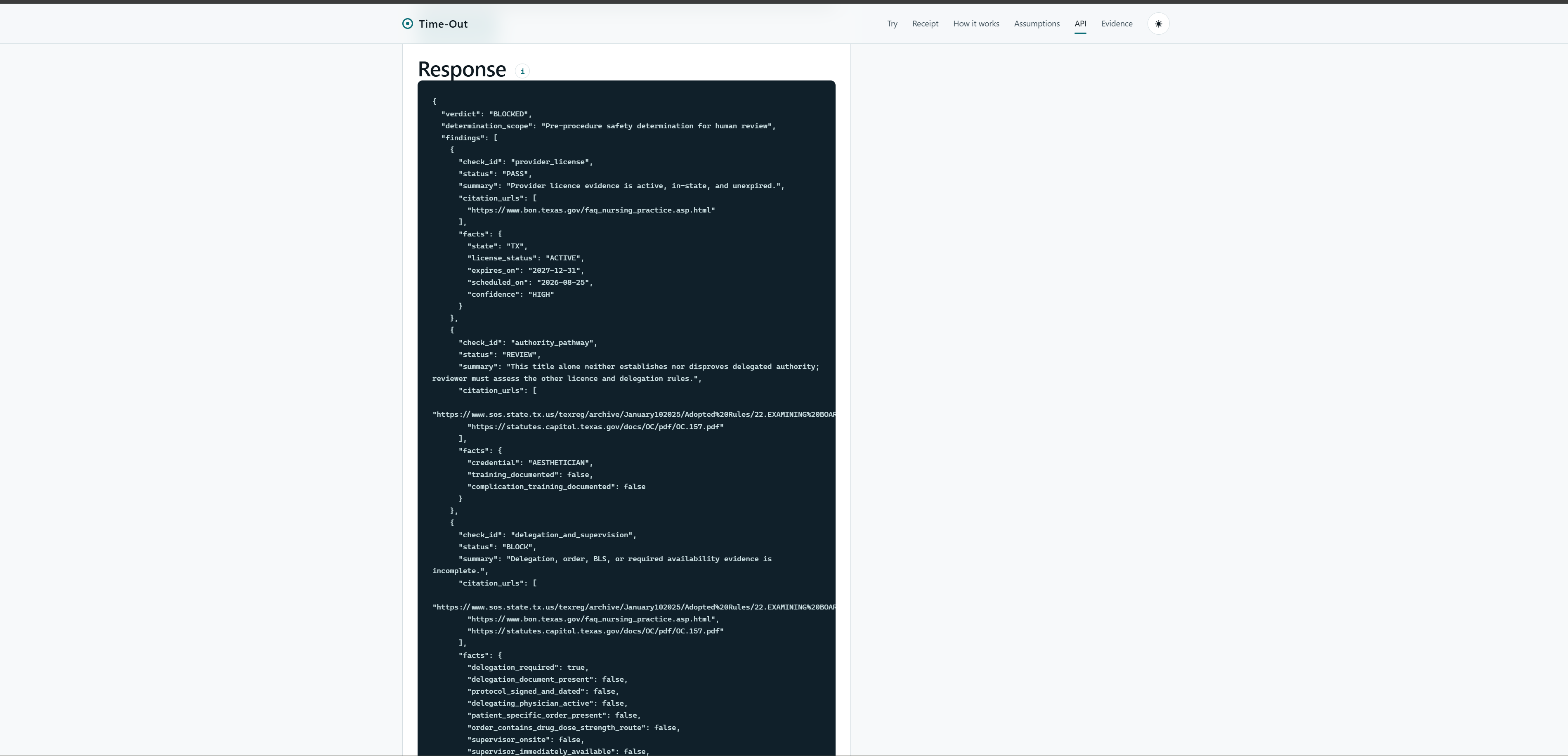
Seven checks run against the Texas ruleset the moment the page loads. Four pass, one needs a human, two fail.
-
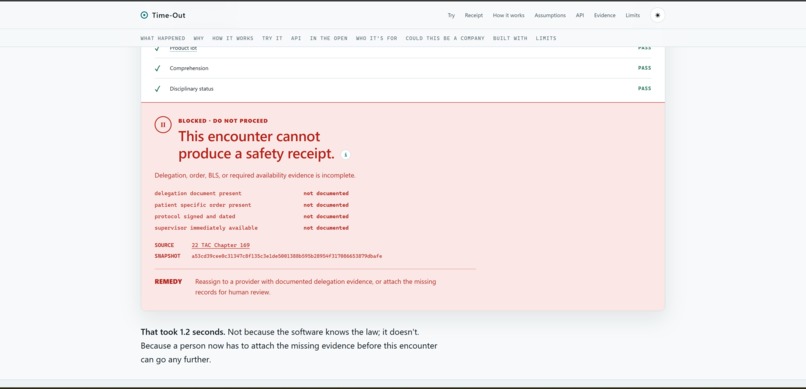
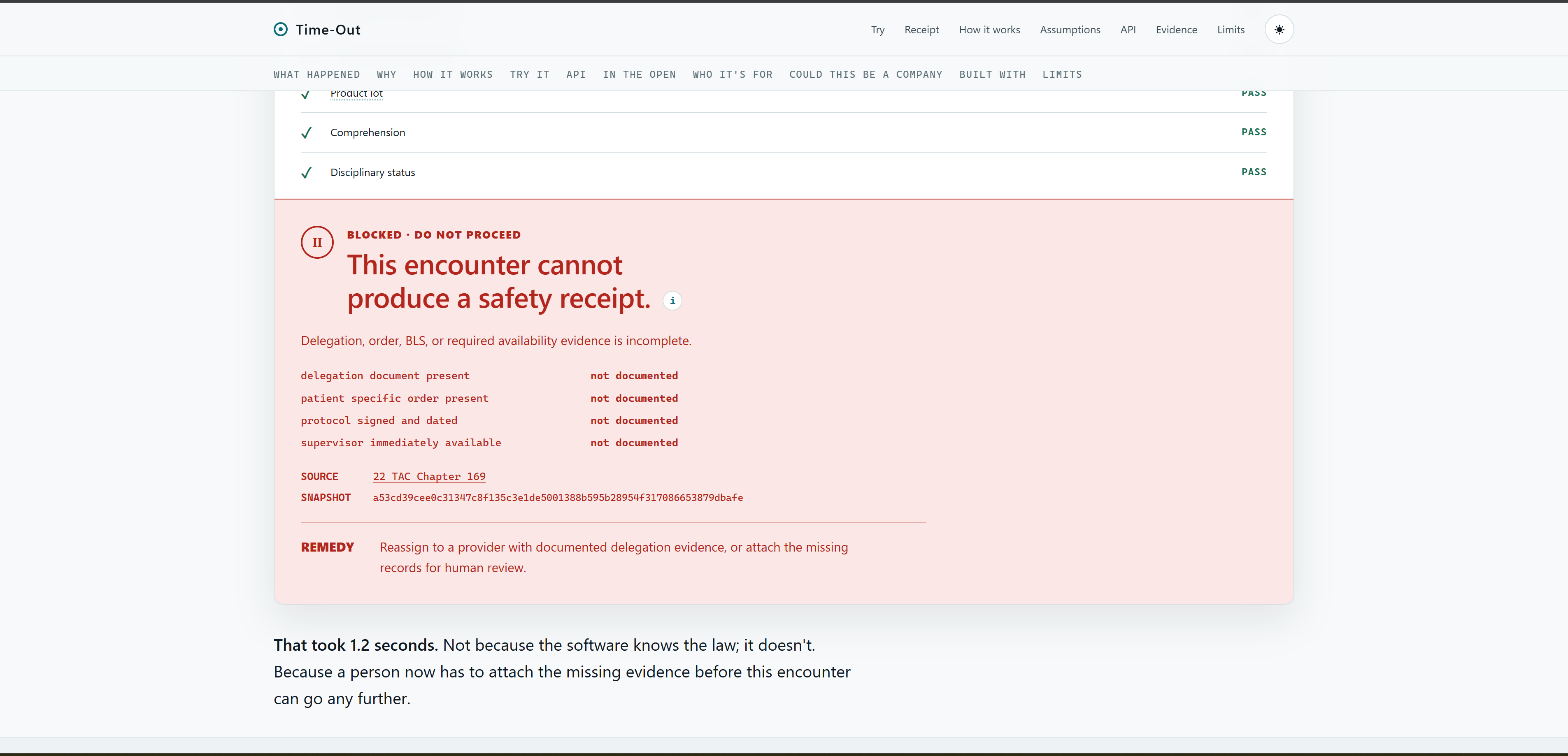
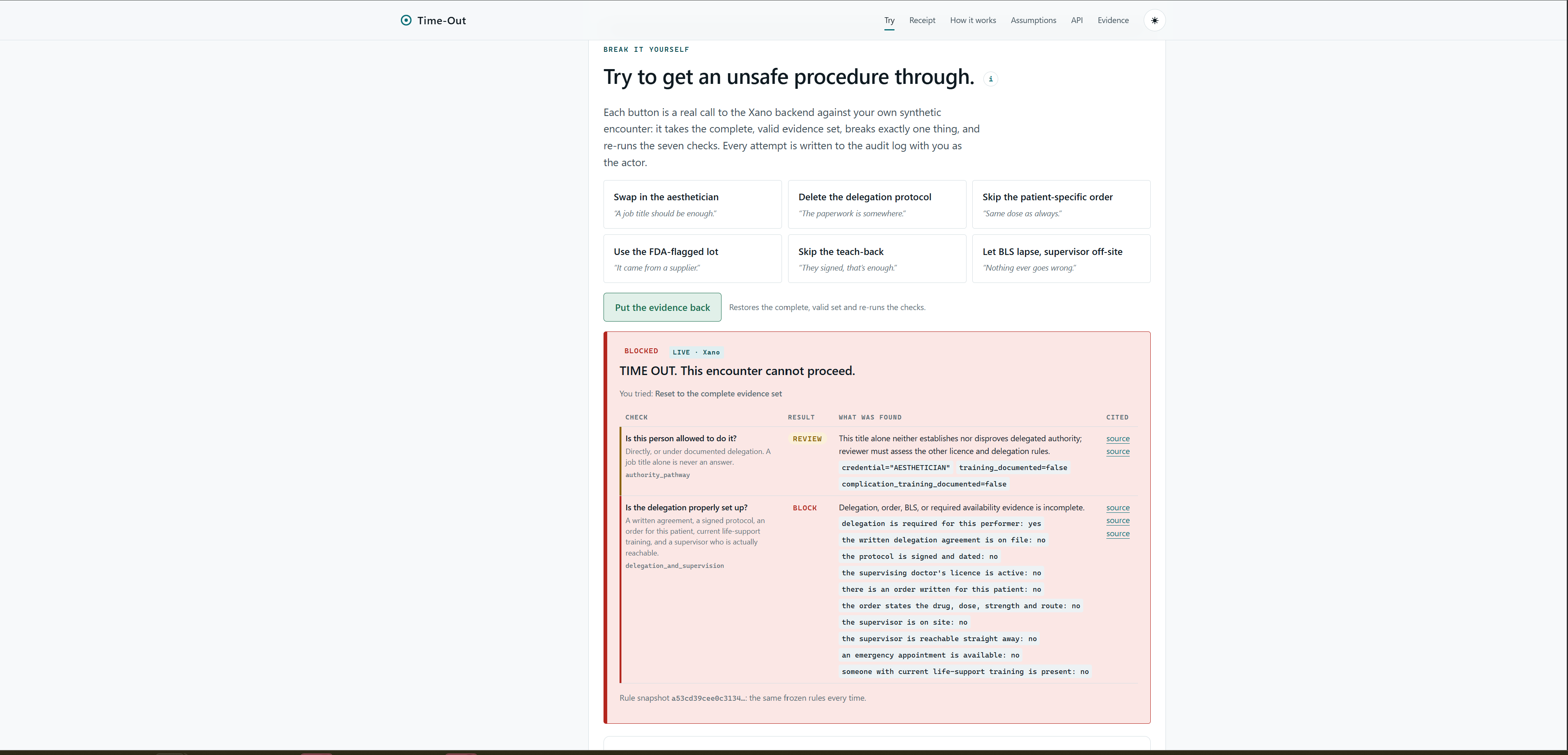
Blocked, and it says why: the four documents that are missing, the rule it applies, and how the clinic fixes it.
-
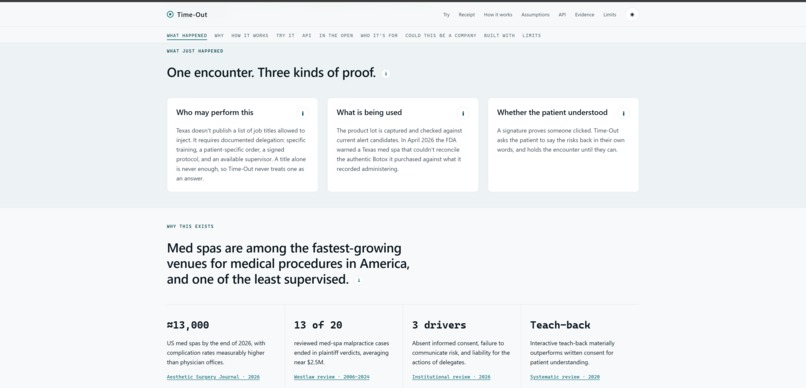
Not an error message. It cites 22 TAC Chapter 169 and the frozen fingerprint of the exact rules used that day.
-
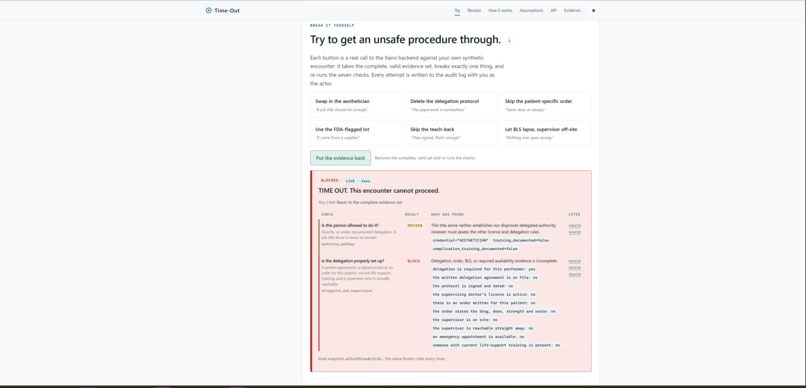
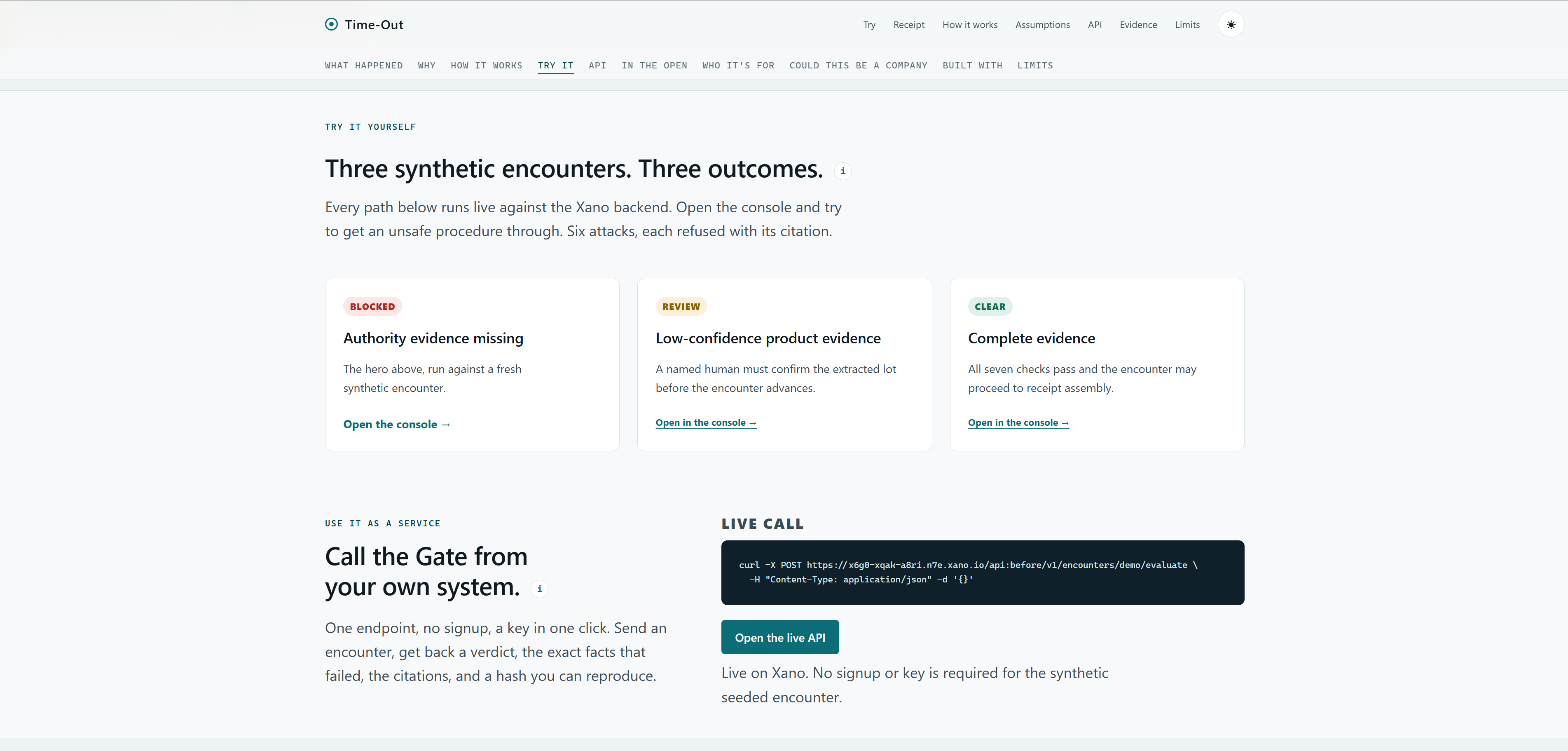
Six buttons, each removing exactly one thing the rules require. Every one is a real call to the live backend.
-
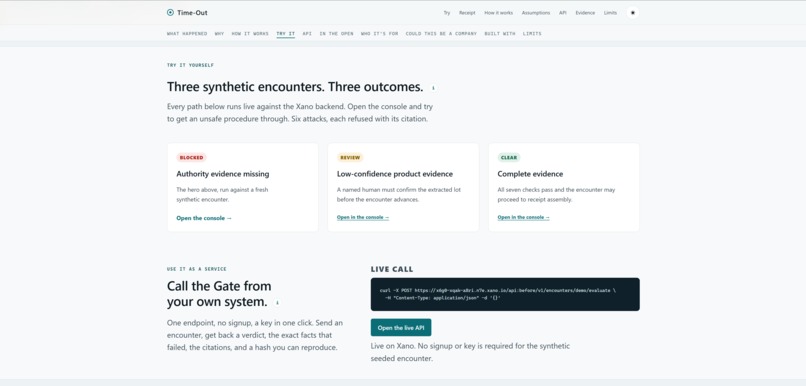
Swap in the aesthetician and it still refuses. A job title on its own is never permission.
-
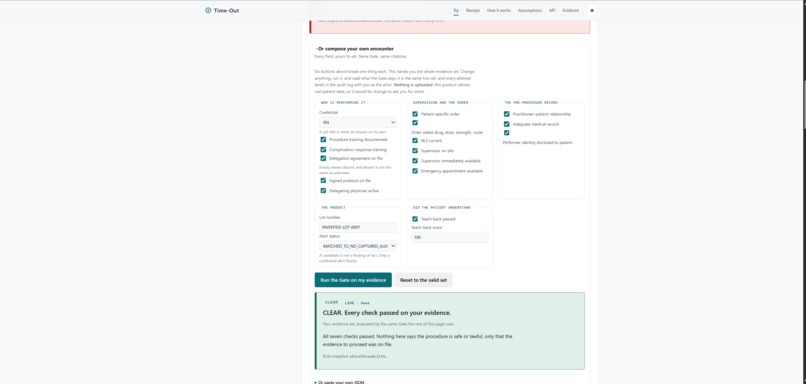
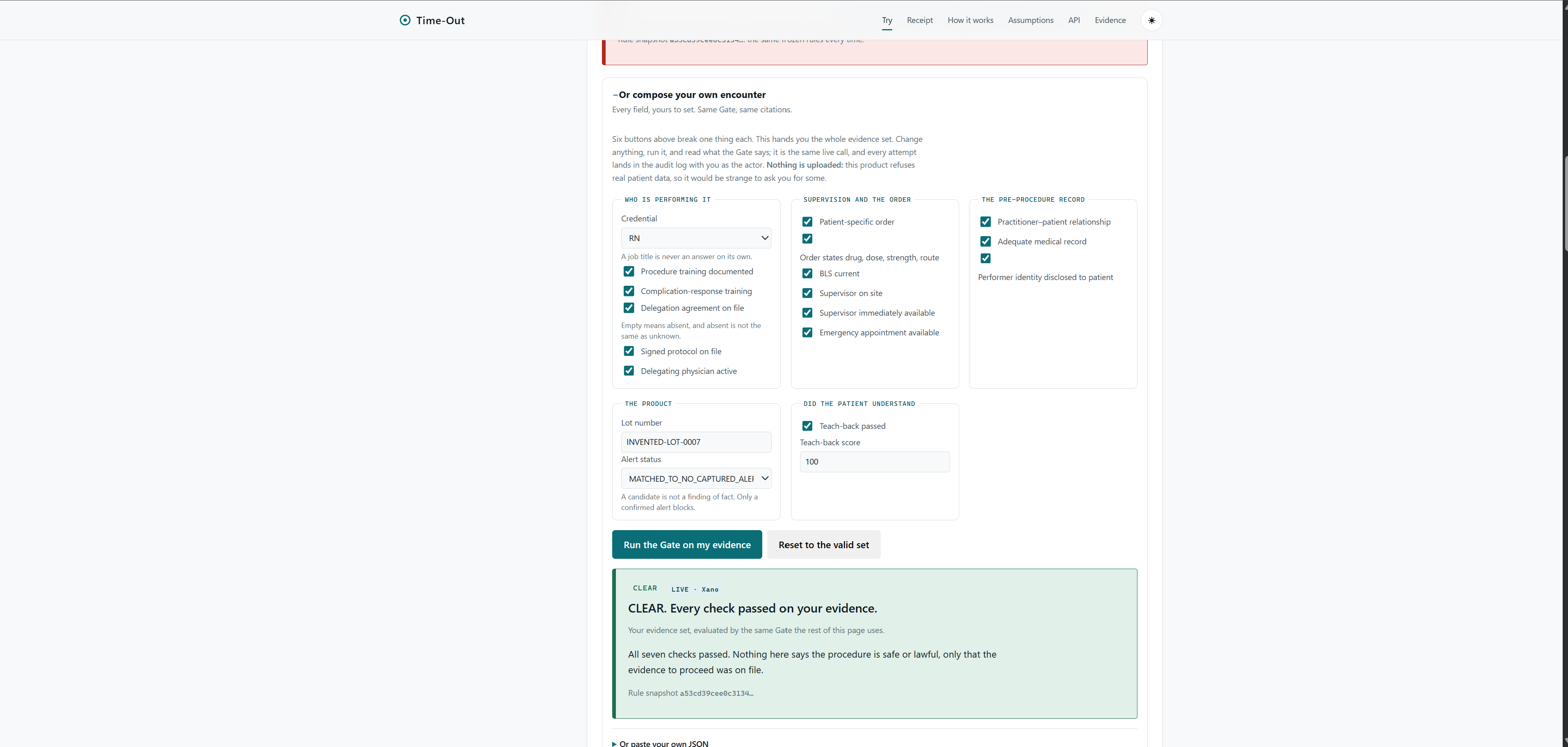
Nineteen fields, all yours. Change anything and the same seven checks run against your evidence, not mine.
-
Every attempt lands in an append-only log with whoever tried it named. Nothing gets edited quietly.
-
What the patient walks out holding: what was checked, who was responsible, and how to verify it later.
-
A standardized skin baseline captured before treatment. A record the patient keeps, never a diagnosis.
-
The receipt fingerprint is published as a DNS record, so anyone can check it without trusting us.
-
An agent assembled this record and then stopped. A named Medical Director signed it by hand through eSign.
-
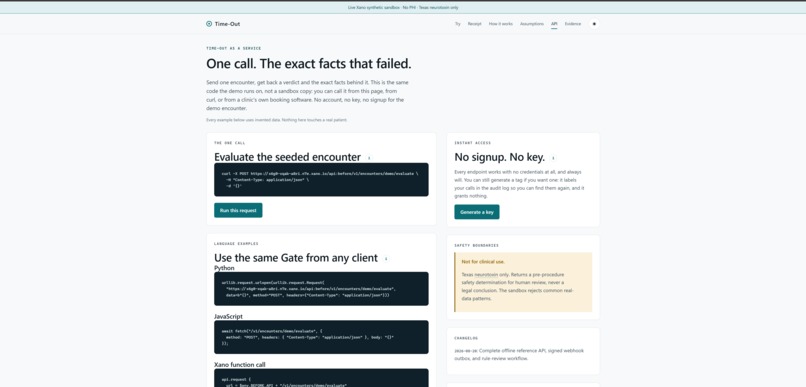
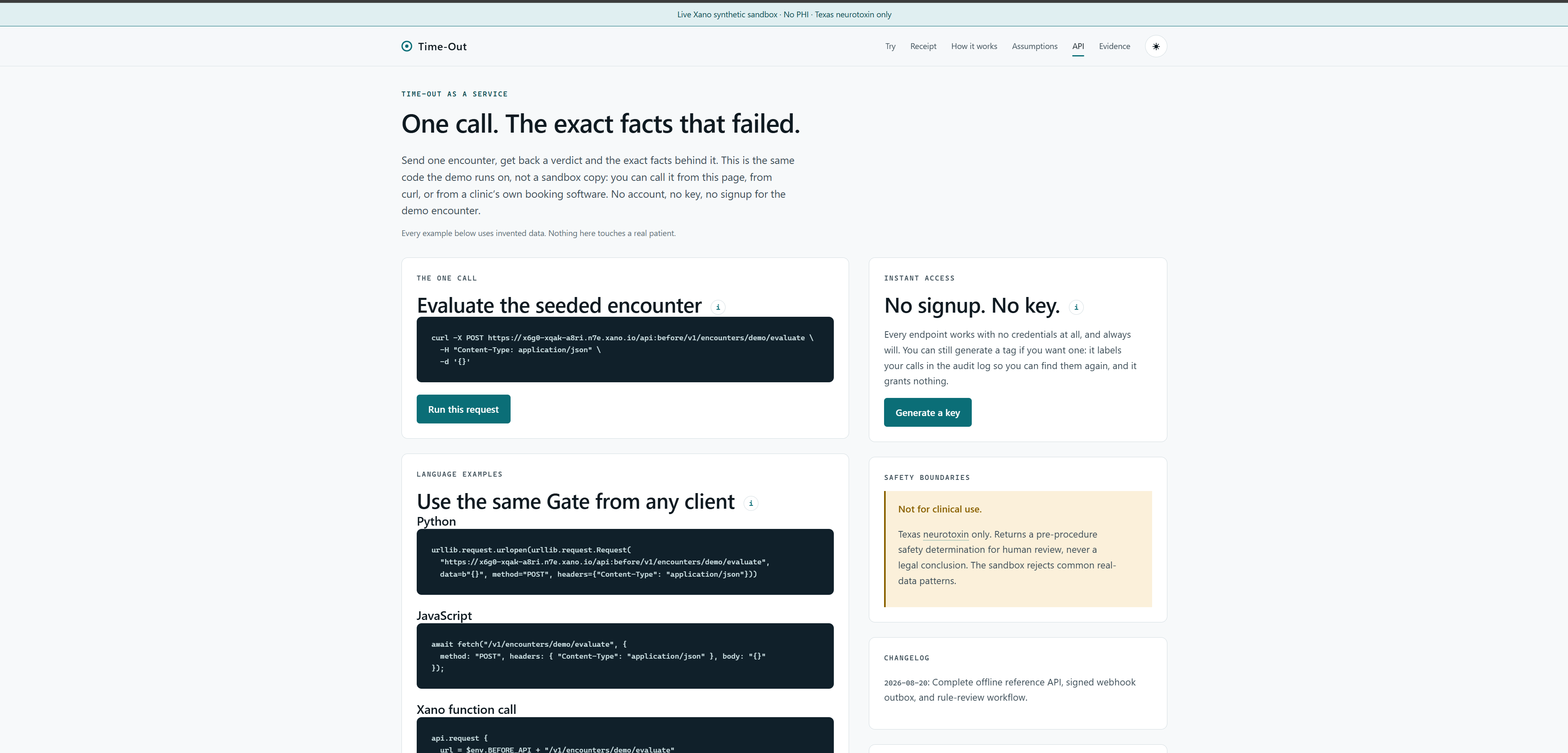
The same seven checks as one HTTP call. No signup, no key, and the whole lifecycle works from any client.
-
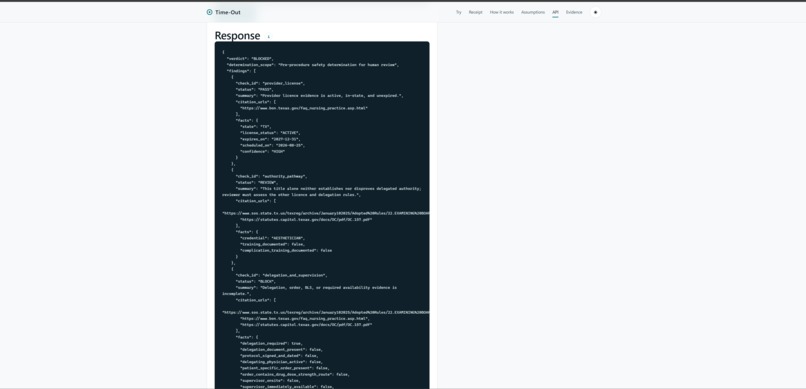
Every way the API can refuse you, with the real status and message. Real patient data is rejected before storage.
-
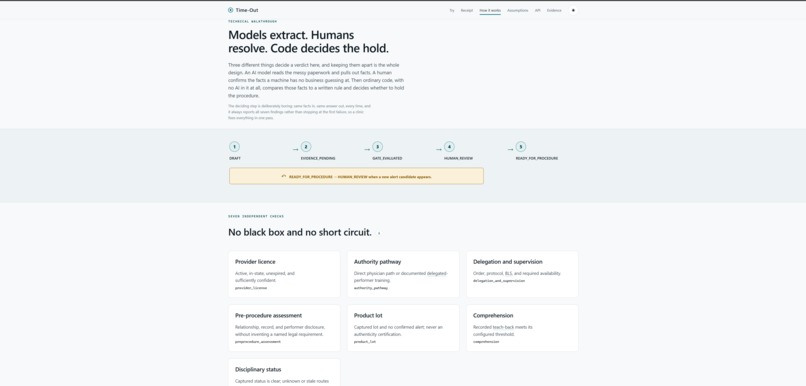
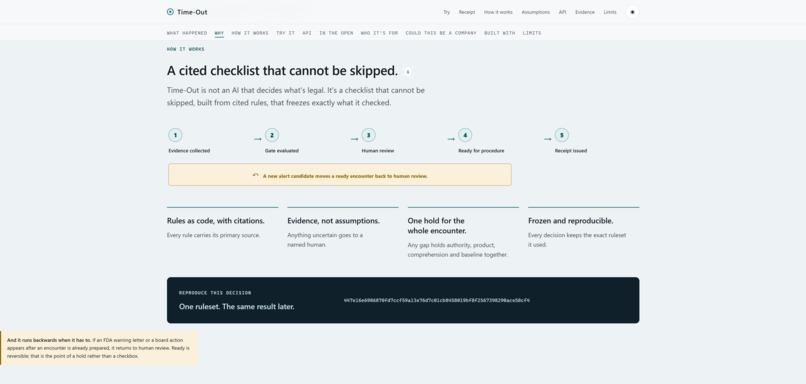
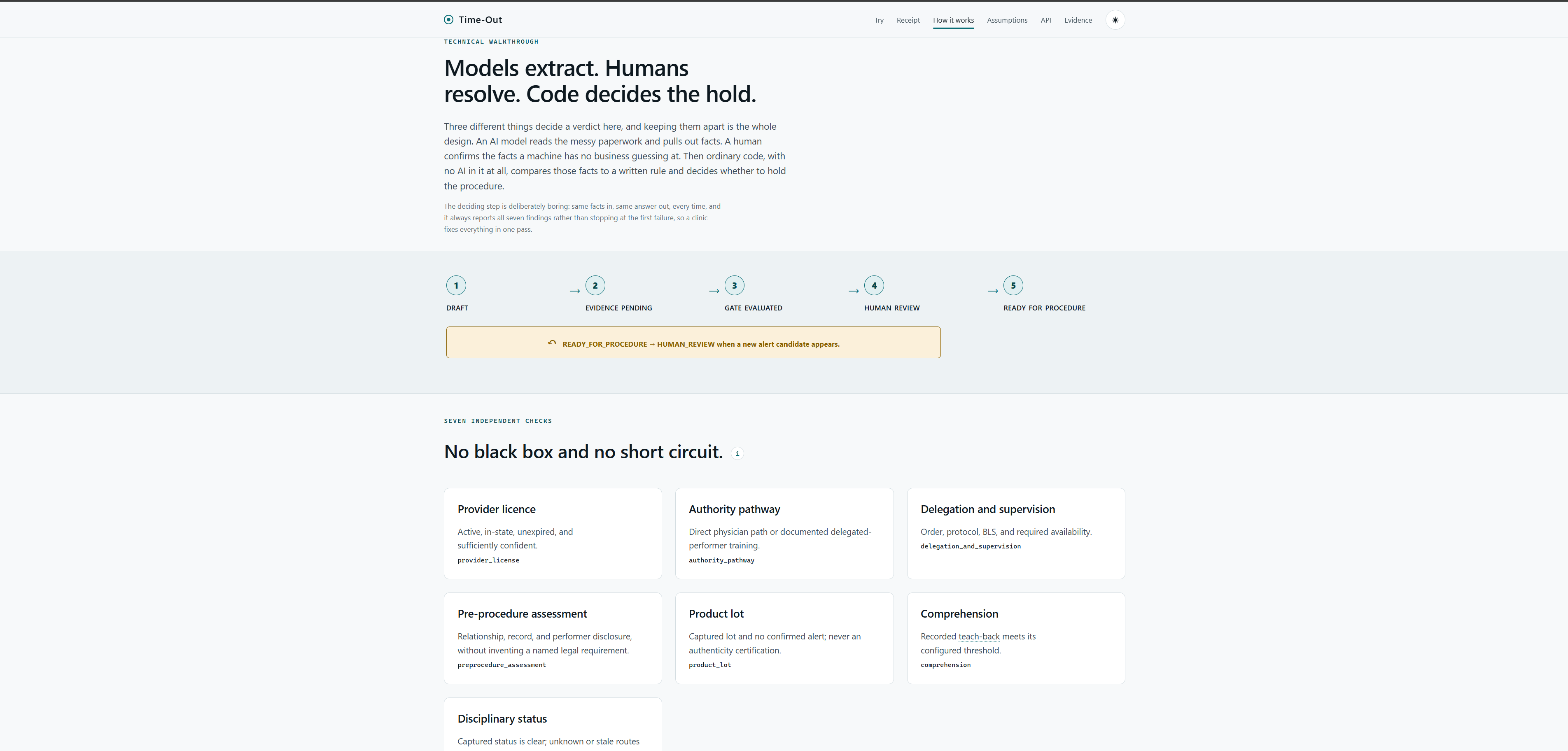
AI reads the evidence. Ordinary code decides. Anything uncertain stops for a named human.
Inspiration
Before any surgery, the whole team stops and confirms out loud: right patient, right place, right procedure. It is called a time-out, and it is boring on purpose. In the study that introduced the WHO surgical safety checklist, complications fell from 11.0% to 7.0% and inpatient deaths from 1.5% to 0.8% (Haynes et al., NEJM 2009).
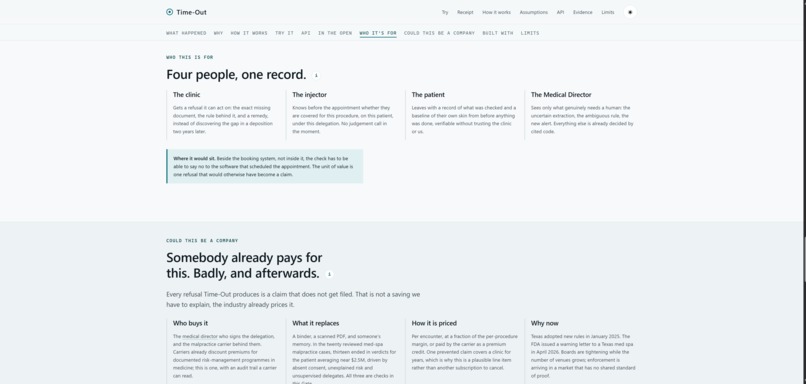
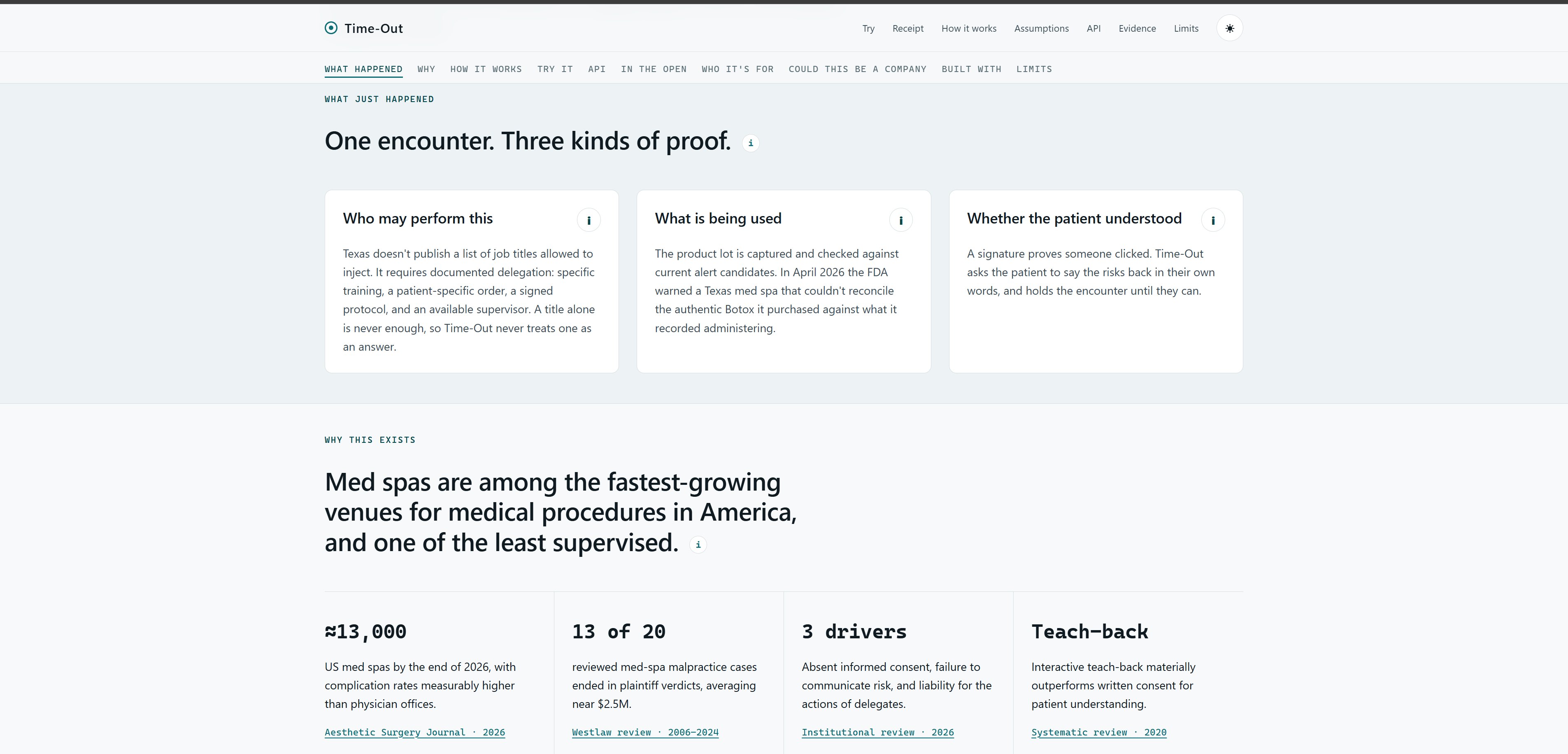
Med spas have no equivalent pause. There are roughly 13,000 of them in the US, growing faster than the oversight, and neurotoxin injections happen thousands of times a day in rooms where the person holding the needle may be an aesthetician, a "laser technician", or a nurse working under a delegation agreement nobody has ever seen.
The thing that made me build this: when med-spa malpractice cases reach a verdict, the leading causes are not bad hands. They are absent informed consent, failure to communicate risk, and liability for the actions of delegates. Paperwork failures, every one of them, and every one of them decidable before the needle goes in. In April 2026 the FDA warned a Texas med spa that could not reconcile the authentic Botox it had bought against what it had recorded injecting.
Time-Out is the pause those rooms are missing.
What it does
Before a cosmetic procedure can go ahead, Time-Out runs seven checks against the Texas ruleset and the evidence actually on file:
- Is the licence active, in-state and unexpired?
- May this person perform this, directly or under documented delegation? A job title is never an answer on its own.
- Is there a patient-specific order, a signed protocol, current BLS, an available supervisor?
- Was the pre-procedure assessment recorded?
- Is the product lot captured and free of any confirmed alert?
- Did the patient pass a teach-back, saying the risks back in their own words rather than ticking a box?
- Any disciplinary finding?
Three answers are possible: CLEAR, BLOCKED, or REVIEW. Some rules are genuinely ambiguous, and when they are, the software says so and a named human decides. It never guesses.
Blocking well is the whole product. A BLOCKED result is not an error message. It names the exact documents that are missing, cites the Texas rule it is applying, and tells the clinic how to fix it. Somebody attaches the missing evidence and re-runs the check. Nobody edits a database. That is the difference between software that stops you and software that helps you.
When everything clears, consent is compiled from a template that branches on who is performing the procedure, the patient completes a teach-back, a standardised skin baseline is captured, an agent assembles the record and stops, and a Medical Director signs the attestation by hand. The patient walks out with a safety receipt: what was checked, who was responsible, their skin baseline, and a fingerprint of the exact ruleset used, published where anyone can verify it later.
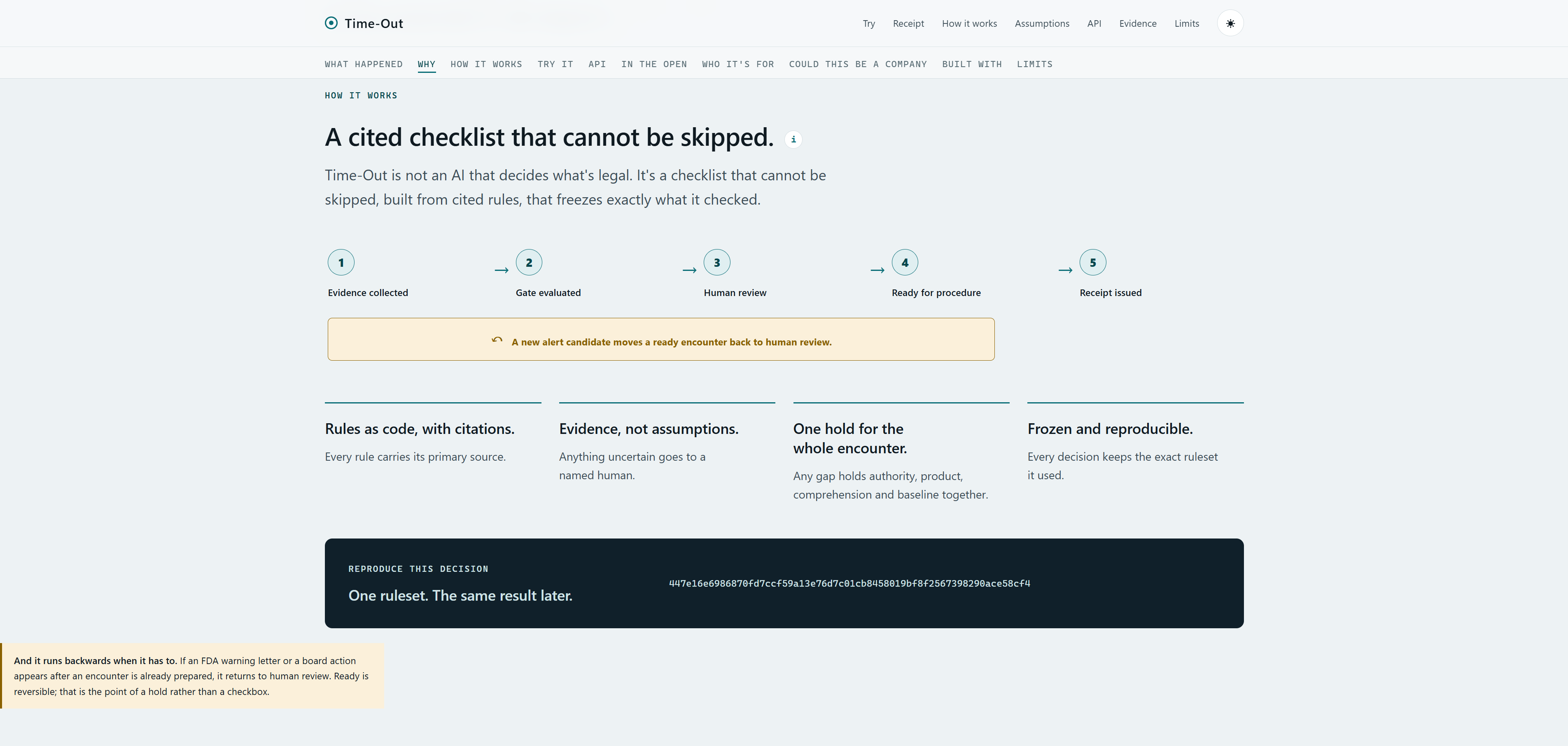
And if an FDA warning letter lands after an encounter is ready, it goes back to review. Ready is reversible.
How we built it
One rule shapes everything: the software never decides what is legal, and no model ever does arithmetic. Models read documents into typed fields with confidence scores. Every verdict comes from deterministic code over a cited rules table. Anything uncertain stops for a named human.
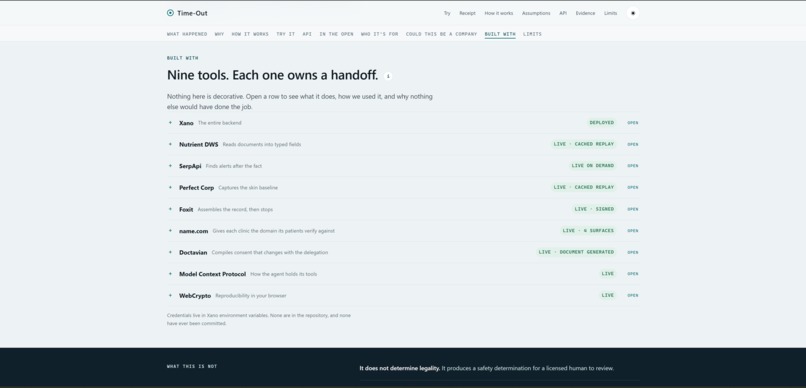
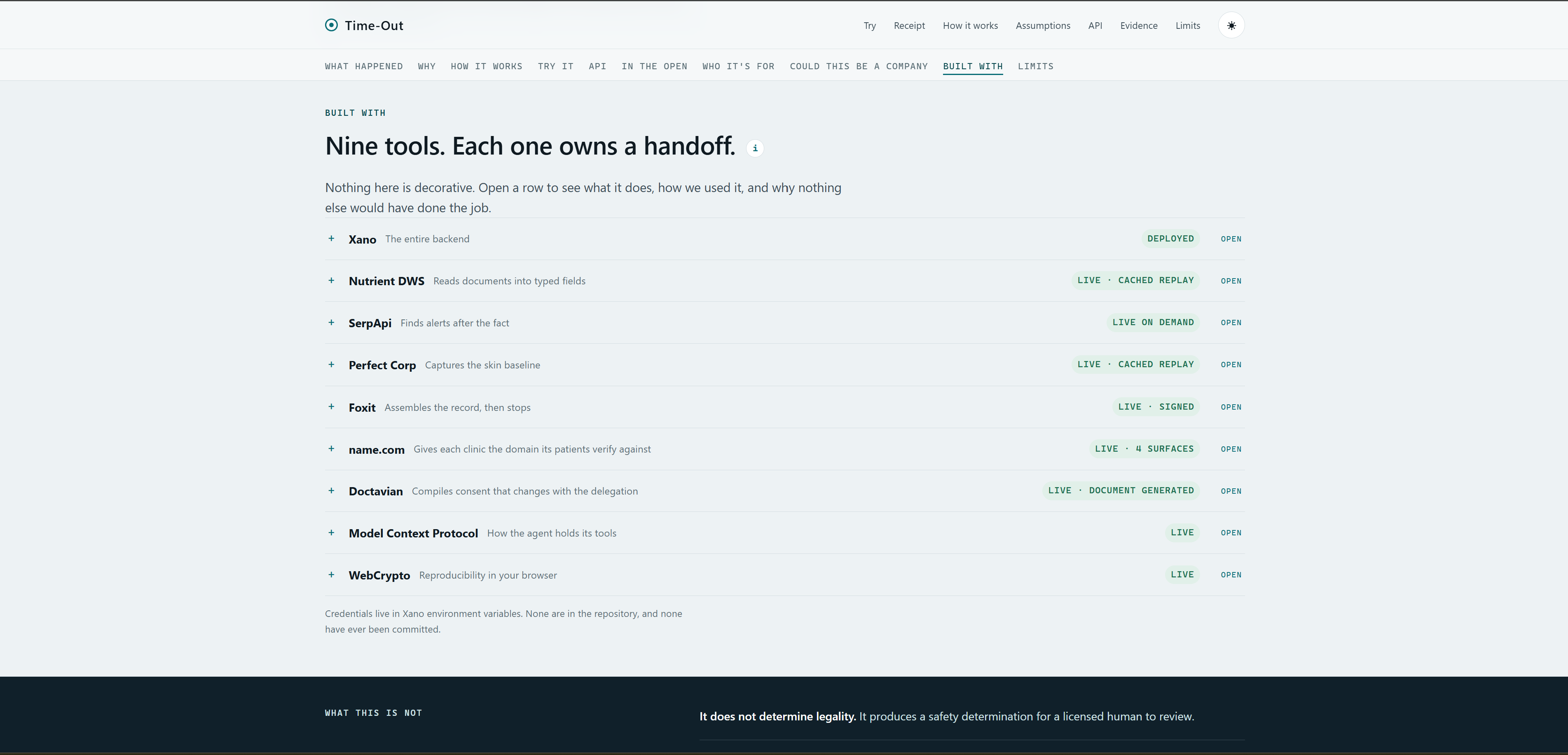
- Xano is the entire backend: 17 tables, 13 public endpoints, 8 functions, the encounter state machine with guarded transitions, the Gate, an append-only audit log, and the static site. Deployed from the CLI and committed as code.
- Nutrient DWS reads credential, intake and product documents into typed fields with per-element confidence and page coordinates. Anything below the confidence floor routes to a Medical Director before the encounter can advance.
- SerpApi searches FDA warning letters and Texas board actions live. A hit is an alert candidate that can reopen a cleared encounter; a person confirms or dismisses it, and that decision is audited. Our first live search returned the actual April 2026 warning letter.
- Perfect Corp YouCam captures the patient's skin baseline before treatment: twelve scored concerns, overlay masks, skin age. A record the patient keeps. A baseline and communication aid, never a diagnosis.
- name.com publishes each receipt's SHA-256 as a DNS TXT record on a registered domain and reads it back through the API, so verification does not require trusting us.
- Doctavian holds one consent template that branches on the authority pathway, loops over cited disclosures, and calculates only the non-clinical disclosure count.
- Foxit runs the assembly agent: from a plain prompt, through the official Foxit MCP server, to a watermarked three-page record, and then it stops. The attestation is a human eSign action, and it was signed: envelope 35704700, status EXECUTED. The agent reads the outcome back but issues only GETs, so it can never act on an envelope.
The API is open on purpose. No signup, no key, no account. You can generate an optional tag that labels your calls in the audit log, and it grants nothing: every endpoint returns 200 with it, with a nonsense key, or with nothing at all. The whole lifecycle works from any client: evaluate the seeded encounter and it comes back BLOCKED, attach the missing evidence, evaluate again and it comes back CLEAR. Verified end to end over plain HTTP with no credentials.
Challenges we ran into
Doctavian returned TEMPLATE_READ_FAILED and I twice concluded it was unwinnable.
Both times I was wrong. The payload needs a root data wrapper that the docs do not
show. Once that was found, generation worked end to end and the consent PDF is committed
and viewable on the site.
Two of the six attacks returned HTTP 400 instead of refusing. Xano rejects "" for
a required text input, and "" is precisely how a caller says "the delegation document
is absent", which is the whole aesthetician-swap attack. Making those inputs optional
is what let the attack be expressed at all.
The Gate failed open on a null delegation id, because null != "" is true. Three
null guards, and a test that pins each one.
The signed record contradicted its own signature page. eSign overlays a signature; it does not rewrite the body. So page 1 read "AWAITING HUMAN ATTESTATION" on a document that had just been signed. The wording now holds in both states, and the record was reassembled and re-signed.
A citation the demo points at had rotted. Texas moved its register to a new portal, so every "22 TAC Chapter 169" link returned "the requested file was not found". The frozen rule snapshot keeps the original URL deliberately, because a snapshot exists to record what was cited when it was taken, and repairing link rot inside it would defeat the point. The reader is redirected at render time instead. Link rot is exactly the failure a frozen snapshot is supposed to survive, and it happened to us mid-build.
An em-dash cleanup pass silently deleted the <title> on all seven pages. The regex
matched a title containing an em dash and returned only the text between the tags,
dropping the tags with the dash.
Browsers treat stray text in <head> as the start of <body>, so the title rendered as
body copy in the corner of every page and every tab showed the bare URL.
Three separate bugs were things that existed but could not be seen. The tip
explaining the glossary rendered 6,254px down the home page. The stats rail was
position: sticky and floated over the verdict card. The API playground answered in
0.6 seconds into a pane 884px below the fold, so the button looked dead. All three
passed every automated check, because the checks verified existence rather than
visibility.
Accomplishments that we're proud of
The blocked screen. It took the most iterations and it is the thing that makes this a product rather than a gate. It names four missing documents, cites the rule, and tells you how to fix it.
You can try to break it, live, with your own data. Six attacks, each removing exactly one thing the rules require, each a real call. Or set all nineteen fields yourself, or download the evidence set, edit it and paste it back. Every attempt lands in the append-only audit log with you named as the actor.
Reproducibility you can check without trusting us. Your browser fetches a live verdict, hashes the canonical ruleset itself with WebCrypto, and compares it to the server's fingerprint. They match byte for byte.
The system refuses real patient data. An email address, phone number or SSN in any field is rejected before storage, not after. We wrote that guard, then found it rejected legitimate synthetic data because it counted digits across all fields at once, and fixed it to work per field.
Seven sponsor integrations that each own a step nothing else could do, with responses cached so the demo never depends on a third party answering at the moment a judge clicks. And 97 offline tests plus 56 live browser checks, CI green, public repo.
What we learned
A checker that only ever says yes has not been tested. Most of the engineering went into the failure paths, and almost every real bug was found by trying to break our own system rather than by running it correctly.
Verifying that something exists is not verifying that it works. Three of our worst bugs shipped past a green test suite because the assertions checked presence, not position or visibility. Screenshots caught what the tests could not.
The hard part of a safety product is the boundary, not the logic. Deciding where the software stops and a human starts is the design. Everything downstream of that follows.
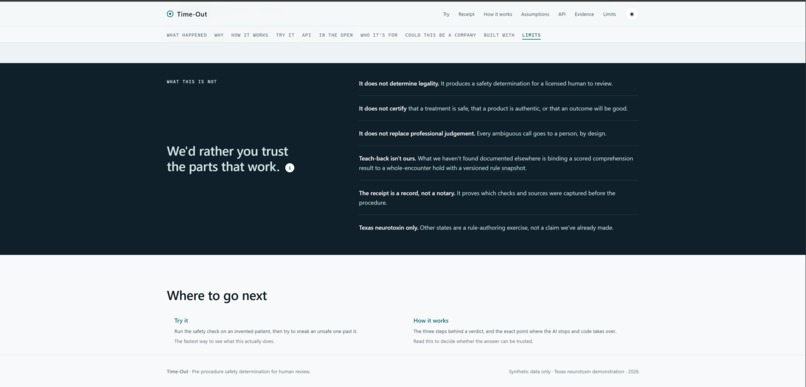
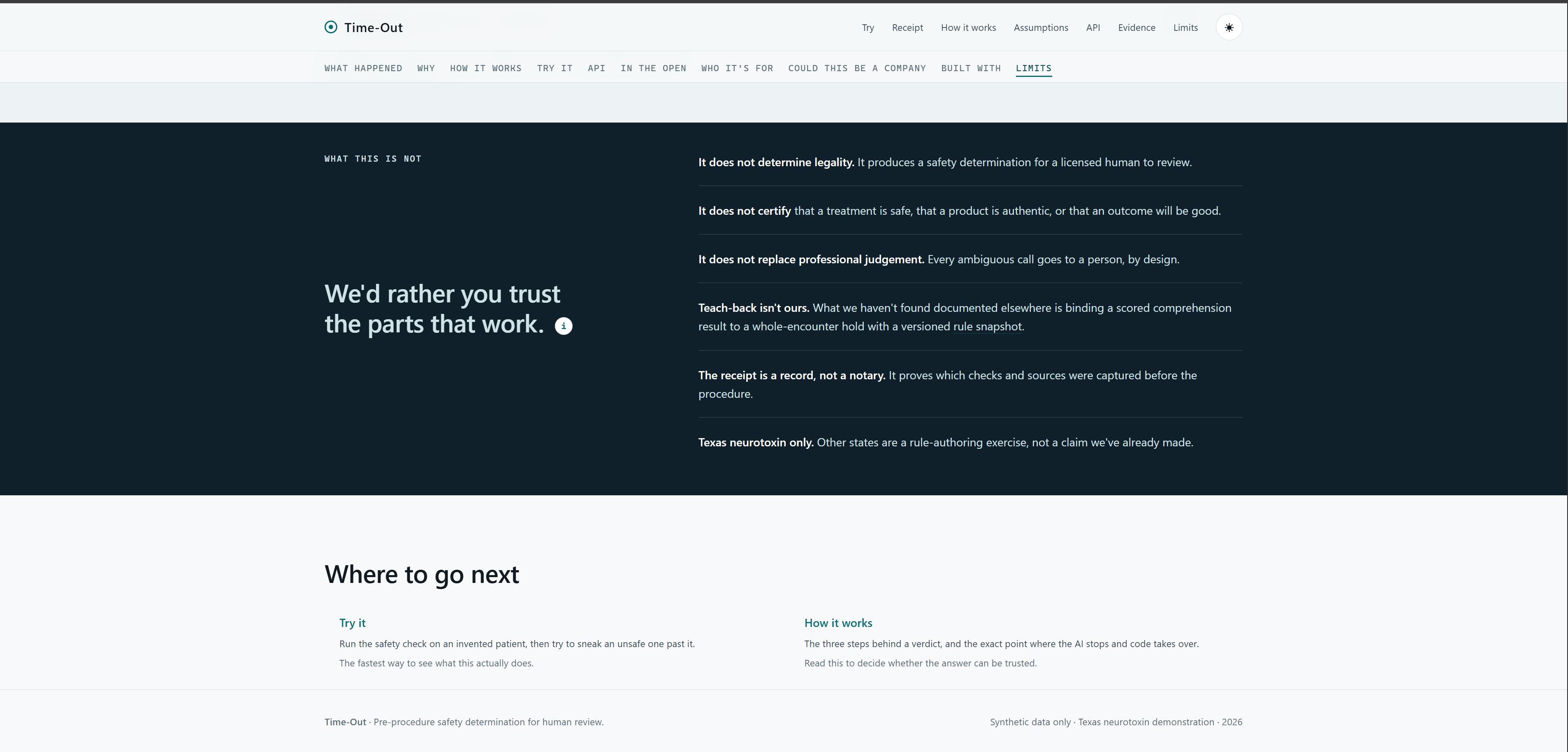
Say what you have not proven. No clinic has used this. We replaced the customer stories we do not have with every assumption the design rests on, every edge case, and the named test that pins each one.
What's next for Time-Out
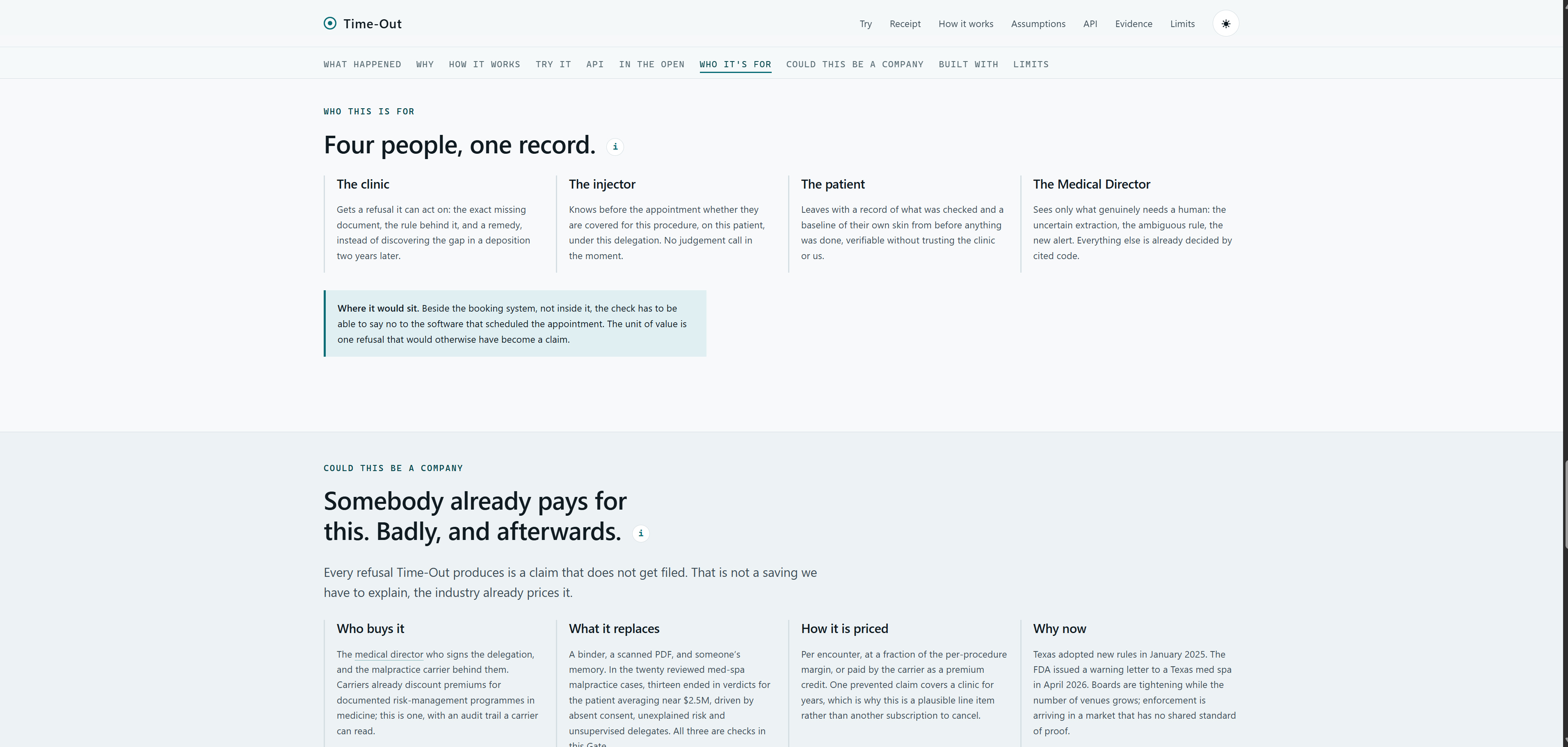
The customer is the clinic, and this sits in front of every procedure they book.
It starts narrow on purpose: Texas, one drug class. Every new state or procedure is a rules file, not a rewrite. The ruleset is data, versioned and hashed, so adding Florida or dermal filler is rule authoring plus review, not re-engineering.
Insurers and defence lawyers already pay for these failures, after somebody has been hurt. Time-Out moves the check to the one moment it is still cheap to fix.
Before the needle.
What would have to be true first: a licensed medical director signing off on the rules for each new jurisdiction, a real credential source instead of synthetic fixtures, and a HIPAA posture that this sandbox deliberately does not have. It refuses real patient data today, on purpose.
Repo: https://github.com/usv240/time-out Live: https://timeout-prod-74602b-x6g0-xqak-a8ri.n7e.xano.io
Built With
- dns
- doctavian
- foxit
- foxit-esign
- foxit-pdf-services
- github-actions
- javascript
- model-context-protocol
- name.com
- nutrient
- oauth2
- perfect-corp
- pkce
- playwright
- pypdf
- pytest
- python
- reportlab
- rest-api
- serpapi
- sha-256
- webcrypto
- xano
- xanoscript

Log in or sign up for Devpost to join the conversation.