-
-
-
-
-
-
-
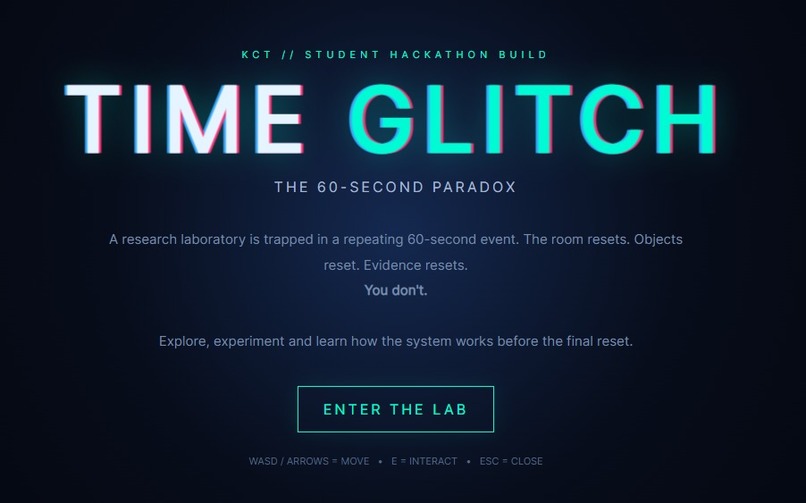
home page
-
-
Inspiration
What it does
How we built it
Challenges we ran into
Inspiration
We were looking to develop an educational game which wasn't a traditional quiz or lesson.
Many technical concepts are provided with formulas, diagrams, definitions and repeated questions. So we thought, how about the player learns by trial and error, makes mistakes, remembers them, and then uses that memory to solve a mystery?
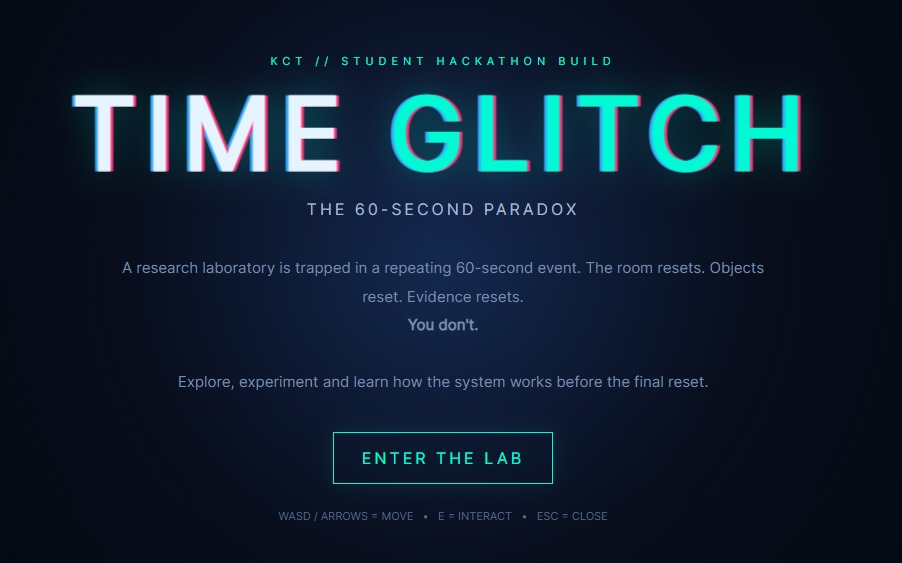
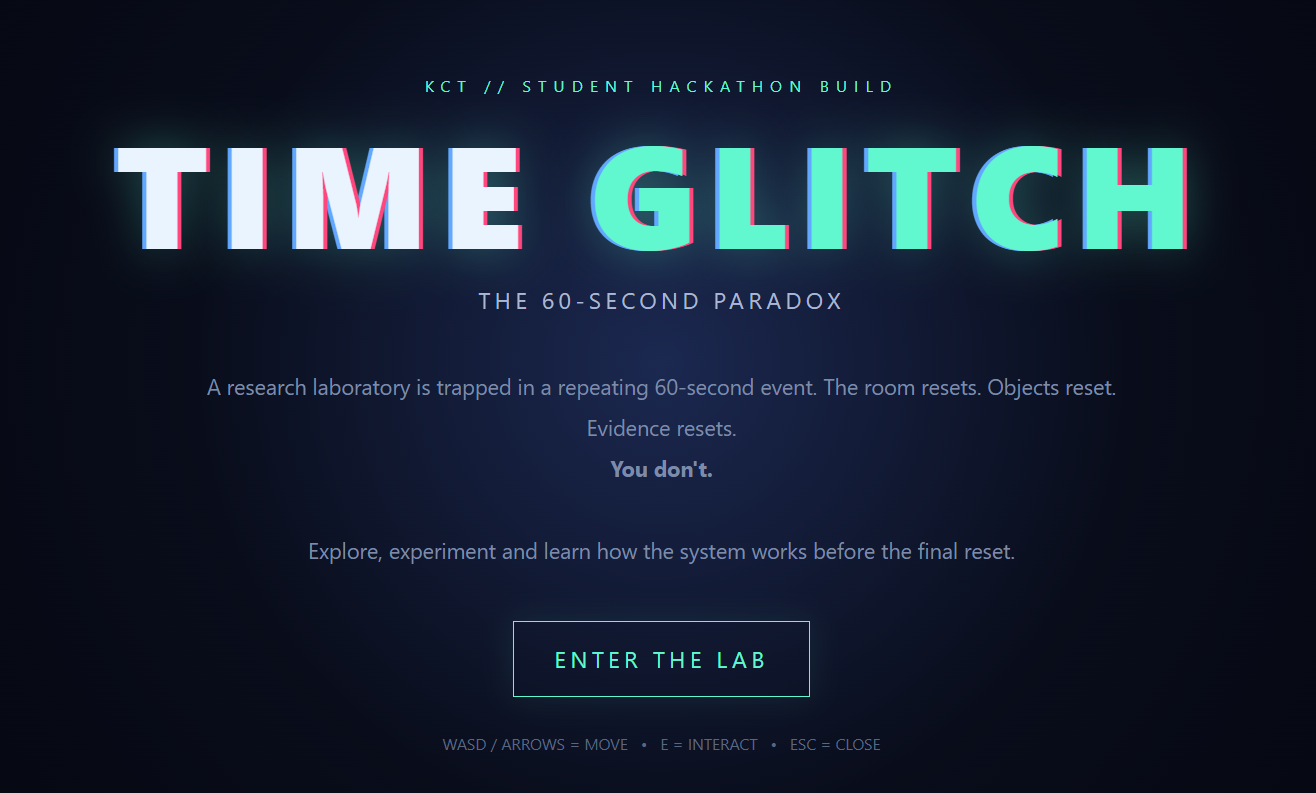
This became the idea of TIME GLITCH — The 60-Second Paradox.
The basic idea is that:
The world resets. Your knowledge doesn't.
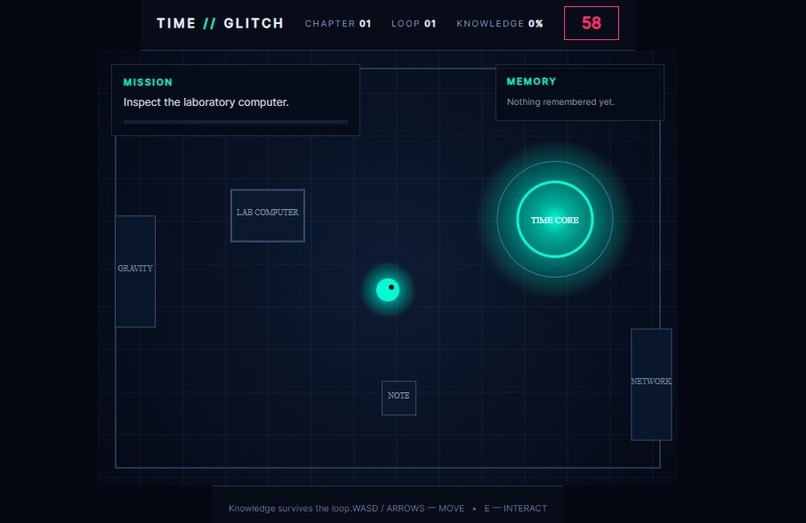
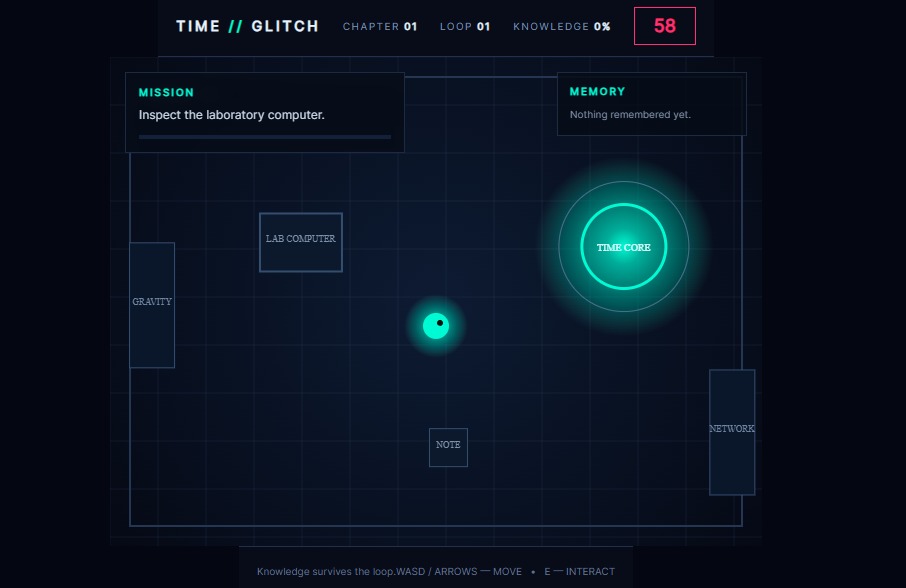
The player finds himself in a futuristic research lab that's being stuck in a 60 second time loop. The environment is reset every 60 seconds, but the player's discoveries and knowledge stay the same.
What We Built
TIME GLITCH is an educational puzzle game for the browser, which merges:
- Storytelling
- Exploration
- Experimentation
- Puzzle solving
- Time-loop mechanics
- Persistent player memory
- Educational concepts
The player is to be tasked with discovering what went wrong in the temporal experiment and investigating the lab itself.
The game poses three major learning problems:
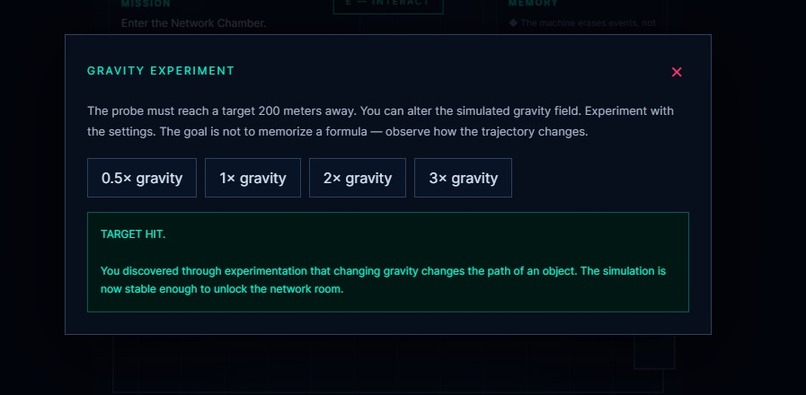
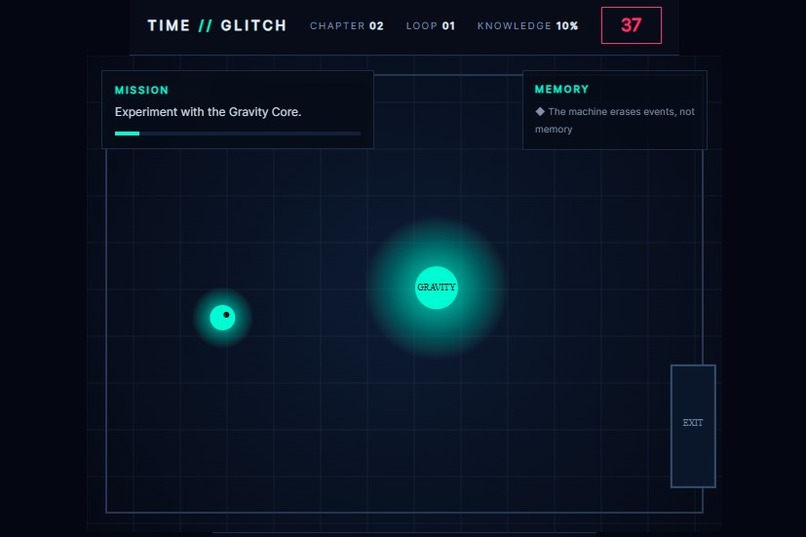
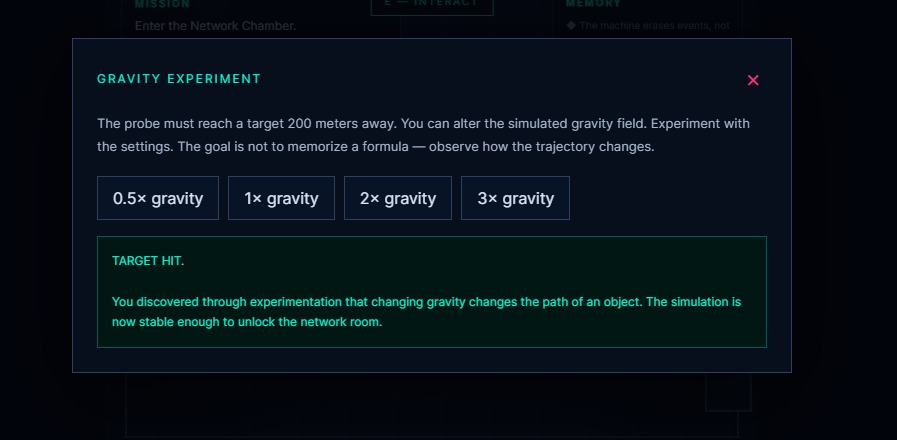
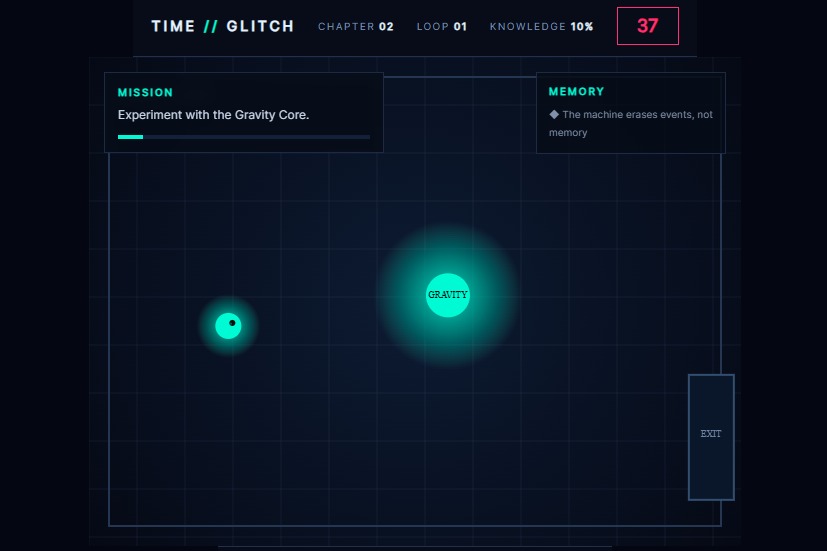
1. Gravity Experiment
The Gravity Chamber is a game in which the player will test various gravities and how they impact the trajectory of an object.
Rather than just asking a physics question, the player learns through:
Experiment → Observe → Learn
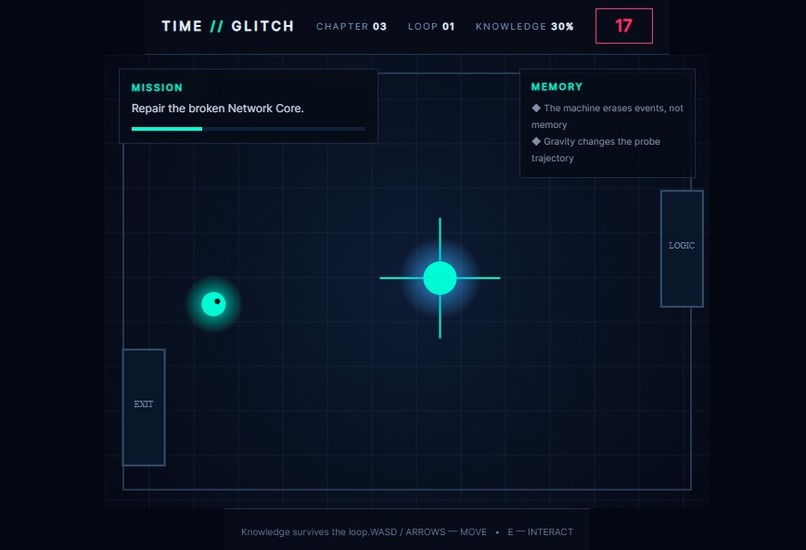
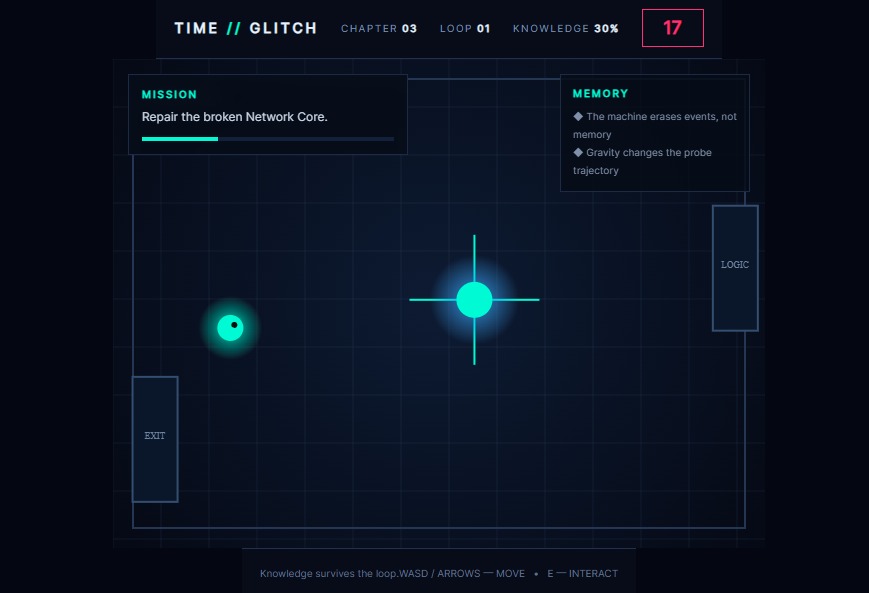
2. Network Routing
The Network Core requires that the player send a packet from a player to a server, in the presence of an unavailable route.
This includes the following concepts:
- Network paths
- Routing
- Packets
- Alternate routes
- Fault tolerance
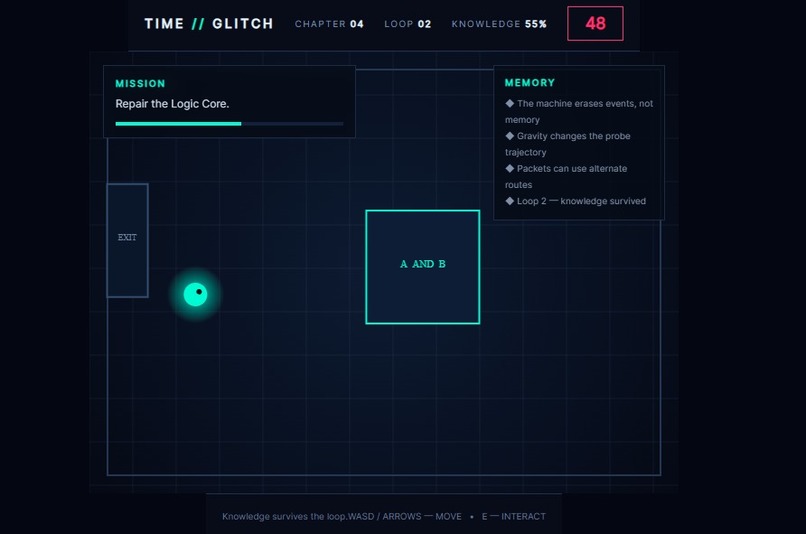
3. Boolean Logic
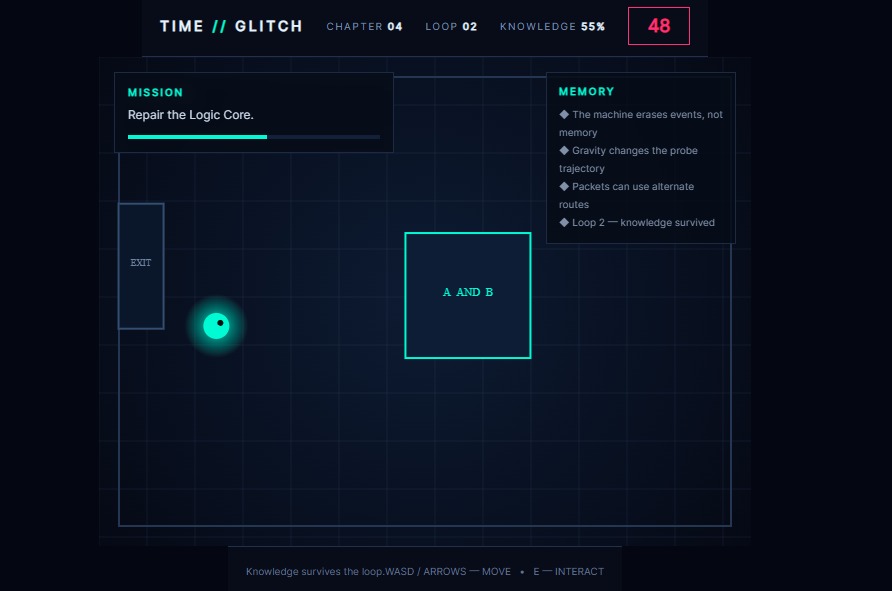
The Logic Core comes with a real-life scenario that calls for a logic condition: When temperature and pressure are both high, the player should trigger the emergency system.
The player should correctly guess the Boolean operation.
This puts programming logic into a real-life context.
Systems Thinking
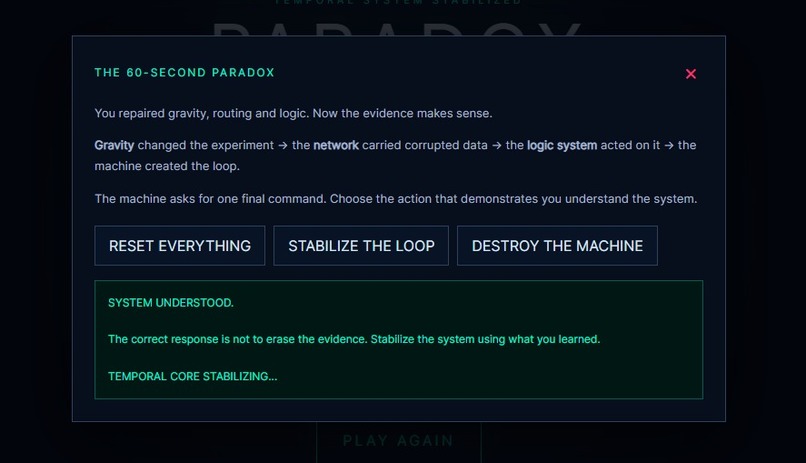
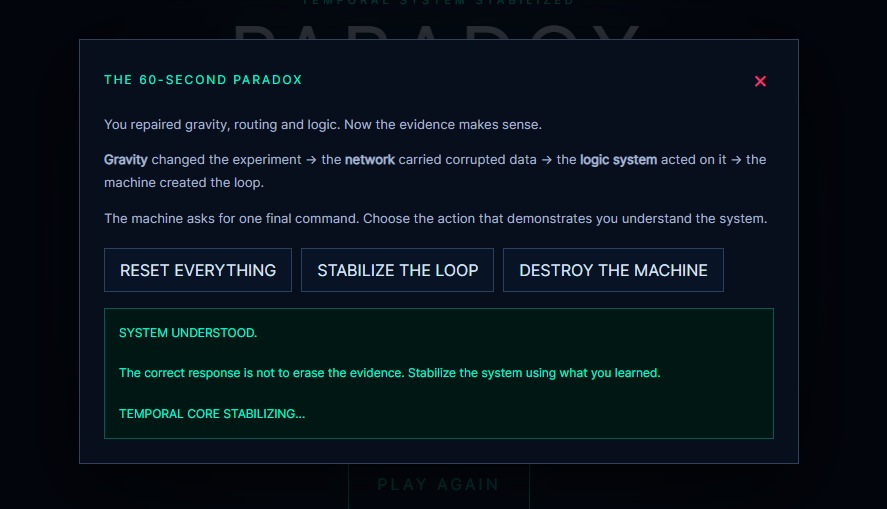
The final puzzle brings all the players' learning together.
The failure is not due to a single part. However, several systems are engaged in interactions:
Gravity, Network, Logic, Temporal Failure
The player is expected to grasp the link between these systems as well as just taking a stab in the dark at the answer.
How We Built It
The project has been developed with the regular web technologies:
HTML5 for the structure of the game.
- CSS3 Interface, Animations, Responsive and futuristic style. JavaScript is used for games logic, interaction, puzzles, timer, progression and state management.
- HTML Canvas to draw the game world
- LocalStorage to save game progress, memories, etc.- LocalStorage to store game progress and memories permanently
- Browser APIs; keyboard controls and interaction
We didn't want to use any external libraries as it is important for the game to be lightweight and it could be played directly in a browser.
Featuring a 60-second timer, several lab areas, interactive objects, puzzle systems, a knowledge meter, persistent memories, particle effects, and a responsive interface. :contentReference[oaicite:1]{index=1}
The Core Game Mechanic
The most crucial mechanic is persistent knowledge.
Once the timer has reached zero, the laboratory resets. But the player's finds are still there.
A player could, for instance, find an essential experiment log in one loop. On the next loop, they already have an idea of where to search and can concentrate on the next challenge.
This makes failure a part of learning.
It is now the case that the gameplay cycle is:
ExPErimEnt: Explore, Experiment, Fail, Remember, Understand, Solve
One of the key messages that we wanted the game to convey was:
Challenges We Faced
The challenge for us was to integrate learning with action on the game.
We didn't want it to be just a bunch of multiple choice questions, masquerading as a game. All concepts should be used for a reason in the story.
One of the other things that we had to overcome was programming the time loop mechanic without the player feeling like he's going to lose everything every time he resets the environment.
The answer was to incorporate knowledge as a part of the progression system. Memorized important discoveries that enables player to become more efficient with each loop.
We also had to find a balance between the interface so that the player can learn the mission, the time, the knowledge level and memories without drowning the games screen.
What We Learned
Creating TIME GLITCH was a great learning tool for us to understand how game mechanics can be used to learn instead of just present educational information inside the game.
We learned how to:
Create learning activities that are interactive Develop browser-based game mechanics with JavaScript Create a game world using HTML Canvas.
- Handle Game State and Progress
- Ensure there is a countdown and reset system in place Use LocalStorage to store persistent player information.
- Link puzzles in relation to a bigger story Use failure as a part of the learning process Designed a lightweight and responsive interface.
First and foremost, we learnt that a player can learn a concept much more naturally if they are given the chance to experiment with it rather than being told the answer.
Future Vision
TIME GLITCH has the potential to be scaled up into a bigger education game platform.
Future modules may include:
- Data Structures
- Algorithms
- Operating Systems
- DBMS
- Cryptography
- Artificial Intelligence
- Mathematics
- Chemistry
We also look forward to things like multiplayer learning, teacher dashboards, performance tracking, and adaptive difficulty.
Conclusion
Our goal with TIME GLITCH — The 60-Second Paradox is to demonstrate that learning doesn't just have to happen in the classroom, in the textbooks and in the quizzes.
The player learns by doing as a time-loop mystery and exploration intertwines with interactive technical challenges.
The world resets. Your knowledge doesn't.
Accomplishments that we're proud of
What we learned
What's next for TIME GLITCH — The 60-Second Paradox
Built With
- css3
- html5
- javascript
- localstorage
- physics

