Inspiration
Tilted started from a simple question: what if multiple people could physically control the same game at the same time?
Instead of giving one player the controls, we wanted every player’s phone to contribute to one shared result. If everyone tilts in the same direction, their inputs reinforce one another. If players disagree, their inputs cancel. That turned a normal marble maze into a social coordination game where communication is part of the control system.
What it does
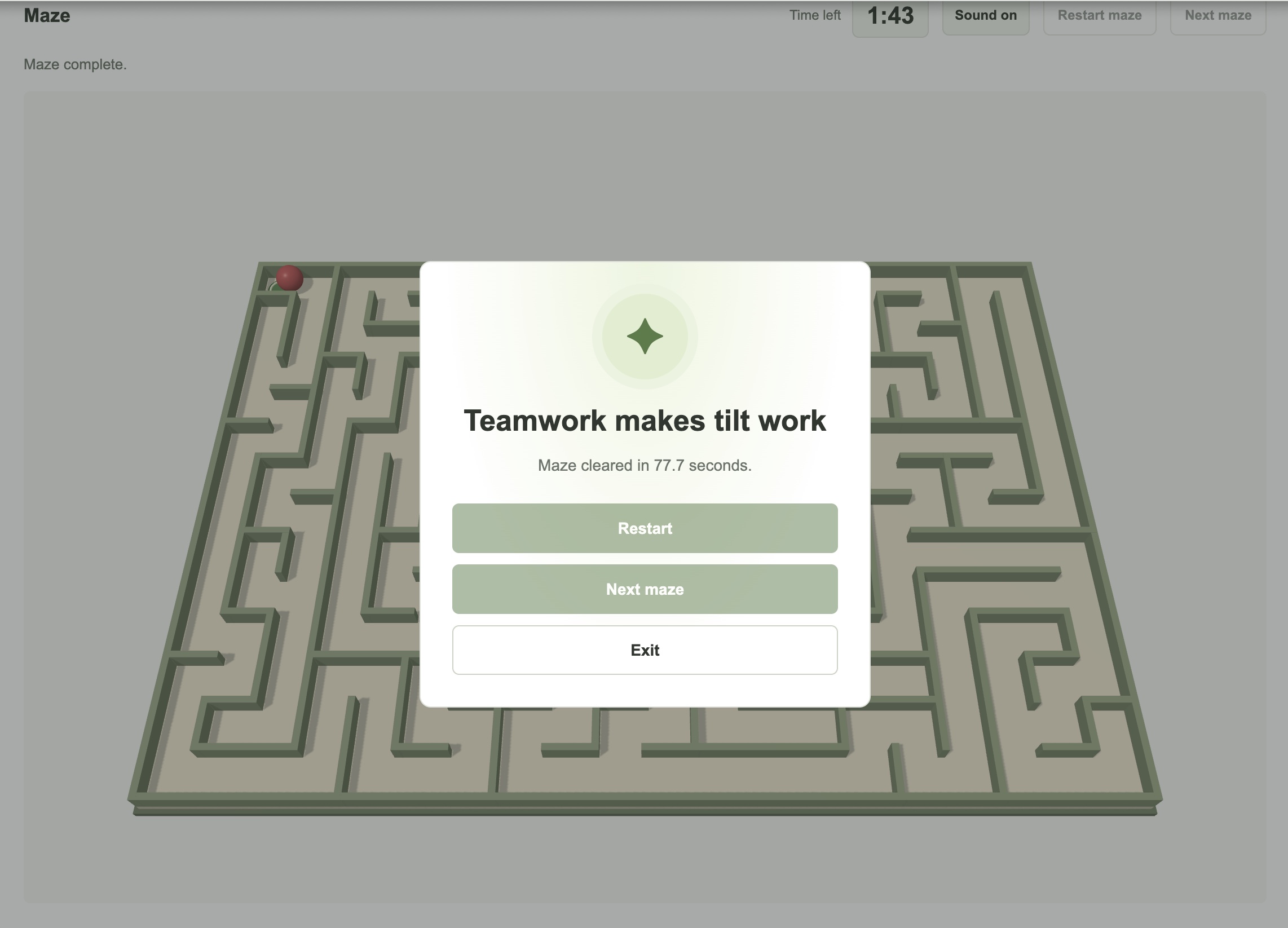
Tilted is a cooperative multiplayer physics game where players use the physical tilt of their phones to control one shared board.
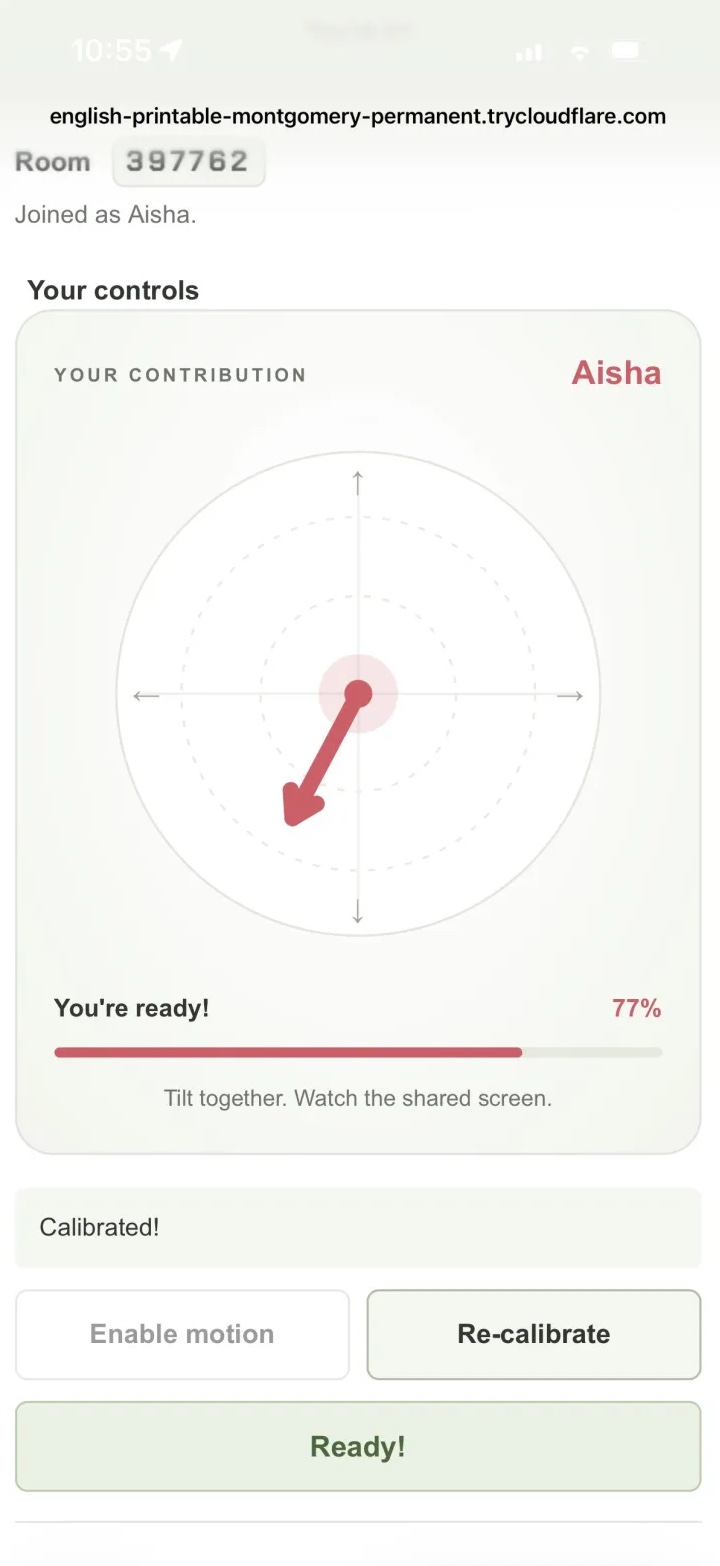
Each phone sends a 2D motion vector representing the player’s tilt. The host combines the players’ inputs into a single team vector, and that resulting direction tilts the game board. The marble then moves naturally through the physics simulation.
The core idea is:
$$[ \mathbf{T} = \frac{1}{N}\sum_{i=1}^{N}\mathbf{v}_i ]$$
where each $$(\mathbf{v}_i)$$ is one player’s input vector and $$(\mathbf{T})$$ is the team’s combined input.
When players coordinate, the marble moves strongly in the intended direction. When they fight each other, the board levels out and the marble slows down.
How we built it
We built Tilted as a browser-based multiplayer experience so players can join from their phones without installing an app.
The project consists of:
- a mobile controller interface for each player
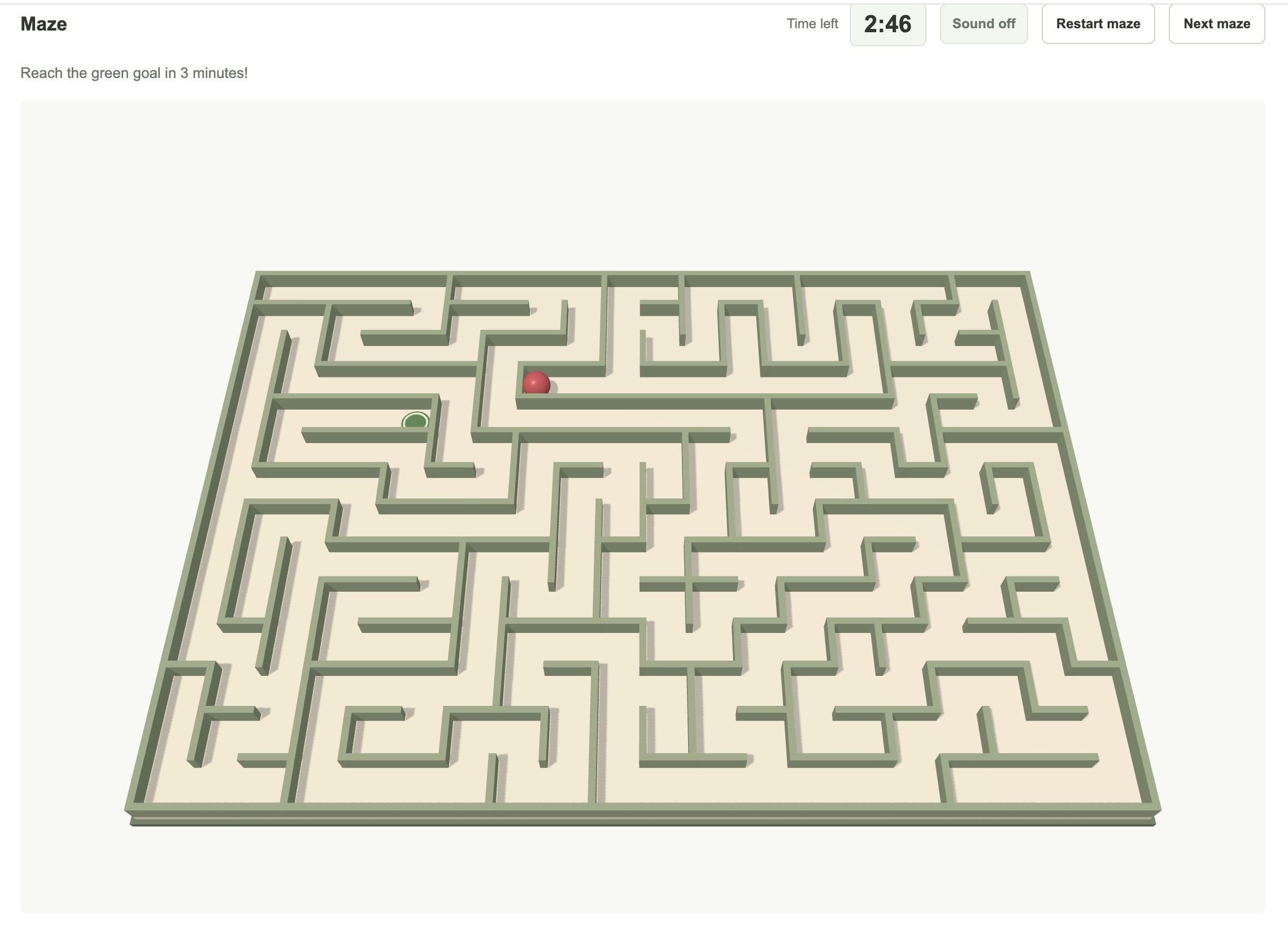
- a host view containing the shared game board and maze
- real-time communication between players and the host
- phone motion/orientation input
- vector aggregation to combine all player inputs
- a physics-based marble and board simulation
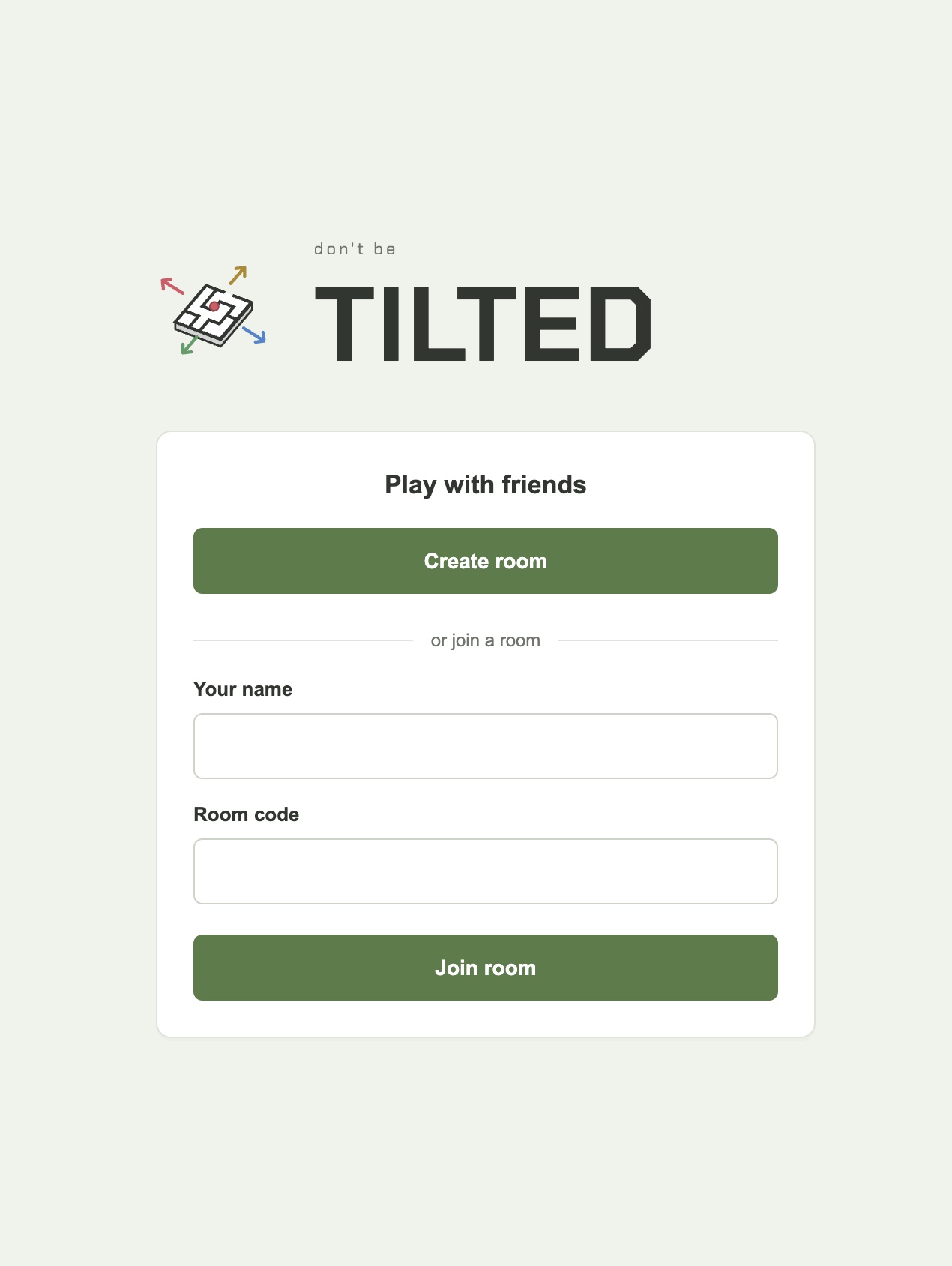
- a lobby and room system for joining a shared game
The phones act as controllers while the host displays the shared world, making it easy for everyone in the room to watch the same result.
Challenges we faced
One of the biggest challenges was translating phone motion into controls that felt natural across different devices.
We also had to decide what the players should actually control. We experimented with the idea of directly moving the marble, but controlling the tilt of the board produced a much more intuitive result: the players control the environment, while physics determines how the marble reacts.
Real-time multiplayer input introduced another challenge. Several phones can send conflicting movements at once, so we needed a consistent way to combine them while keeping the game responsive.
We also spent time refining the user experience around joining a room, calibrating phone orientation, and making the multiplayer interaction understandable without requiring a long explanation.
What we learned
We learned a lot about real-time multiplayer architecture, browser motion sensors, coordinate systems, physics simulation, and synchronizing input from several independent devices.
More importantly, we learned how much game design can emerge from a very small mathematical idea. Averaging a few vectors sounds simple, but once several people are physically contributing those vectors, it creates communication, conflict, cooperation, and chaos.
That social behavior became the most interesting part of Tilted.
Built With
- codex
- css3
- html5
- javascript
- matter.js
- node.js
- physics
- three.js
- typescript
- vite
- websockets


Log in or sign up for Devpost to join the conversation.