-
-
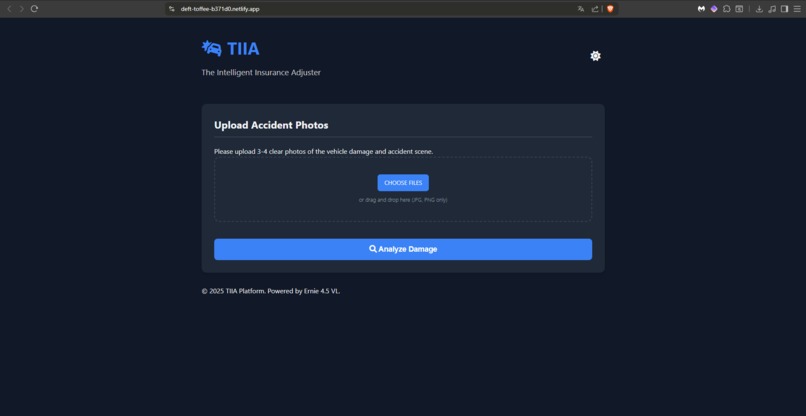
Home Page
-
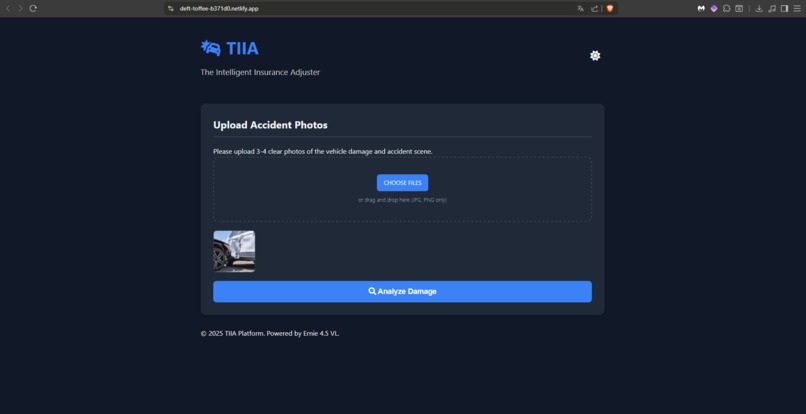
File Uploading
-
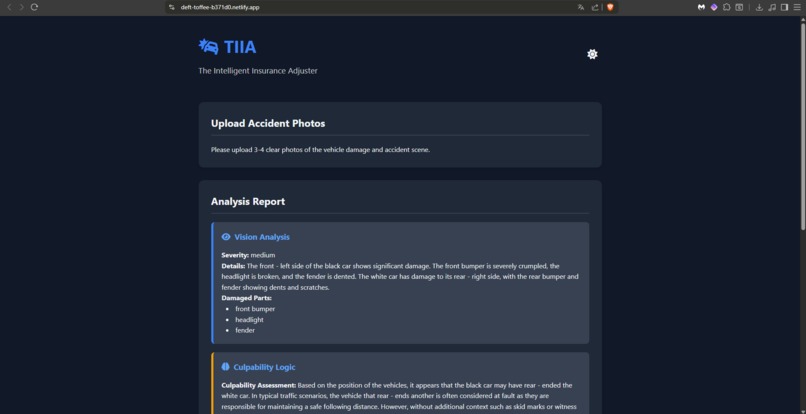
Final Report
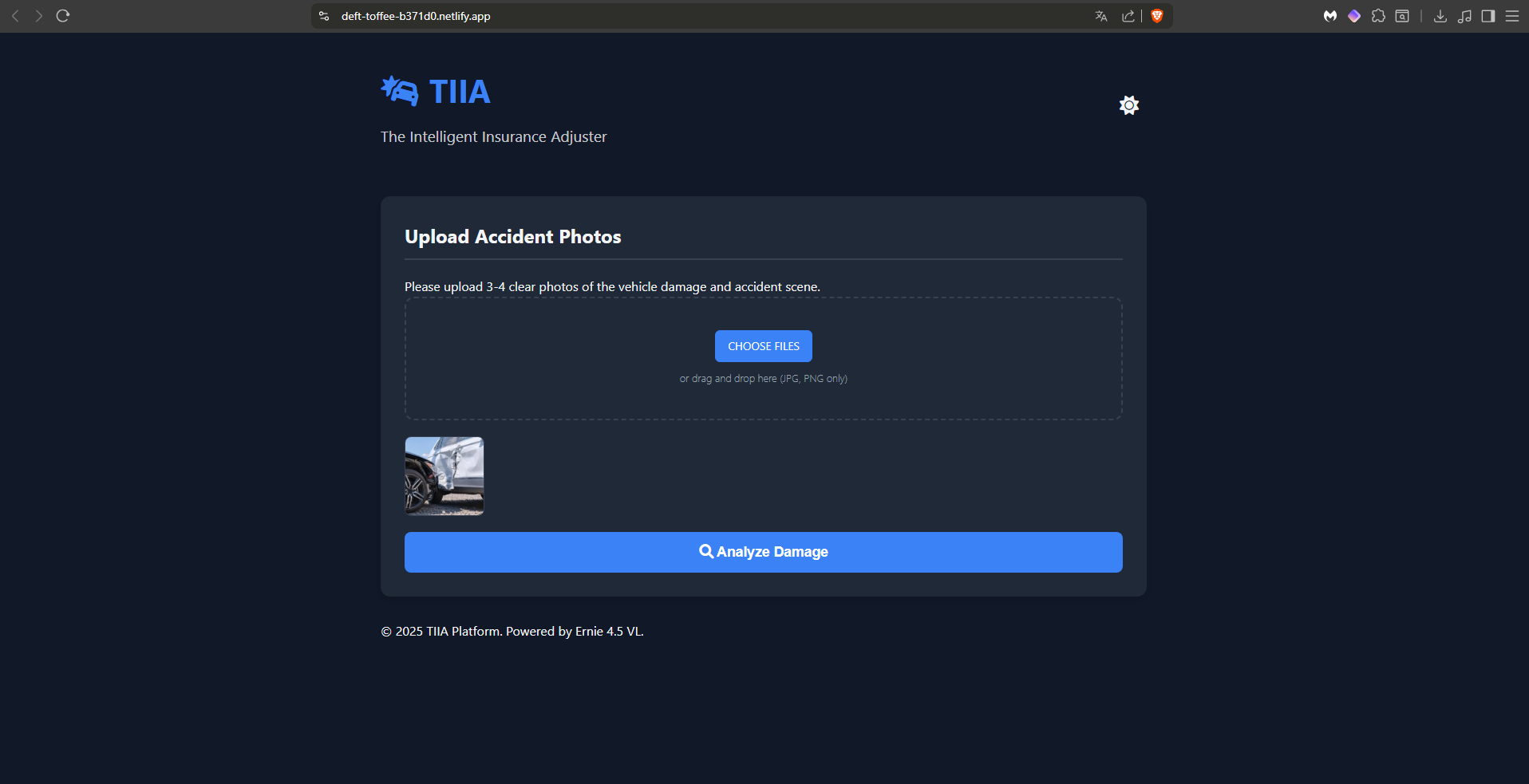
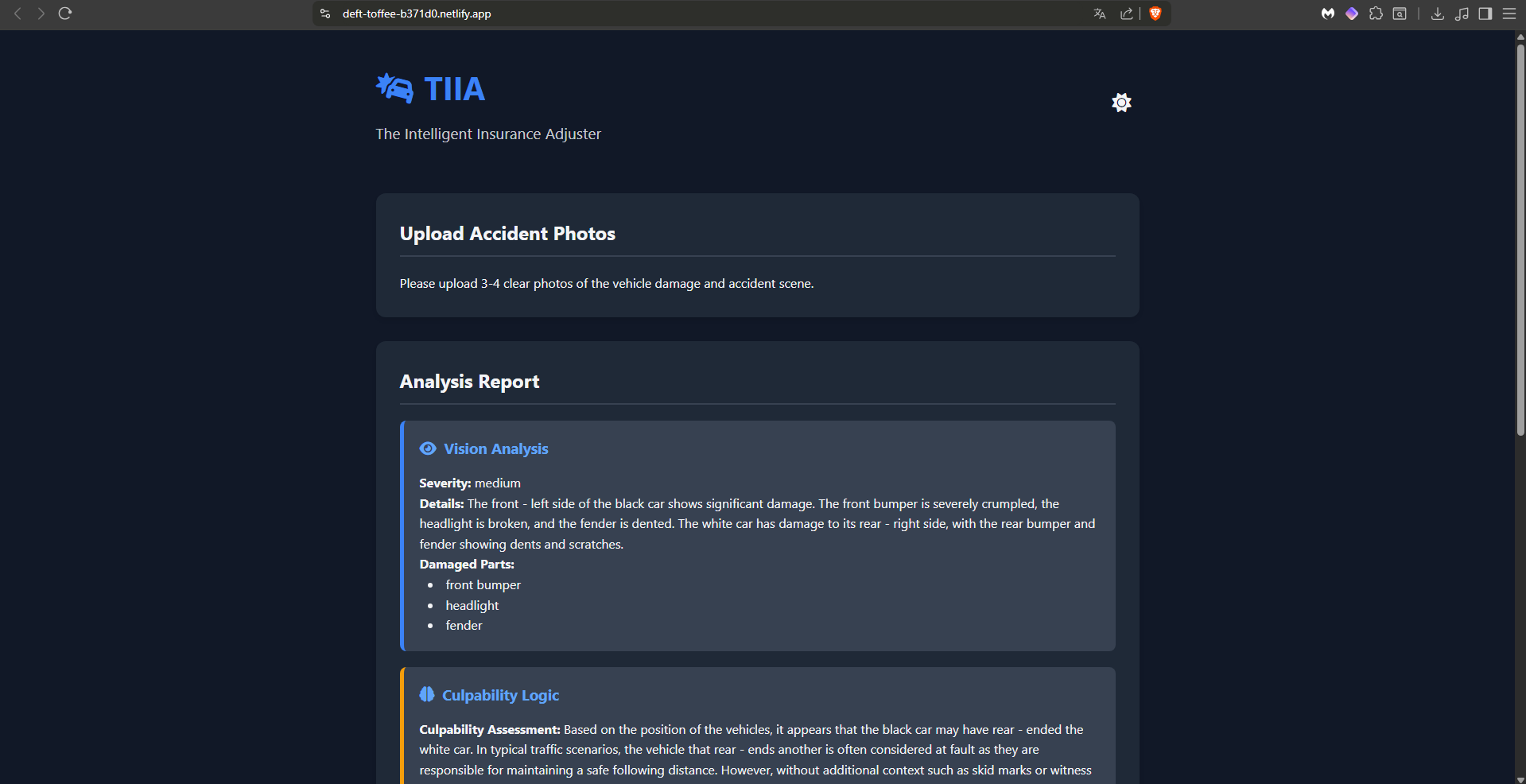
The TIIA Story: Revolutionizing Insurance with Ernie 4.5 VL 💡 Inspiration The inspiration for TIIA (The Intelligent Insurance Adjuster) came from a simple, frustrating reality: the insurance industry is stuck in the past. Currently, if you have a car accident, you have to wait days for a human adjuster to look at your photos, and the process is filled with subjectivity and delays. We realized that with the arrival of Baidu’s Ernie 4.5 VL, we finally had a "brain" capable of not just seeing damage, but reasoning through it. We wanted to build a bridge between raw visual evidence and professional insurance logic.
🛠️ How we built it We architected TIIA as a robust, decoupled full-stack application:
The Brain (Backend): We built a Flask API that acts as the orchestrator. It securely handles image encoding and communicates with the Novita AI endpoint using the baidu/ernie-4.5-vl-424b-a47b model.
The Logic: We designed a sophisticated system prompt that forces the model to perform three distinct cognitive tasks: visual identification, traffic rule reasoning (culpability), and economic estimation.
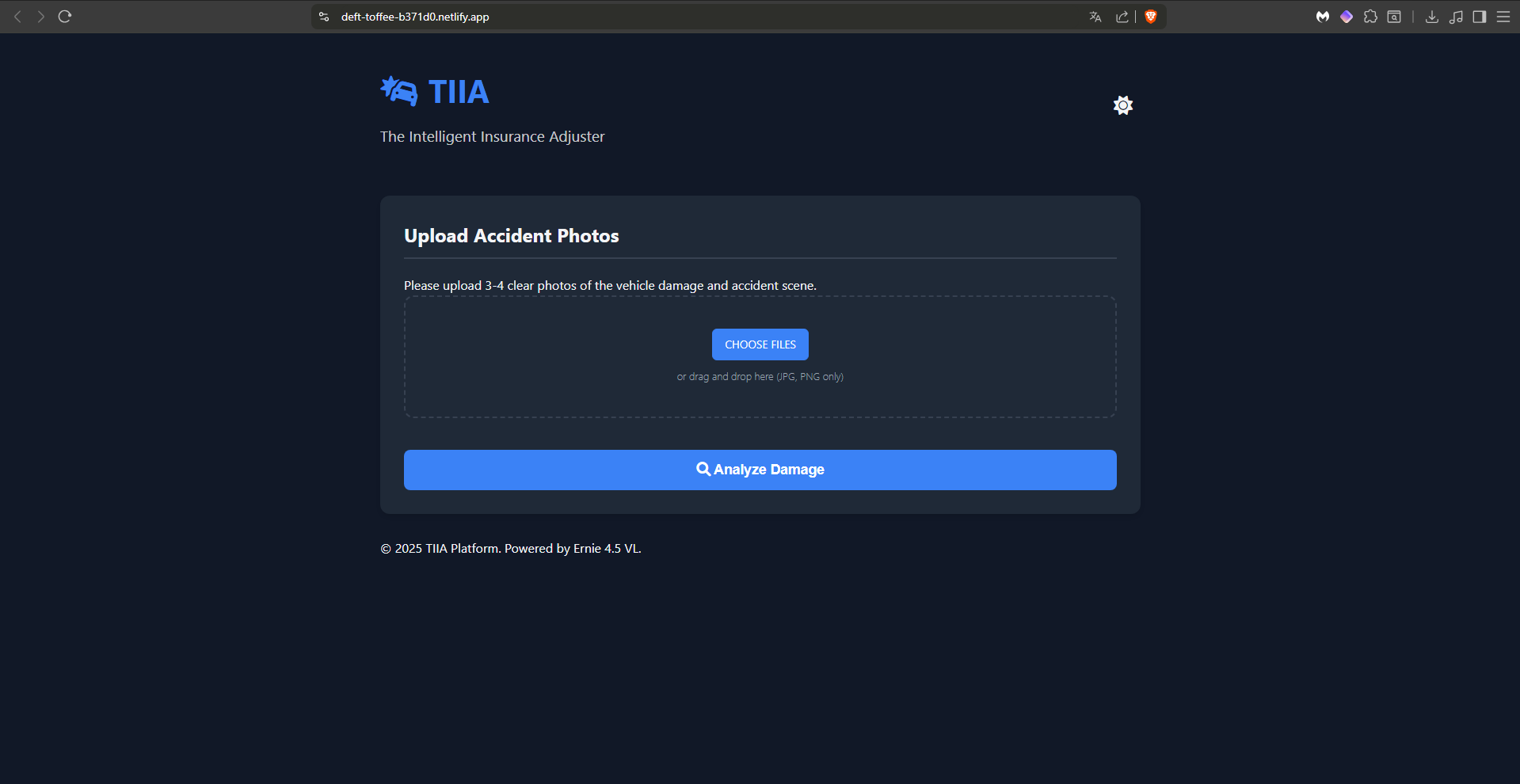
The Interface (Frontend): A clean, responsive dashboard built with HTML5, CSS3, and Vanilla JavaScript. We implemented a dark/light mode toggle and used jsPDF to allow users to download their reports instantly.
The Pipeline: Images are processed in memory, converted to Base64, and sent to Ernie 4.5 VL to receive a structured JSON response that powers our UI.
🧠 What we learned Building TIIA was a masterclass in Vision-Language (VL) orchestration. We learned that:
Context is Queen: Ernie 4.5 VL is incredibly good at spatial reasoning if you provide the right context.
JSON Mode is Life: Prompting for structured data is essential for building real-world apps that don't break.
Multimodal Synergy: The true power of AI isn't just "seeing" or "writing," but doing both simultaneously to solve complex human problems like insurance fraud or liability.
🚧 Challenges we faced It wasn't all smooth sailing. We ran into a few "lol que mal" moments:
Handling Multiple Images: Initially, we struggled with how to send multiple high-res photos without hitting token limits or confusing the model's spatial logic. We solved this by optimizing the image payload and refining the prompt to treat the set as a single "accident scene."
CORS & Deployment: Configuring the backend to talk securely with the frontend across different domains (Netlify and Render) gave us some headaches, but we nailed it by implementing strict CORS policies.
The "Human" Touch: Tuning the AI to estimate repair costs accurately required several iterations of the prompt to ensure it accounted for both parts and labor in a realistic way.

Log in or sign up for Devpost to join the conversation.