-
-
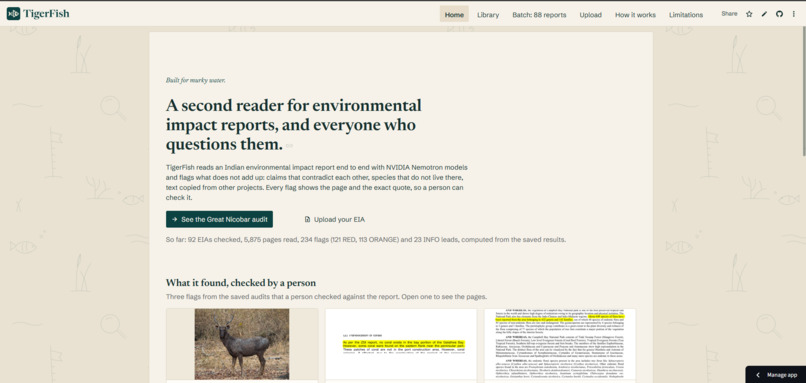
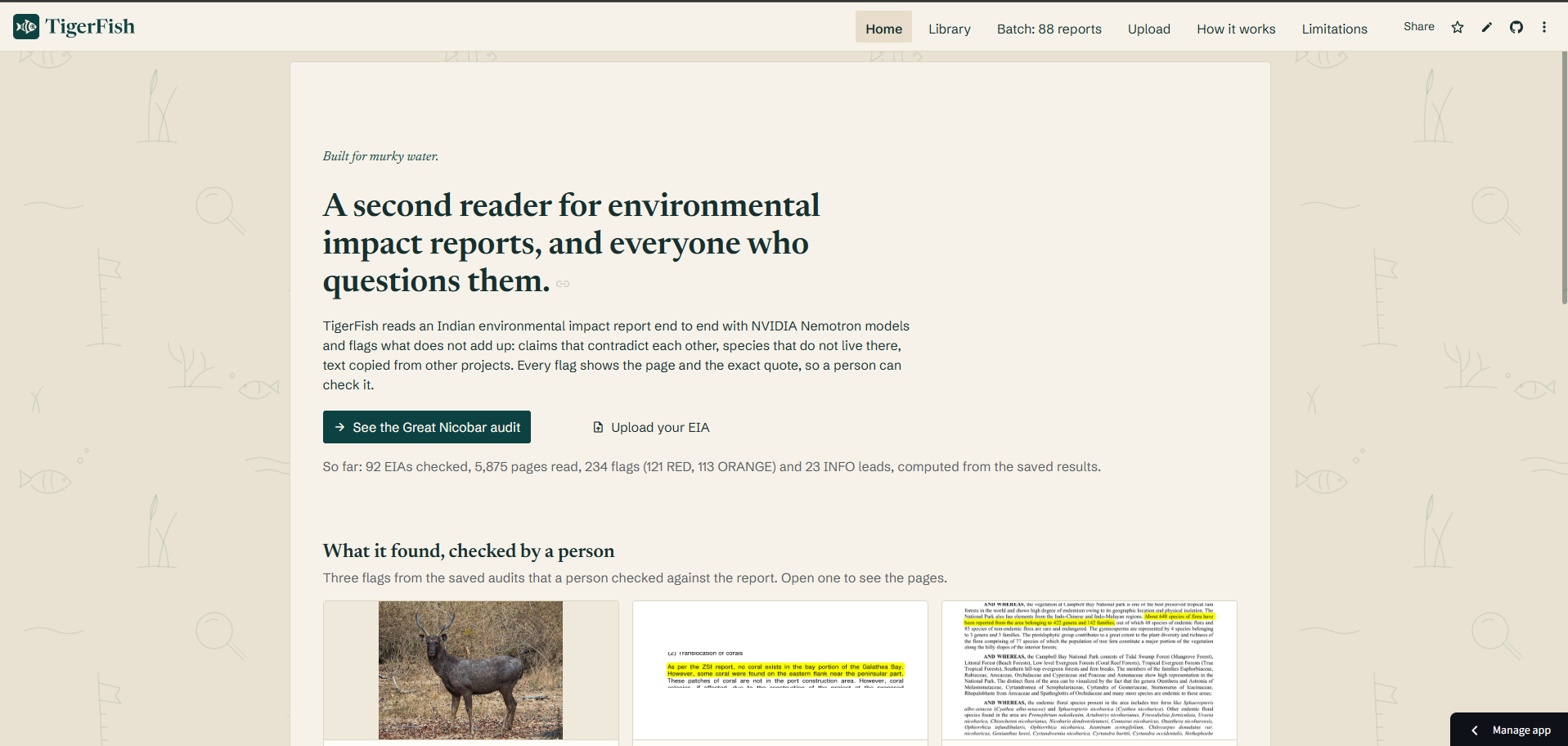
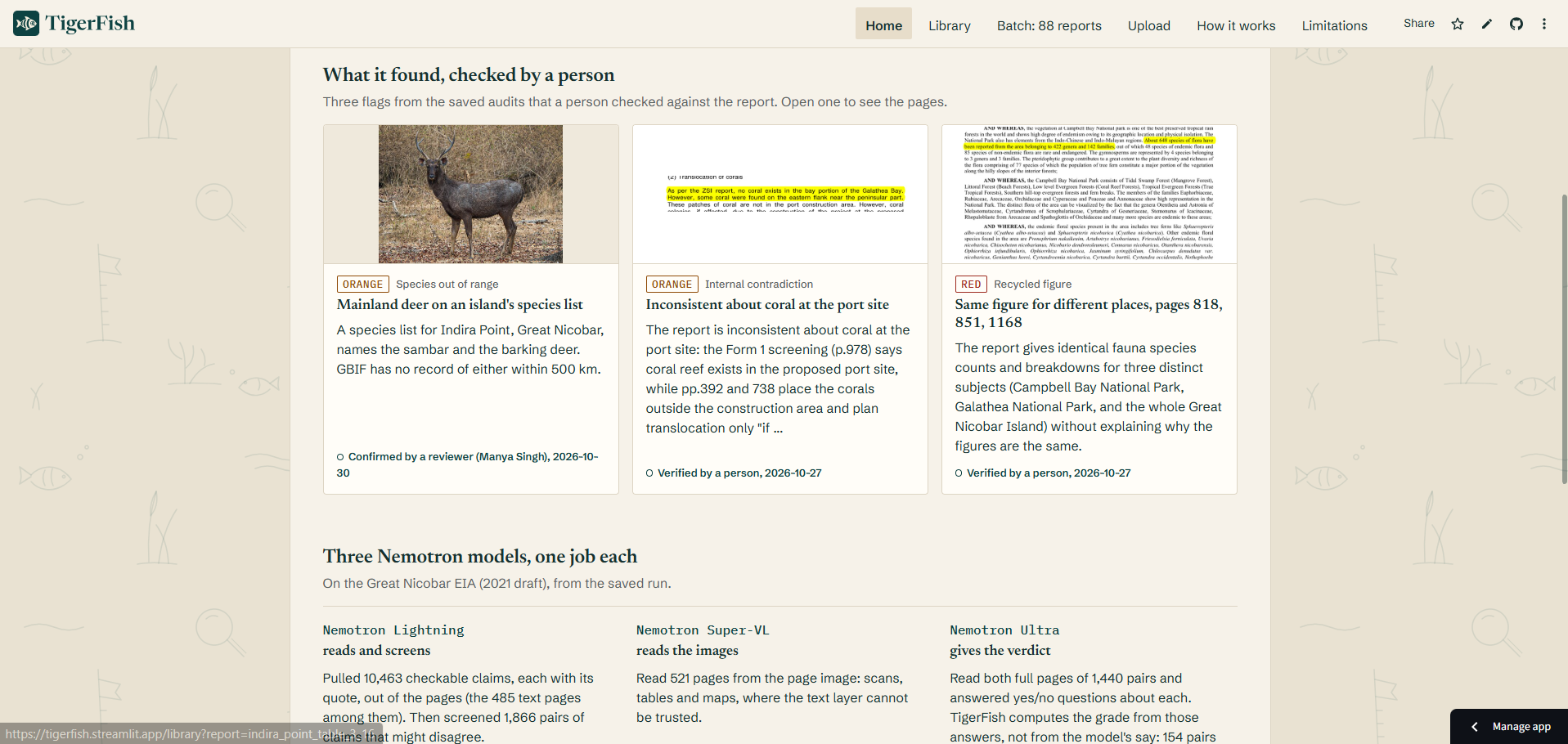
Our landing page
-
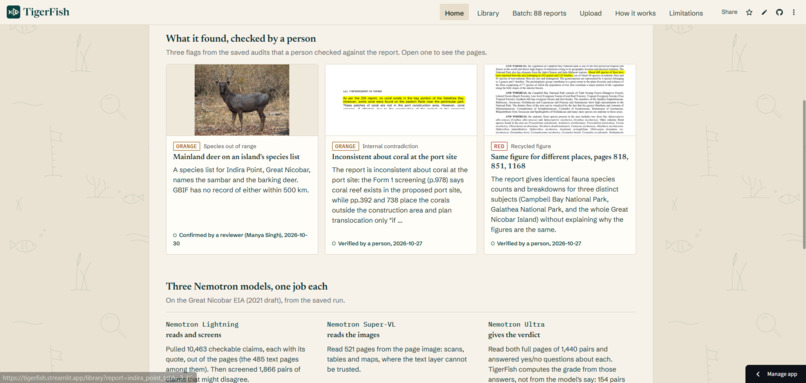
What tigerfish found
-
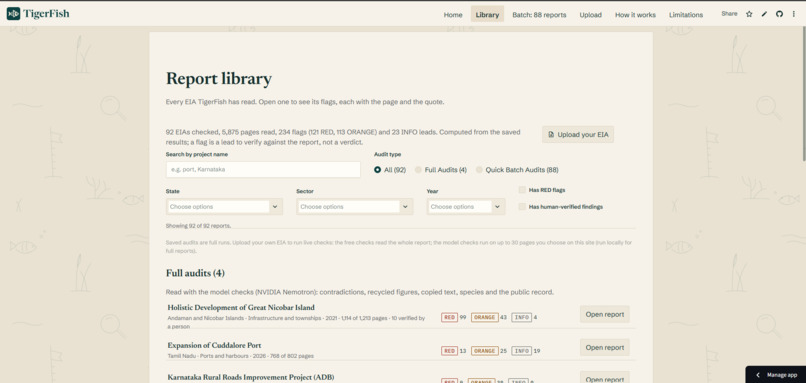
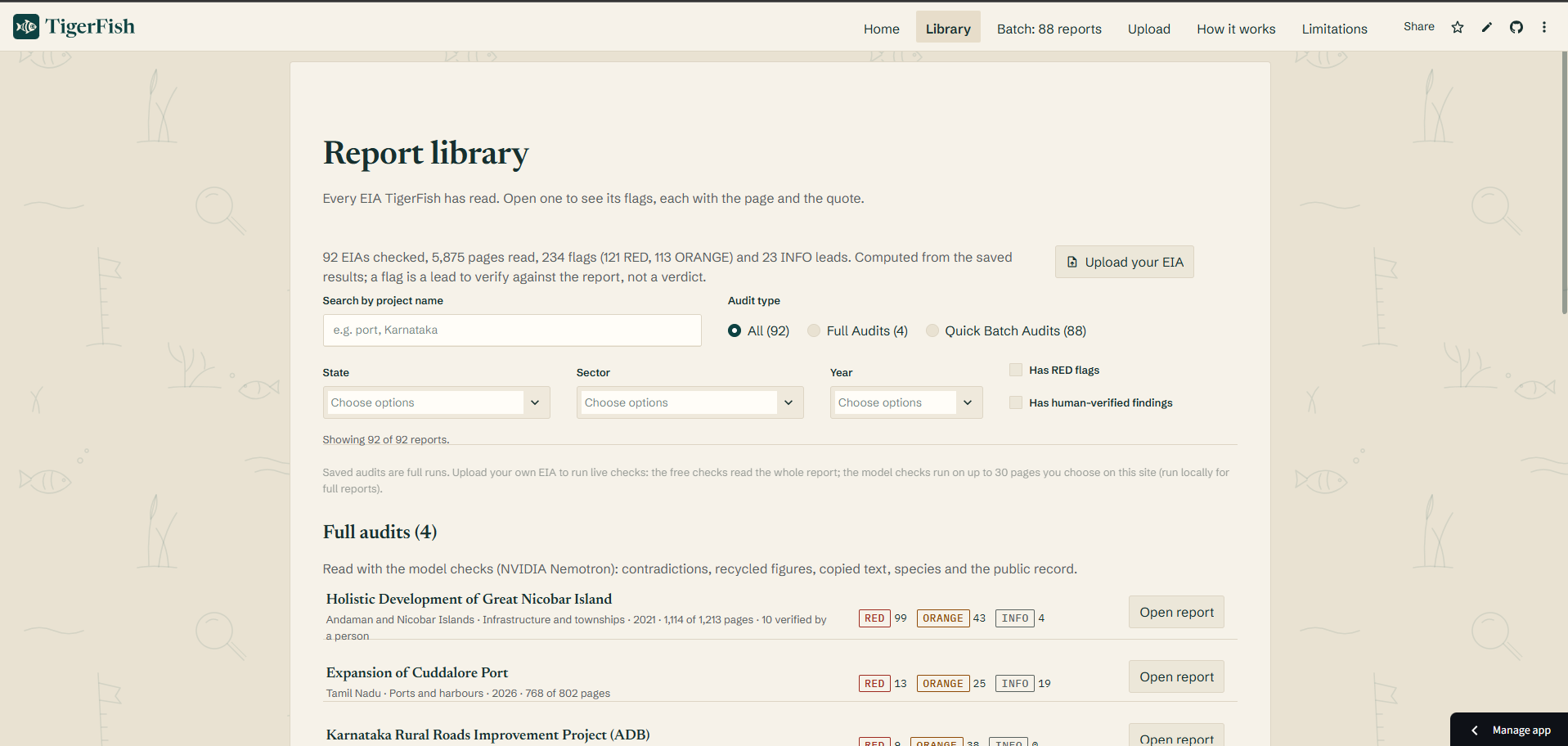
Find an EIA or record you are curious about
-
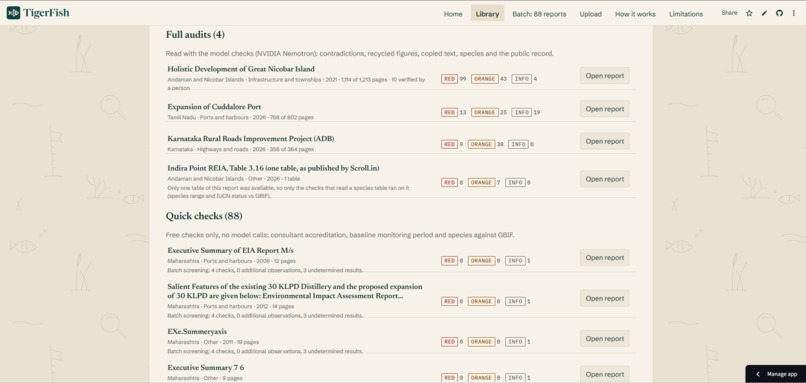
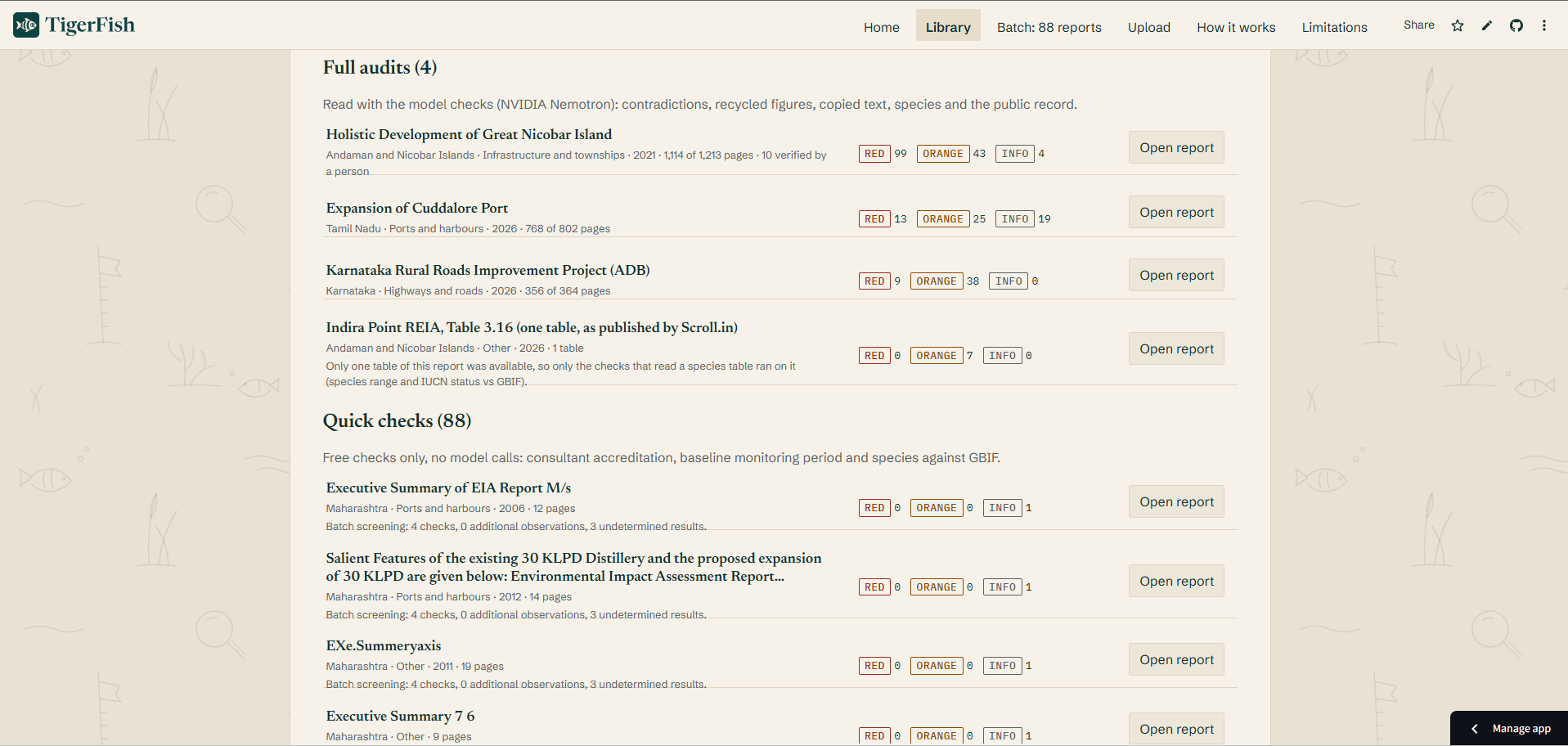
Full audit records and Quick check records in our library
-
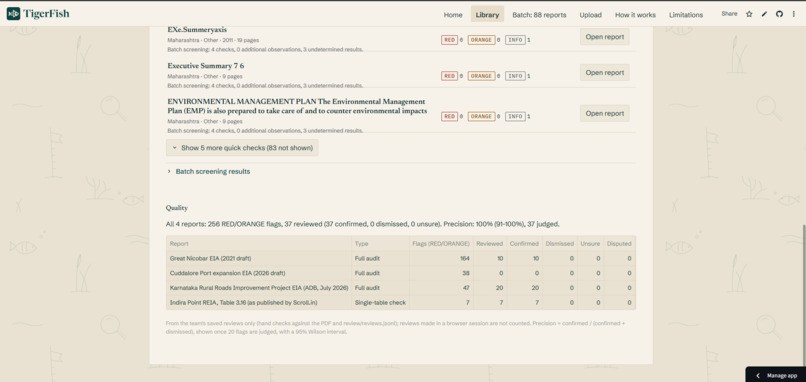
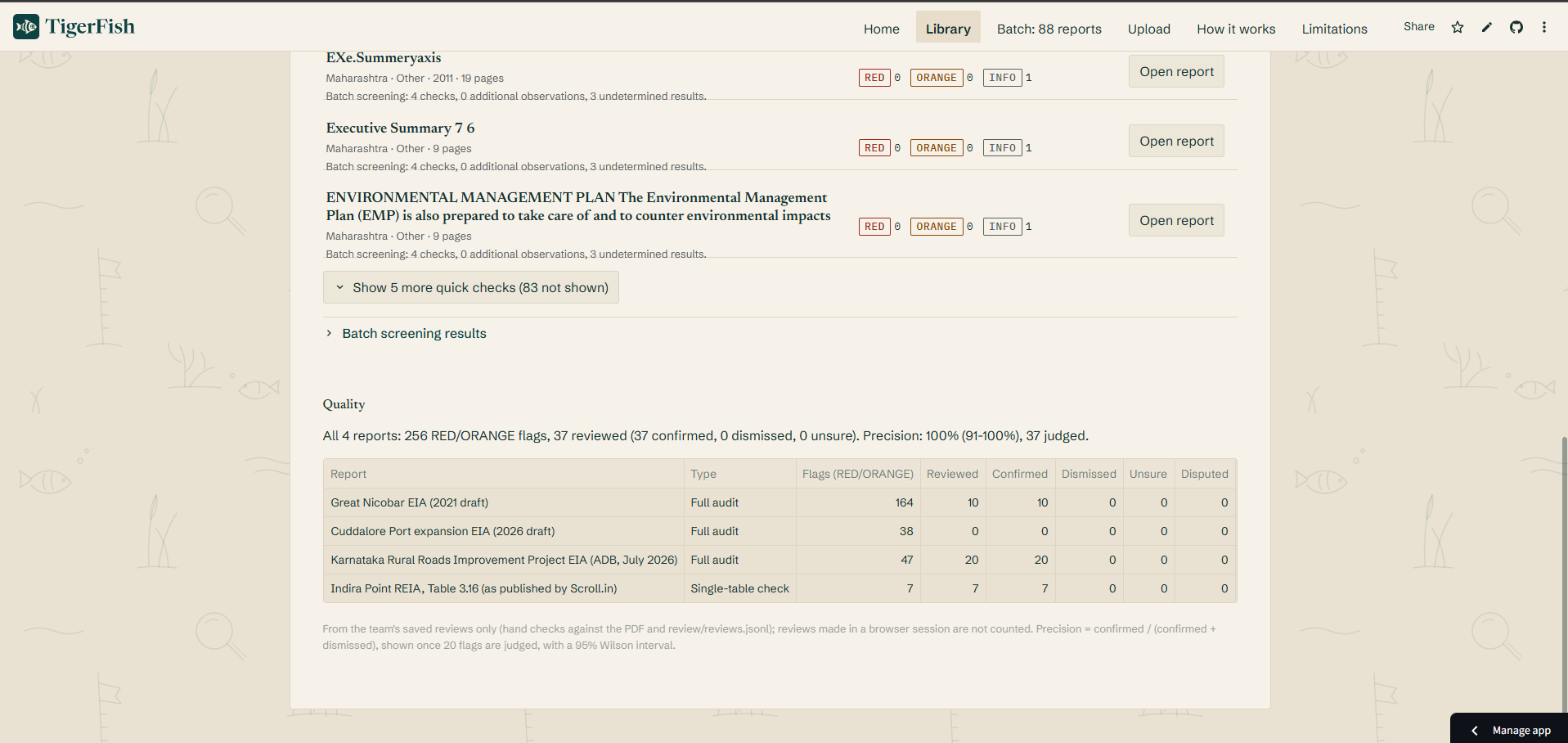
Human verification of flags and precision of Tigerfish
-
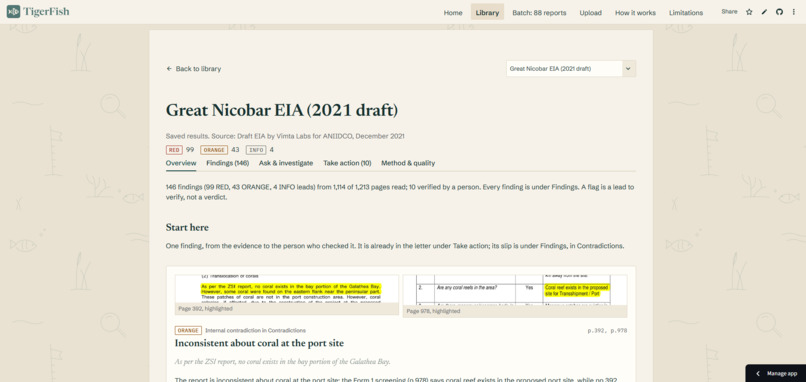
Into a full audit EIA
-
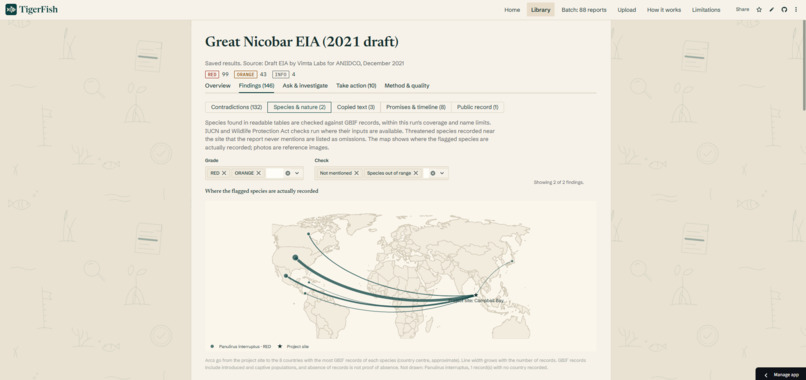
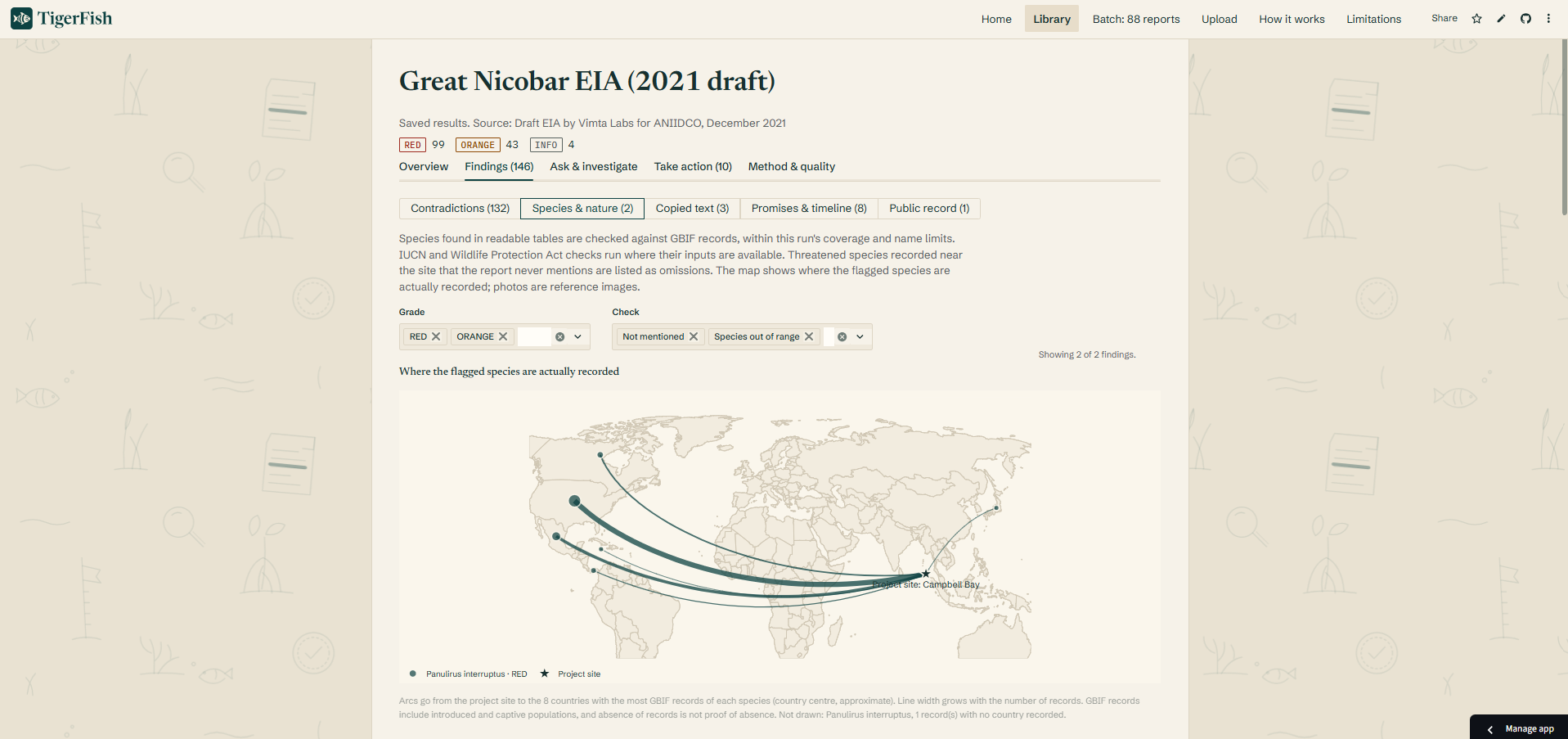
Our visual where flagged species are actually recorded in the EIA
-
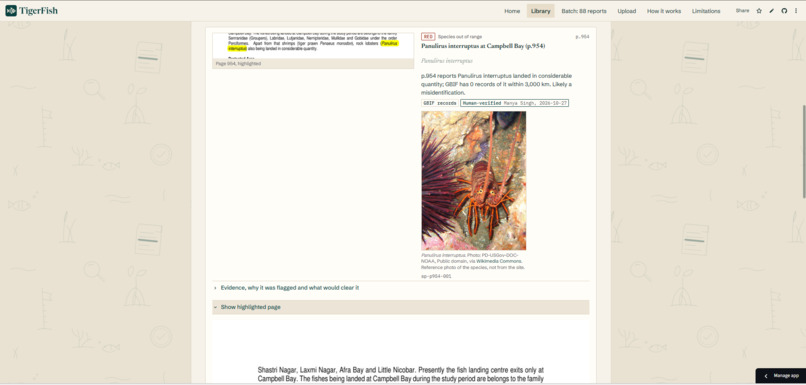
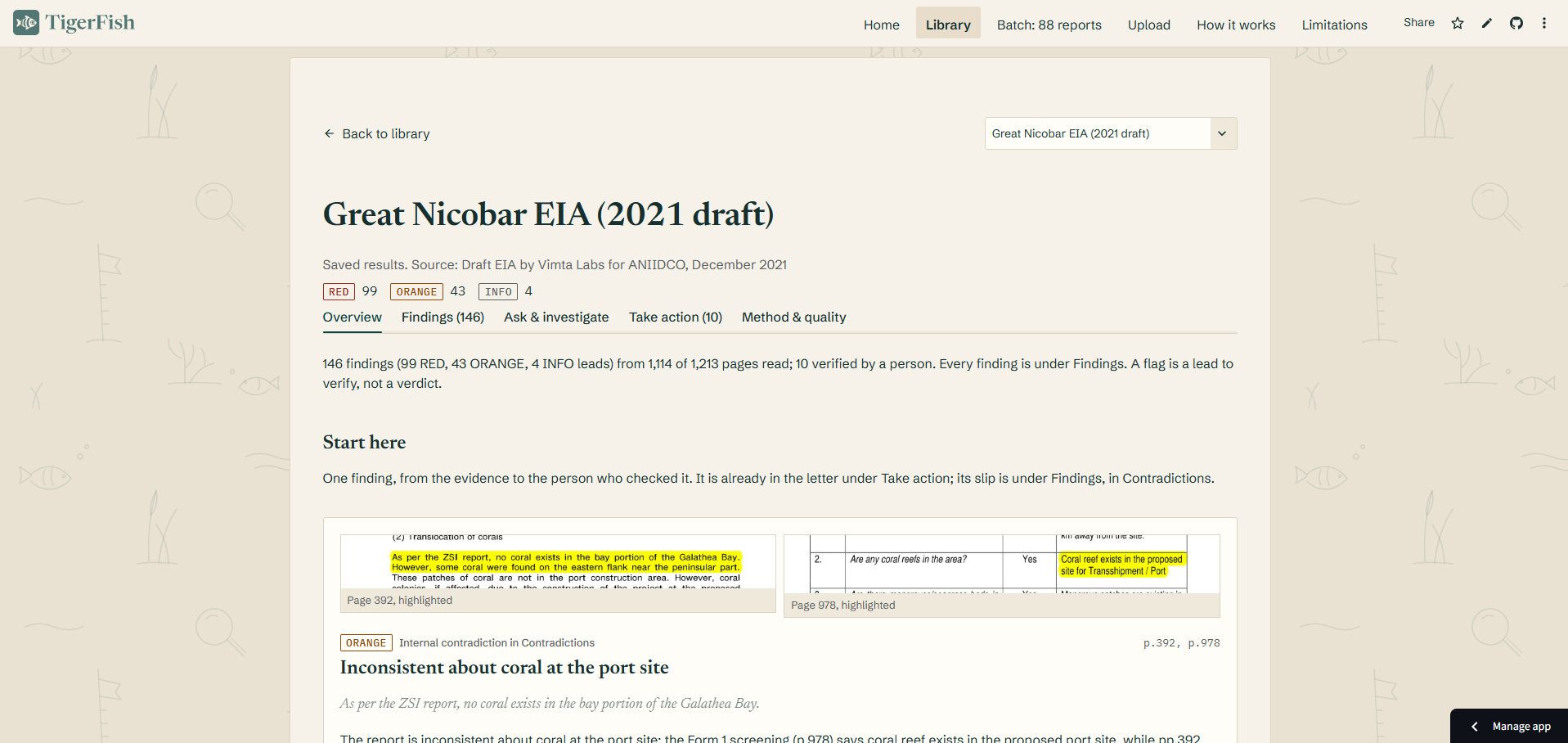
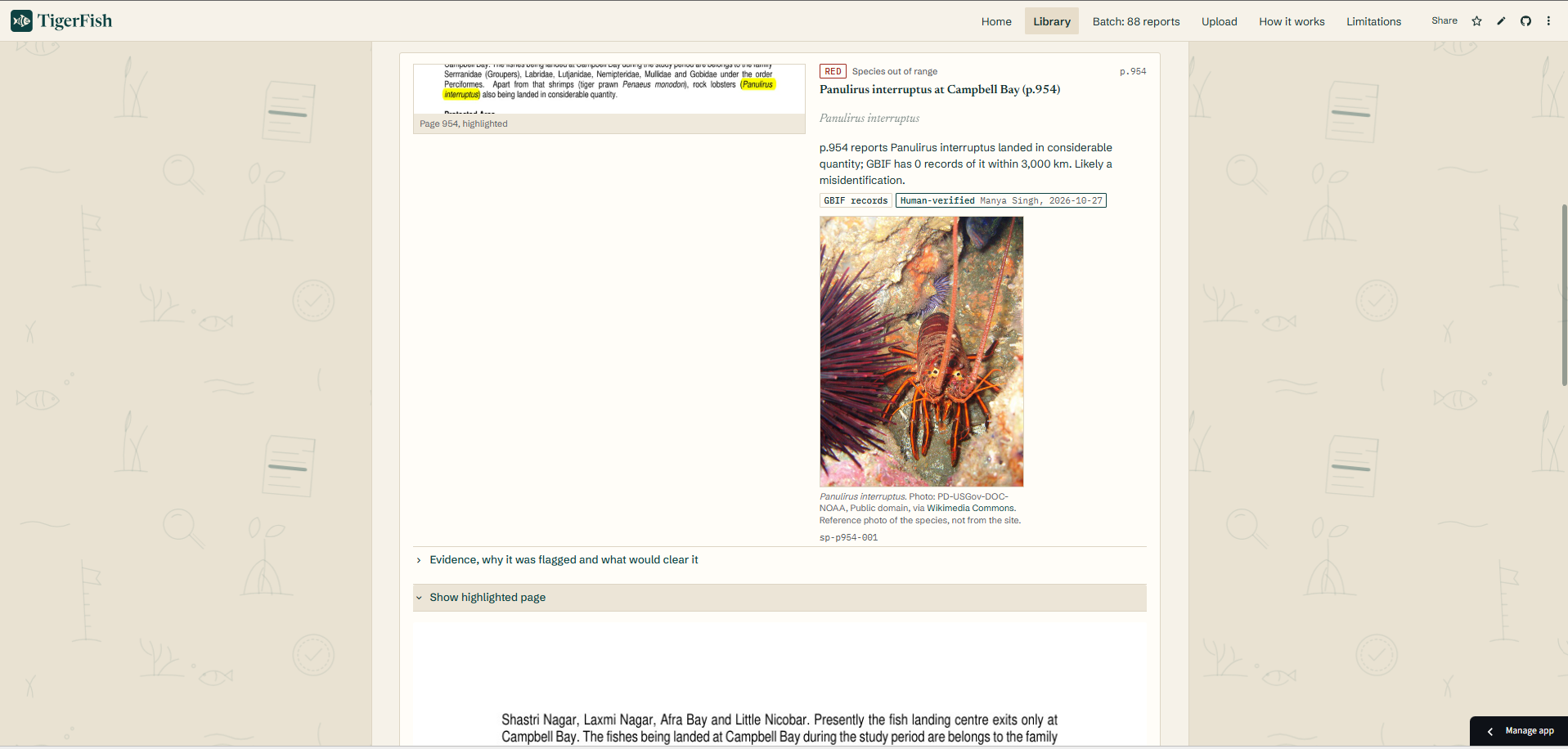
Where exactly did Tigerfish find a flag in the report with all you need to know
-
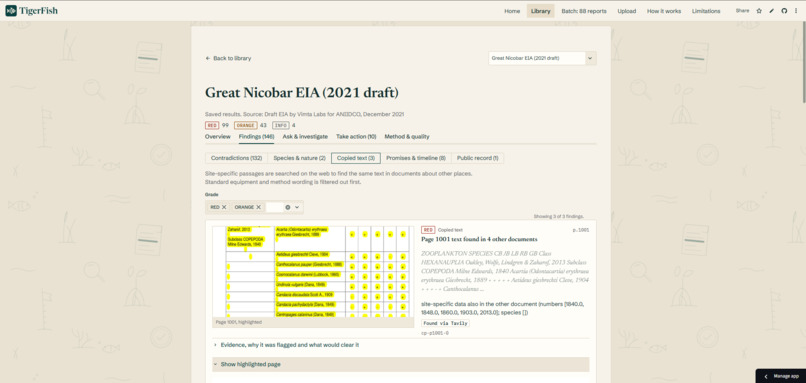
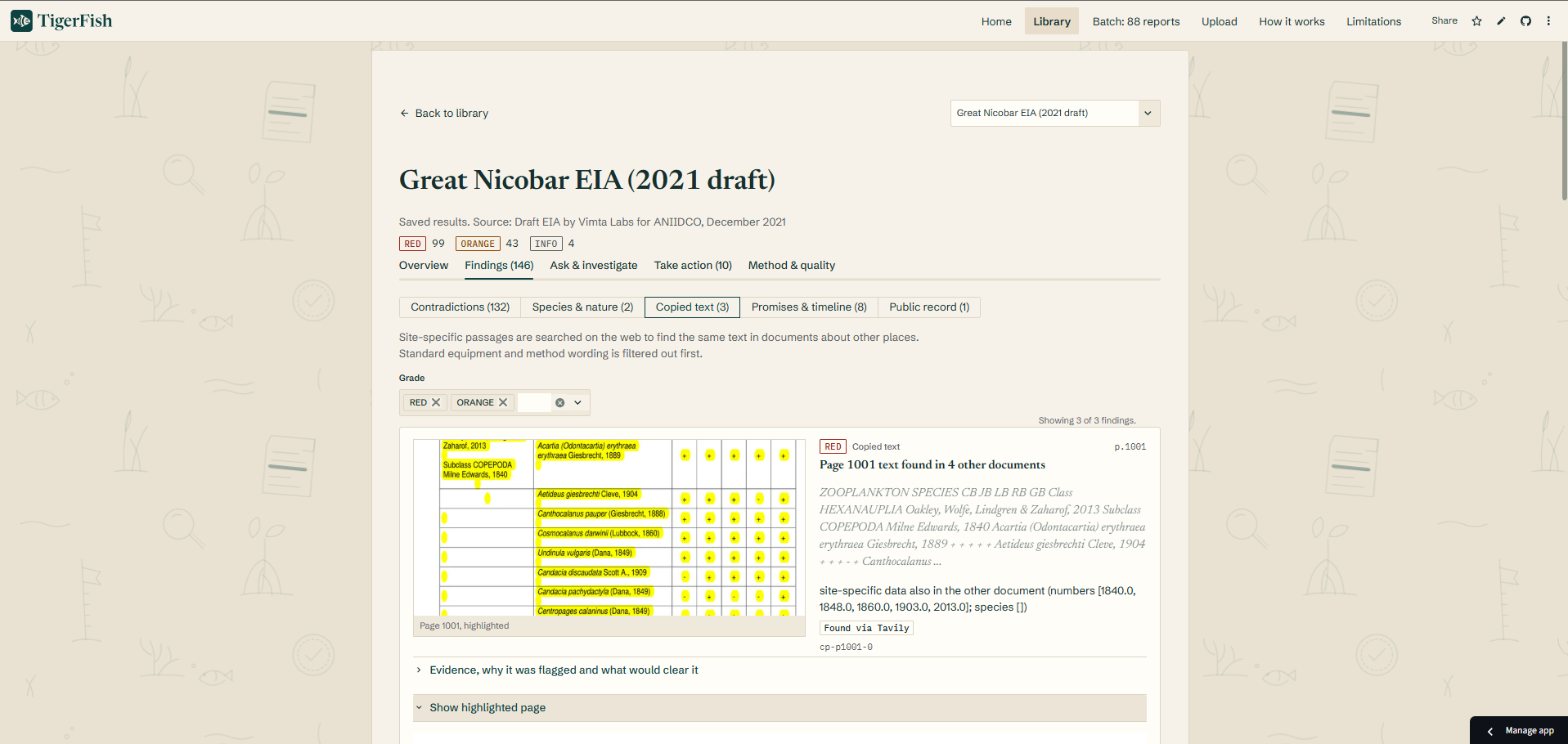
Tigerfish finds the same text in documents about other places
-
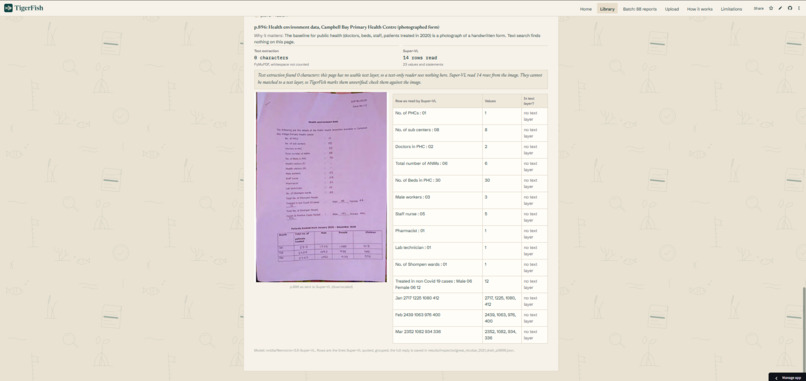
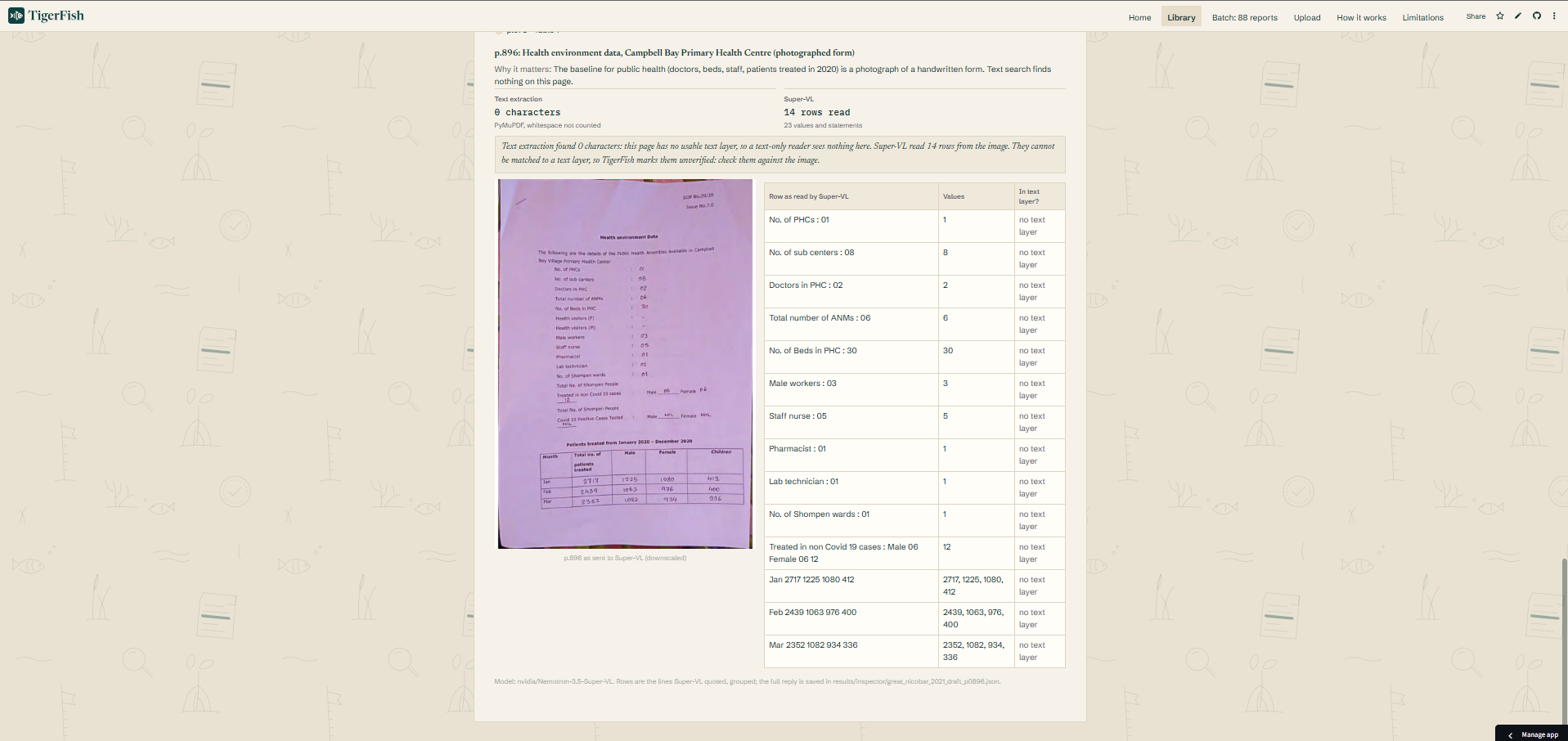
Super-VL to the rescue
-
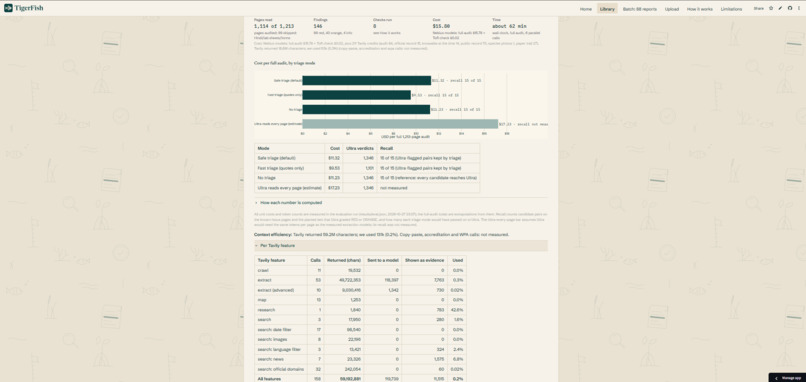
Know about our models behind every audit
-
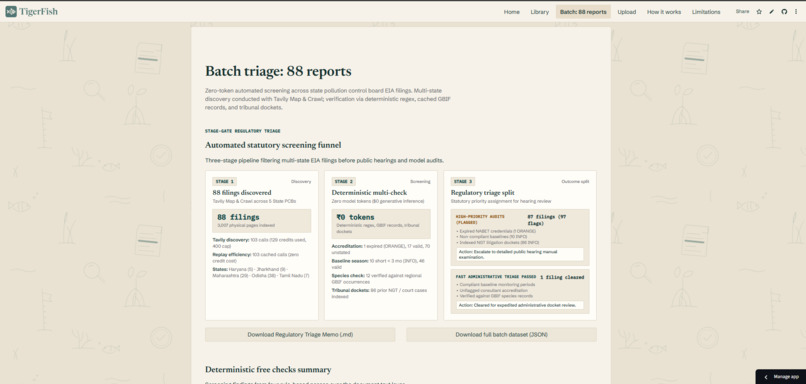
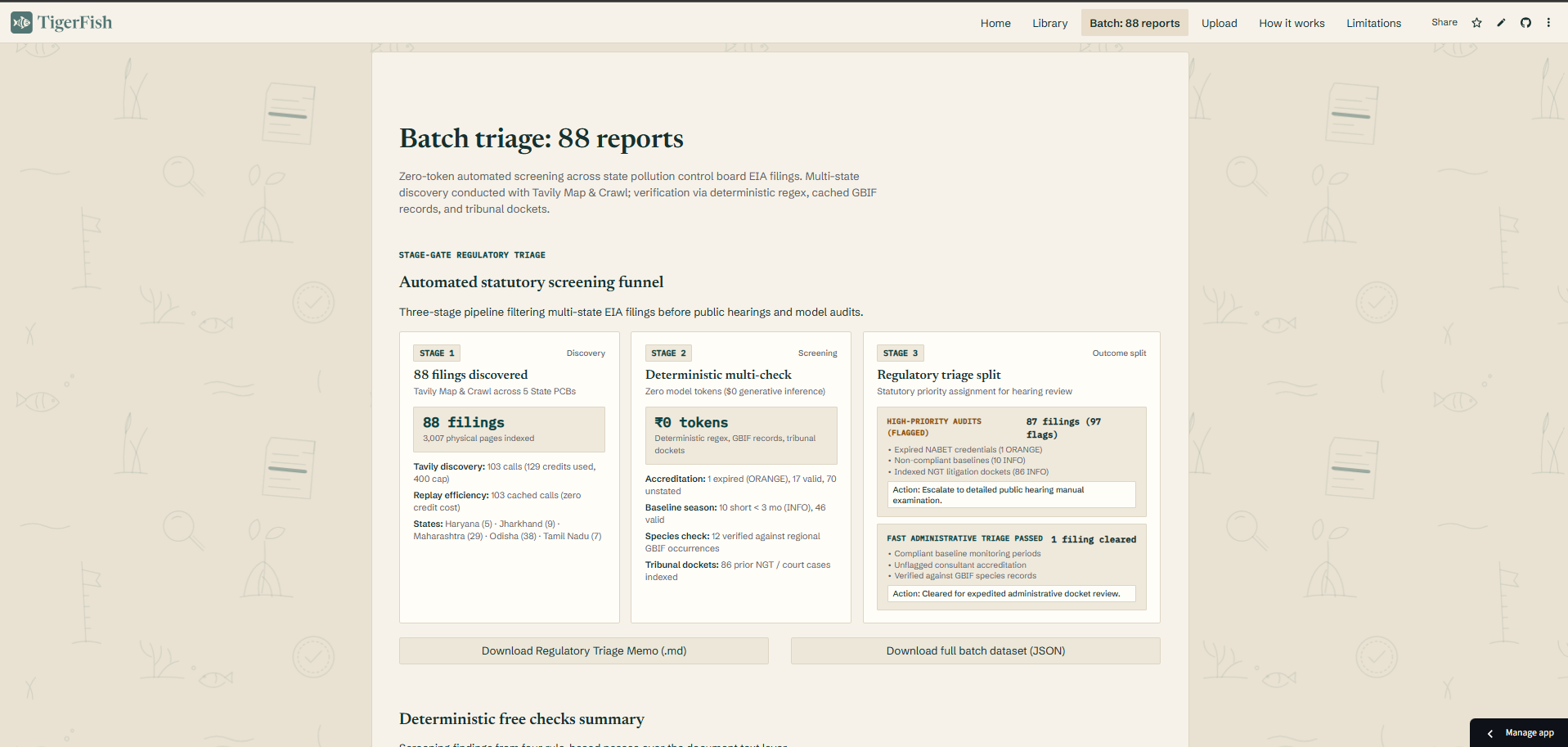
Zero-token automated screening across EIA filings using Tavily
-
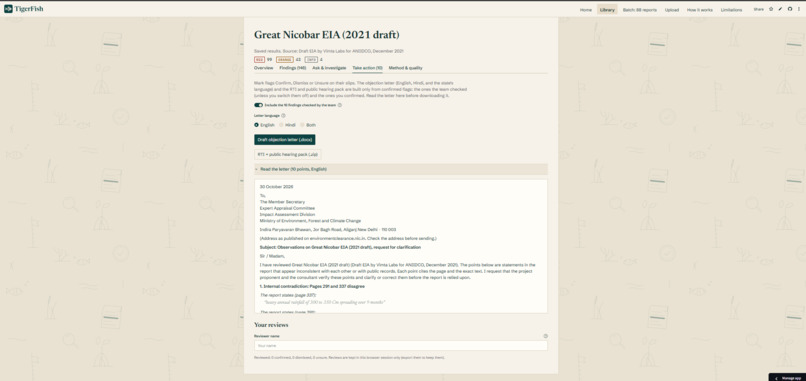
How users can express their concerns about Tigerfish
-
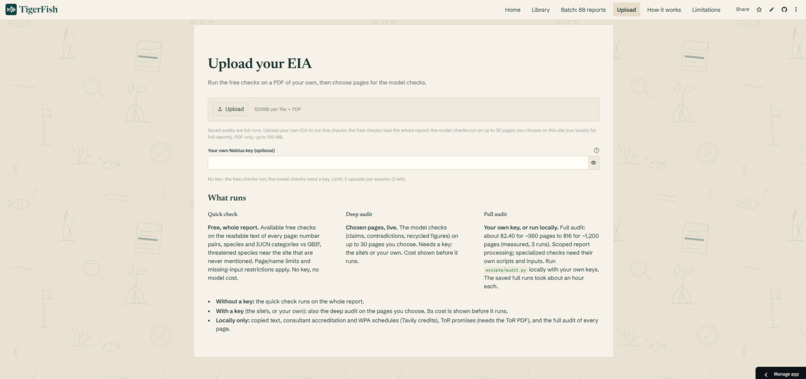
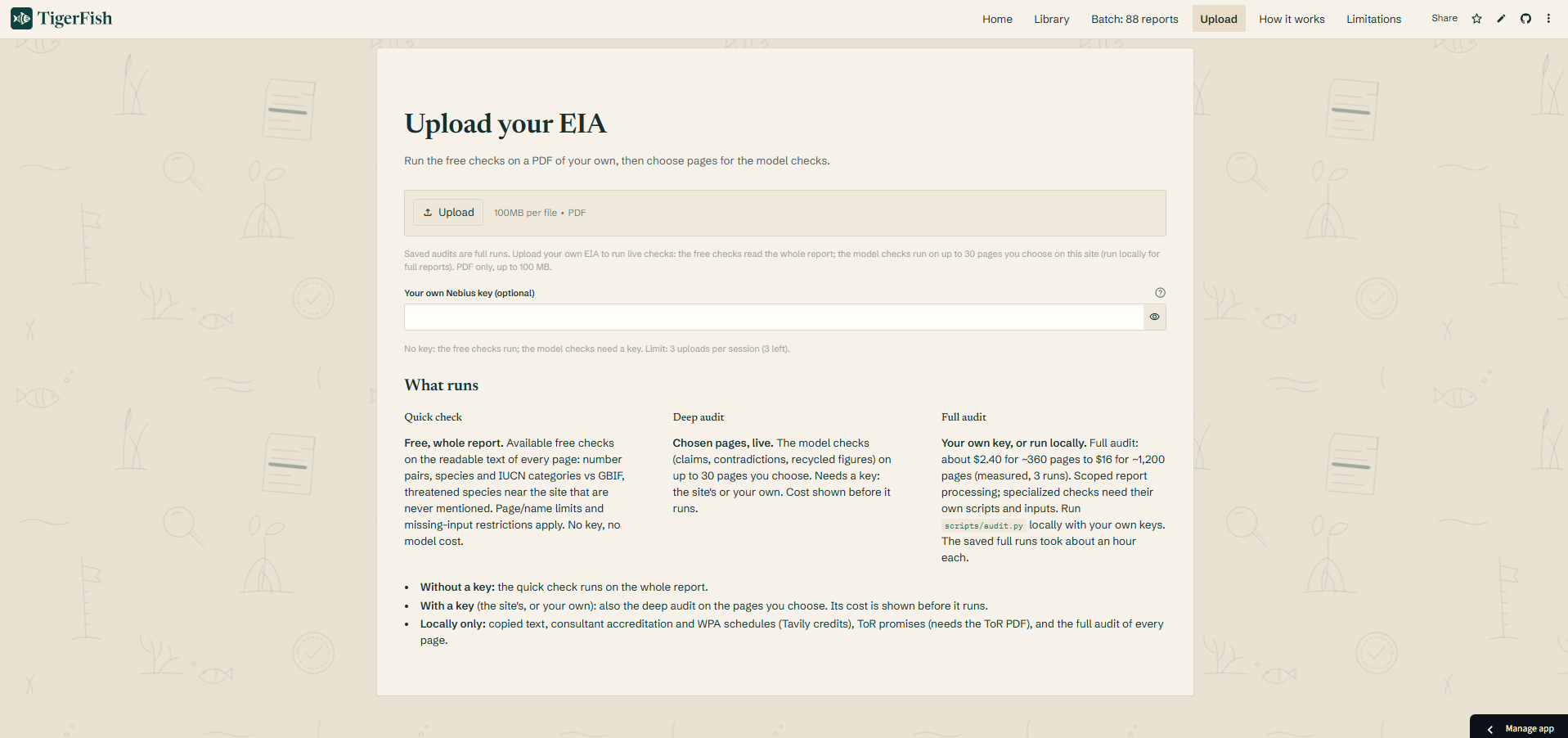
Upload your own EIA to Tigerfish
-
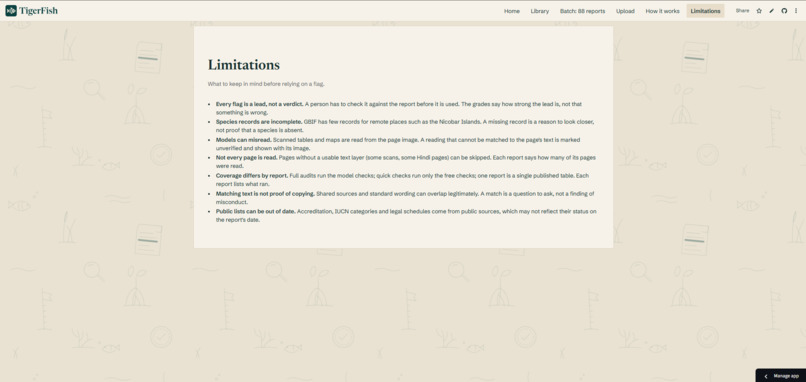
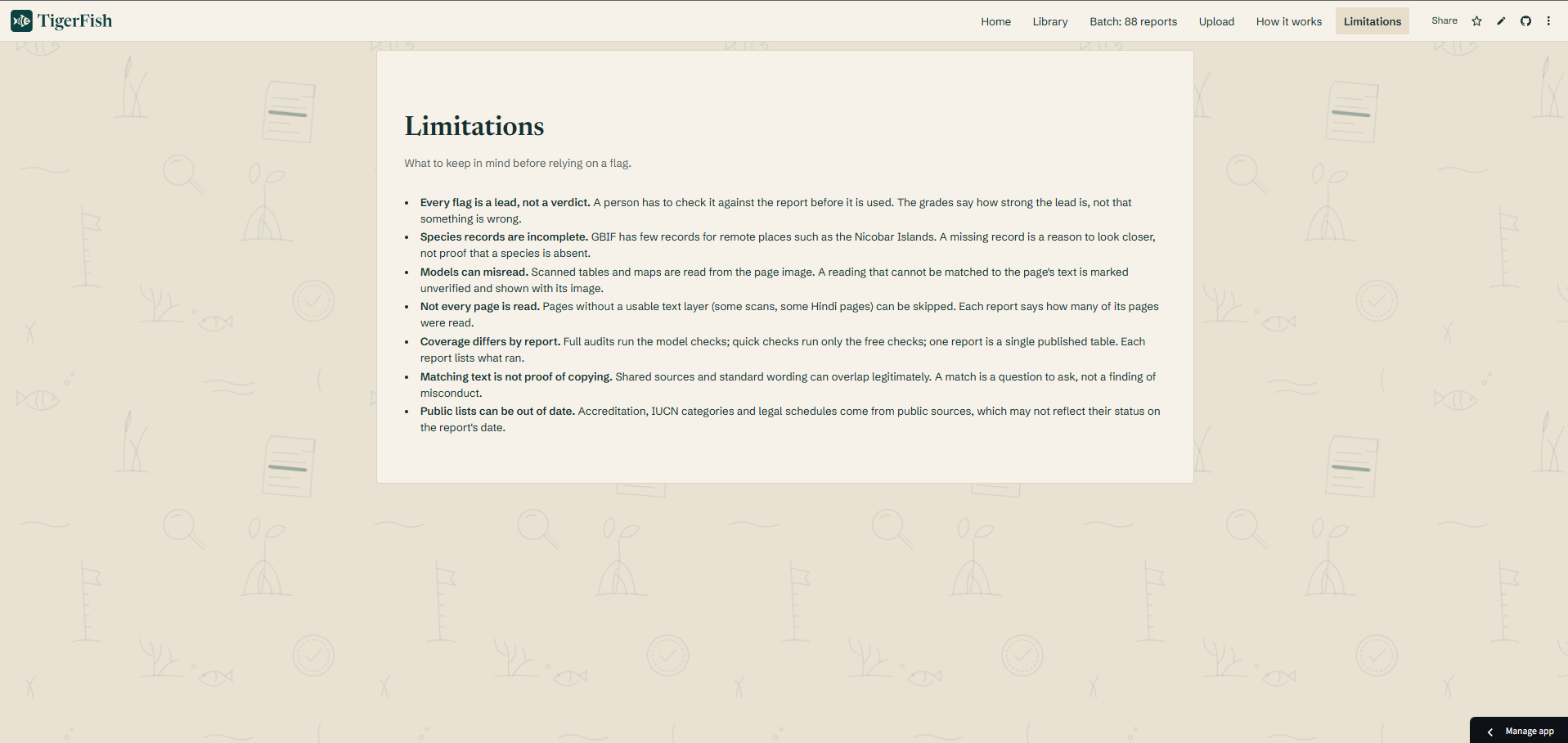
Our honest limitations for all our users to know
Inspiration
In 2026, Scroll.in reported that a government environmental report listed an African tiger fish swimming off Great Nicobar, an Indian island thousands of kilometres from Africa. It went into the official record unchallenged.
That isn't a one-off. India decides the fate of forests, coastlines, coral reefs and the communities living beside them through Environmental Impact Assessments: reports of 300 to 1,200 pages, paid for by the very developer seeking approval. The public gets one hearing, after the draft is written and the site is already chosen. A fisher in Cuddalore or a tribal council in Nicobar has days to answer a document that would take an expert weeks to read. An error on page 954 can decide what happens to a coastline for the next fifty years.
We built TigerFish so that no report goes unread again: a second reader for environmental impact reports, and everyone who questions them.
What it does
Drop in an EIA and TigerFish reads every page, then asks the questions a careful reviewer would:
- Is it consistent? Two pages that disagree on the same figure, or numbers recycled from elsewhere.
- Are the species real here? Every species is checked against GBIF occurrence records near the site.
- Is anything missing? Threatened species recorded nearby that the report never mentions.
- Is it current and legal? IUCN status, Wildlife Protection Act schedules, and the consultant's NABET accreditation.
- Was it copied? Passages and site data matched against the web.
- Did it keep its promises? Terms of Reference conditions versus what was actually surveyed, on a timeline.
- Does it match the public record? Official documents, hearings and parliamentary replies, found on government portals.
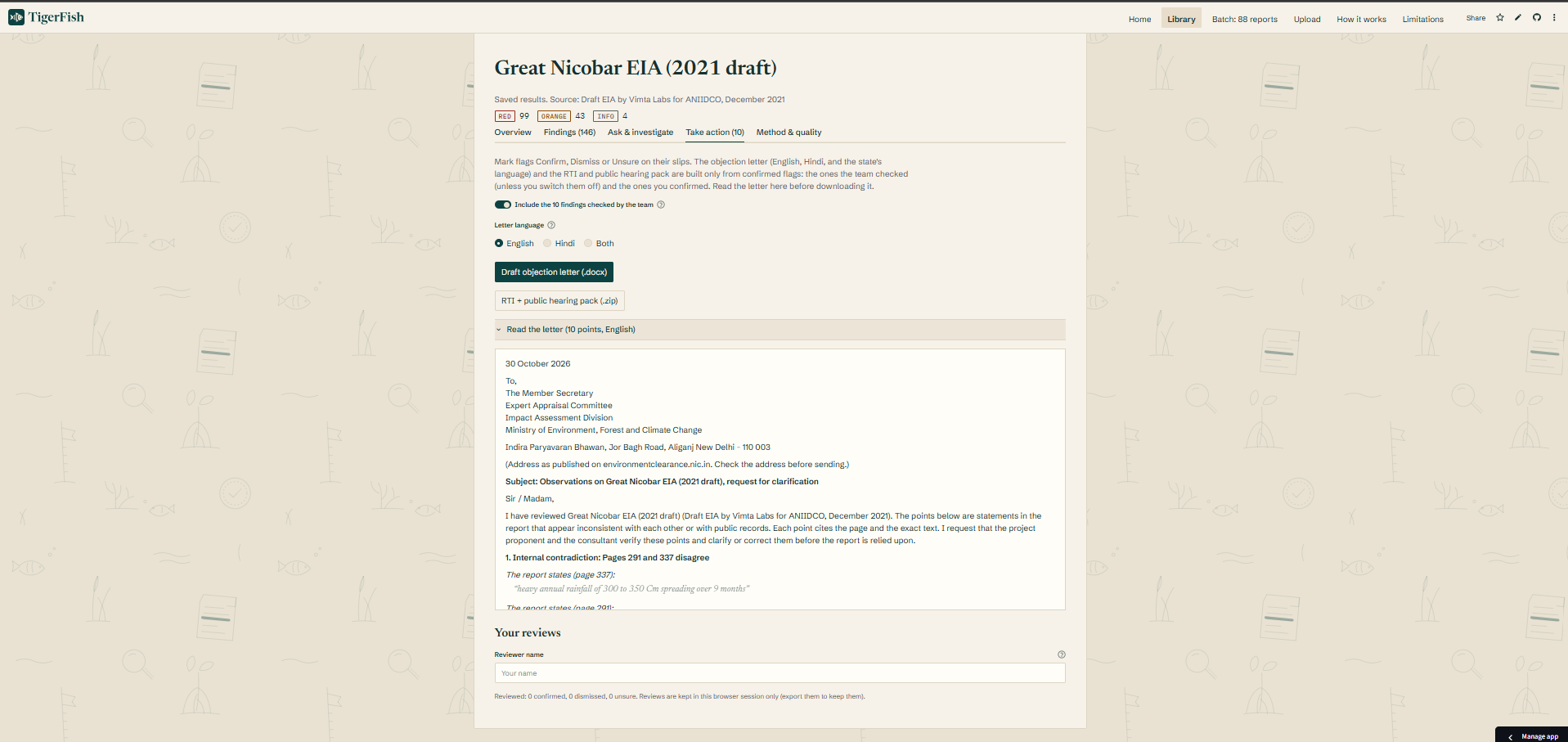
Every flag shows the exact quote, the highlighted page and the evidence, so anyone can verify it in seconds. Then TigerFish turns findings into action: a draft objection letter in English, Hindi, Tamil or Kannada, an RTI request pack, and the right authority's published address. It saves reviewers hours and hours of reading, and catches the blunders that slip past tired eyes.
How we built it
NVIDIA Nemotron on Nebius Token Factory, three models, each matched to its job:
- nvidia/Nemotron-3_5-Lightning reads every text page, extracts each factual claim with its exact quote, and triages thousands of candidate pairs so only real suspects reach the expensive model.
- nvidia/Nemotron-3.5-Super-VL reads scanned pages and tables with no text layer, which government PDFs are full of. Our scanned-page inspector shows its reading beside the original image.
- nvidia/Nemotron-3-Ultra-550b-a55b judges each possible contradiction by answering small structured questions (same subject? same place? same scope? incompatible? explained?). Our code, not the model, turns those answers into a grade. Ultra also reads the whole report in its 1M-token context to write a reviewer's memo, answers questions in "Ask the report" with 98.9% of input tokens served from cache, and drives an Investigate agent with native tool calling and replayable traces.
Token Factory's OpenAI-compatible API let us switch model sizes with one string, run 6 parallel workers, and meter every token for hard cost caps and resumable runs.
Tavily is how TigerFish checks the outside world:
- Search with exact match to catch copied passages, plus official-domain filtering, date cutoffs, news search, and Hindi and Tamil language filters
- Extract, including advanced PDF table extraction, to verify every web quote on its source page; anything unverifiable is dropped and counted
- Map and crawl with natural-language instructions on government portals to build each project's paper trail, which surfaced the granted Terms of Reference for Great Nicobar
- Research to assemble a timeline of public notices, hearings and parliamentary replies
- Image search for freely licensed species photos
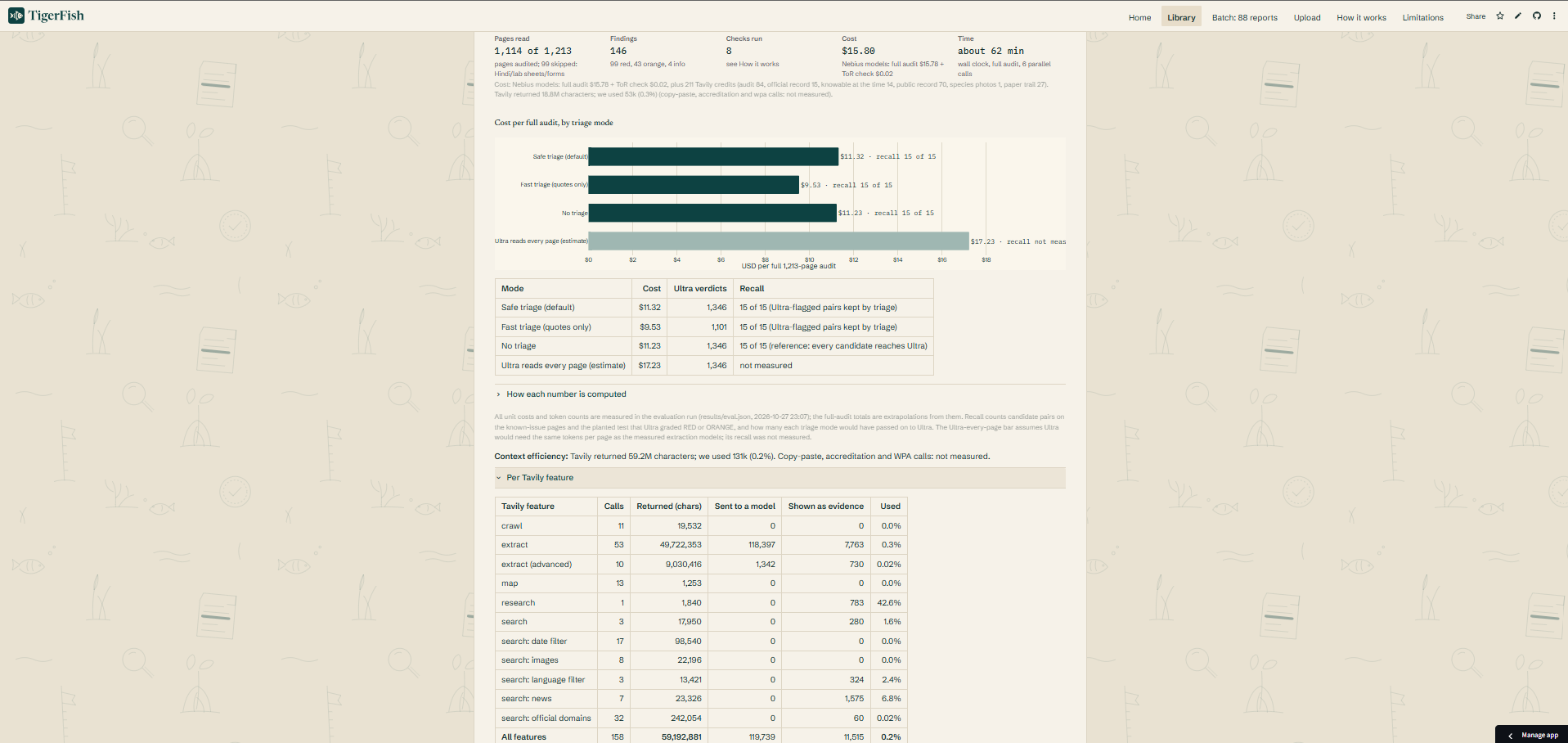
Across the project Tavily returned 31.6 million characters, and only 0.41% reached a model or the screen. Every response is cached and every run has a credit cap.
Also in the stack: GBIF for species occurrences and IUCN status, Wikimedia Commons for licensed photos, NABET minutes for accreditation, Streamlit on Streamlit Community Cloud with a free replay mode, Plotly for the species map, and Playwright and pytest for over 900 tests and browser checks. Every finding is labelled with the model that read, screened and judged it, and the tool that found its evidence.
Challenges we ran into
- Cost. Our first pairing produced 67,689 candidate pairs, about $115 for one report. Subject-keyed pairing cut it to around 1,800 with our evaluation unchanged, bringing a full 1,213-page audit to $15.78.
- False alarms. In our 100-page rehearsal they fell from 8 to 1 once Ultra answered structured questions and code computed the grade.
- Honesty under pressure. A report matching its own published copy, a proposed versus a granted Terms of Reference, an accreditation we could only call "could not be confirmed". We kept neutral wording everywhere and published every limitation we found.
Accomplishments that we're proud of
- It works on real reports, not demos. TigerFish caught 12 of 12 known issues in the 1,213-page Great Nicobar EIA, each verified by hand, and left both negative controls alone.
- It finds what humans missed. A 7 to 9 day "rapid reconnaissance" where the proposed Terms of Reference called for a 3-month baseline. A California spiny lobster with zero GBIF records within 3,000 km. A consultant accreditation that the official minutes could not confirm.
- It saves hours and hours. A 1,213-page report is fully audited in about an hour for $15.78, and a 364-page one costs $2.40. That's within reach of a newsroom, an NGO or a village council, not just a law firm.
- It scales. Three full audits across three states and two approval systems (Indian clearance and an Asian Development Bank project), plus 88 more EIAs screened with free checks.
- It turns findings into action. Letters in four languages and RTI packs, so a finding becomes a filed objection, not just a screenshot.
- It's honest by design. A precision panel that refuses to show a percentage until enough flags have been reviewed by humans, real costs on screen, published limitations and replayable agent traces.
- We couldn't find another tool that audits Indian EIAs page by page with verifiable evidence and turns the results into public action.
What we learned
AI earns trust when it answers small, checkable questions and shows its source. The right model for each job beats one giant model for everything, on both cost and quality. And when the stakes are a coastline or a forest, "here is the page, please verify" beats "trust me" every time.
What's next for TigerFish
- Watching government portals and catching new draft EIAs the day they're published, before the hearing clock runs out
- Putting TigerFish in the hands of journalists, environmental lawyers and community groups, starting with the projects we've already audited
- Routing uncertain flags to environmental experts, so every finding gets a human check
- More Indian languages, better scanned-document reading, and every state's pollution control board
- Beyond India: any country where big projects are approved on long reports and short deadlines

Log in or sign up for Devpost to join the conversation.