-
-
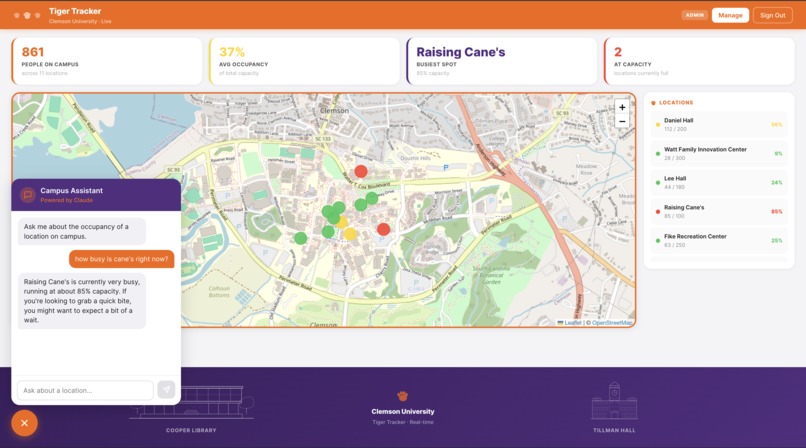
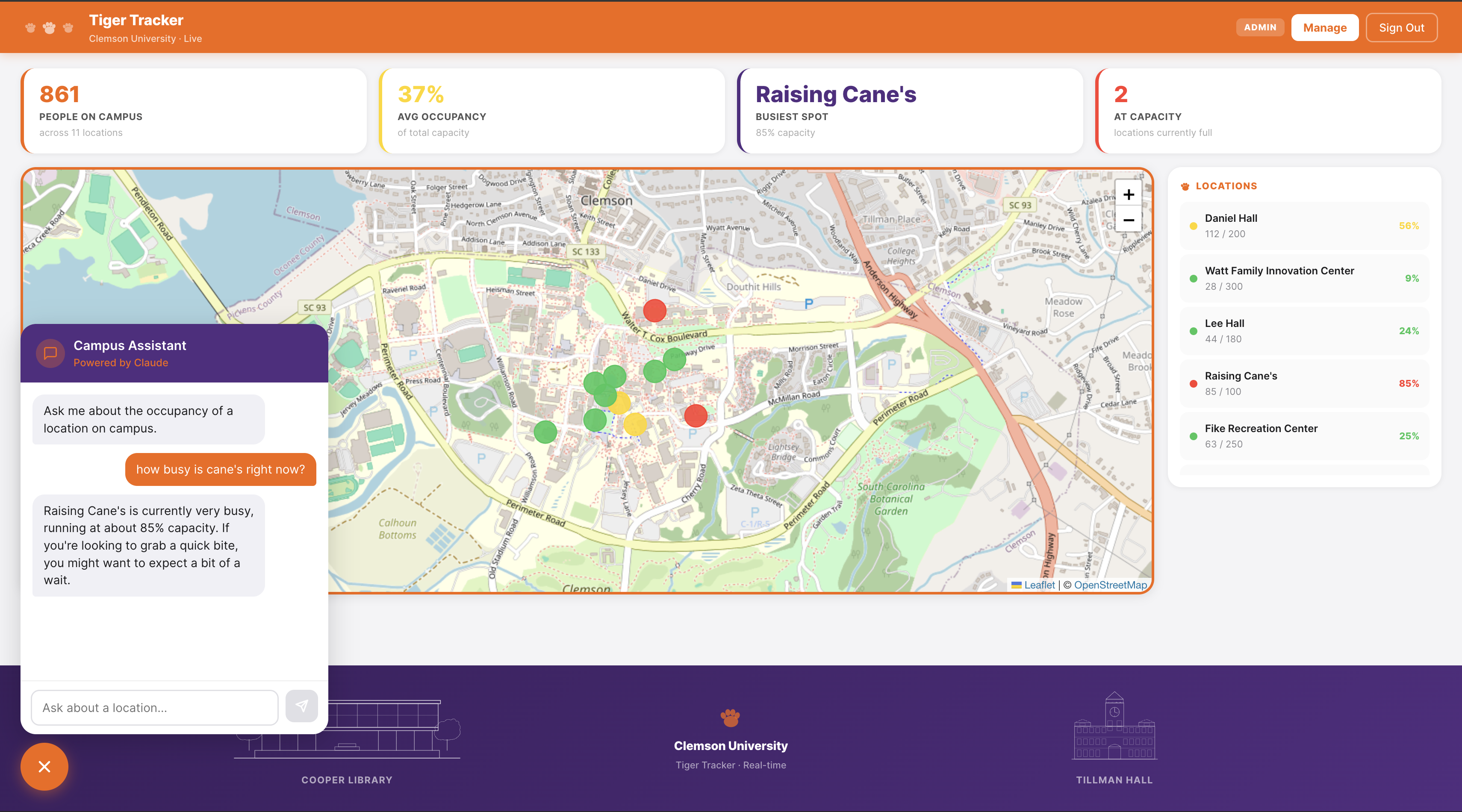
Tiger Tracker | Dashboard
Inspiration
We wanted to help students find a comfortable and relaxed place to study or hang out with friends. As it stands, it can be difficult to determine what locations on campus are going to be busy at what times. Sometimes, even the quiet places on campus can be packed, and places that are usually busy can be unusually quiet.
What it does
Tiger Tracker allows students and faculty to find the uncrowded and tranquil places on campus. Hardware devices, such as a Raspberry Pi, can be connected to a webcam and used to keep count of how many students enter and exit a building or room. This data is relayed to the front-end web app, which displays the real-time room/building occupancy for each tracked location. There is also a chat assistant integration, which uses historical and real-time data to aid students in finding the best time and place to get some quiet study hours in.
How we built it
For the hardware portion of our project, we used Python to handle the visual processing from the webcam(s) connected to the Raspberry Pi and laptop(s). For the AWS portion, we used AWS Kinesis and DynamoDB to handle tracking the occupancy of different buildings/rooms. We used AWS Cognito for user authentication, and everything was tied together with AWS Amplify.
Challenges we ran into
We ran into several difficulties when first configuring the Raspberry Pi(s). Our first Pi did not come with a power cord or microSD card, and we did not have the appropriate accessories on hand. The second Pi we tried did come with both a microSD card and a power cable, but only included a miniHDMI cable, and the microSD card was improperly formatted/configured. The third Pi we used did have a microSD card, but the power cables we scavenged did not provide sufficient power/voltage. After a quick pit stop at a team member's apartment, we were able to finally collect the cables, adapters, and other accessories needed to start hacking.
Accomplishments that we're proud of
We are rather proud of the real-time updates and modularity of our solution. The fact that a simple Raspberry Pi and a cheap webcam can view and count students exiting/entering a building, while maintaining a low-latency connection with AWS Kinesis, proved to be rather exciting. Additionally, given that we used Python, we noted that our project was highly portable and could be run on anything from a Windows laptop to a Linux laptop or even a little Raspberry Pi.
What we learned
We learned a great deal about using AWS Kinesis to process and sync data streams in real-time, and we got ample experience using Python for live video processing. We also learned a lot about using Lambda functions to interact with DynamoDB and other essential AWS services.
What's next for Tiger Tracker
The next steps would be to iterate and improve upon our current solution, then deploy small hardware devices across campus.


Log in or sign up for Devpost to join the conversation.