-
-
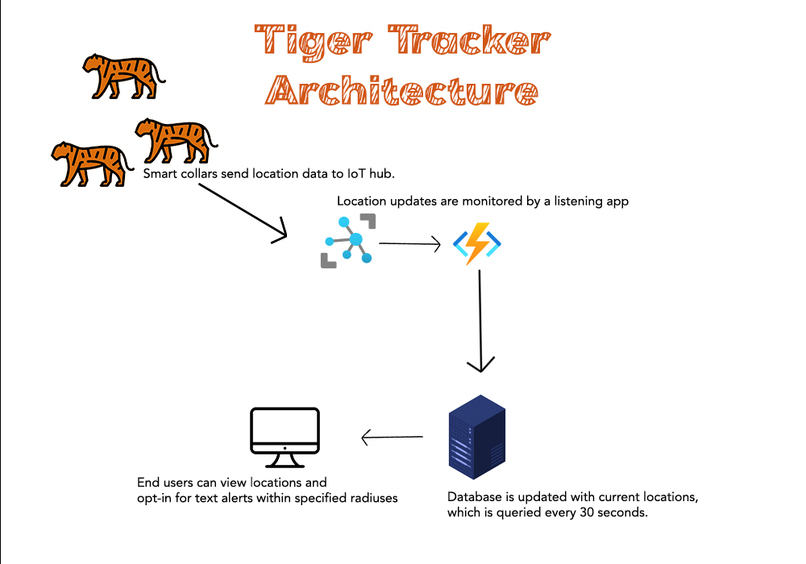
Architecture Diagram

Inspiration
A road-building boom in Nepal is rapidly creating new roads, highways, and railways. These are all threats to the small wild Tiger population. With Tiger Tracker, we hope to create a warning system that will help save the lives of these tigers through the power of Microsoft Azure's IoT Hub. The Internet-of-Things will allow us to preserve biodiversity and save these precious creatures.
What it does
Tiger Tracker provides a map updated every 30 seconds of the current location of each tiger with a collar. We are monitoring locations of tigers within a 10k radius of Kathmandu, Nepal. Users can opt in to receiving text alerts if a tiger enters a designated area. You can draw a rectangle around the area where you live, work, or frequently travel and be notified when a tiger crosses in so that you can pay more attention to your surroundings while driving or even walking.
The goal is to make people living in areas where tigers may frequent more aware of their presence so that we can reduce the number of accidents that stand to threaten the wild tiger population.
Implementation Overview
Here are some high-level steps on how this service can be fully implemented:
- Humanely capture and equip each tiger with collars with LoRaWAN-compatible modules that work more efficiently than traditional GPS. Release them back into the wild.
- Encourage users in the Kathmandu metro area to signup for text alerts by creating a custom notification area using the tools provided on the website.
- Use the Twilio API to quickly and easily send these SMS alerts, an action that is triggered using data from IoT Hub.
- Provide researchers insights into the data that we collect so that the movement patterns of these animals can more closely be understood.
- Educate the public, invite them to become more involved in understanding the impact they directly have on preserving biodiversity.
- Save the tigers of Nepal -- and eventually save them in other countries as well.
How we built it
Tiger Tracker smart collars contain devices that will be registered on Azure's IoT Hub. Location data is reported to the hub, which is listened for and sent to a database, which in turn allows us to update a Google Map with current location data of every device (tiger). We are using the Twilio API to send SMS alerts. In total, technologies used include: Node.js, HTML, CSS, PHP, MySQL, Google Maps API, Twilio.
Challenges we ran into
It was my first time using Azure and its IoT offerings. There was a steep learning curve at first, but the demos helped immensely.
For consistency (and to impress the Microsoft judges), I wanted to use a Bing map, but due to my experience with Google Maps and also needing the ability to add a drawing tool to the map, I went with Google Maps. Perhaps this can be recreated using a Microsoft product, but I wasn't able to figure it out within a reasonable time frame.
Accomplishments that we're proud of
We have a strong, working prototype, a strong concept, and a clear path on how we can fully implement this idea. It's an idea that I believe everyone can easily understand and support.
What we learned
This was my first time using Azure's many cloud-based services.
What's next for Tiger Tracker
We will need to localize the website and provide translations for all applicable languages. I also would like to implement this idea for other regions where tigers are endangered, such as the Russian Far East.


Log in or sign up for Devpost to join the conversation.