🚀 Inspiration
Designing PostgreSQL schemas is a critical but often fragmented workflow. Developers switch between SQL editors, diagram tools, documentation, and AI chat windows just to reason about tables, relationships, and migrations. This context-switching slows iteration and increases the risk of schema mistakes.
Tiger SQL was inspired by a simple question:
What if schema design, visualization, and AI reasoning lived in one transparent workspace?
Instead of treating AI as a black box, Tiger SQL makes database thinking visible and interactive 🧠.
🧩 What it does
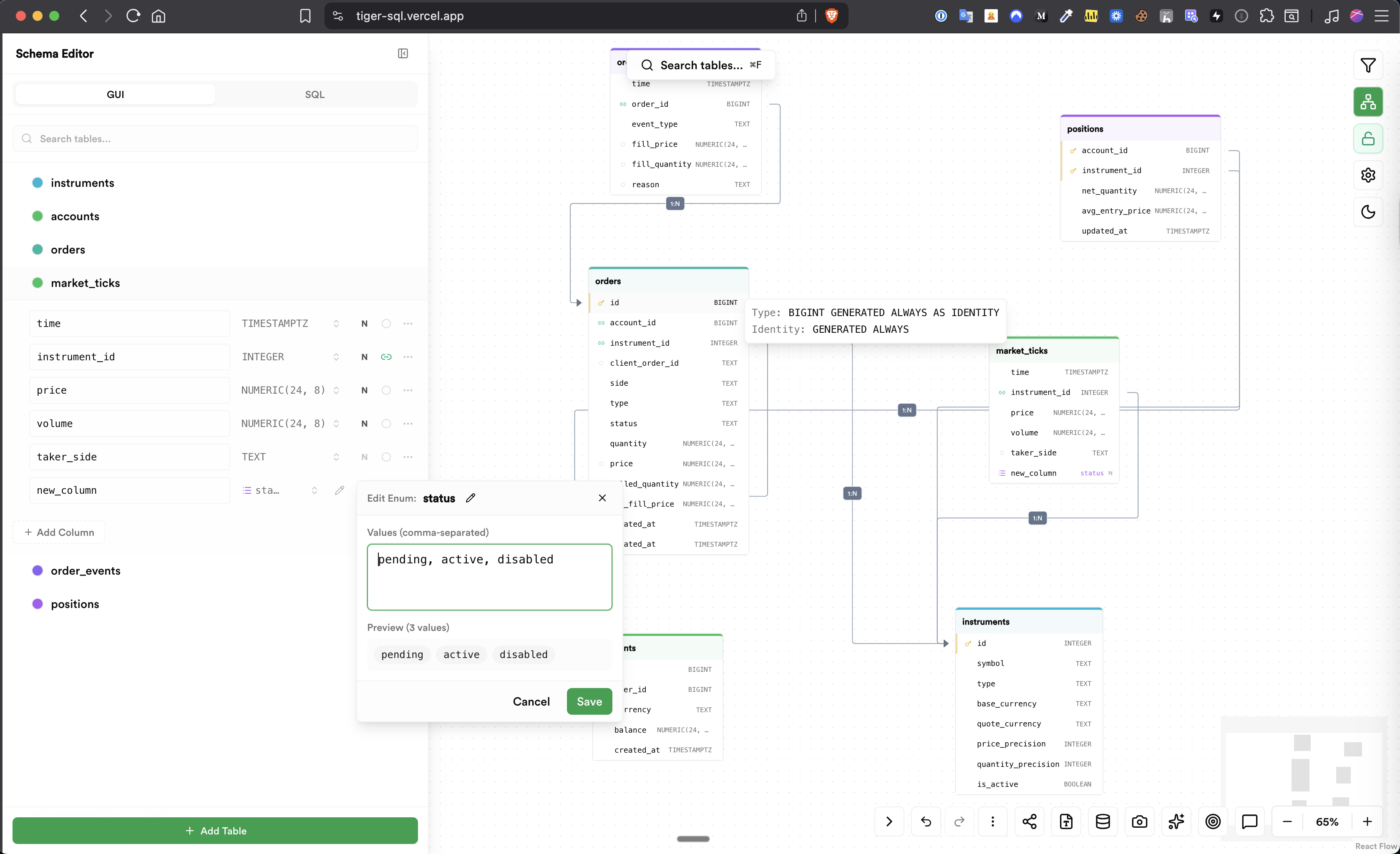
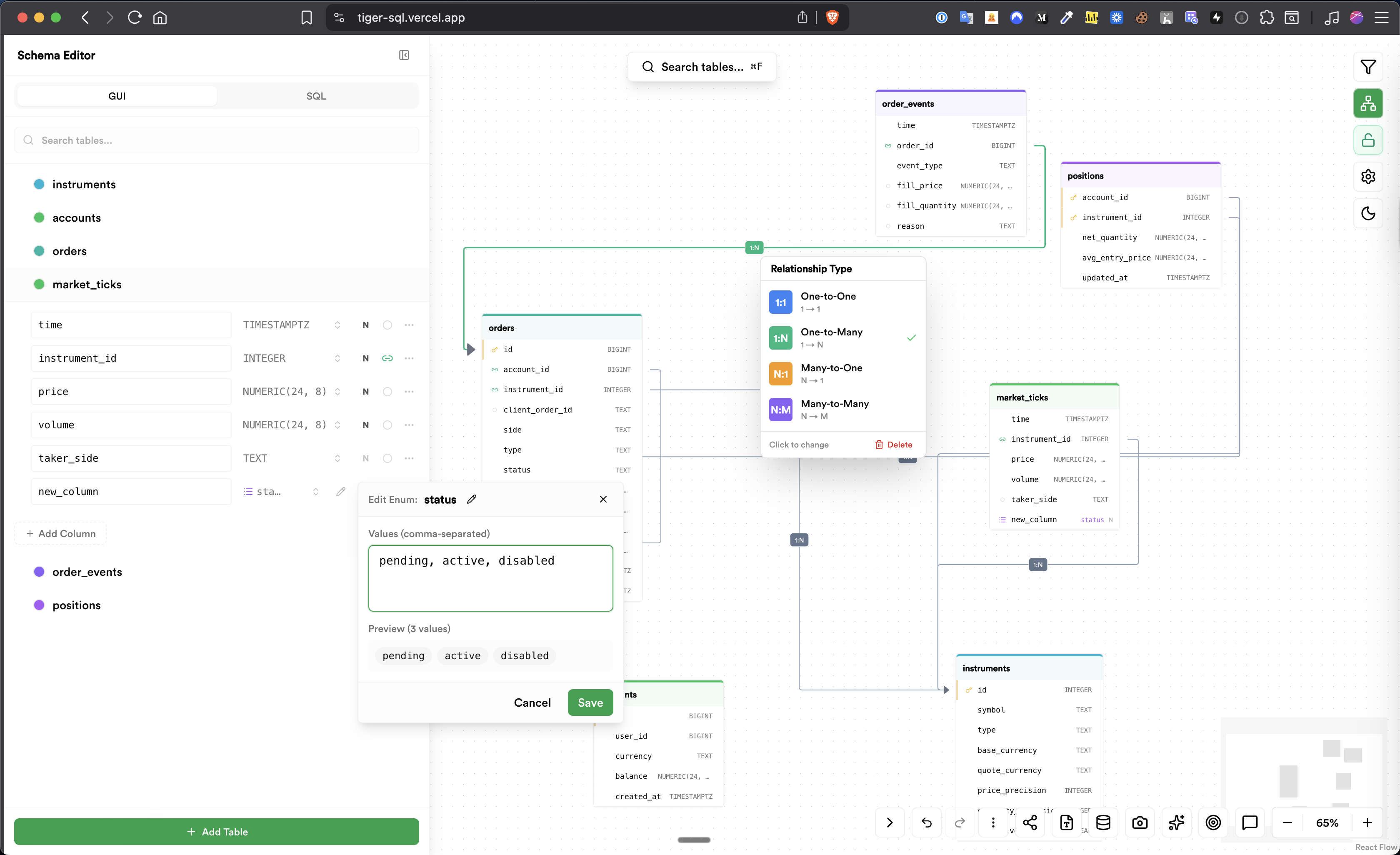
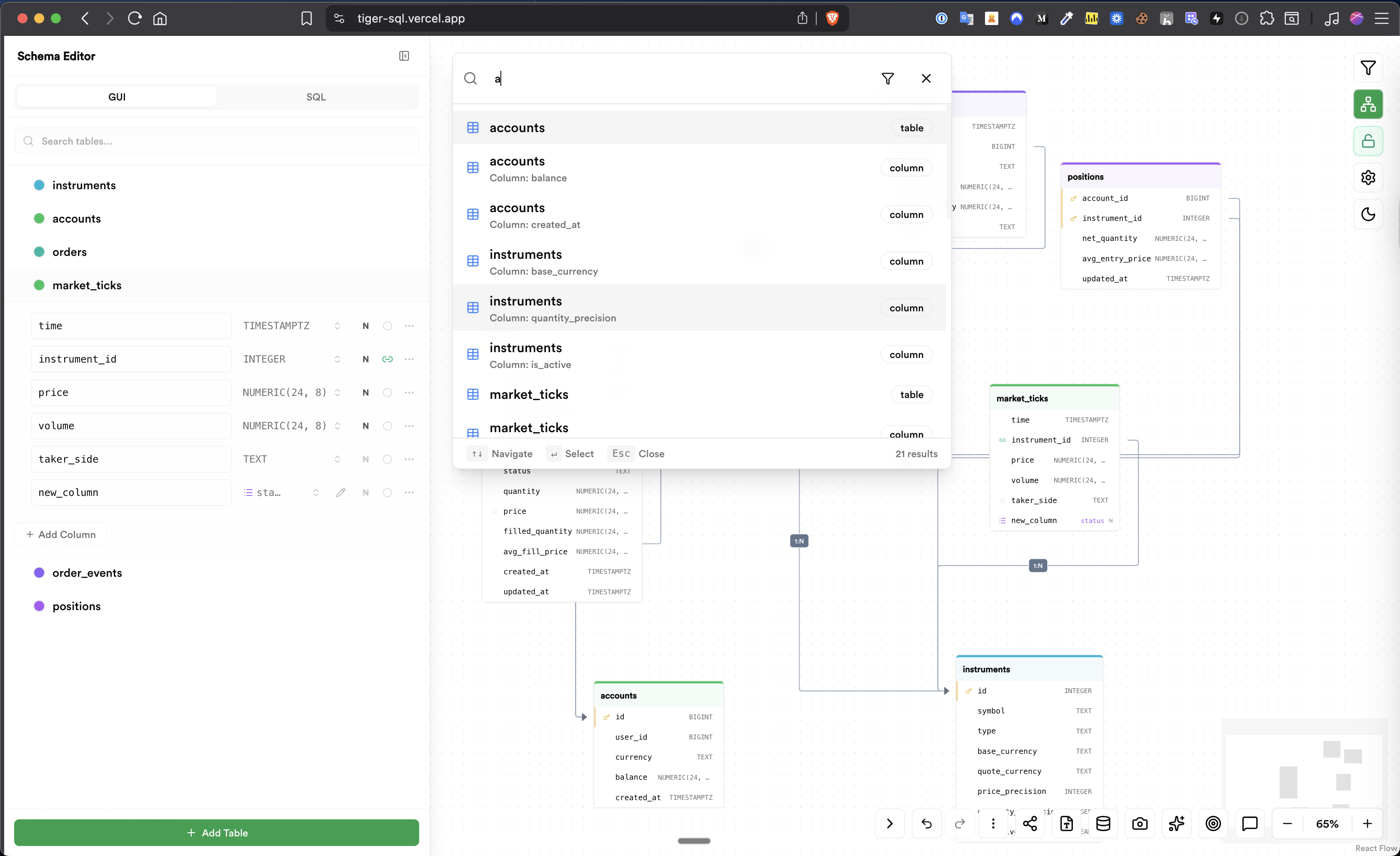
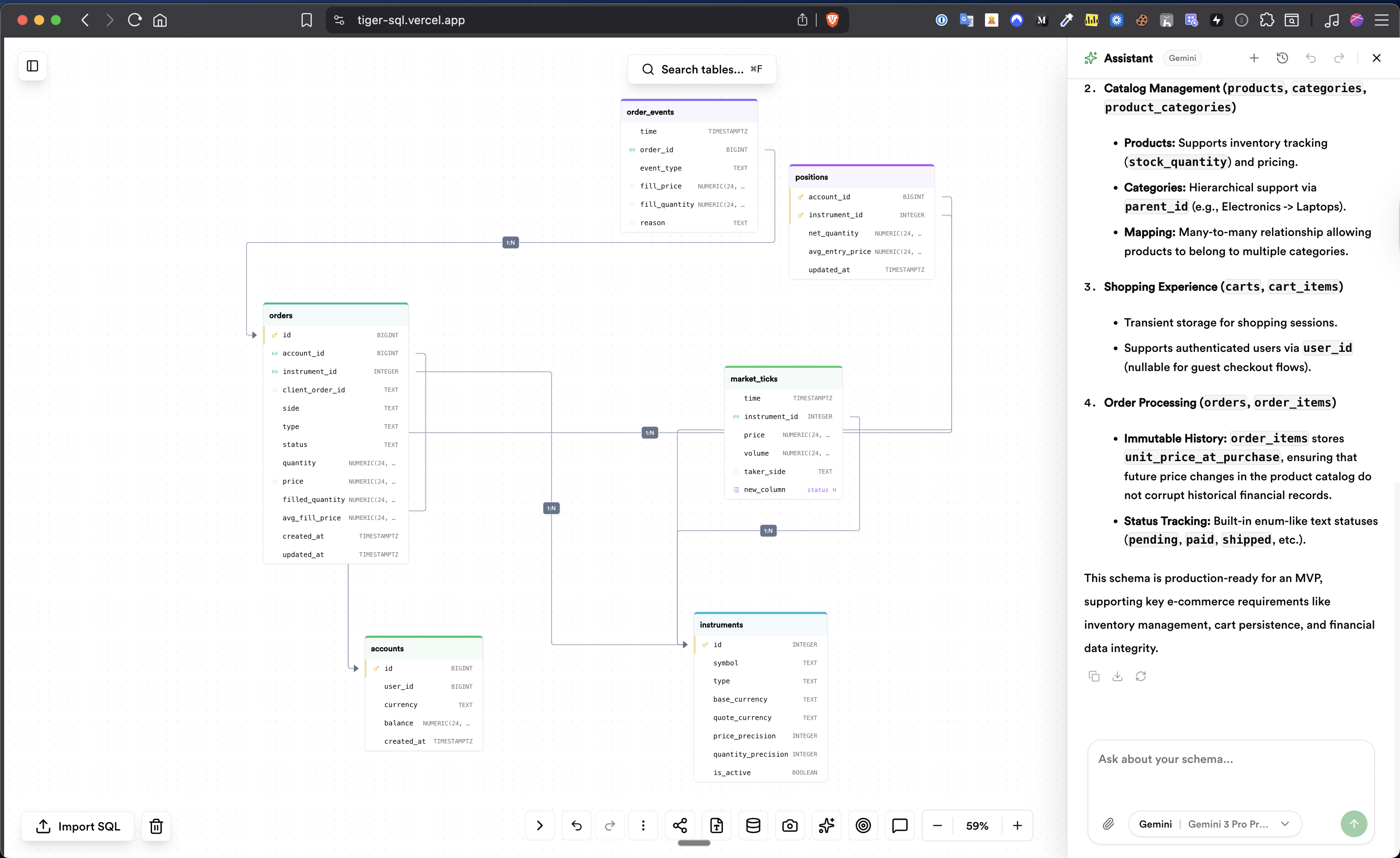
Tiger SQL is an AI-first workspace for designing and understanding PostgreSQL schemas.
It allows developers to:
- 🗣️ Design and evolve schemas using natural language
- 📊 Instantly visualize tables, relationships, and constraints
- 📥 Import existing PostgreSQL schemas
- 🤖 Interact with AI in a transparent, inspectable way using MCP (Model Context Protocol)
The goal is not just to generate SQL, but to help developers reason about database design decisions.
🛠️ How I built it
Tiger SQL is built as a modern, developer-first web application:
- ⚛️ Next.js + React + TypeScript for UI and logic
- 🎨 Tailwind CSS + shadcn/ui for a clean, accessible interface
- 🗄️ PostgreSQL + Drizzle ORM for schema modeling and validation
- ⚡ Bun as the runtime for fast development
- 🧠 Vercel AI SDK (v6) to orchestrate AI interactions
- 🔗 OpenAI & Google Gemini as interchangeable LLM providers
- 🧩 Model Context Protocol (MCP) for transparent AI context
- ⏱️ TimescaleDB MCP tooling for structured schema introspection
The architecture prioritizes explainability, safety, and developer control.
⚠️ Challenges I ran into
- 🎯 AI determinism — keeping schema outputs predictable and valid
- 🧭 Schema visualization — maintaining clarity as schemas grow
- 🧠 Context management — sending only relevant schema context to the AI
- 🎛️ UX balance — powerful features without cognitive overload
Each challenge shaped the product toward clarity and trust.
📚 What I learned
- 👀 AI is most useful when its reasoning is visible
- 🧑💻 Developer tools benefit from precision over hype
- 🧩 MCP-style architectures enable explainable AI systems
- 🎨 Good dev-tool UX reduces cognitive load without hiding complexity
🔮 What's next
🧾 Versioned schema history and diffs
Track every schema change with clear diffs, history, and rollback support — similar to code versioning.🗂️ Schema management via Git repositories
Connect a user’s own Git repo to manage schemas using real commits, branches, and pull requests.👥 Real-time multi-collaboration (Figma-style)
Enable multiple developers to design and edit schemas together with live cursors, presence, and conflict-aware updates.🔁 Migration previews and validation
Generate, preview, and validate SQL migrations before they reach production.🌐 Multi-database support
Extend beyond PostgreSQL to support other relational databases.🔌 Deeper MCP integrations
Connect safely to staging and production databases with transparent, inspectable AI context.
Tiger SQL aims to become a collaborative, version-controlled workspace for database design 🐯.
Built With
- bun
- drizzle-orm
- google-gemini
- model-context-protocol-(mcp)
- next.js
- openai-api
- postgresql
- react-flow
- shadcn/ui
- tailwind-css
- timescaledb
- typescript
- vercel
- vercel-ai-sdk-(v6)

Log in or sign up for Devpost to join the conversation.