
Inspiration
I am lazy. Don't get me wrong: I want to learn languages, build a side hustle, and work out three times a week. But instead, I scroll. Instagram, TikTok, X — and when I've exhausted those, even the news. I know that actually working toward my goals would feel better than watching one more short. Knowing isn't always enough to make me put down my phone.
So I asked: what if the urge to scroll could become the nudge to do something I care about? That's why I built tiger.mom.
What it does
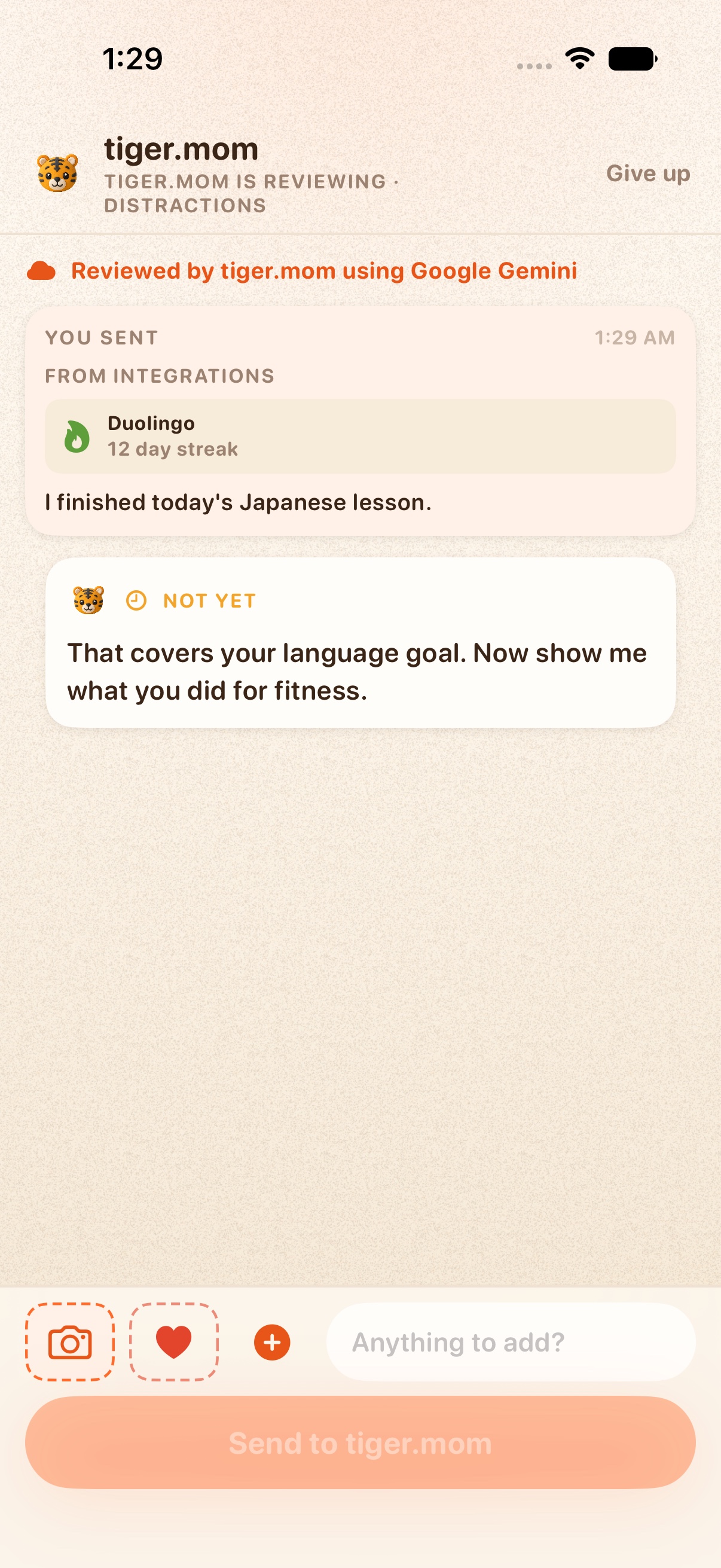
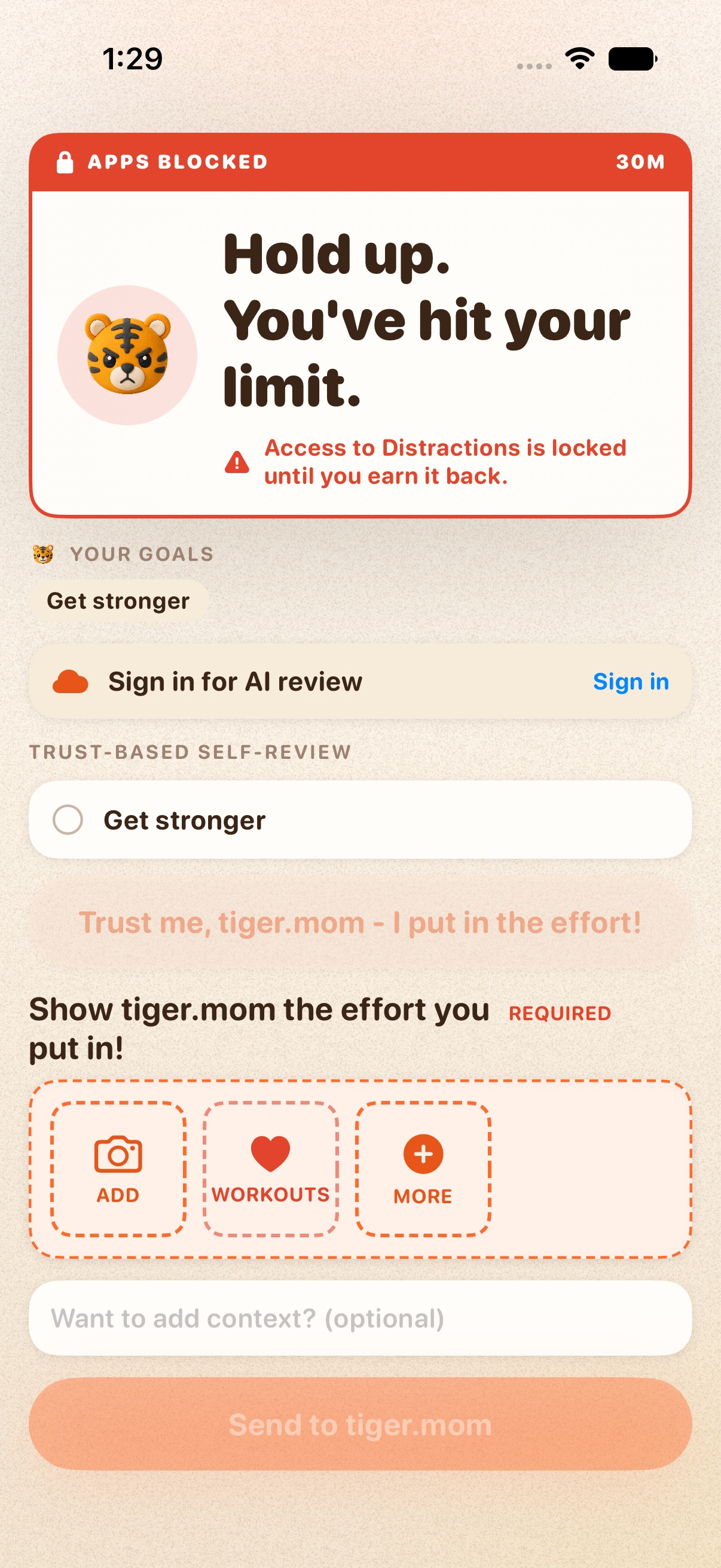
Choose the apps that distract you, give yourself a daily allowance, and set a goal. Once the allowance runs out, tiger.mom shields those apps. To earn them back, do something toward your goal and show your work: a screenshot of language practice, a workout from Apple Health, GitHub activity, a photo, or an audio recording.
In Pro, tiger.mom reviews the evidence and tells you what counted. If you've put in the effort, your apps unlock. If you haven't, she tells you what would make the proof stronger. The free tier lets you try the same basic loop with a self-confirmed check-in.
How I built it
I built tiger.mom while using it on myself. Early on, I made a rule: no Instagram until I'd practiced Chinese, exercised for 30 minutes, and made a GitHub commit. That made bugs in the blocking and proof flow impossible to ignore — if the app failed, I didn't get to scroll either.
The iOS app is built in Swift and SwiftUI. Apple's FamilyControls and DeviceActivity handle app selection, time limits, and shields. RevenueCat handles Pro purchases, restoration, and entitlement state. Proof review uses a two-stage AI flow: first extract what the evidence actually shows, then judge it against the user's goal. Apple Health and GitHub can provide more direct evidence; screenshots remain the flexible fallback. There is also a manual path when someone doesn't want cloud AI review.
Challenges and what I learned
The hardest part was making a strict app feel supportive. A rejection should help an honest user understand what to do next, not make them feel accused. I also learned that a Screen Time app has to be reliable at the exact moment someone is tempted to cheat: blocking, entitlement changes, and the unlock flow all have to agree.
Proof can be personal, so privacy shaped the architecture. RevenueCat gets subscription information, not the user's proof. Cloud AI review requires consent, and the app handles the no-consent path rather than quietly sending evidence elsewhere. Building and testing with my own daily goals kept these choices grounded in the real experience.
Built With
- revenuecat
- swift

Log in or sign up for Devpost to join the conversation.