-
-
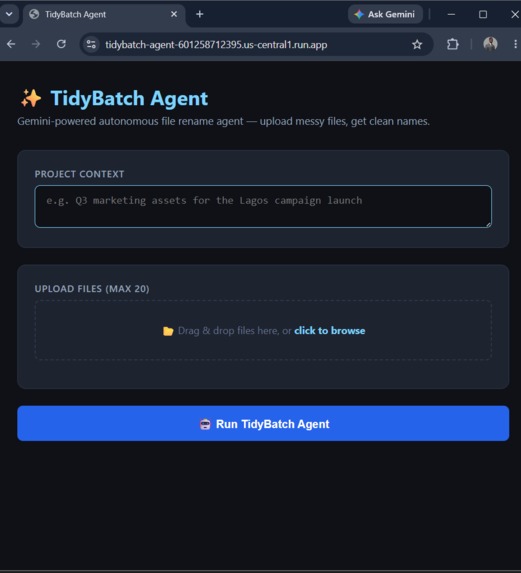
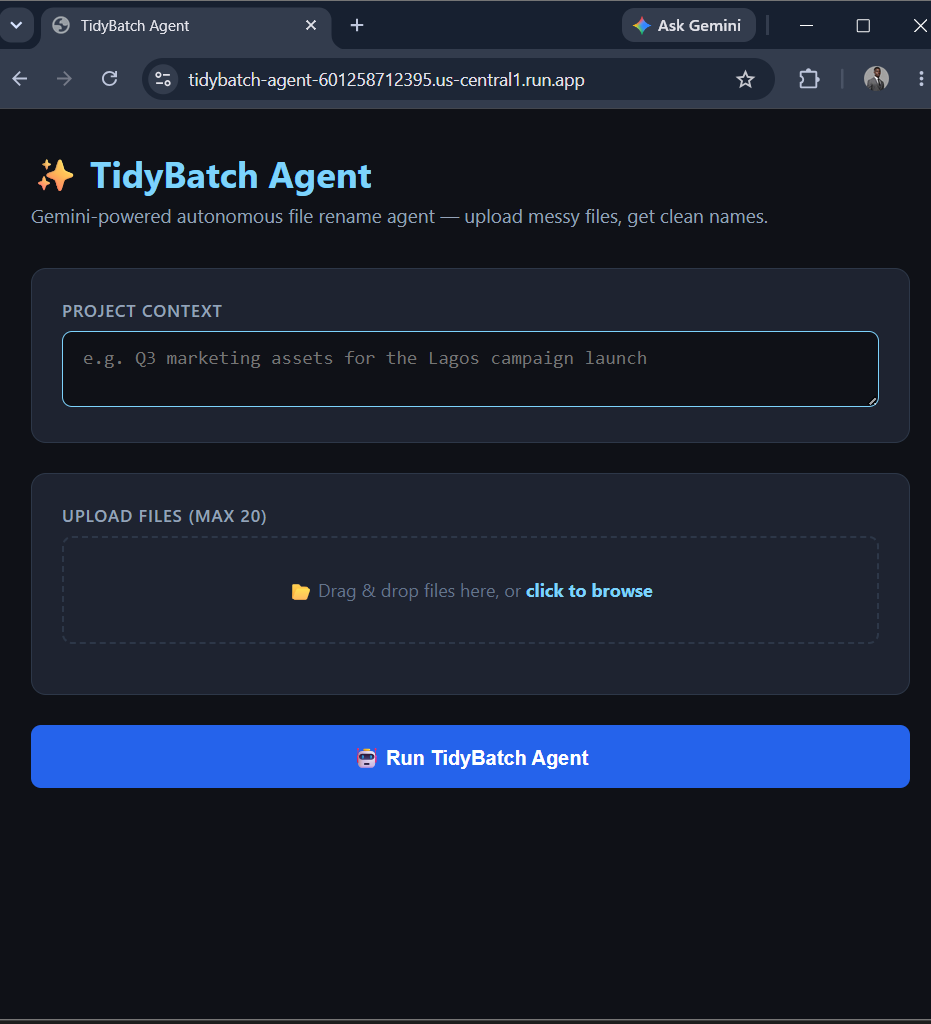
TidyBatch Agent
Problem Statement
Teams and individuals accumulate files with names like IMG_2034.jpg,
FINAL_v3_REALLY_FINAL.pdf, and untitled_document_1.docx. Renaming them
manually is tedious, inconsistent, and error-prone — especially across
large batches from multiple contributors.
Solution
TidyBatch Agent is a lightweight autonomous multi-step agent that:
- Accepts a project context and a batch of files from the browser.
- Uses Gemini 3.5 Flash (Vertex AI) to read filenames and text snippets and propose meaningful, standardised replacements.
- Runs a deterministic Python validator to enforce safety rules before any file is touched.
- Copies files with their new names, packages them into a ZIP, and generates a full audit trail (JSON + CSV).
- Lets the user download everything in one click.
Built to be deployed on Google Cloud Run as a stateless, serverless container.
How It Works
Browser → POST /triage
  → FastAPI reads files, extracts metadata
  → Agent calls Gemini via Vertex AI (google-genai SDK)
  → Gemini returns [{original, proposed, reason}] JSON plan
  → Validator enforces: extension preserved, no traversal, no reserved names, unique
  → Processor copies files, builds ZIP + audit
  → Browser gets session download links
Technologies
- Python 3.11 — core runtime
- FastAPI — async HTTP API
- Google GenAI SDK (
google-genai2.20.0+) — Gemini client - Vertex AI (Gemini Enterprise Agent Platform) —
publishers/google/models/gemini-3.5-flashatglobalendpoint - Google Cloud Run — serverless container deployment
- Docker — container packaging
- stdlib only — zipfile, csv, tempfile, uuid (no heavy dependencies)
Google Cloud / Gemini Proof Points
- Gemini 3.5 Flash (
publishers/google/models/gemini-3.5-flash) on Vertex AI Enterprise Agent Platform makes every filename-planning decision. - The JSON rename plan is produced exclusively by Gemini 3.5 Flash — no hardcoded filename rules.
- Location:
globalendpoint (required for Gemini 3.x models);GOOGLE_GENAI_USE_ENTERPRISE=Trueset in runtime environment. - Local development auth: Workload Identity Federation — the EC2 instance's AWS identity is federated to GCP via a WIF pool, allowing keyless access to Vertex AI with no long-lived credential files in the repository.
- Cloud Run deployment auth (planned): the Cloud Run service will use its
attached runtime service account with
roles/aiplatform.user— no keys, no WIF config, no credential files required at runtime. - Cloud Build will be used to build and push the Docker image.
Challenges
- Parsing Gemini's JSON output reliably (markdown fences, trailing text). Solved with a defensive strip + json.loads + schema validation.
- Extension preservation: Gemini sometimes strips or changes extensions. Solved deterministically in the validator — the original extension always wins.
- Uniqueness without a database: implemented a seen-set dedup loop with sequential suffixes (-001, -002) in pure Python.
- Ephemeral file safety: temp dirs are cleaned immediately after ZIP is built, even if the copy step raises an exception.
Accomplishments
- True agentic pipeline: Gemini makes the naming decision, Python enforces safety.
- Zero-dependency validator: all safety checks are deterministic, auditable Python.
- Complete audit trail: every decision logged to JSON + CSV.
- Full test suite covering 14 validator edge cases and 9 processor scenarios.
- Cloud Run deployment with no database, no auth service, no message queue.
Lessons Learned
- Defensive JSON parsing from LLM output is essential — always strip fences, always validate schema, always fall back gracefully.
- Separating the AI decision layer from the deterministic enforcement layer makes agents more auditable and safer.
- Minimal stacks (no ORM, no queue, no vector DB) deploy faster and fail less.


Log in or sign up for Devpost to join the conversation.