Inspiration
In our room, clothes, books and plates are "just roaming." We know where everything goes. We just don't put it there, because we're tired or lazy. My roommates struggle with this too. During a break I tried something: I put one shirt and one pair of pants on hangers, and the bed was clear. It felt good. That moment, seeing the spot clear, is what Tidy Troop is built around.
What it does
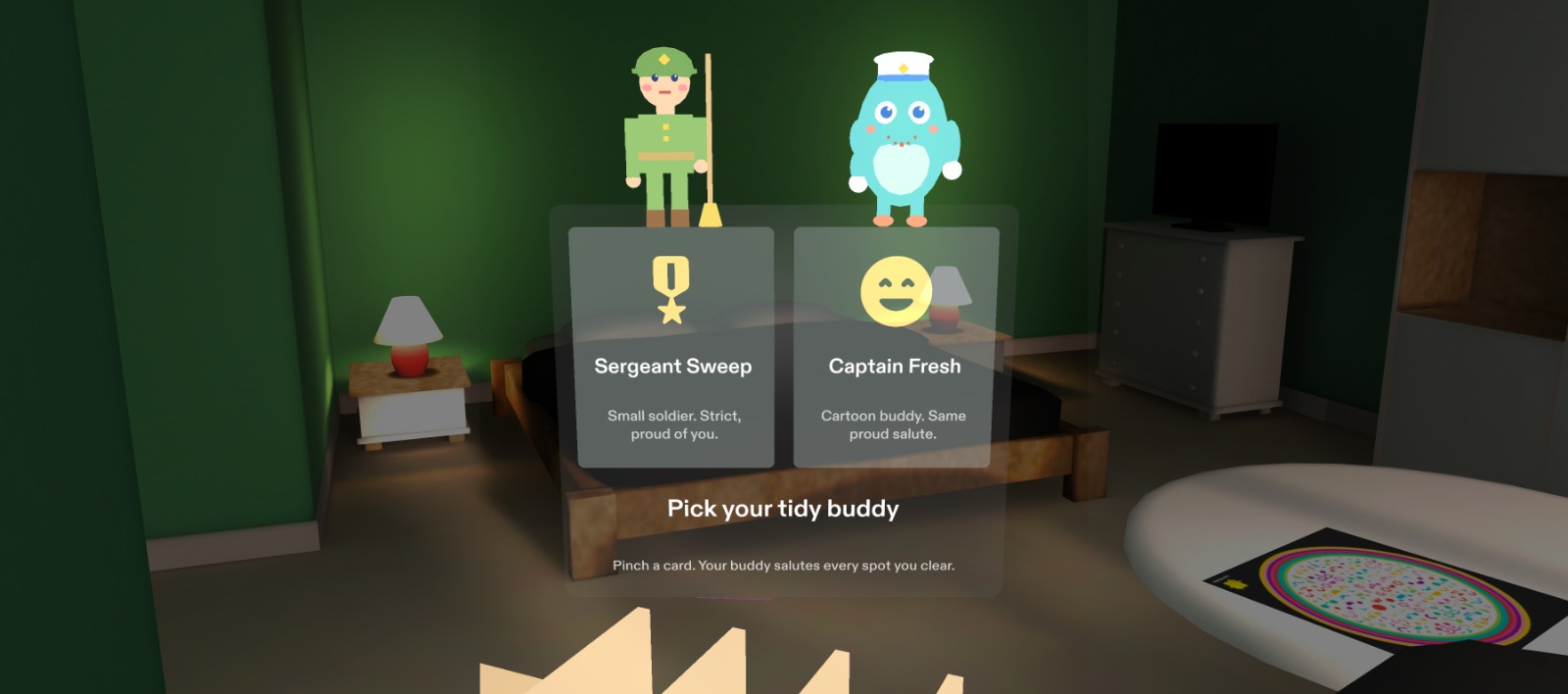
- You pick a buddy on two big cards: Sergeant Sweep, a small soldier with a helmet and broom, or Captain Fresh, a round cartoon buddy in a captain's cap. Both are original characters.
- Numbers 1 to 5 appear on the mess: a shirt, a pair of pants and a book on the bed, a book on the floor and a plate on the floor behind you. Your buddy salutes and tells you where to start: "5 things out of place! Start with number 1!"
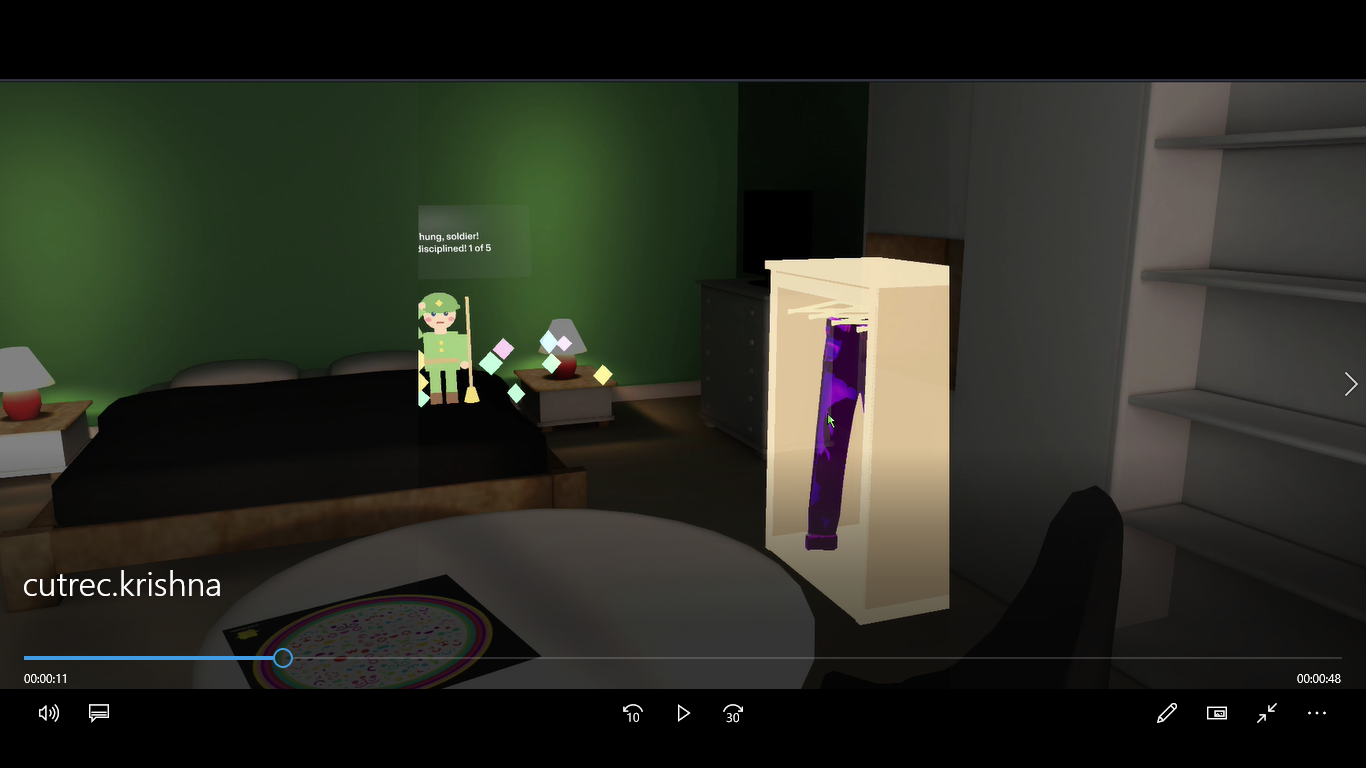
- You grab a thing, carry it, and drop it where it belongs: clothes on the hangers in the cupboard on your right, books on the shelf and plates in the rack on the table behind you. While you carry it, only the places it fits glow. It snaps in with a bugle and its number disappears.
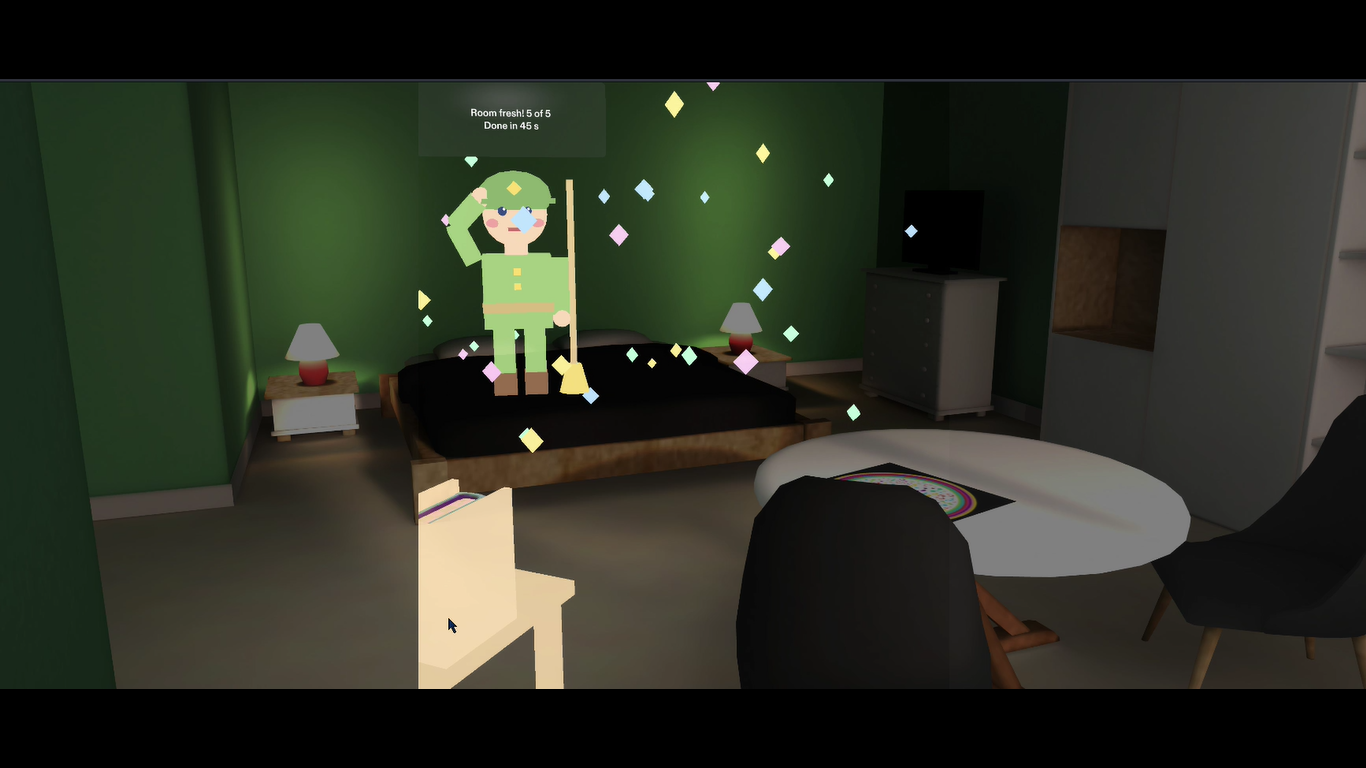
- When you turn back, your buddy is standing on the exact spot you just cleared. It salutes, with a few sparkles around it, and says what you did, in its own voice ("Shirt hung, soldier!" or "Nice! Shirt hung!"), and "You are disciplined! 3 of 5". The salute waits until you look, so you never miss it.
- When the last thing leaves the bed, your buddy cheers "Bed clear!" with a bigger burst of sparkles and a shimmer sound.
- If every item left is out of view, a small arrow and one soft chime point you to the nearest one. Plate 5 sits on the floor behind you, so you'll meet the arrow.
- After the 5th item, your buddy says "Now look at your bed!" and the arrow points the way. On the clear bed it grows big and holds a final salute. A wave of light sweeps out from the bed with sparkles and a fanfare: "Room fresh! 5 of 5", with the time you took underneath.
Why it belongs on glasses
- The numbers sit on the actual shirt, book or plate, and the reward appears on the exact spot you just cleared. You watch your real room get "clean and clear" as you go.
- Your hands stay free to carry clothes and plates. A phone app would have to be held and looked at while you tidy.
- It's an overlay: the real version would respond to the real mess in your room.
How the preview stands in for a real room
The preview can't see a real room, so the green bedroom in Lens Studio's Colorful Home preview scene plays the room. The mess lies on its own double bed and floor. The places things belong are virtual: a small open cupboard with hangers on your right, and a small table with a book shelf and a plate rack behind you. Both are sized to fit whole inside the small SPECS display, because a big virtual cupboard always looked cut in half. Dropping an item in its place stands in for the glasses noticing you put the real thing away. A second setting, "Around the user", puts a whole stand-in room (virtual bed, cupboard, desk and chair) around wherever you start, so it also works in other preview scenes.
Who it's for
Students sharing a room, like me and my roommates, who know where things go but are too tired to start.
How I built it
Planned with Devpost's plan-lens skill. It interviewed me and wrote devpost/planning-notes.md and devpost/design-brief.md.
Built by an AI coding agent, Kiro, running Snap's CLAD skills and agents (installed into Kiro with a port of the CLAD plugin; details in .kiro/third-party/README.md). The agent worked in Lens Studio 5.24.1 entirely through the Lens Studio MCP: building and editing the scene, writing and compiling TypeScript, driving the preview, reading logs and taking screenshots.
Interaction: Spectacles Interaction Kit for grabbing and dropping (Interactable and InteractableManipulation), and UI Kit for the picker cards and the speech bubble.
3D:
The 5 items are AI models made with SPECS text-to-3D. Sign-in didn't work in Lens Studio 5.24.1, so the agent generated them in Lens Studio 5.23.2 in a separate scratch project (the organisers' workaround) and brought them in.
The two characters are built in code with MeshBuilder, so their parts can move: the salute arm is solved with 2-joint IK, and the legs march.
The furniture is code-built too.
Sound: the click, snap, chime, bugle and fanfare were generated by CLAD's sound skills (local synthesis, no samples).
Voices: 30 clips made on the laptop's CPU with the Kokoro-82M voice model through kokoro-js (tools/make-voice-lines.mjs): voice am_michael for Sergeant Sweep and af_heart for Captain Fresh. My first try used the Windows voices, which sounded robotic.
Icons: Google Material Icons through CLAD's icon picker.
Testing: the agent checked each done criterion in the preview through the MCP, using real clicks and drags, camera turns, logs and screenshots. LEAF tests are written (LeafDrafts/) but couldn't run, because LEAF 4.0.0 needs Lens Studio 5.25 typings and 5.25 isn't out yet.
Challenges we ran into
Sign-in didn't work in Lens Studio 5.24.1, so AI 3D generation had to run in 5.23.2 in a separate project. Opening this project in 5.23.2 breaks the interaction kit, so the two versions had to stay apart.
- LEAF couldn't run on 5.24.1, so testing went through the preview instead.
- The AI models first looked purple under the preview lighting and came in lying in different directions. Each one was measured, turned and scaled to its real size, and set to show its own colours.
- Lens Studio crashed once and lost unsaved work, and the project moved to a new computer in the middle of the build. After that I saved after every step and kept a handoff file.
What we learned
Glasses add light but can't take things away, so the reward has to be added to the real room, right where the real change happened.
- If a phone could do the same thing, it isn't really an AR idea. The glasses version has to use what you're looking at and keep your hands free.
- On an additive display, dark colours vanish.
- Good AR shows things only when they're needed and then gets out of the way.
- The glasses show only a small window of what you see. A reward that plays behind you is wasted, so it should wait until you look.
What's next for Tidy troop
- Recognise real clothes, books and plates on a real bed, and learn where things go in each room.
- Let roommates tidy together in one shared session (Connected Lenses).
- Maybe bring back streaks over several days, if one session isn't enough to build the habit.
Built With
- clad
- kiro
- lens-studio-5.24.1-and-5.23.2
- lens-studio-mcp
- meshbuilder
- specs
- specs-text-to-3d
- spectacles-interaction-kit
- spectacles-ui-kit
- typescript

