-
-
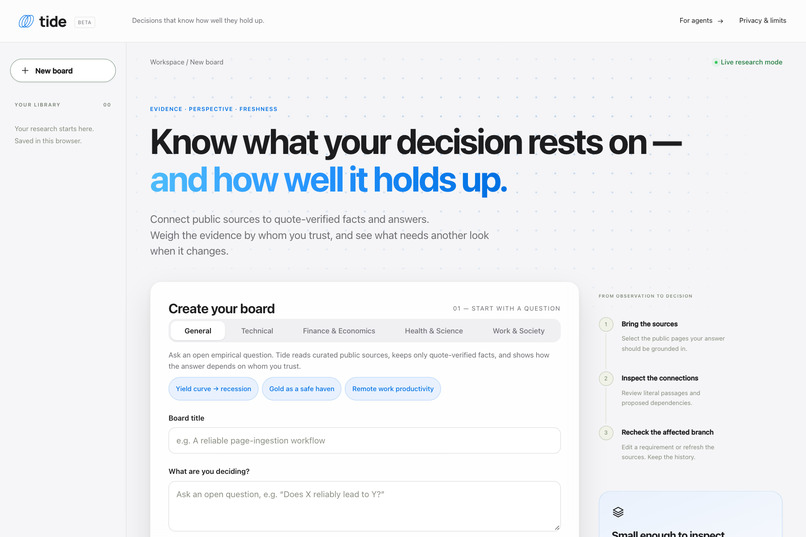
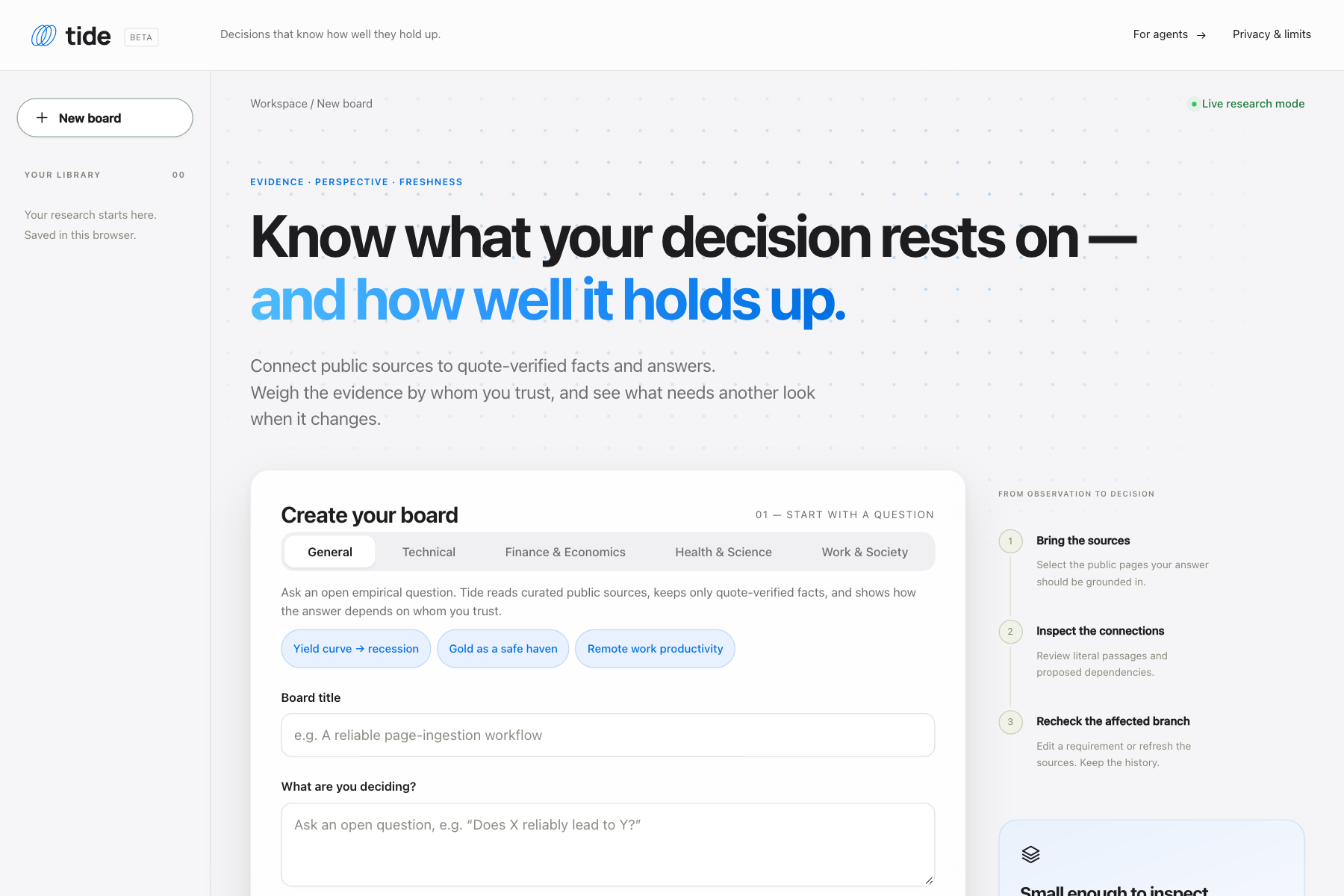
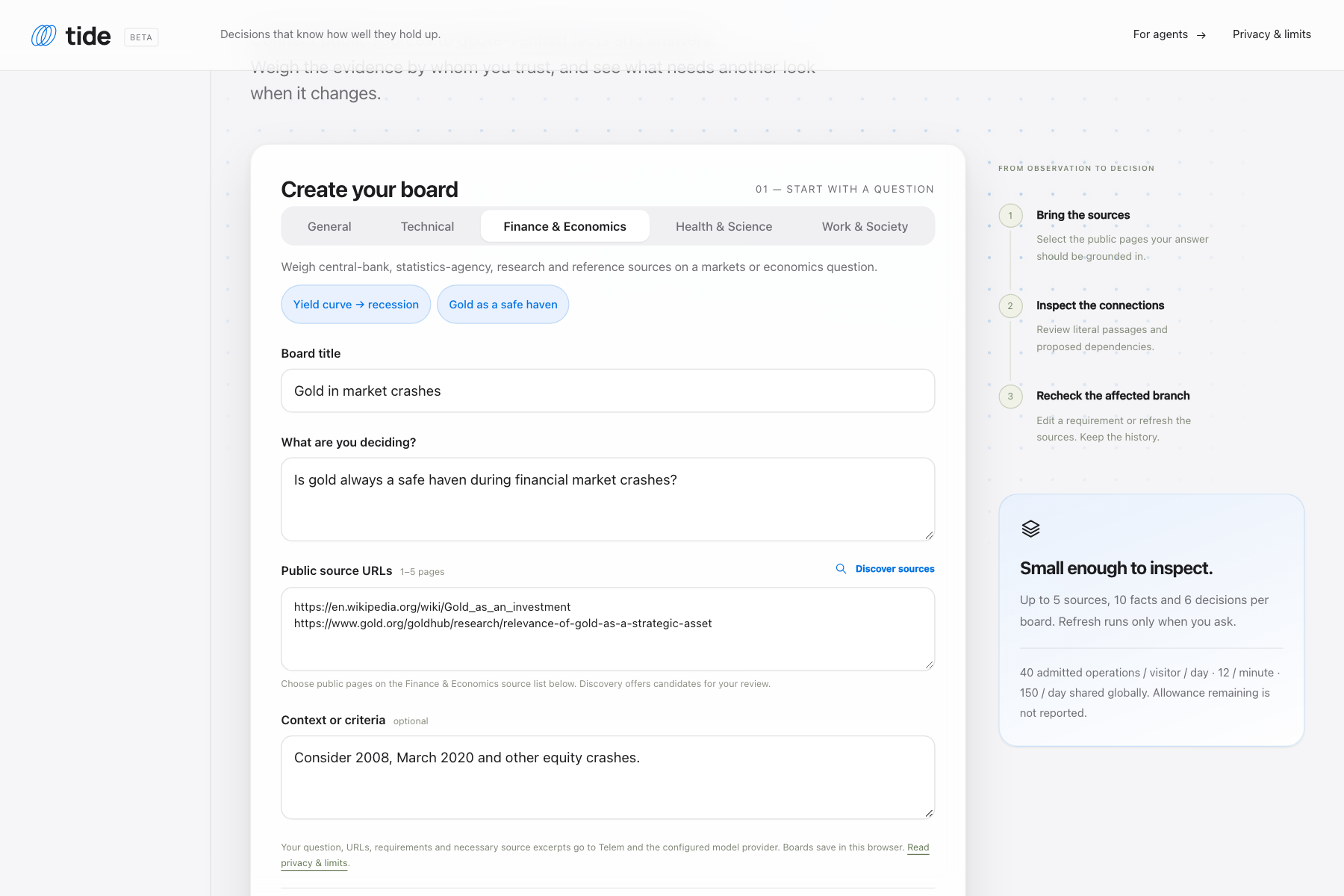
Ask any question in a mode: General, Technical, Finance & Economics, Health & Science, Work & Society
-
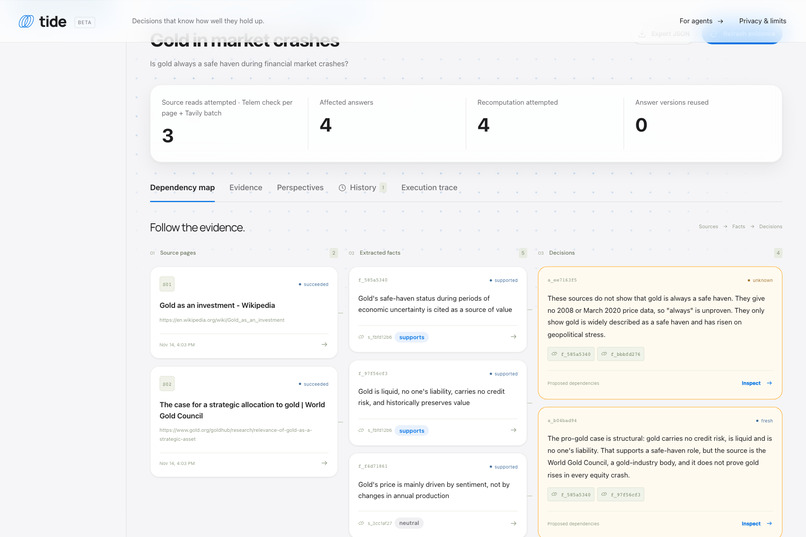
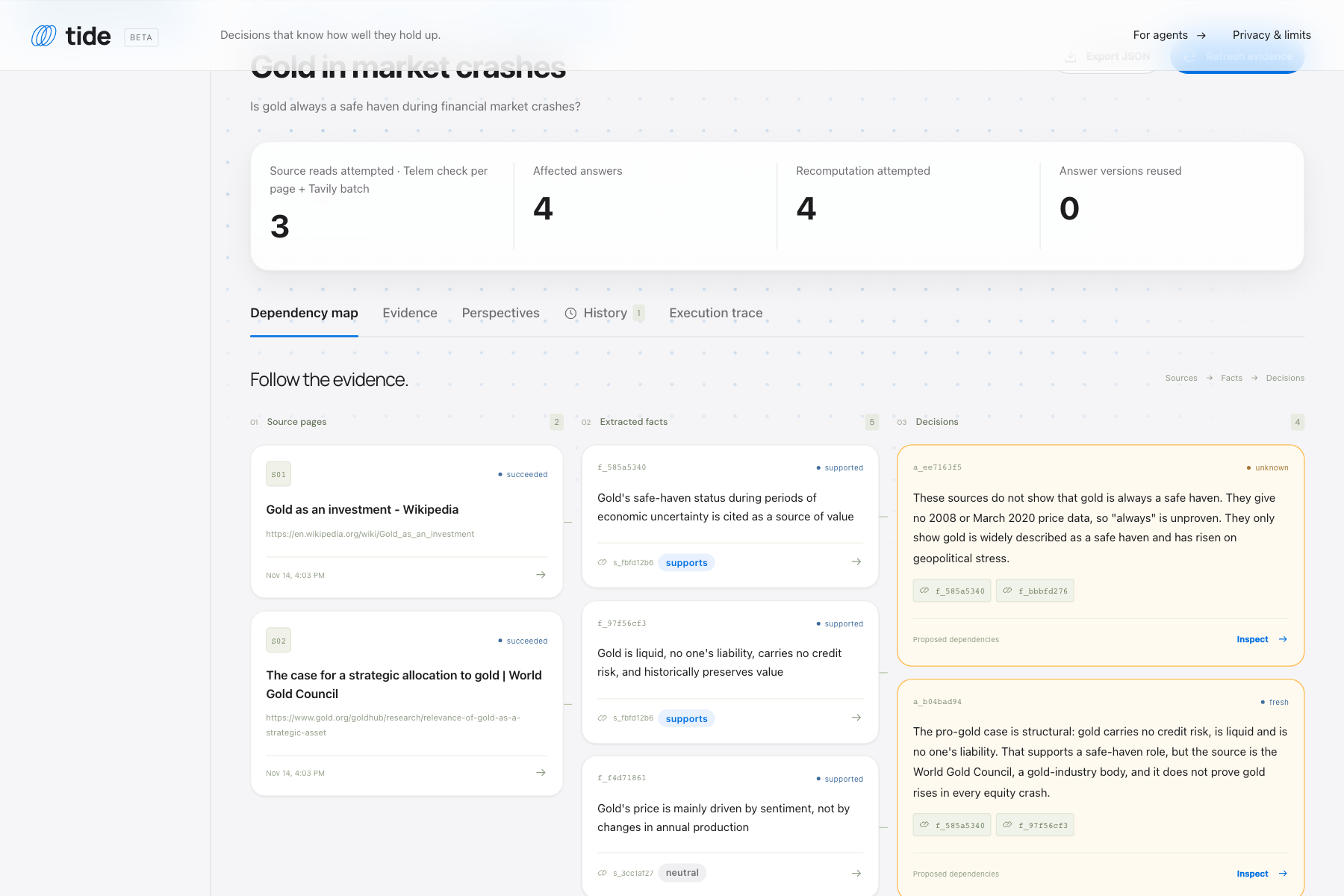
Dependency map: source pages, quote-verified facts with stance, and plain-language answers
-
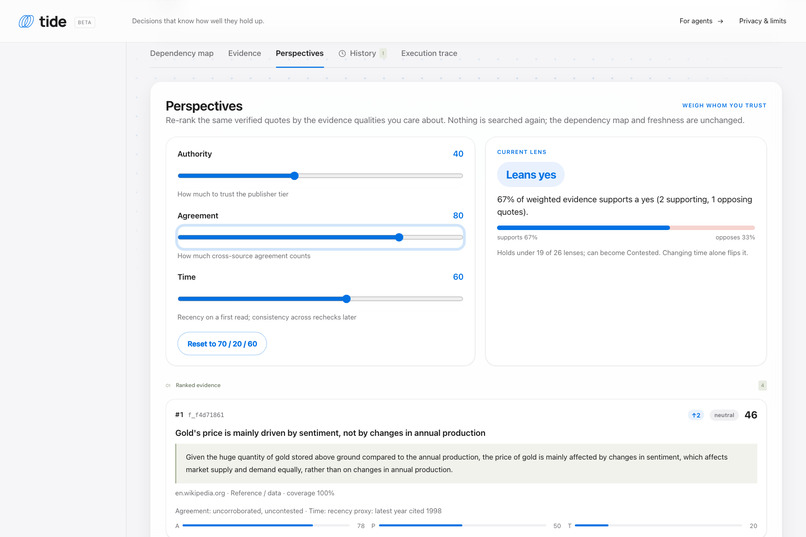
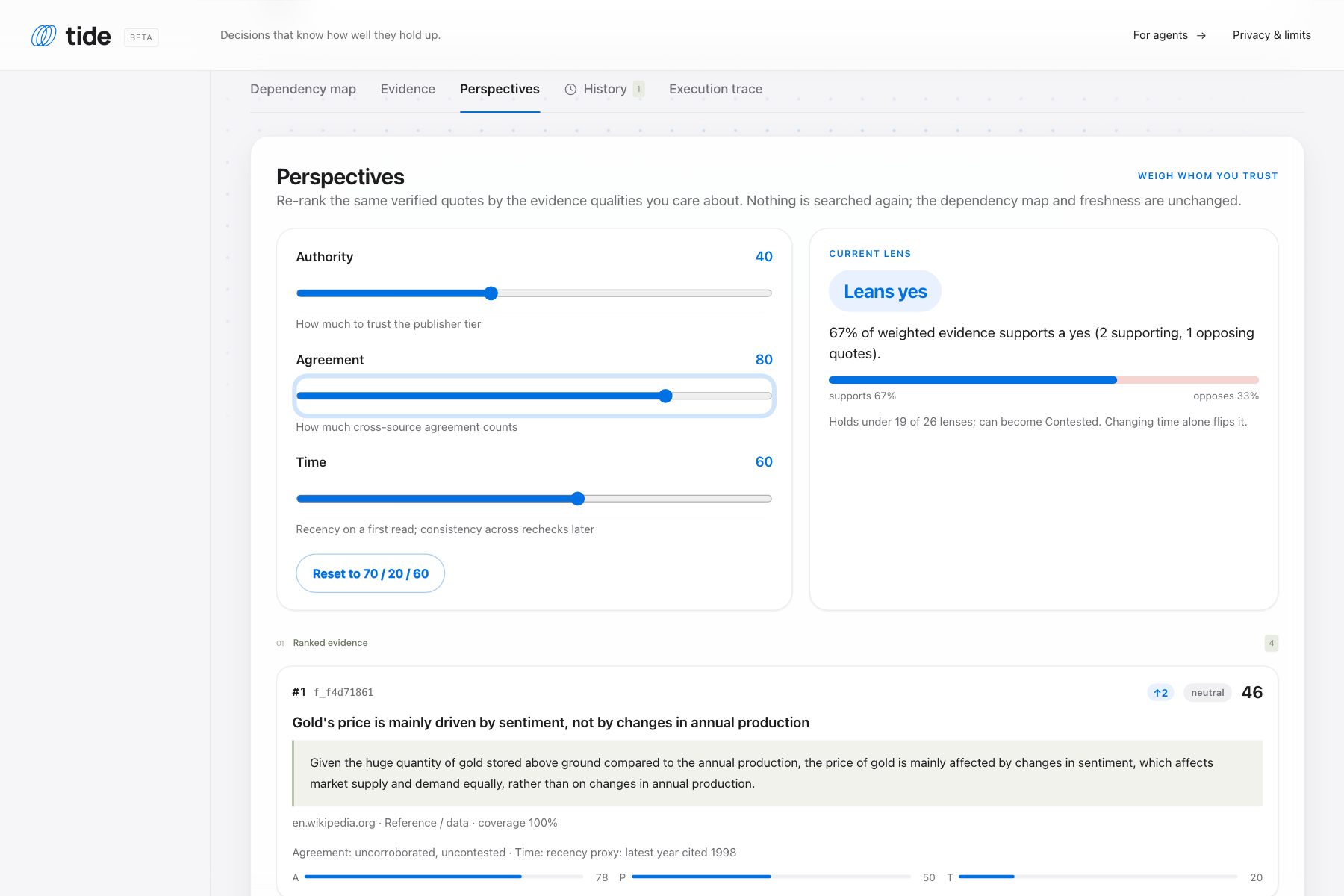
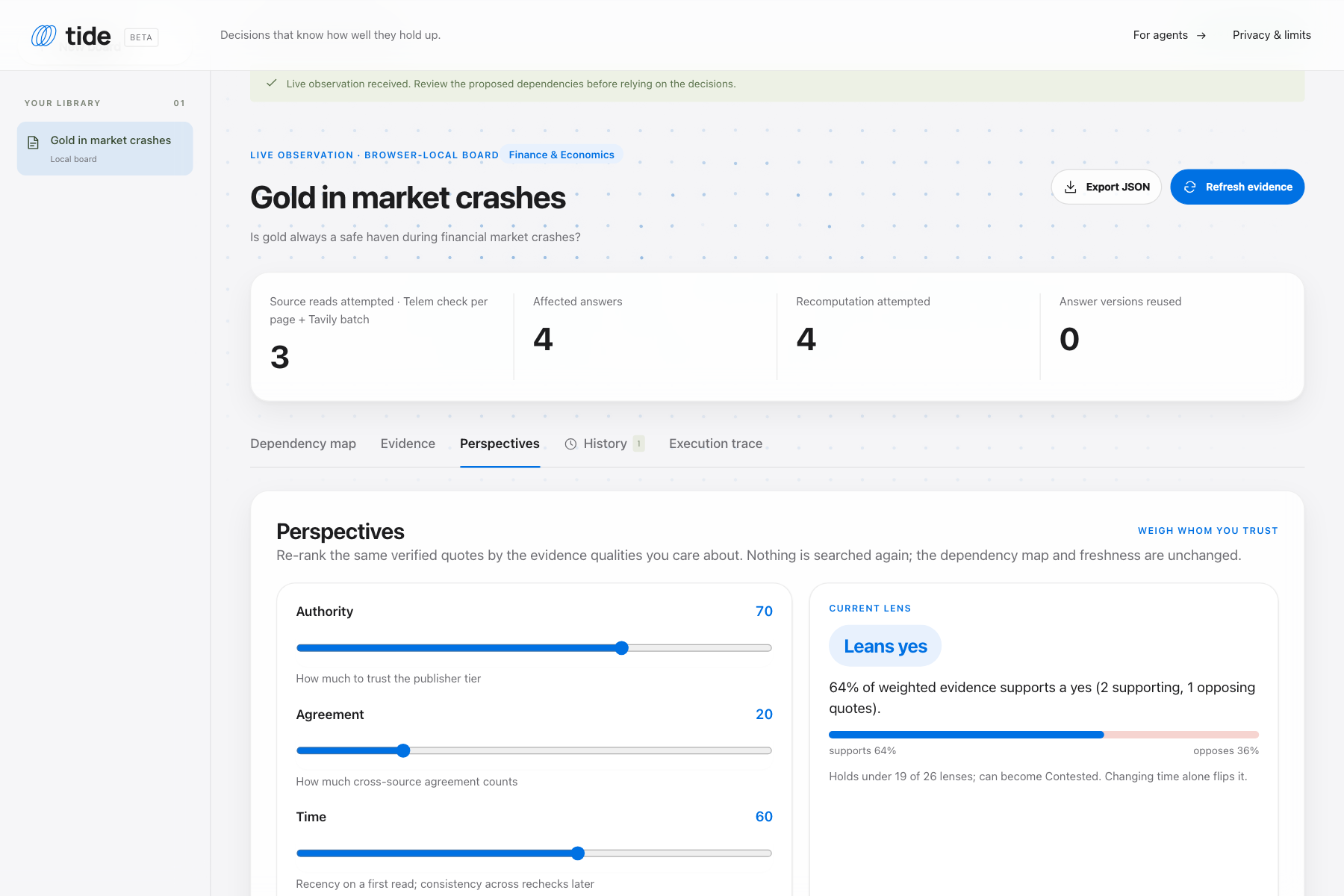
Drag the weights: ranked evidence re-orders live with rank-change badges and a support meter
-
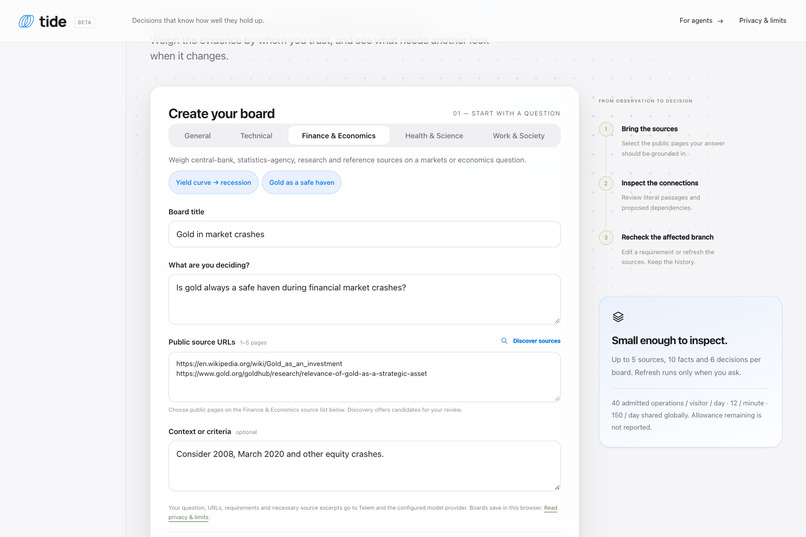
Each mode reads its own curated sources: central banks, statistics agencies, research, reference
-
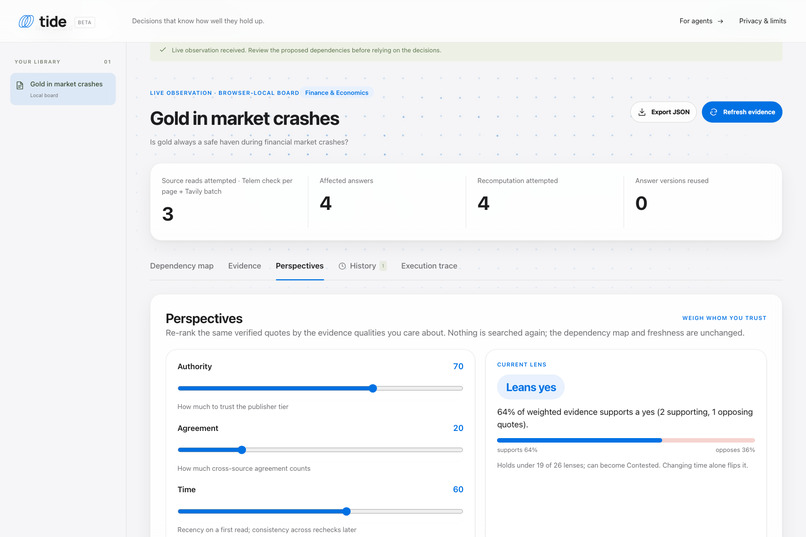
Perspectives: weigh Authority, Agreement and Time to get a verdict and a 26-lens sensitivity check
-
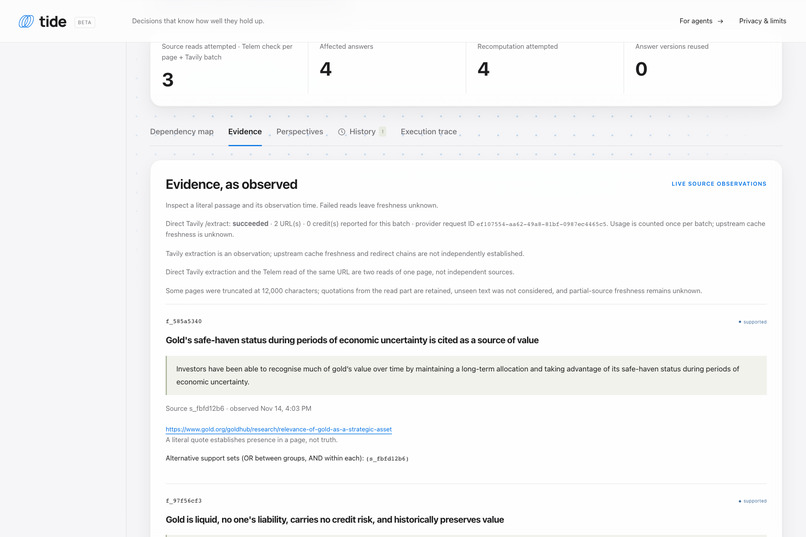
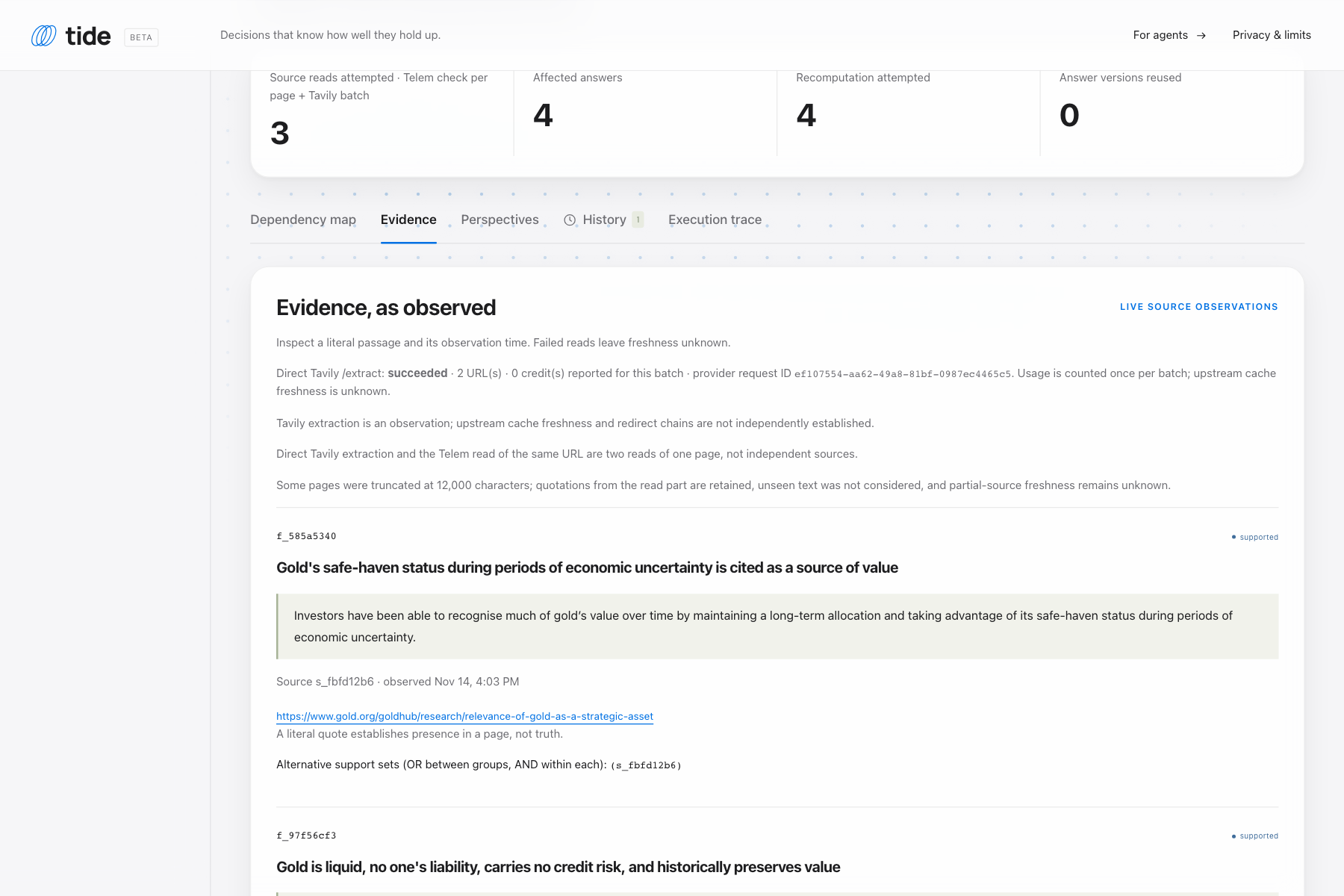
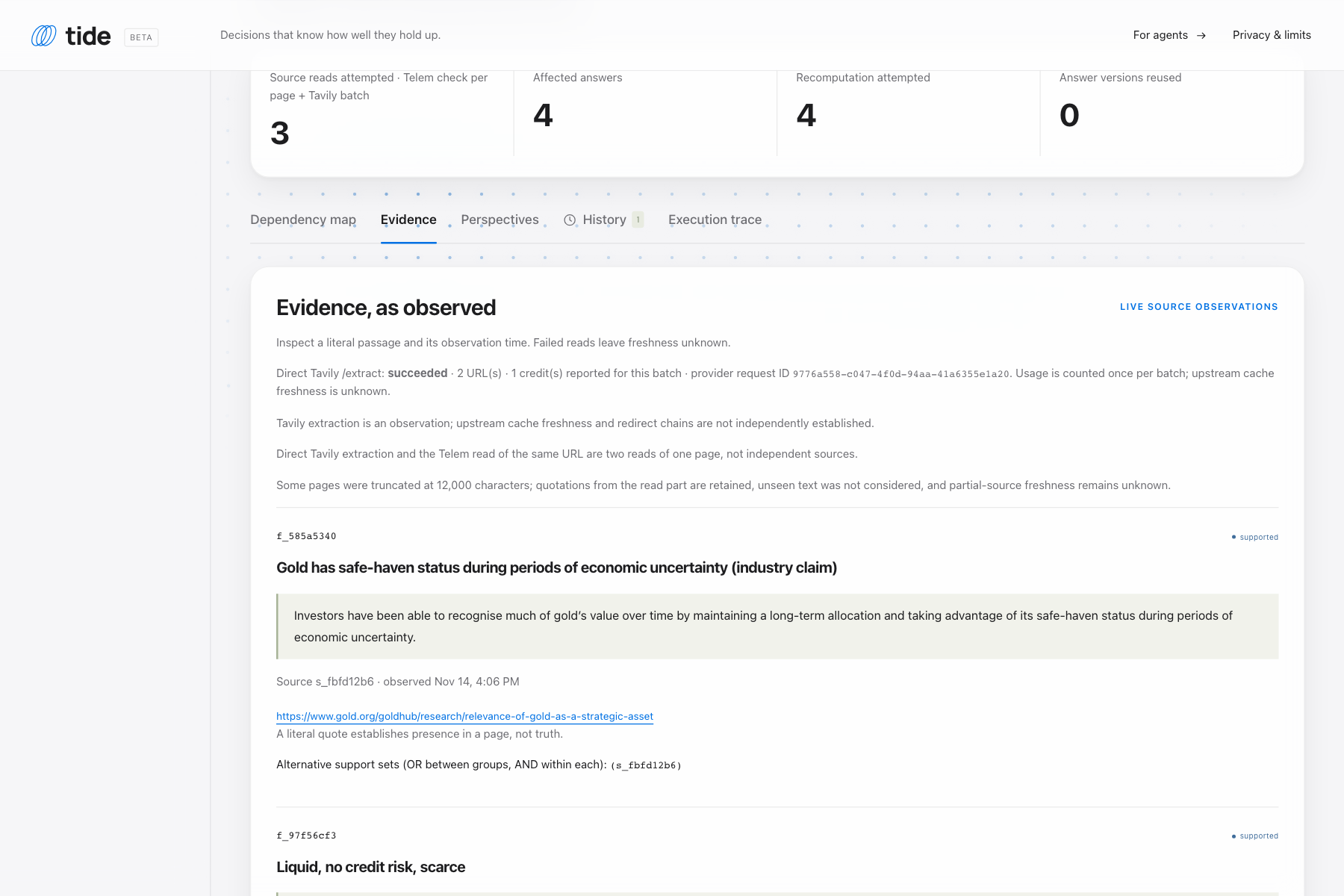
Evidence, as observed: literal quotes, sources, timestamps and provider details
-
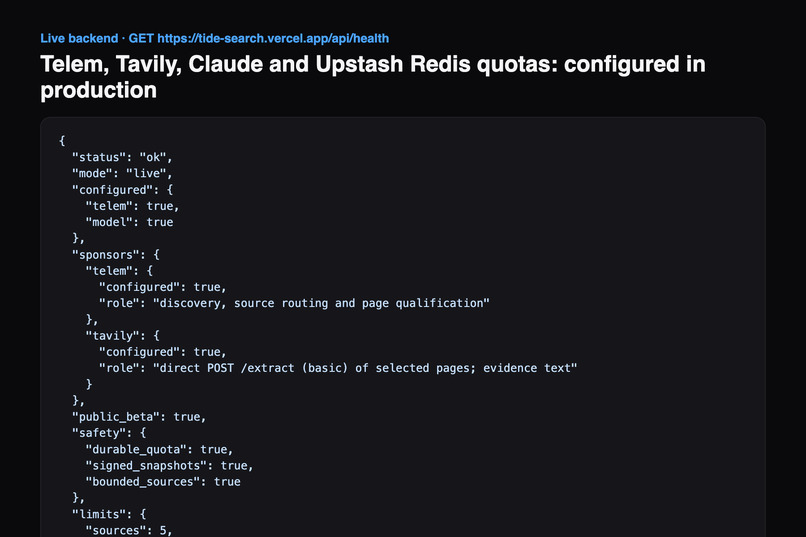
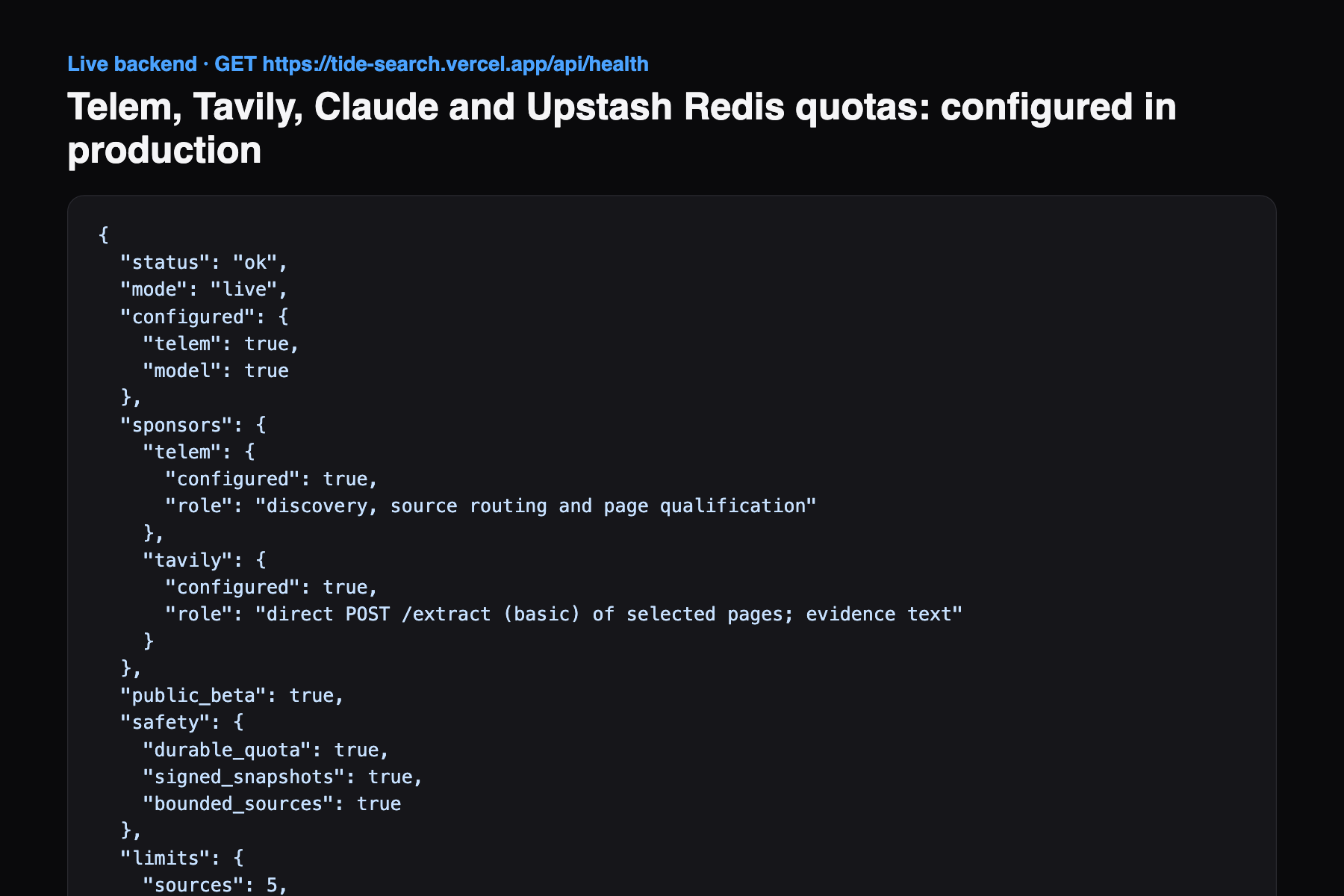
Live backend health: Telem, Tavily, Claude and Upstash Redis quotas configured in production
-
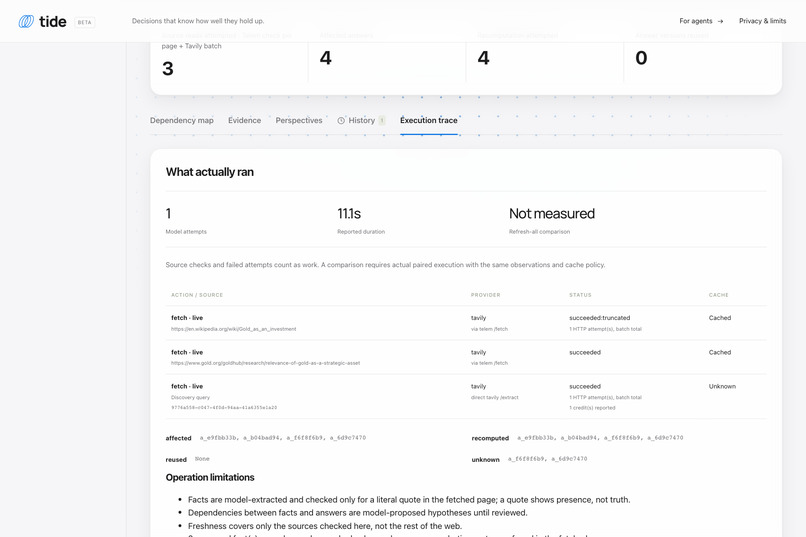
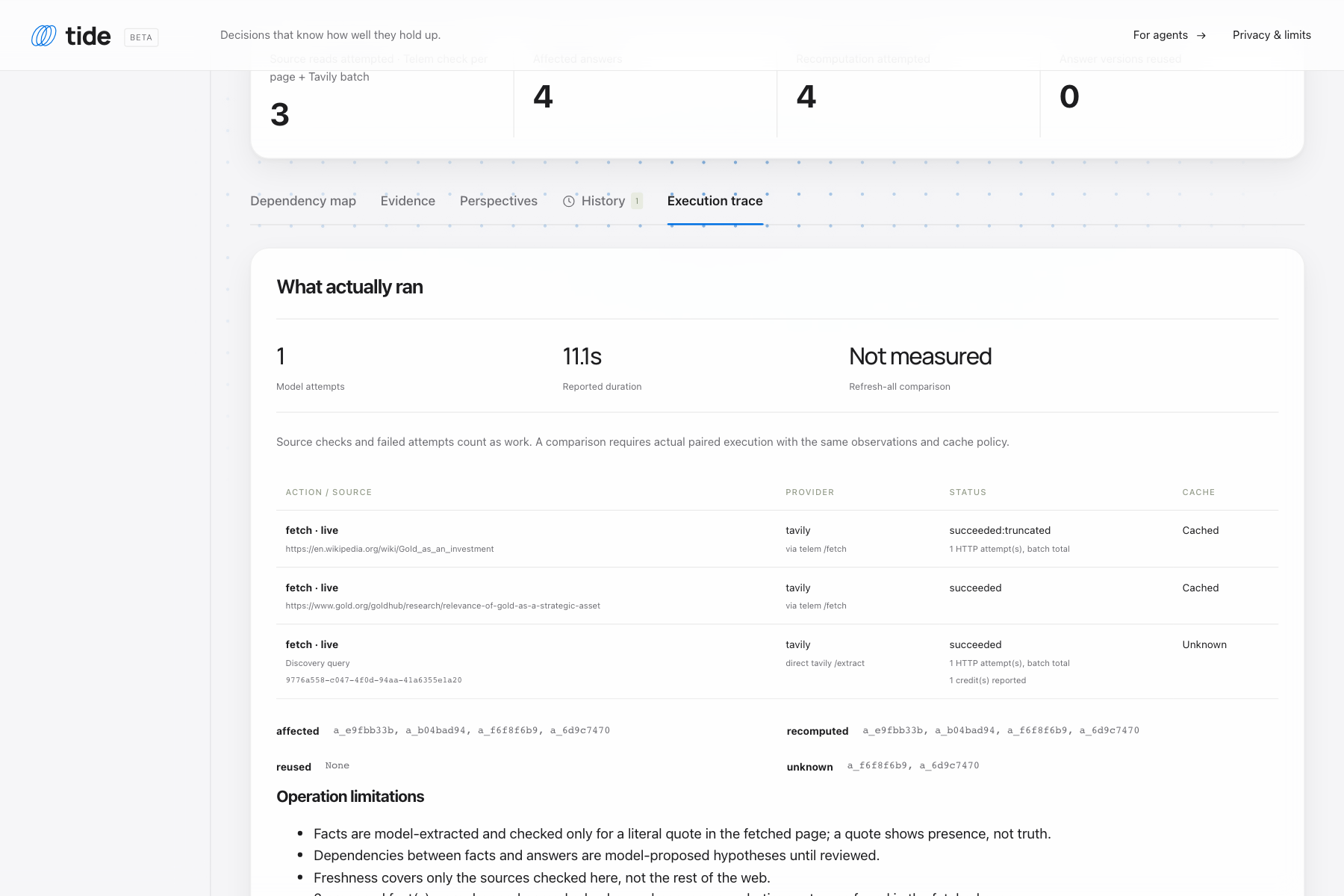
Execution trace: real Telem and direct Tavily /extract calls with request IDs, attempts and timing
-
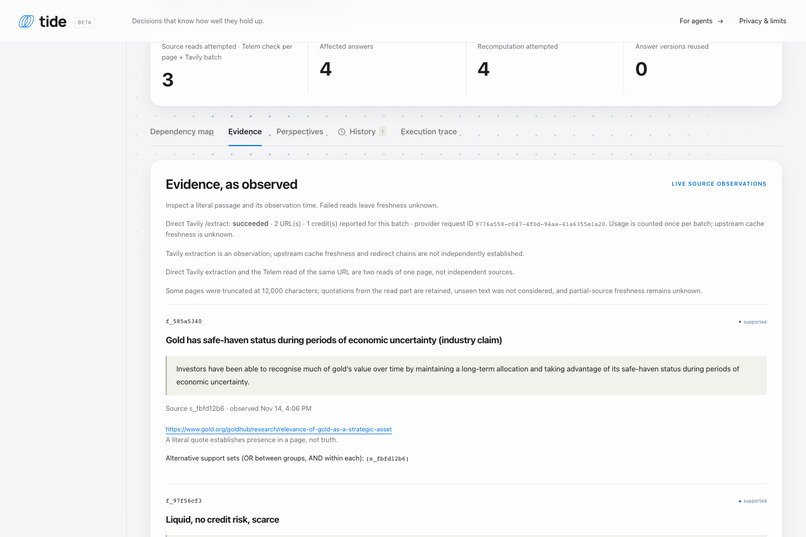
Evidence header: direct Tavily extraction succeeded, with provider request ID and Telem qualification
🌊 Tide — Research That Moves With the Evidence
Research changes. Your decisions should know when.
An evidence-aware research workspace that tracks what changed, reveals what matters, and lets you explore how different perspectives shape the same conclusion.
💡 Inspiration
The internet never stops changing. Our research notes do.
Every day, we make decisions based on articles, reports, documentation, and data. But the moment we finish researching, that information begins to age.
We kept coming back to two questions:
01 — Is this still true?
A government report gets revised. Documentation changes. A new study contradicts an earlier finding.
Your saved research doesn't notice. Your conclusions stay exactly where you left them, even when the evidence supporting them has changed.
02 — What if I trusted different evidence?
Two people can examine the same sources and reach different conclusions.
One prioritizes institutional authority. Another values agreement across independent sources. A third cares most about whether a claim has remained consistent over time.
Neither necessarily lacks evidence. They're evaluating it differently.
We had previously explored these problems independently, and we had drafted two ideas:
- Ripple — A system connecting research conclusions to their underlying evidence, with selective rechecking when information changes.
- PerspectiveSearch — An engine for exploring how different evidence-weighting preferences influence research conclusions.
Tide brings these ideas together into one experience since they are heavily complementary.
Not another chatbot that gives you an answer and disappears.
A research workspace that helps you understand why an answer holds up, what could change it, and how much confidence it deserves.
🌊 What It Does
Ask questions. Trace evidence. Challenge conclusions.
Tide transforms a research question into a living, inspectable evidence board.
Instead of returning a single opaque AI response, Tide exposes the sources, facts, dependencies, and competing perspectives behind its conclusions.
🔎 01. Research with context
Choose a research mode tailored to your question:
- General — Explore topics across disciplines.
- Technical — Investigate software, engineering, and technical documentation.
- Finance & Economics — Examine economic indicators, financial research, and institutional data.
- Health & Science — Explore scientific findings and research literature.
- Work & Society — Investigate labor, public opinion, and societal trends.
Each mode uses curated source policies, prioritizing relevant publishers such as central banks, statistical agencies, scientific institutions, reference works, survey organizations, and developer documentation.
Try asking:
"Does an inverted yield curve reliably predict a U.S. recession within 12 months?"
📚 02. Evidence you can actually verify
AI-generated citations shouldn't require blind trust.
Tide uses Telem to discover and qualify research sources, Tavily Extract to retrieve page content, and Claude to structure the evidence into facts, stances, and answers.
But there's an important additional step:
Every accepted factual quotation must appear literally in the retrieved source text.
Each fact retains its source and observation timestamp, allowing users to inspect where the evidence came from.
No fabricated quotations. No pretending an inaccessible page was verified.
🕸️ 03. See the reasoning behind every decision
Tide organizes research into an explicit dependency graph:
Sources → Facts → Answers
Every answer is connected to the facts supporting it, and every fact connects back to its original source.
This makes research traceable.
You can see which evidence supports a conclusion, which claims contradict it, and which answers depend on a particular fact.
⚖️ 04. Change your perspective, not your research
This is where Tide becomes more than a research assistant.
Every piece of evidence is evaluated across three dimensions:
| Dimension | What it measures |
|---|---|
| Authority | How authoritative is the publishing source? |
| Agreement | How strongly does independent evidence agree? |
| Time Consistency | Has this evidence remained consistent across observations? |
Adjust the three weights using interactive sliders.
Tide instantly recalculates evidence rankings and updates its verdict:
Leans Yes · Leans No · Contested · Insufficient Evidence
No additional research request. No waiting for another model response.
Then Tide goes one step further.
Its 26-configuration sensitivity sweep tests how conclusions behave under different weight combinations.
You can discover whether a verdict is stable across perspectives or identify which weighting changes its outcome.
The goal isn't to manufacture certainty. It's to make uncertainty understandable.
🔄 05. Recheck what matters. Not everything.
Traditional research workflows often repeat the entire investigation whenever something changes.
Tide uses its dependency graph to do something more selective.
Change your requirements or context?
Tide recomputes only the dependent answers, without fetching new pages.
Refresh your evidence?
Tide compares observations and recomputes only answers affected by changed facts.
And when a source can't be reached, Tide doesn't silently mark it as current.
Unknown stays unknown.
💾 06. Your research stays yours
Tide is designed to work without requiring an account.
Research boards are stored locally in IndexedDB, with immutable revisions and support for importing and exporting boards.
For developers, Tide also includes a local MCP agent kit with 9 tools and 2 skills, bringing research-board capabilities into agent workflows such as Claude Code and Codex.
A visual research workspace for humans. Structured research capabilities for agents.
🛠️ How We Built It
Tide combines modern web engineering, agent-assisted research, evidence verification, and dependency-aware computation.
The experience
Next.js 16 · React 19 · TypeScript
We built Tide around an Apple Human Interface Guidelines-inspired design language, using system typography, translucent surfaces, spring-based interactions, and a React Bits ripple-grid background.
The goal was to make complex research feel approachable without hiding its underlying structure.
Animations also respect reduced-motion preferences.
The research pipeline
Telem → Tavily → Anthropic API → Verification
- Telem (
hack.telem.ai) discovers and qualifies relevant research sources. - Tavily Extract retrieves the underlying page text.
- Claude proposes structured facts, evidence stances, and research answers.
- Server-side verification checks that quoted facts appear literally in the retrieved material.
- Tide's evidence engine connects the results into an inspectable dependency graph.
The reasoning engine
The core data model is a typed source → fact → answer graph.
Reverse-dependency tracking makes it possible to identify which conclusions are affected by a change without rebuilding unrelated answers.
We also ported PerspectiveSearch's Authority / Agreement / Time evaluation logic from Python into pure TypeScript.
Evidence weighting and sensitivity analysis run locally, allowing interactive perspective changes without repeating source discovery or extraction.
The security and deployment layer
We designed Tide for a publicly accessible, account-free beta while keeping its backend bounded.
That includes:
- Server-signed research snapshots
- Mode-specific source allowlists
- SSRF protections and redirect validation
- Atomic rate quotas using Upstash Redis
- Explicit handling of unavailable or unverifiable evidence
The principle: powerful research capabilities, with boundaries users can understand.
🧩 Challenges We Ran Into
01. Making AI citations genuinely verifiable
Long, information-dense pages from sources such as Wikipedia and the Federal Reserve made evidence extraction difficult.
We needed to preserve exact quotations without allowing ordinary text truncation to invalidate otherwise useful evidence.
This forced us to distinguish between a missing quotation, an incomplete extraction, and a genuinely unsupported claim.
02. Turning subjective judgment into transparent scoring
PerspectiveSearch originally used model-based rubrics to evaluate source authority.
For Tide, we chose explicit publisher tiers instead of presenting an opaque model judgment as objective precision.
That tradeoff made the scoring system more transparent and inspectable.
03. Handling failures without manufacturing confidence
What happens when a page disappears, an API request fails, or a model can't complete its analysis?
A conventional assistant may continue presenting an earlier answer without making its current validity clear.
We built Tide to distinguish unavailable evidence from verified evidence, marking affected research as stale or unknown instead of pretending a failed check succeeded.
A trustworthy research tool needs to communicate what it doesn't know.
🏆 Accomplishments We're Proud Of
We didn't just connect three AI services. We connected the entire lifecycle of a research decision.
- Verifiable evidence: Accepted quotations are checked against fetched source text.
- Inspectable reasoning: Conclusions have explicit dependencies connecting them to their evidence.
- Interactive perspectives: Users can explore competing evidence preferences without new searches.
- Sensitivity analysis: A 26-weighting sweep reveals whether conclusions withstand alternative priorities.
- Selective recomputation: Changes propagate only to affected answers.
- Agent interoperability: An MCP toolkit extends Tide into developer-agent workflows.
- Persistent research: Local boards, immutable revisions, and portable exports keep work accessible.
Most importantly, these capabilities reinforce one another rather than existing as disconnected features.
🧠 What We Learned
Fresh evidence isn't automatically convincing evidence. And convincing evidence isn't necessarily fresh.
Building Ripple taught us how to connect conclusions to changing sources.
Building PerspectiveSearch taught us how different assumptions about evidence quality shape the conclusions people reach.
Combining them revealed something more interesting:
Research confidence isn't a single number.
It's a relationship between what the evidence says, where it came from, whether it still holds, and how we choose to evaluate it.
Tide makes those relationships visible.
We also learned that building responsible AI experiences sometimes means deliberately doing less: refusing to invent citations, exposing scoring assumptions, and acknowledging incomplete information.
Those constraints make the product more useful, not less.
🚀 What's Next
We're exploring three natural extensions of Tide:
01 — Smarter evidence evaluation
Introduce model-assessed source authority alongside transparent publisher tiers, so users can compare the two rather than relying on a hidden score.
02 — Collaborative research
Expand source selection with user-approved domains and introduce shared boards for teams working on the same decision.
03 — Continuous evidence monitoring
Add scheduled source rechecks with notifications when meaningful evidence changes affect a decision.
Imagine opening Tide and seeing:
"Two sources changed overnight. One conclusion is now contested."
That's the research experience we're working toward.
🔍 Current Limitations
We believe research tools should be as transparent about their limitations as their capabilities.
- Evidence stances and dependency relationships are proposed by a model and remain available for human review.
- Boards currently support up to 5 sources, 10 facts, and 6 answers.
- Automated background monitoring is planned, not currently available.
These are intentional boundaries of the current version, not features we want to imply already exist.
🌊 Tide
Research that moves with the evidence.
Know what changed. Understand what matters. Decide with perspective.
Built With
- anthropic
- indexeddb
- mcp
- next.js
- node.js
- react
- react-bits
- redis
- tavily
- telem
- typescript
- upstash
- vercel
- zod
