-
-
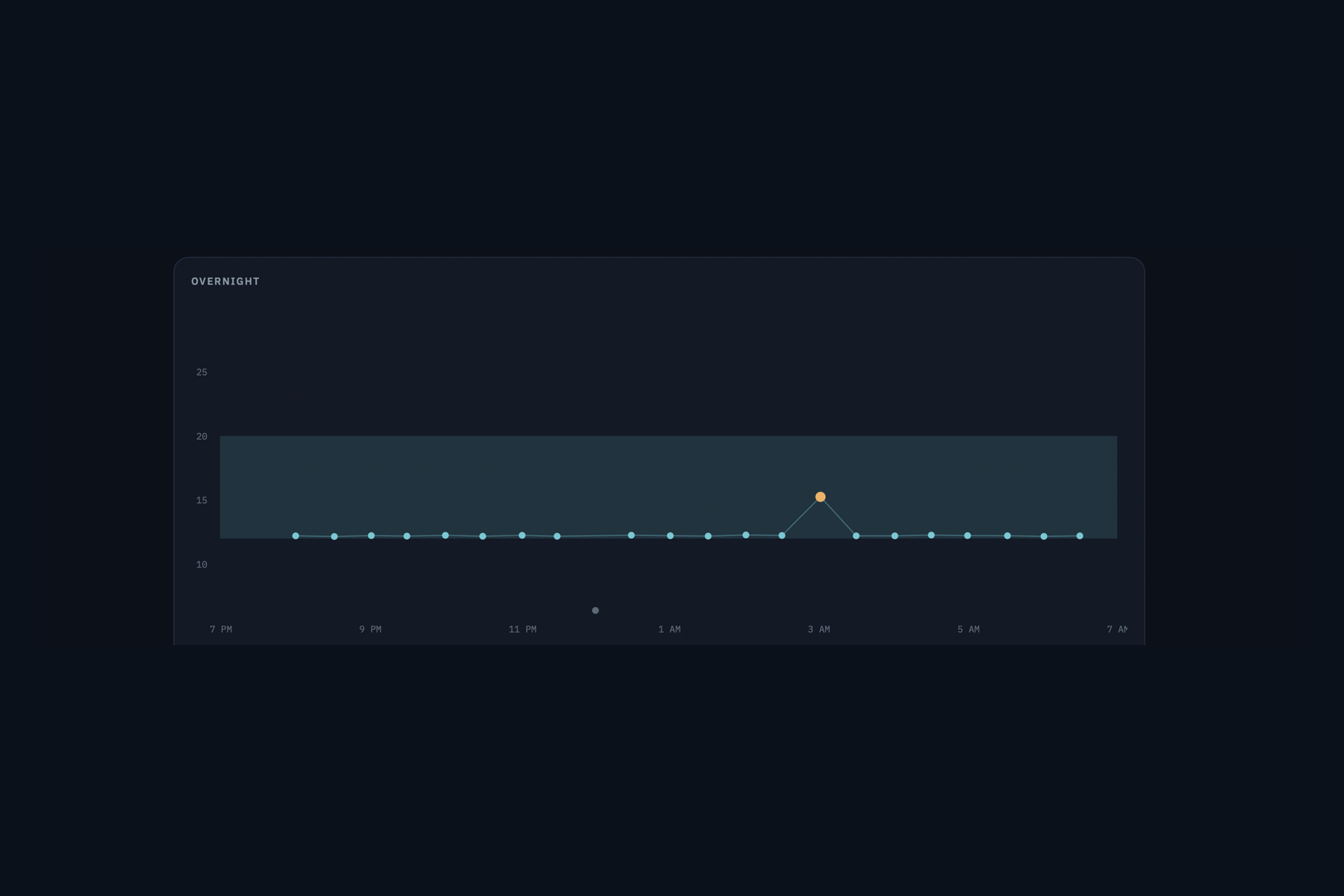
overnight
-
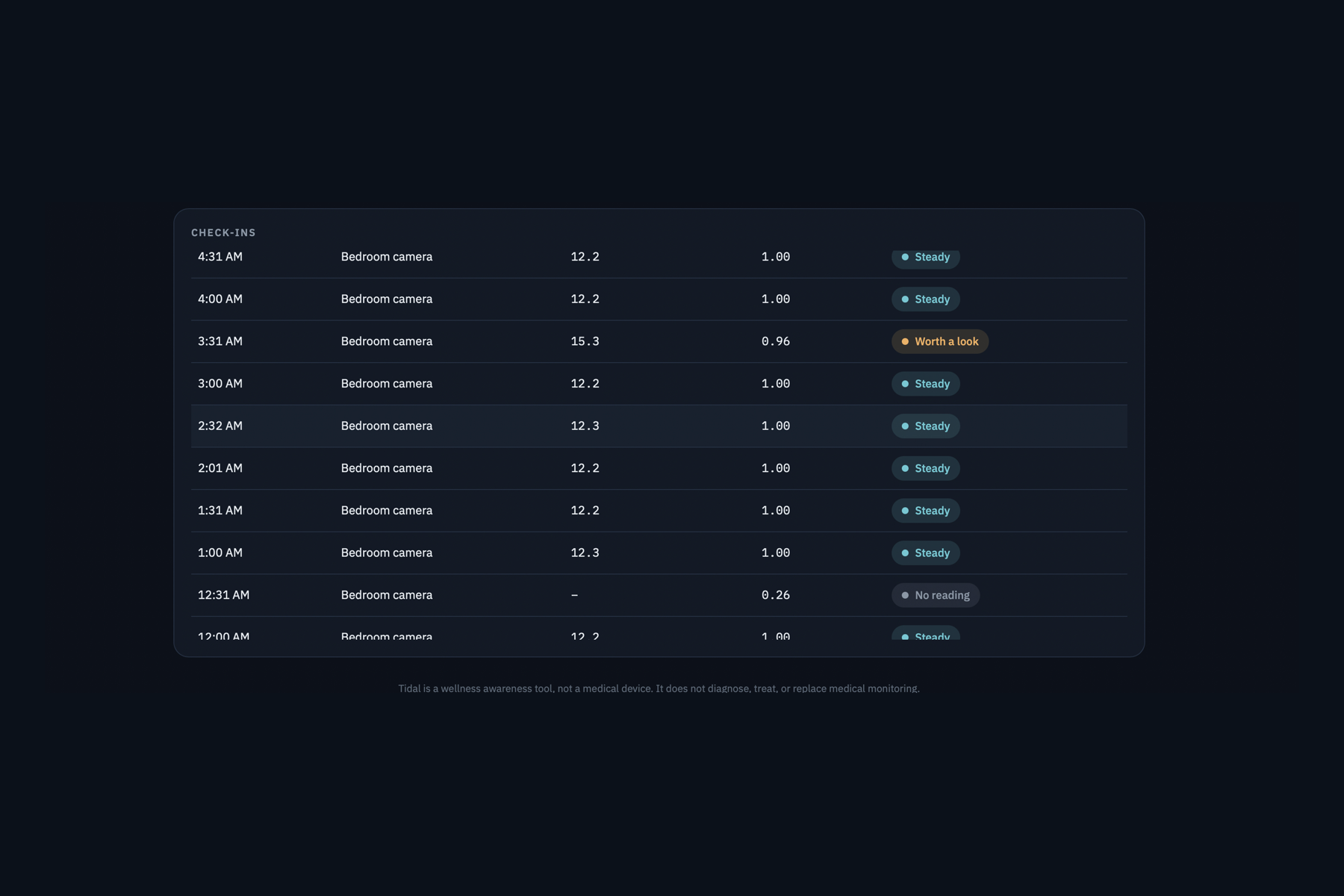
checkins
-
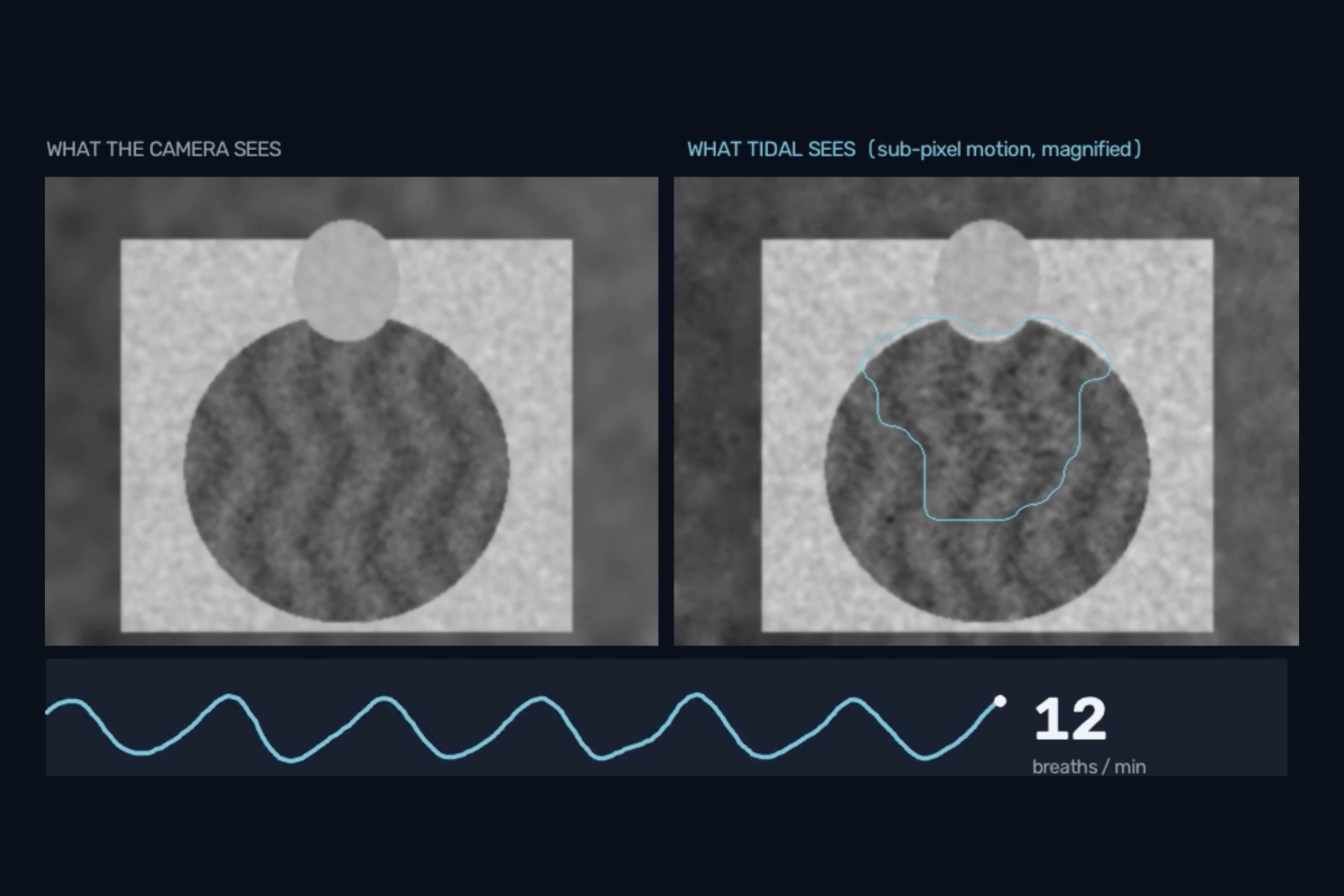
magnified
-
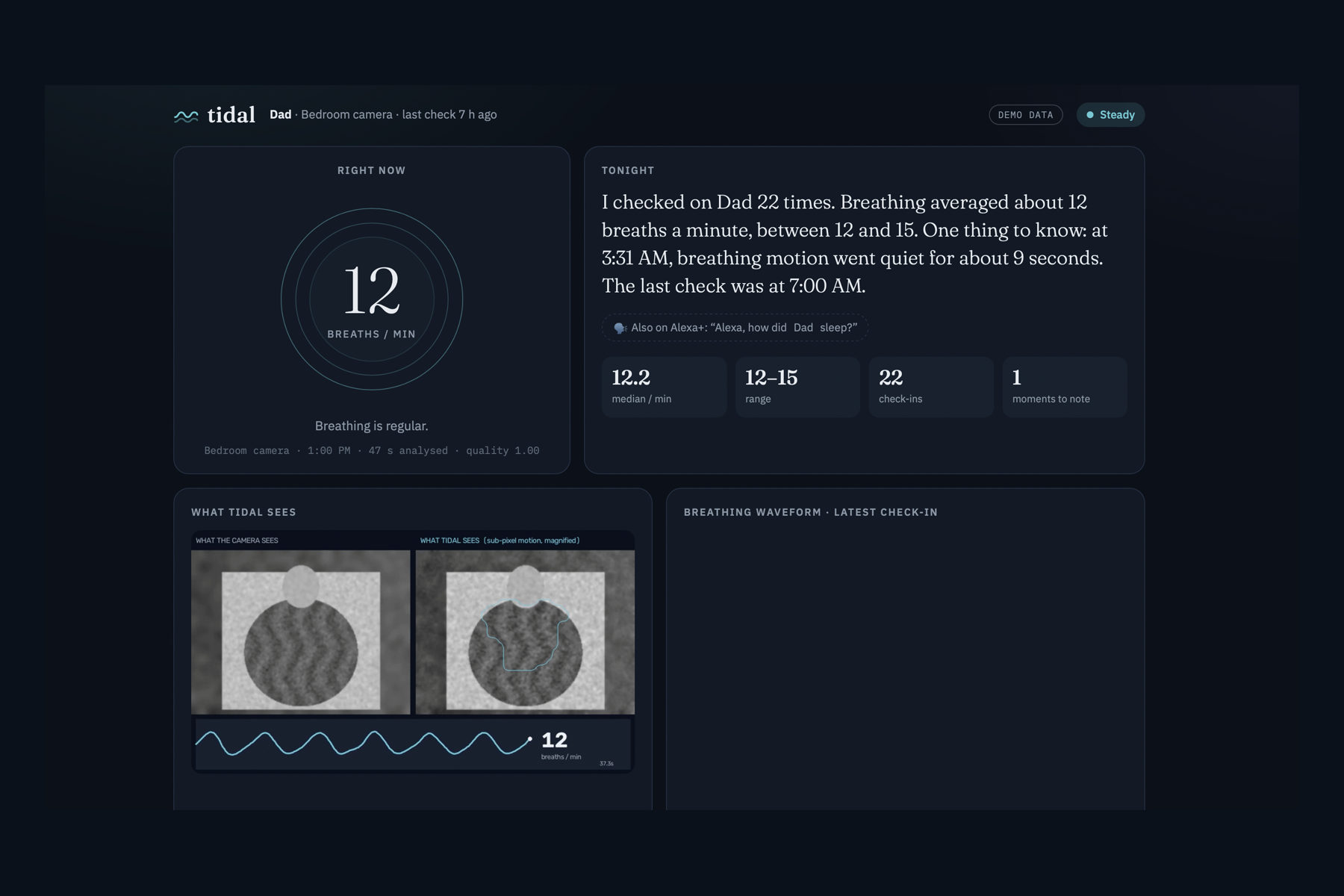
dashboard
Inspiration Millions of adult children lie awake wondering whether a parent who lives alone is OK. The usual answers don't work at 2 a.m.: wearables get left on the nightstand, go uncharged, or are simply refused, and a camera feed of someone asleep looks frozen — it tells you nothing.
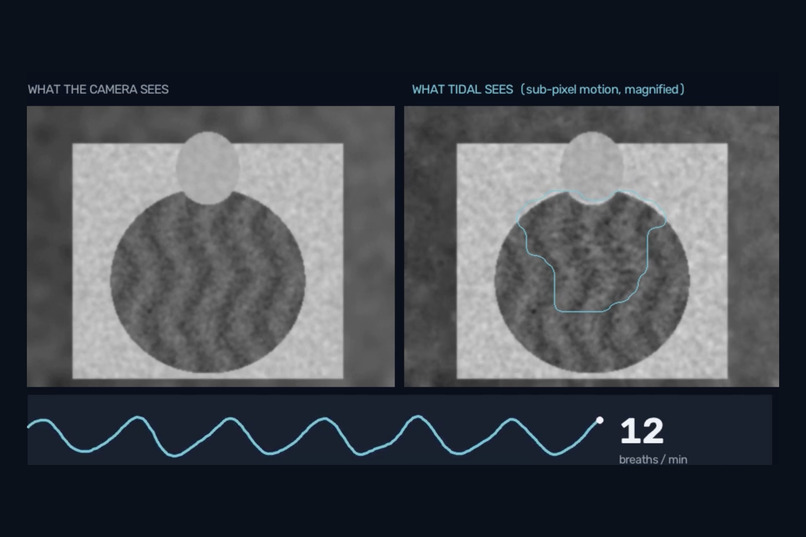
But a sleeping chest still moves a few millimetres with every breath. On a home camera that's a fraction of a pixel — invisible to people, measurable by physics. Millions of homes already have a Ring camera in the room. We wanted to give those cameras a capability they've never had, with zero new hardware.
What it does Tidal turns a Ring camera into a contactless breathing monitor for caregivers:
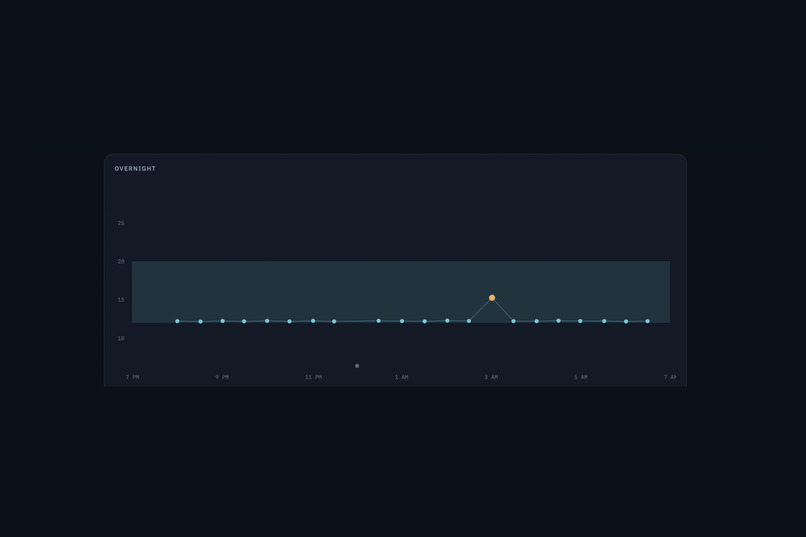
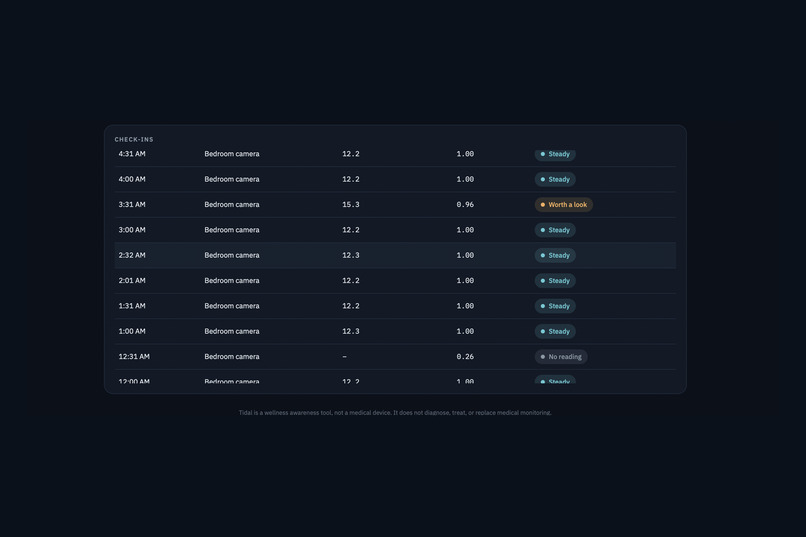
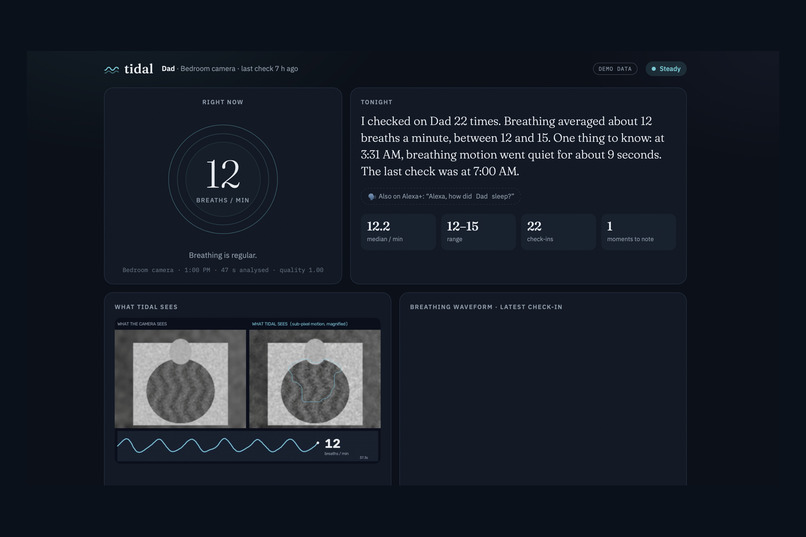
Breathing rate from sub-pixel chest motion, through blankets and in infrared night vision. Moments worth a look — breathing motion going quiet, or a rate outside the usual resting range — shown in amber, never red. Tidal never diagnoses. Honest refusals: when the signal isn't trustworthy (empty bed, heavy compression, lots of movement) it says "no clear reading" instead of guessing. One calm answer on a dashboard, and by voice: "How did Dad sleep?" → "I checked on Dad 22 times. Breathing averaged about 12 breaths a minute. One thing to know: at 3:31 AM, breathing motion went quiet for about 9 seconds." How we built it The physics. Model a row of pixels as a texture moving by a tiny displacement δ ( t ) δ(t). To first order,
I ( x , t
)
f ( x + δ ( t ) ) ≈ f ( x ) + δ ( t ) ∂ f ∂ x I(x,t)=f(x+δ(t))≈f(x)+δ(t) ∂x ∂f
so every pixel's brightness is a scaled copy of the chest motion, with gain equal to the local image gradient. That single equation drives both halves of Tidal: the estimator reads δ ( t ) δ(t) back out of brightness changes, and the magnifier (MIT's Eulerian Video Magnification) adds α δ ( t ) ∂ f / ∂ x αδ(t)∂f/∂x back in so you can see the chest rise and fall.
The signal chain (open-source tidal_vitals, pure NumPy/SciPy/OpenCV): 8×8 block pooling → illumination removal (per-frame median) → H.264 skip-block repair → smoothness-priors detrending → zero-phase Butterworth band-pass (0.1–0.7 Hz) → automatic chest ROI by spectral SNR, contrast and spatial coherence → PCA → windowed FFT with parabolic peak interpolation → a confidence model that only reports a number at ≥ 0.6 ≥0.6. No body or face detector needed. Pulse (POS rPPG) is included as experimental and hidden unless its own confidence passes.
Ring. HMAC-SHA256-verified, de-duplicated motion webhooks; clip download through Ring's pre-signed redirect flow; and scheduled live check-ins over WHEP — because a still, sleeping person never triggers motion detection, which is exactly when you want to know they're breathing. Developed end to end against the ring-sandbox emulator.
Alexa+. Tidal ships an MCP server (Streamable HTTP, protocol 2025-11-25) with get_night_summary, get_latest_vitals, list_attention_events, get_breathing_trend and check_in_now. Every tool returns a speech field written for voice, identical to the dashboard sentence.
AWS. Amazon Bedrock (Converse API) can phrase the nightly summary — it only ever phrases numbers computed deterministically, with a template fallback.
Hosting. One Docker service on Render serving the dashboard, API, webhook and MCP endpoint. It fails closed: in public mode it won't start without its secrets, webhooks are rejected without a signing key, and the MCP endpoint requires a bearer token.
Challenges we ran into We measured the video encoder. Our first estimator confidently reported ~13 breaths a minute from an empty, heavily compressed night scene. H.264 skips unchanged macroblocks and refreshes them periodically — a perfect fake rhythm. We added skip-block reconstruction and a codec-aware confidence model. Then it fooled us again. Testing 48 freshly rendered clips, 3 of 6 empty rooms still slipped past a hard cutoff and reported a rate. Replacing the cliff with a continuous penalty separated them cleanly: every true signal ≥ 0.81 ≥0.81, every empty or codec-starved clip ≤ 0.33 ≤0.33. Memory. A 30-second analysis peaked at 2.4 GB. Chunked float conversion, frame-by-frame motion detection and a streamed render cut that ~4× with identical results. Accomplishments that we're proud of On ground-truth video with known physiology, through real H.264: breathing within 0.2 breaths/min from 8.8 to 25 /min, including 0.15-pixel motion and infrared night vision; the 12-second breath-hold detected; roll-overs excluded; and empty-room and codec-starved clips correctly refused. Twenty-two automated tests cover the physics, the Ring webhook security, the MCP tools and the hosted demo's access rules.
What we learned The hard part of contactless sensing isn't finding a signal — it's knowing when the signal you found is fake. Refusing to answer is a feature.
What's next for Tidal A real-home beta against a reference breathing band, Ring App Store certification and OAuth account linking, per-person ROIs for shared beds, phase-based magnification for less noise, and senior-living pilots.
Tidal is a wellness awareness tool, not a medical device. The public demo uses synthetic footage with a known breathing rate.

Log in or sign up for Devpost to join the conversation.