-
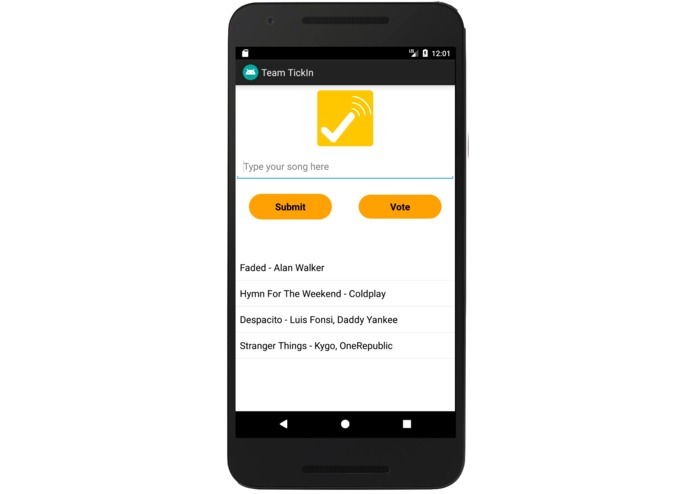
Mobile App
-
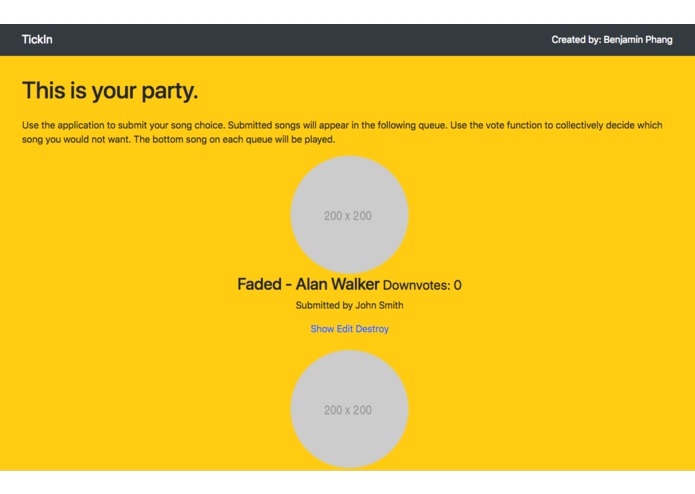
Web App


Inspiration
After attending several parties and gatherings both in and out of Berkeley, our team members felt there was one dominating person who would control the music for the entire duration of events. Music is an important aspect of a social gathering and contributes to the vibe, but if the attendees of the event cannot have a say in the music they listen to, then it truly doesn’t allow everyone in the gathering to have fun.
Our team felt passionate about making social gatherings fun and inclusive for everyone, and by allowing everyone to have a say in the music they listen to, our innovation can bring people closer together and enable everyone to have fun! Our innovation ultimately shapes the culture of the music entertainment sphere.
What it does
TickIn's Song Queue is a feature that can be integrated into another live music streaming app, like Spotify, or serve as an independent application. The feature “democratizes music entertainment” by allowing everyone to have a voice in the music they listen to. Essentially, once an attendee of an event has the ‘Tickin Song Queue” app, he/she has a fair share of control of the aux cord.
Our feature introduces a gamification tactic for increasing engagement of the attendees and creating a community around the music streaming app they are using. The attendee can add their preferred song to the queue every 15 minutes with the free version, or add their song to the queue every 10 minutes with the paid version. Additionally, every attendee has the option to “vote against” the current song they are listening to if they don’t like the song. Free users have 1 vote every 20 minutes, while paid users have one vote every 10 minutes. Meanwhile, a DJ or event host will be in control of the web application, which broadcasts the songs in the queue, and displays the number of votes against a song. Once the number of votes against the current song has reached a certain threshold, the current song will be popped off the queue and the next song will be played.
By enabling a free and paid version of the application, we allow the entire community to participate and truly provide a democratic music environment by positively shaping the culture of music entertainment.
How we built it
We have created both the mobile and the back end web application for “Ticking Song Queue.” We used Java to design the back-end for the app via Android Studio. We created the mobile app to show how the TickIn application would work when it is a separate application. We also used Spotify’s SDK to show how the application would work when it is integrated into another live music streaming platform like Spotify.
The web application was used to show how an event host, for example, can view the queue of songs and the number of votes against the current song. The web application was built on Ruby on Rails and used the PostgreSQL open source database for the front end. JSON and SQL were used to receive and store information from the mobile application on the back end. When a song or vote is submitted via the mobile app, the web application updates the sql database to add one song or one vote, and the front end displays that change.
Challenges we ran into
The main challenge we ran into involved receiving data from the mobile application, but eventually we learned how to establish a connection between the server and the app. The mobile app had to send a JSON object to the website to update the sql database, but because the server initially had problems, it took a long time to make it work.
Accomplishments that we're proud of
The queue structure was very difficult to implement in the first place, but after creating a “last-in first-out” queue data structure, we worked on the voting system. We were able to design the platform such that, after a majority of “no” votes have been reached, the song will be ‘dequeued’ from the song queue. Also, establishing a connection with the mobile app and moving the data to the website were significant challenges were were able to effectively overcome.
What we learned
We learned how to implement a queue structure, establish a connection between a web server and mobile app, and receive/store data on the back end. We also learned how to collaborate as a team, and integrate our team’s varied skill set to create an effective product. We noticed that brainstorming and collaboration are key to success, and throughout the project, we learned the process of creating a product through ideation, design, development, testing, and deployment.
What's next for Team Tickin's Song Queue
Our go-to market strategy is to present our product idea to various music streaming platforms such that they can integrate it into their application. For example, Spotify could integrate this feature into their music streaming application, and this feature would also be a short-term strategy to emphasize their core value of “music for everyone” and simultaneously increase the application’s active user base and generate more revenue.
TickIn Song Queue could also be presented as an independent application for music streaming, but it will need access to the licensed music and playlists. Therefore, we believe the best go-to market strategy is to market this feature to various music-streaming applications so that it can be integrated into their application as an additional feature for generating more revenue.


Log in or sign up for Devpost to join the conversation.