-
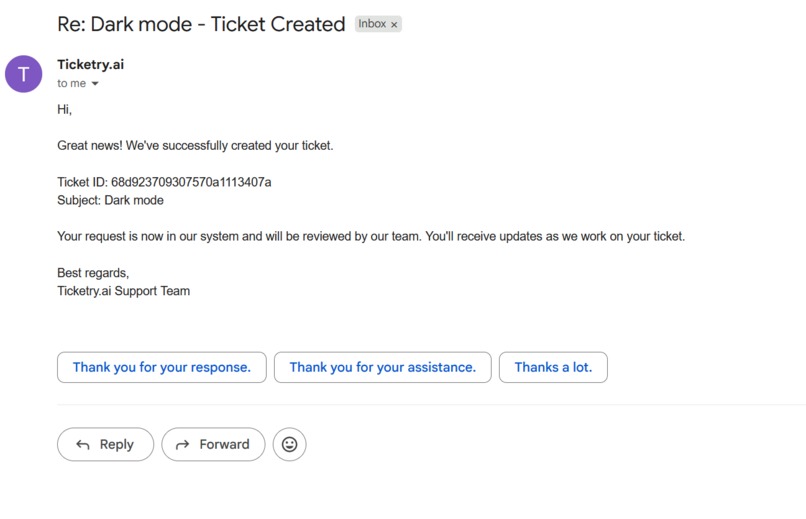
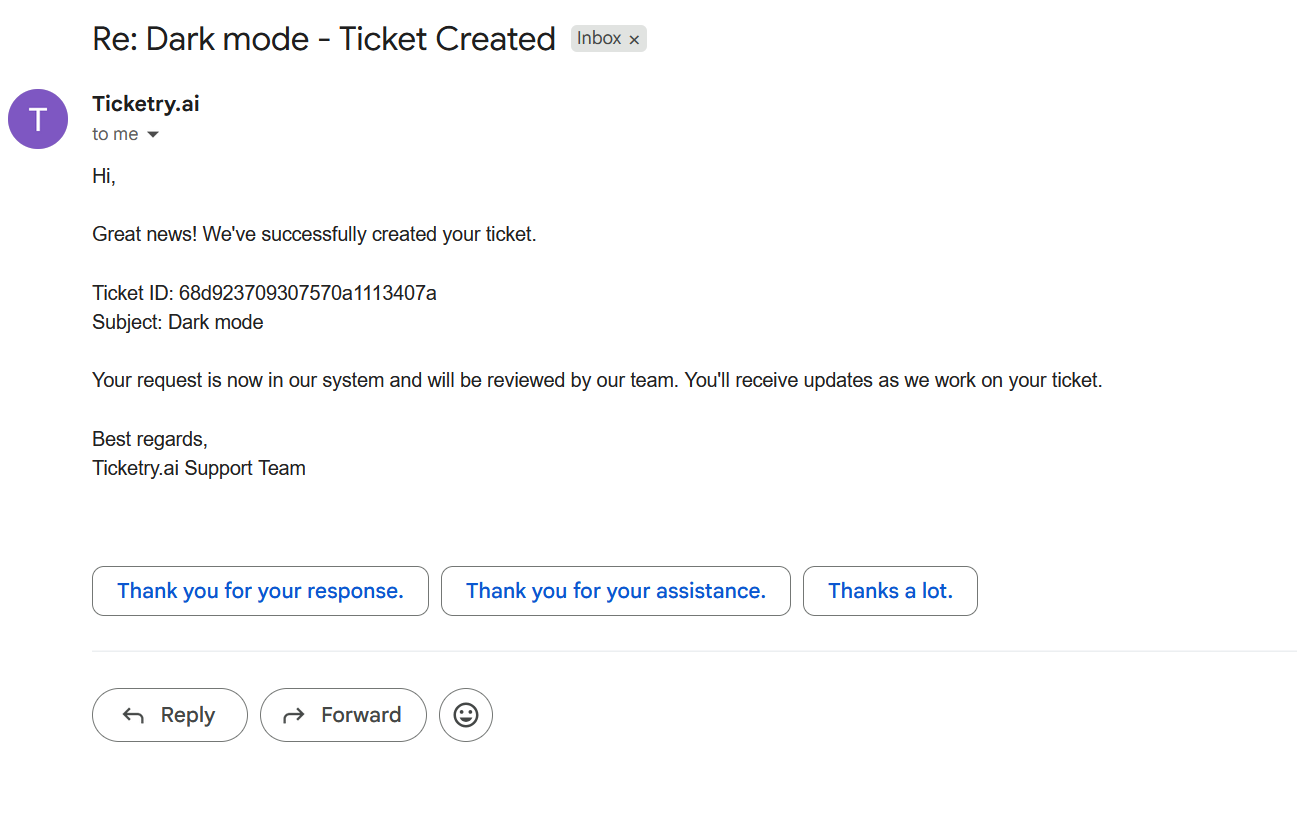
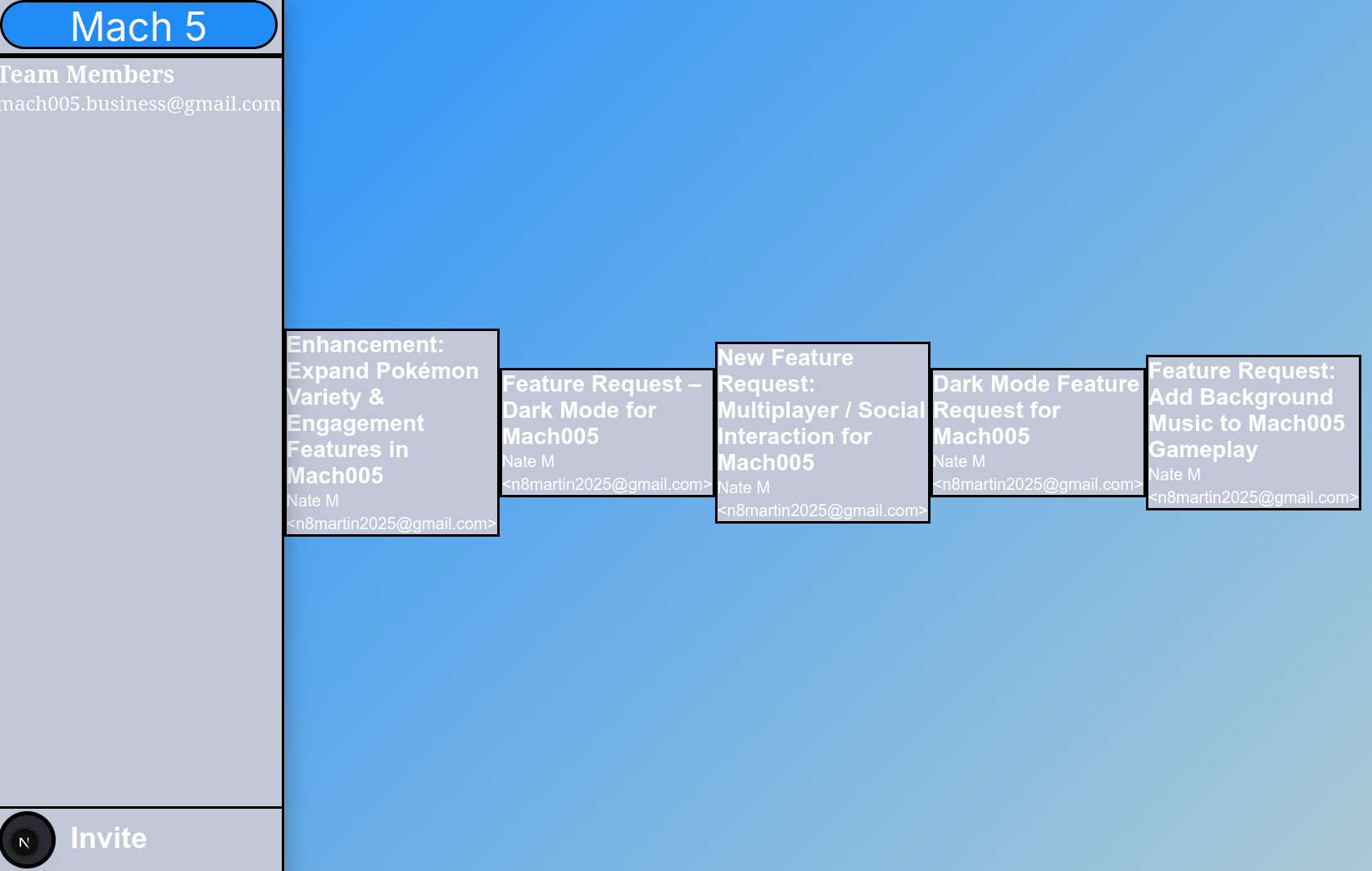
Feature request created email.
-
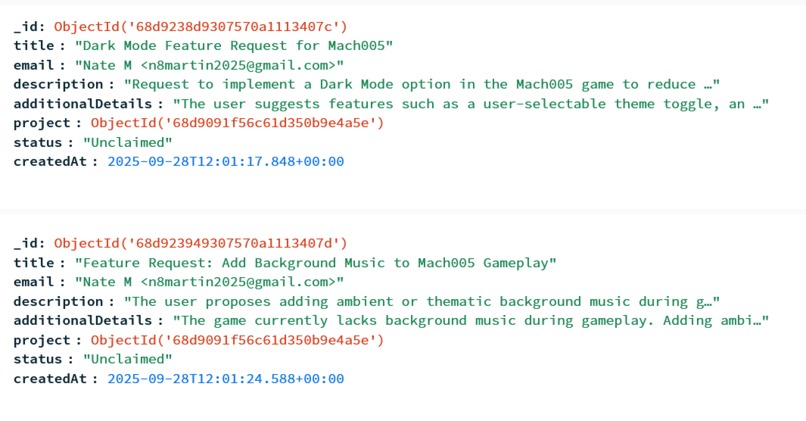
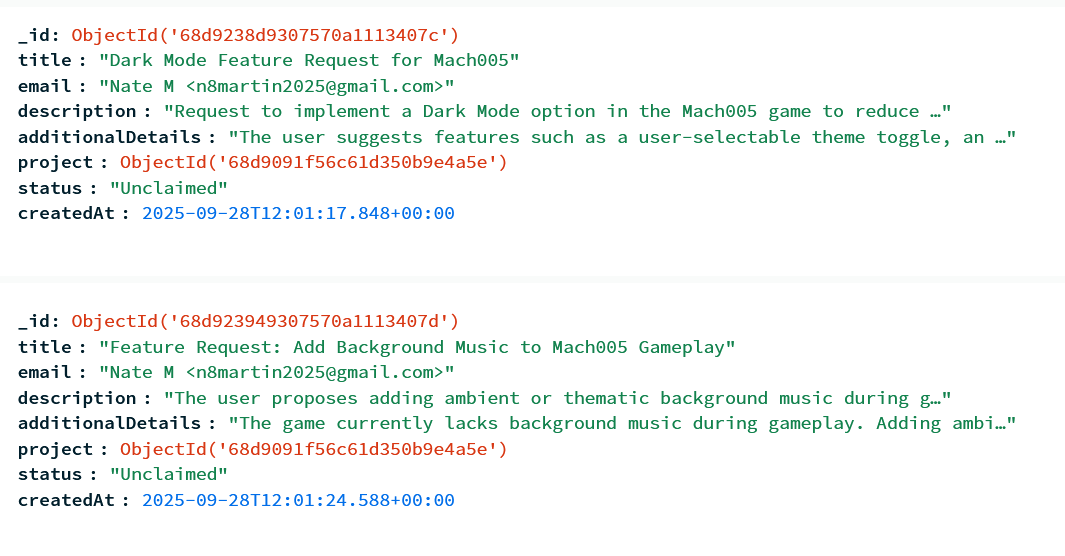
Database showing the tickets and the valuable information that is condensed with AI.
-
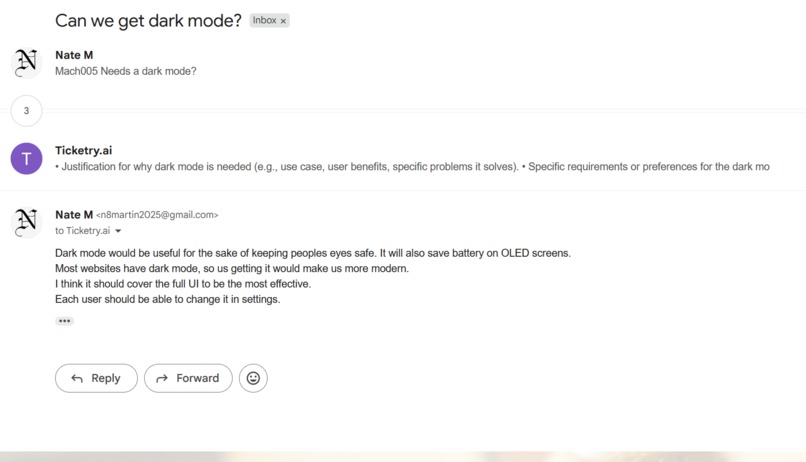
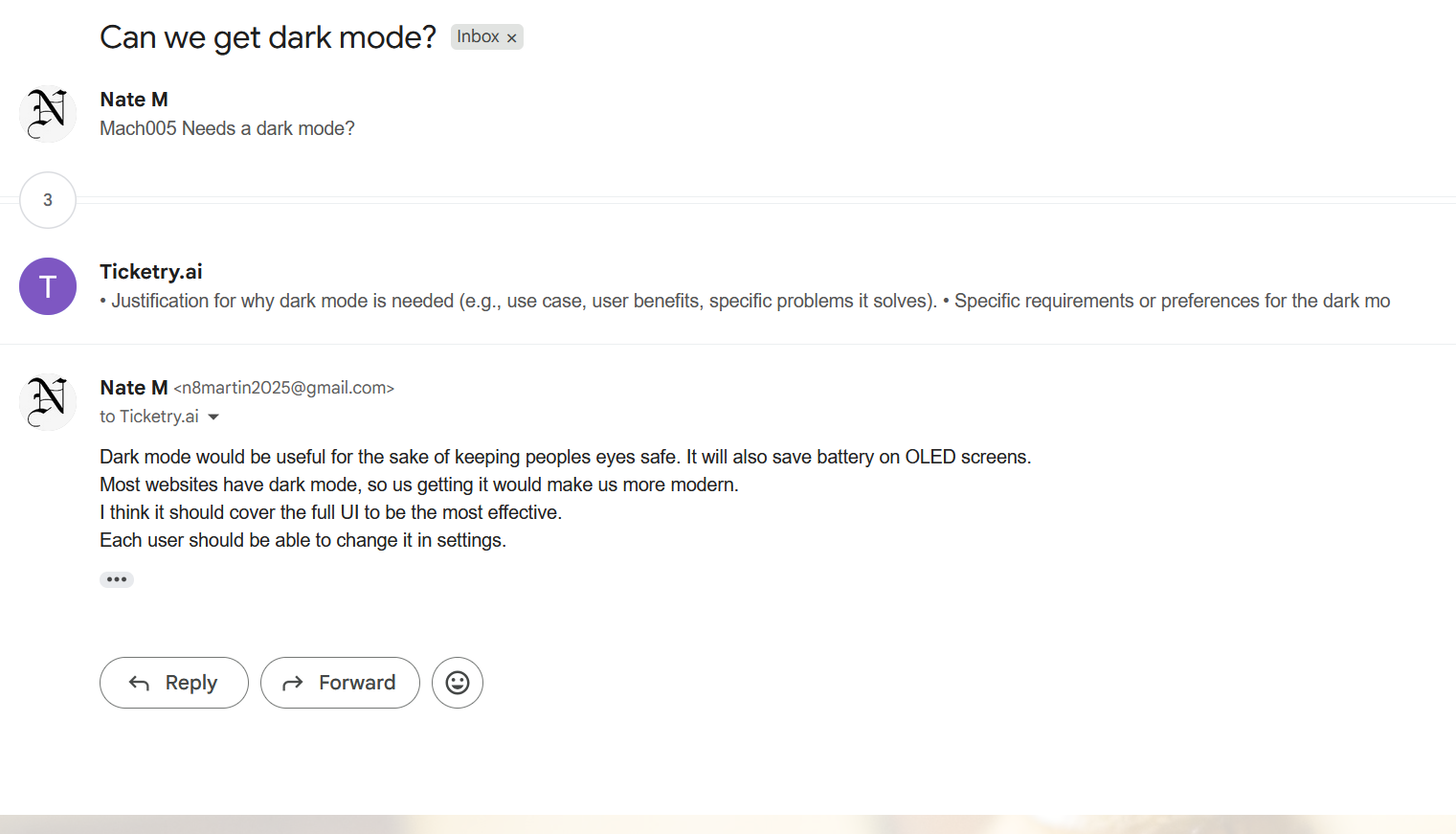
Example of reaching out for a feature request and being asked for more details.
-
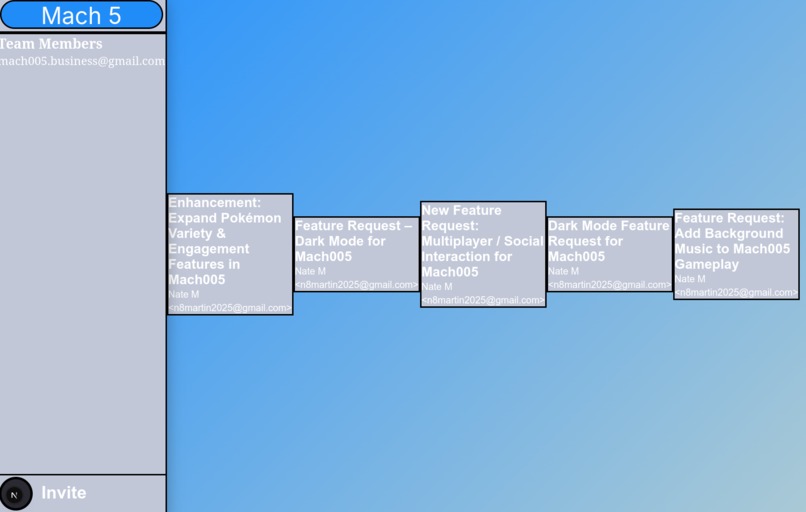
Developer interface to see, claim, finish tickets.
-

Demonstration of login screen which utilizes Auth0
-
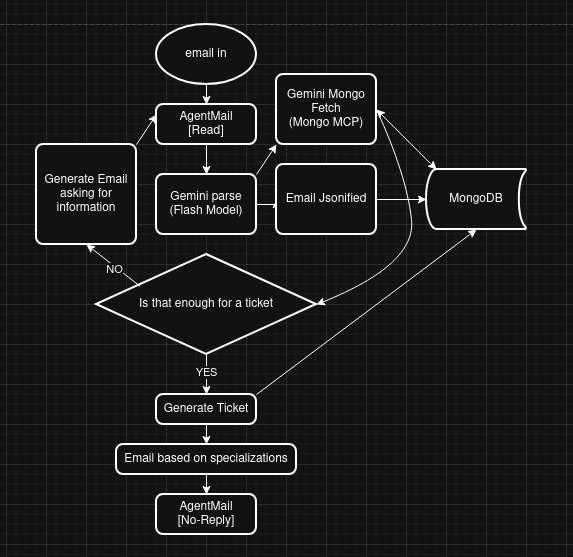
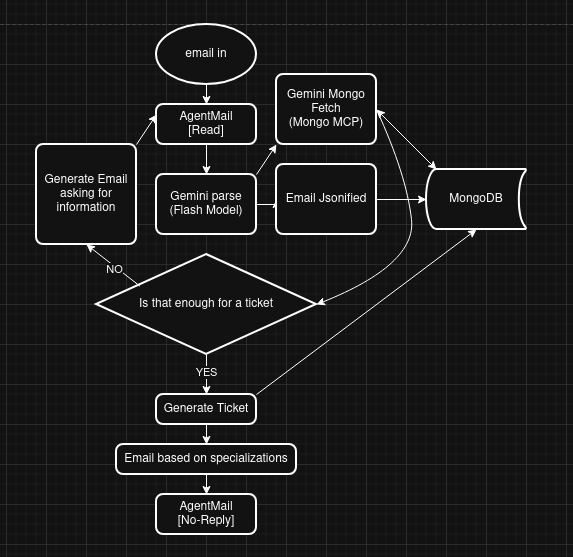
Original flow charting and planning of the core product features

Project Story
💡 Inspiration
Every developer has been on the receiving end of vague or incomplete requests:
"The website is slow."
"Can you fix the login?"
These requests usually arrive via email, get lost in inboxes, or require endless clarification before they can even enter a backlog.
We wanted to eliminate this friction. Our inspiration came from imagining a world where business users don’t need to learn new tools or processes—they just send an email—and developers instantly receive structured, complete tickets they can actually act on.
That’s why we built Ticketry.AI 🎫 — a system that turns messy emails into actionable tickets automatically.
⚙️ How We Built It
We combined AI, email integration, and modern web frameworks to make the workflow seamless:
- Email Intake → Business users send emails to a dedicated address via AgentMail.
- AI Analysis → Google Gemini 2.5 Flash reviews the thread, classifies the request, and checks for missing details.
- Smart Follow-Up → If information is missing, Ticketry.AI automatically emails the user to ask for specifics.
- Ticket Creation → Once complete, the request becomes a structured ticket in MongoDB Atlas.
- Developer Dashboard → A modern Next.js 15 + React 19 web app (with Auth0 authentication) gives devs a clean UI to manage, claim, and resolve tickets.
The backend runs on Node.js/Next.js, orchestrating the AI, email services, and database into one continuous pipeline.
✨ Key Features
- Zero learning curve: Business users just email as usual—no new tools, no training.
- AI-powered clarity: Gemini AI extracts, validates, and follows up for missing info.
- Multi-language support: Users can email in nearly any language while developers receive structured tickets in English, making global products easy to manage even with English-only dev teams.
- No more incomplete tickets: Every ticket is structured before it enters the backlog.
- Instant feedback: Users automatically get confirmation and updates.
- Seamless for developers: Tickets are clean, classified, and ready to work—no more chasing context.
- Full lifecycle tracking: Tickets move smoothly from Unclaimed → Claimed → Resolved.
- API access: REST endpoints allow integration with other services and automation pipelines.
In short: Ticketry.AI turns “I need this” into “It’s in the backlog” in minutes, not days. 🚀
🖼️ Typical Workflow
- User emails: "The login button is broken on Safari."
- AI analyzes: Detects it’s a bug and checks for missing details like browser version and steps to reproduce.
- If info missing: Ticketry.AI emails the user: "Can you provide browser version and steps to reproduce?"
- User replies: The missing details are added to the thread.
- Ticket created: A complete, structured, developer-ready ticket is added to the backlog.
- Dev claims ticket: Status updates are tracked, and the user is automatically notified.
🚀 What We Learned
We each walked away from the hackathon with unique lessons:
Nathanael Martin: "I realized that adding AI isn’t as intimidating as I thought. I expected it to be costly and complex, but it turned out to be one of the easiest and most impactful parts of our build."
Gabriel Wheeler: "This project showed me how microservices can accelerate development while keeping quality high. Auth0, in particular, saved us time while making our app more secure and production-ready."
Nickalaus Raby: "I learned the value of time management and planning. This was the shortest hackathon I've gone to, and even with things planned out we went right to the time limit. I really had to think things through and plan ahead, but even then things went awry and needed to be completely reworked and changed on the spot."
🧩 Challenges We Faced
Hackathons always bring roadblocks. Here’s what challenged each of us most:
Nathanael Martin: "My biggest challenge was exhaustion. Coming off midterms, Formula team prep, and work, I was mentally drained. My solution was 1,000+ mg of caffeine and six thirty-minute naps just to keep moving forward."
Gabriel Wheeler: "AI hallucinations were tough to manage, especially when the model didn’t know the tools I was using. I learned the best fix was to feed documentation directly into the context window to ground its responses."
Nickalaus Raby: "Keeping LLMs stable with such a unique and niche tech stack proved to be a very difficult challenge. AI had a tendency to be using outdated versions of our libraries and suggested deprecated features, which required a much higher vigilance to reap the rewards of AI coding."
🌟 What’s Next
- Integrations:
- Jira and Linear sync for project management.
- GitHub Issues for dev workflows.
- Trello sync for visual project boards.
- Slack integration for instant team notifications.
- Jira and Linear sync for project management.
- Smarter AI follow-ups: Context-aware clarifications that feel even more natural.
- Analytics dashboard: Insights into trends (e.g., top requested features, most common bugs).
- Scaling for enterprise: More robust email intake and role-based permissions for large teams.
- Better data: Attachments, checklists, dates, and other features for AI to use in their ticket creation
- Heightened control: Configurable prompts, categories, and access control for Ticketry agents
- Increased transparency: Opt-in mailing lists, ticket tracking, and email-centered updates for a user's projects
Ticketry.AI — where business communication meets developer productivity. 🚀


Log in or sign up for Devpost to join the conversation.