🧭 About the Project
Languages are not just tools for communication. They are vessels of culture, identity, and history. Yet today, many languages are disappearing due to a lack of digital presence and accessible learning resources. Tibetan, despite its rich cultural heritage, remains a low resource language in the AI ecosystem, making it difficult for modern learners to engage with it.
I built Tibetan Heritage AI to address this gap.
My goal was to create an AI powered cultural preservation platform that does not just translate text, but actively helps people learn, interact with, and experience Tibetan language and storytelling in a meaningful way.
💡 Inspiration
The idea originated from a simple but powerful observation.
While AI is advancing rapidly, it disproportionately benefits high resource languages, leaving culturally significant but underrepresented languages behind.
I wanted to challenge that imbalance.
Instead of building another generic AI application, I asked myself how AI could be used to preserve culture instead of just optimizing productivity.
This led me to design a system that combines translation, education, and storytelling, which are essential to keeping a language alive across generations.
🛠️ How I Built It
I developed a full stack AI system that integrates modern web technologies with large language models to deliver a seamless and interactive experience.
🔹 Core Features
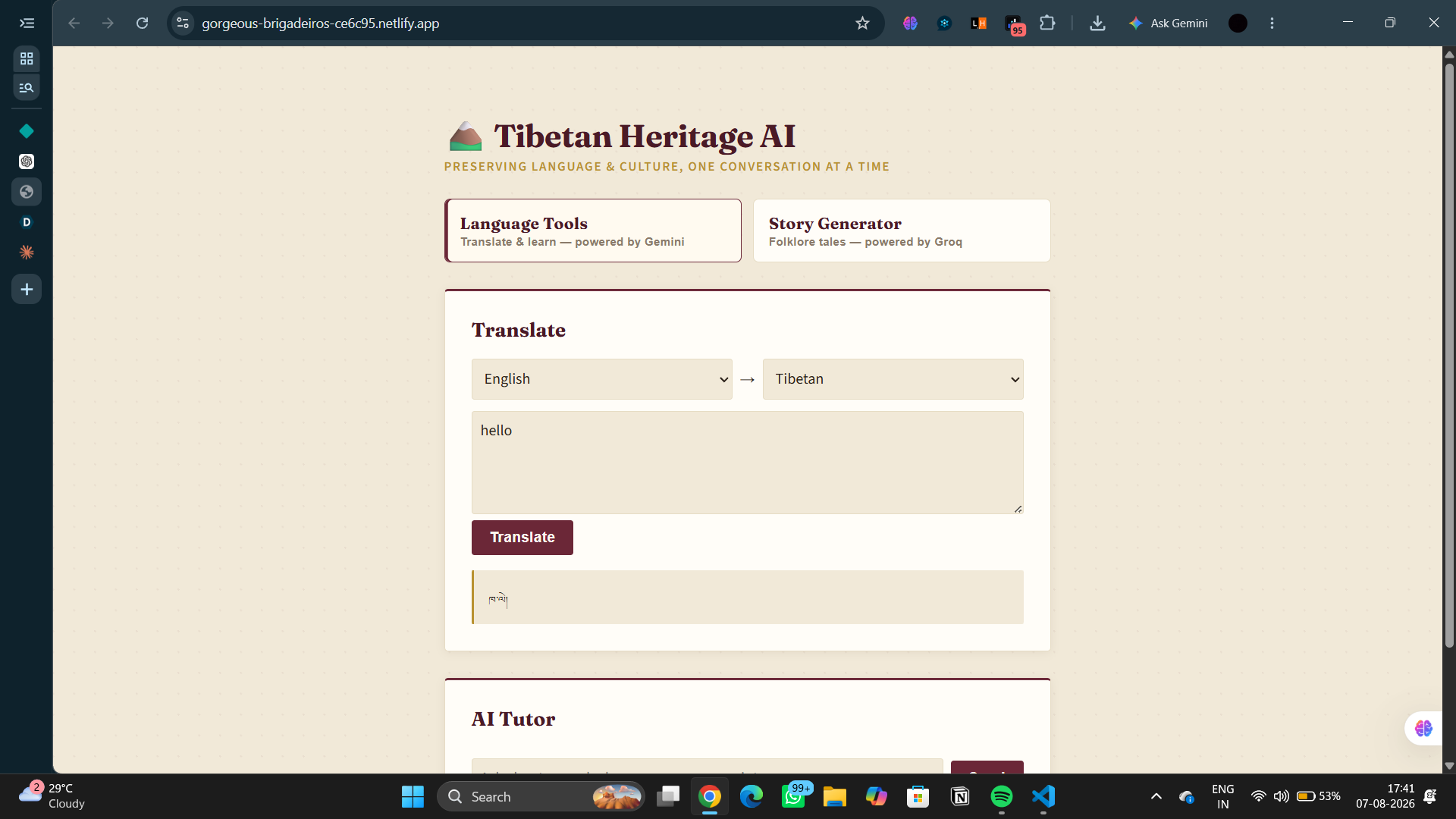
🌐 AI Translator Enables multilingual translation involving Tibetan, making the language more accessible to global users.
📚 AI Tutor A conversational learning assistant that explains meanings, context, and usage, turning passive translation into active learning.
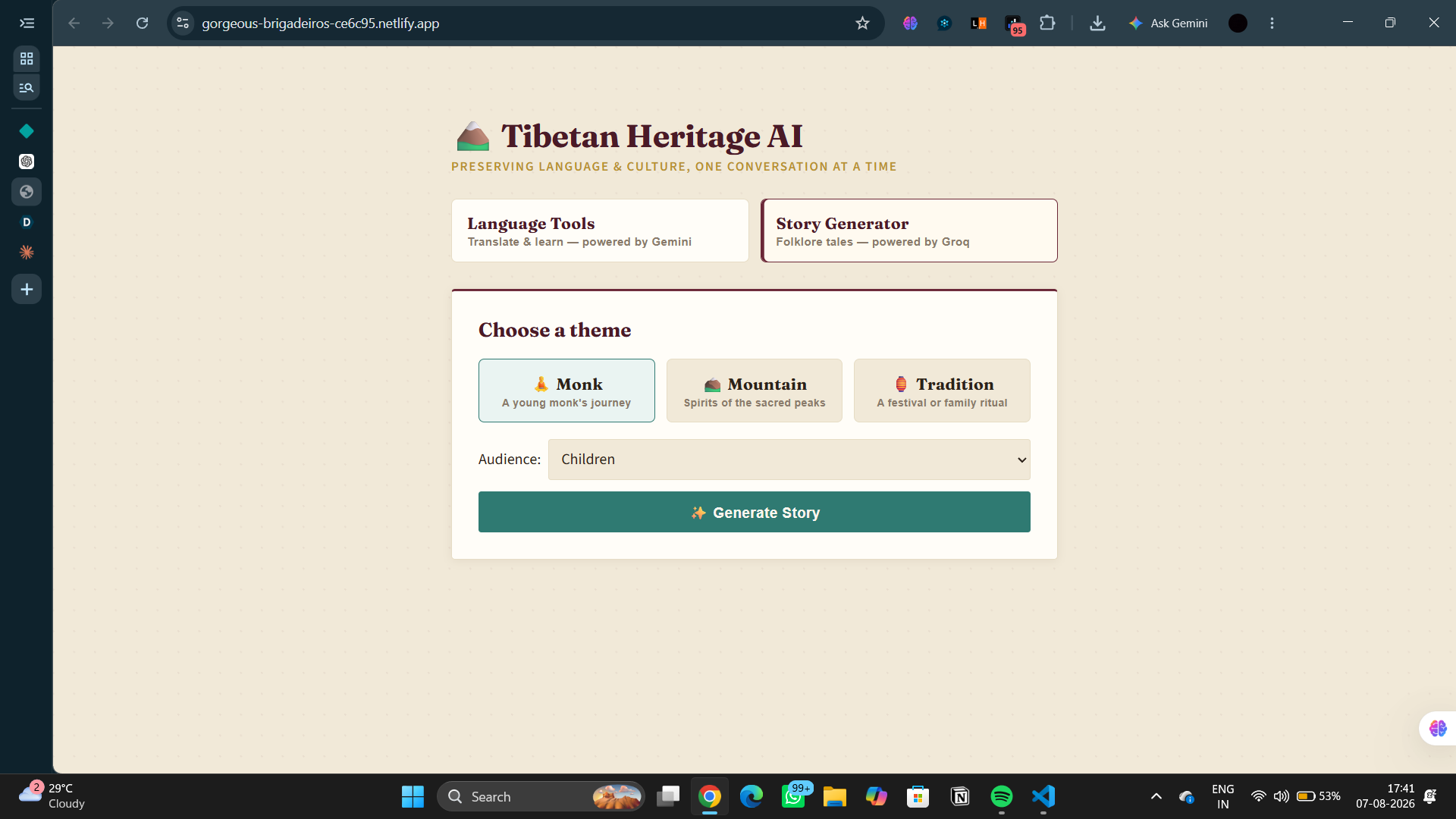
📖 Folklore Story Generator Generates culturally inspired Tibetan stories, making the learning experience engaging and immersive.
🔹 Technical Architecture
User → React Frontend → FastAPI Backend → Gemini API → Response
Frontend uses React with Vite for a fast and responsive user interface. Backend uses FastAPI for efficient request handling and modular routing. The AI layer uses Gemini API for translation, tutoring, and content generation. Deployment is handled using Netlify for the frontend and Render for the backend.
🔹 System Design Highlights
The backend follows a modular routing structure to handle translator, tutor, and story generation tasks efficiently. Context aware prompt engineering is used to improve the quality of responses generated by the language model. The system is built with a scalable API driven architecture. Frontend and backend are cleanly separated for flexible deployment.
🚧 Challenges I Faced
1. Low Resource Language Barrier
Tibetan lacks sufficient datasets for traditional NLP pipelines. To overcome this, I used large language models for contextual understanding instead of relying on dataset heavy approaches.
2. Time Constraints
Building multiple AI features within a short hackathon timeline required careful prioritization. I focused on delivering a fully working MVP rather than attempting too many features.
3. Deployment and Integration Issues
Separating frontend and backend created integration challenges. I deployed the backend on Render and used environment based API configuration to ensure smooth communication.
4. Balancing Impact and Technical Depth
I needed to ensure the project remained both meaningful and technically strong. I focused on building a system that demonstrates real world applicability while maintaining solid AI integration.
📚 What I Learned
AI can be a powerful tool for cultural preservation, not just automation. Large language models can help bridge gaps in low resource language ecosystems. A working and polished product is more impactful than an incomplete complex system. System design and deployment are as important as model selection.
🌍 Impact and Future Scope
Tibetan Heritage AI is designed as a foundation, not a finished product.
Future improvements include speech recognition, pronunciation assistance, community driven datasets, and expansion to other endangered languages.
My long term vision is to build AI systems that preserve not just languages, but the cultures and identities they represent.
🏁 Conclusion
Tibetan Heritage AI demonstrates how modern AI can go beyond convenience and productivity. It can become a tool for inclusion, education, and cultural continuity.
In a world where technology often replaces tradition, I believe AI should help protect it.
🧰 Built With
React FastAPI Python Gemini API Vite Netlify Render
Built With
- ai
- artificial-intelligence
- cultural-preservation
- education
- fastapi
- for
- full-stack
- generative-ai
- language-learning
- llm
- machine-learning
- natural-language-processing
- python
- react
- social-good
- translation

Log in or sign up for Devpost to join the conversation.