-
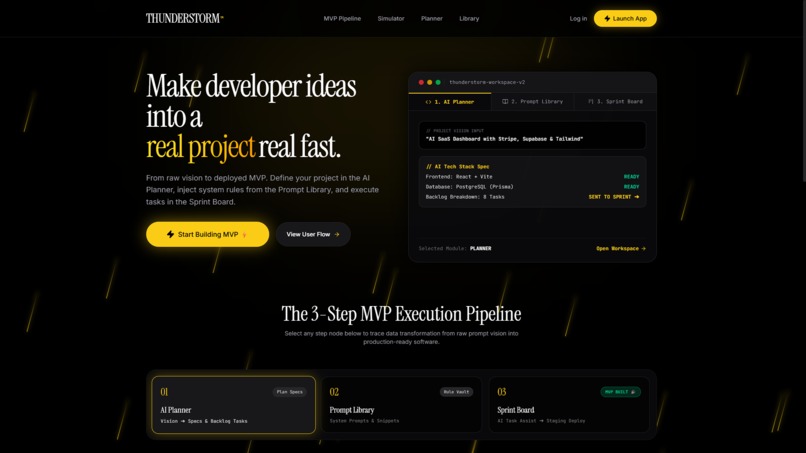
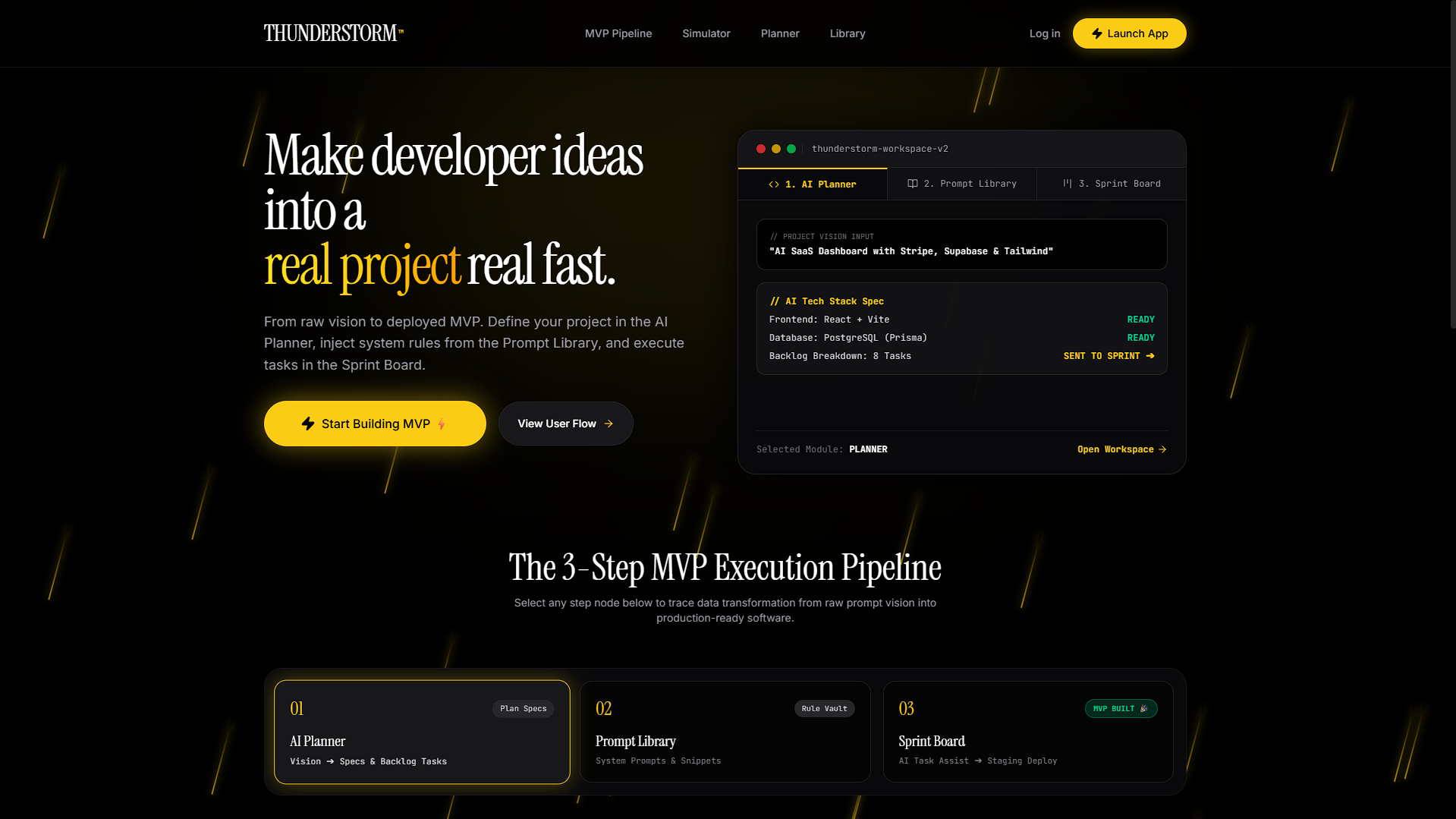
Landing Page - The Landing Page introduces Thunderstorm.
-
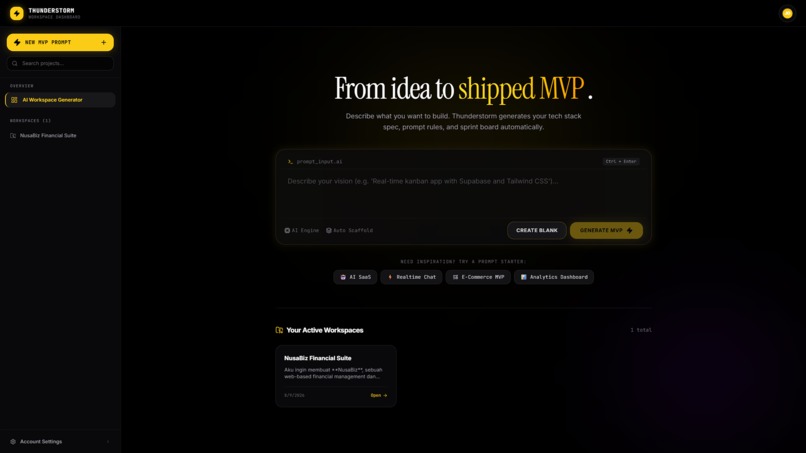
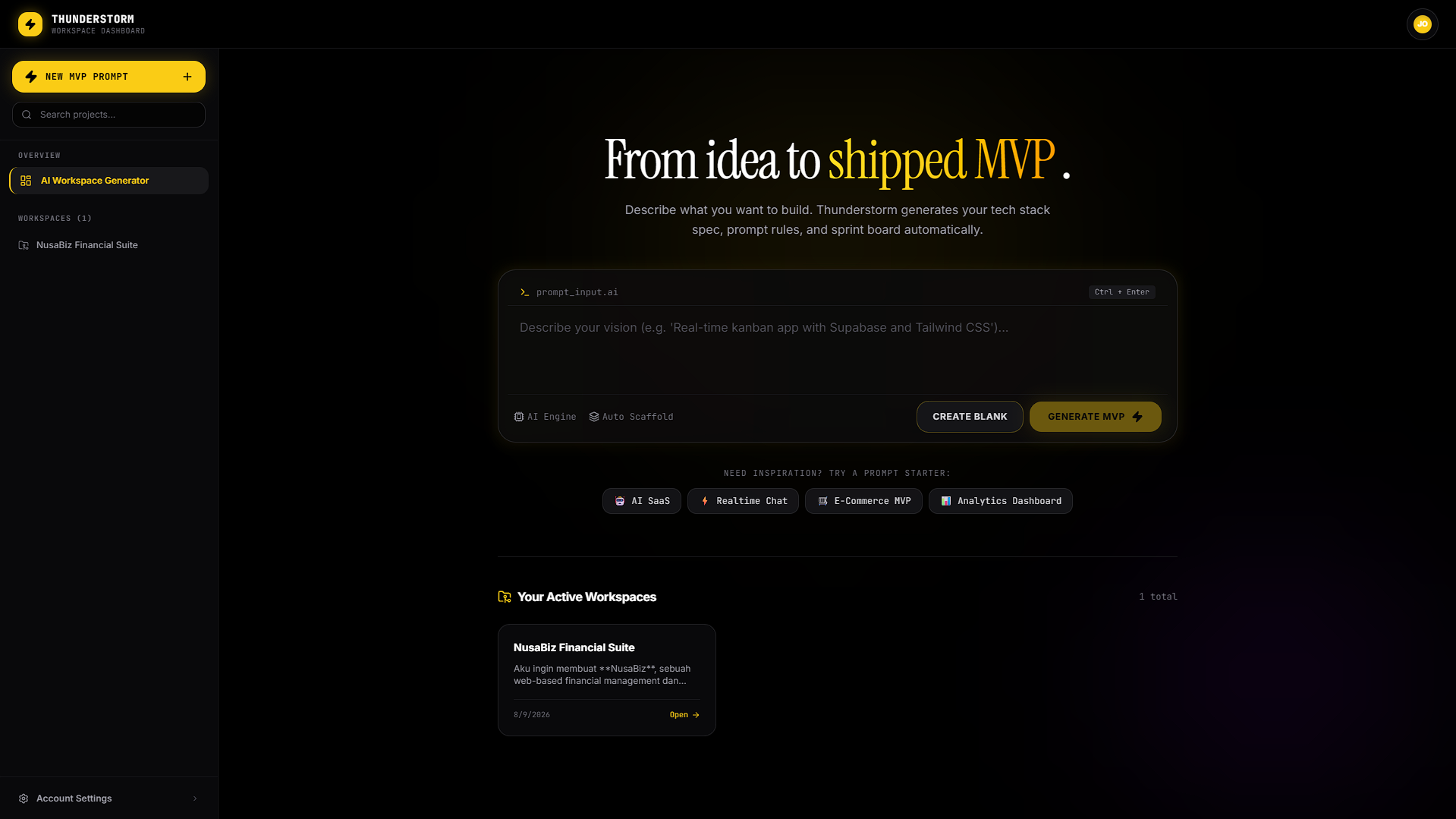
Dashboard - AI workspace hub to create, access, and manage projects through AI-generated MVPs or blank workspaces.
-
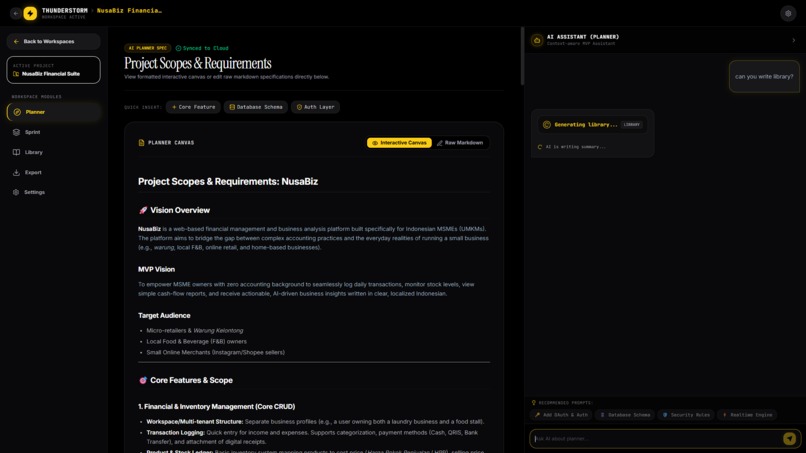
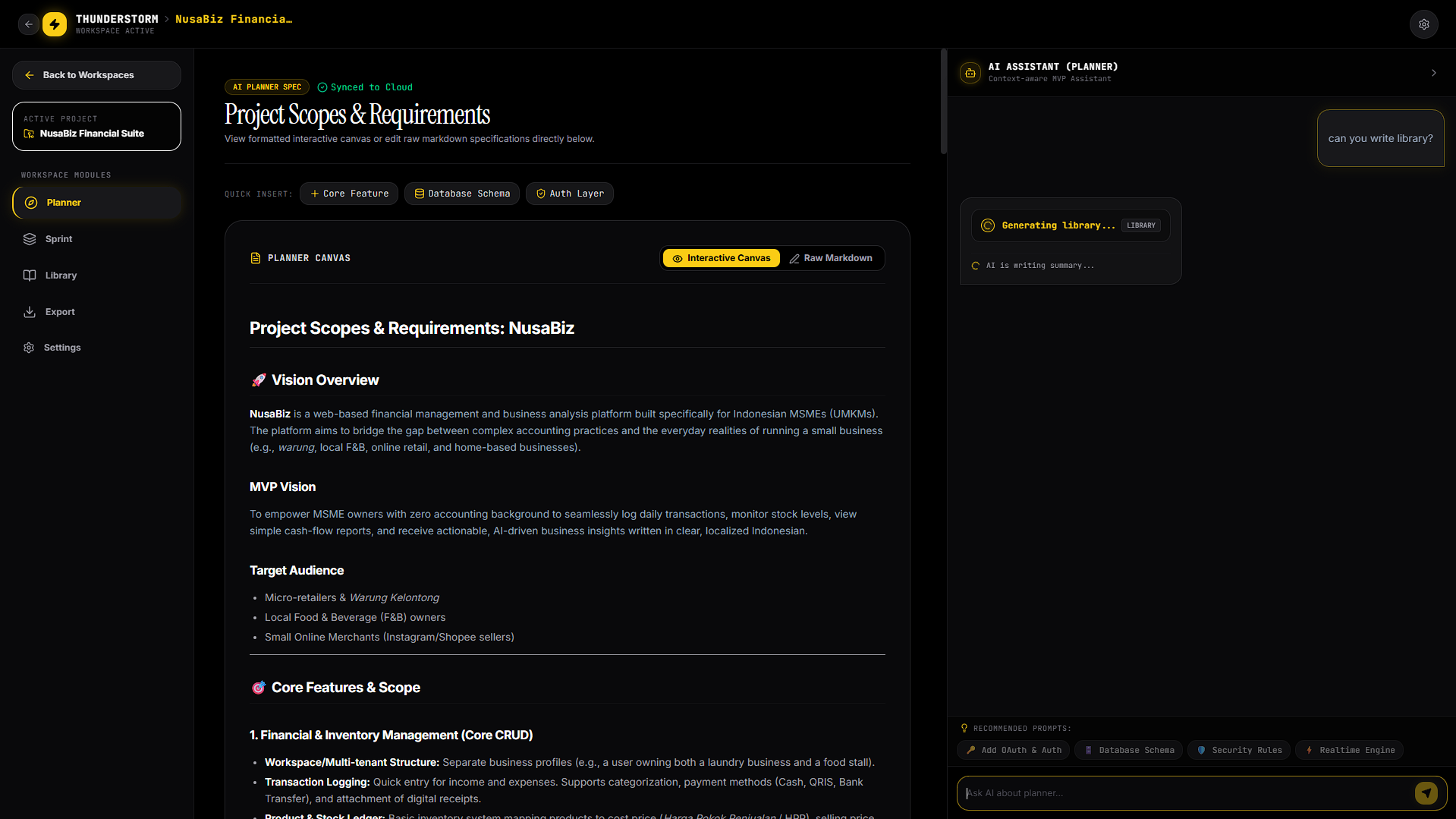
Planner Page + Ai Assistant - AI-assisted MVP planning with project requirements, architecture, tech stack, database, APIs, and guidance.
-
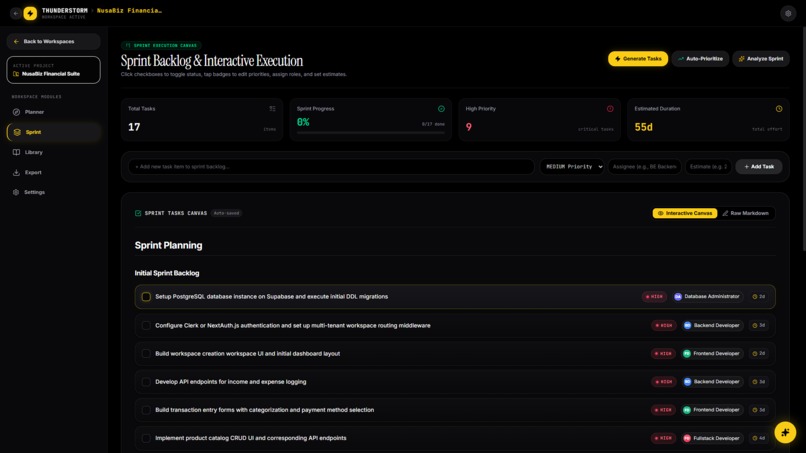
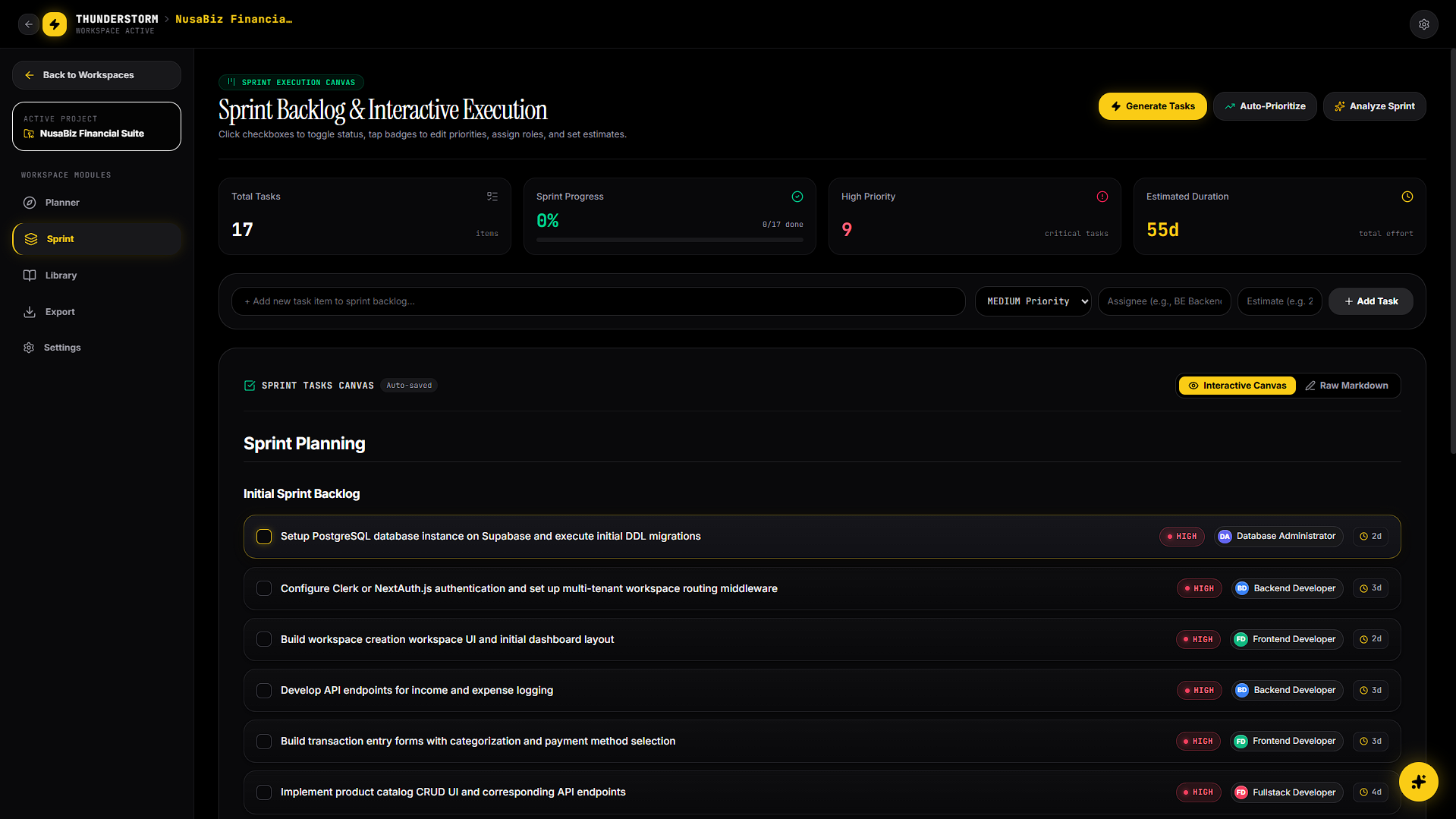
Sprint Page - Interactive sprint board for organizing AI-generated development tasks, priorities, assignees, and progress.
-
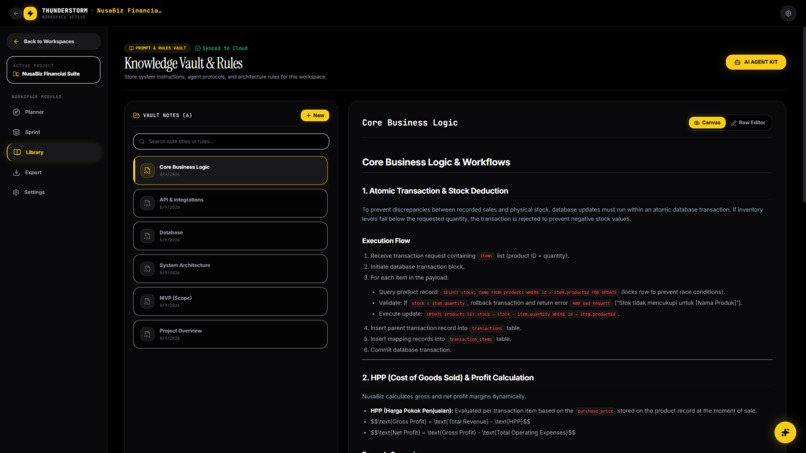
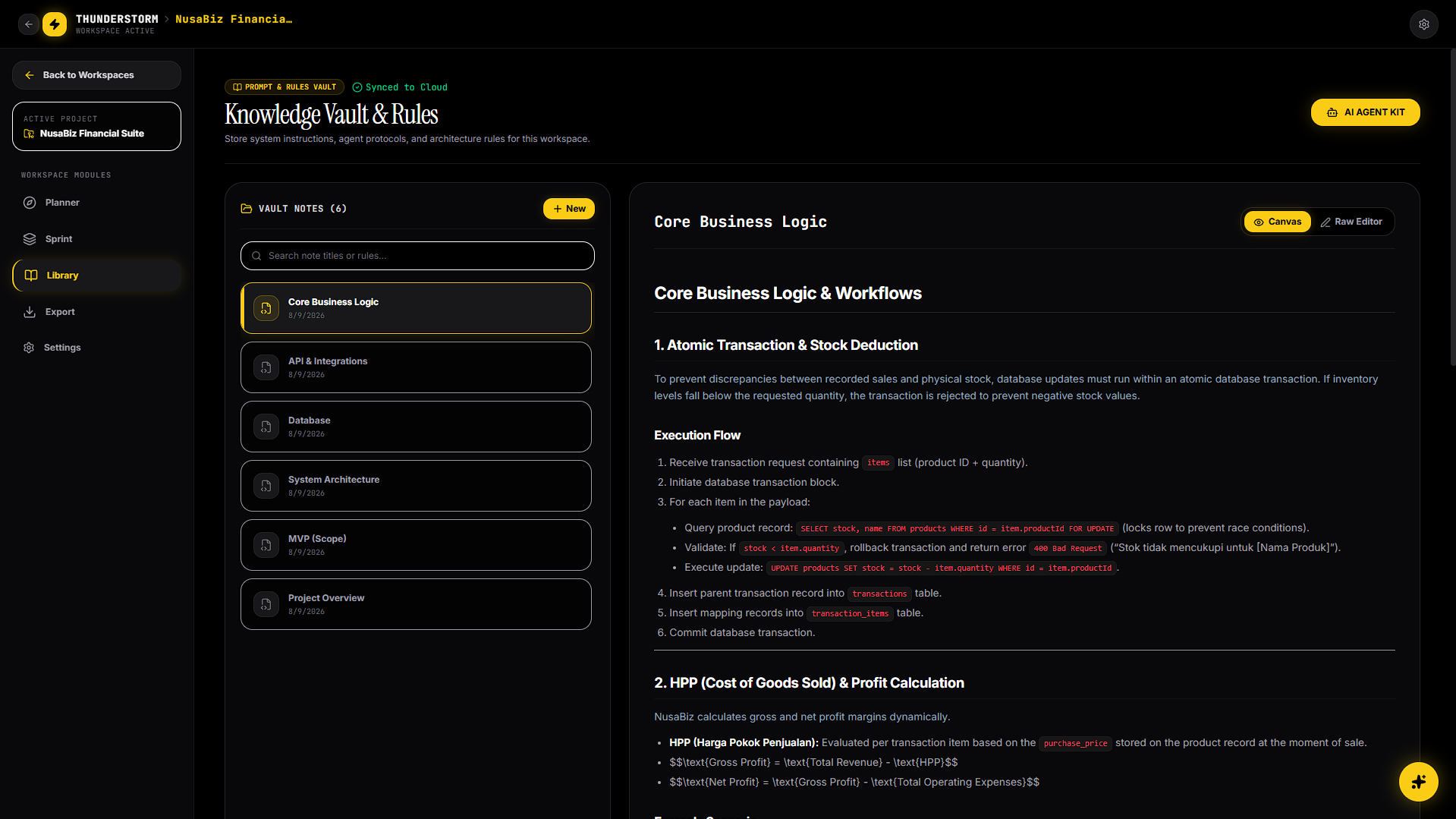
Library Page - Knowledge hub for technical documentation, architecture notes, business rules, and project-specific development insights.
About Thunderstorm
Inspiration
Turning an idea into a working MVP is often harder than coming up with the idea itself.
A project can start with a simple concept, but quickly become overwhelming once it involves defining requirements, choosing a technical stack, designing a database, planning APIs, writing documentation, and breaking everything down into development tasks.
This is what inspired us to build Thunderstorm — an AI-powered workspace designed to bridge the gap between a raw idea and a development-ready MVP.
Instead of treating planning, documentation, and task management as separate activities, Thunderstorm brings them together into one connected workspace.
How It Works
Thunderstorm starts with a project idea and helps transform it into structured development resources.
The workspace consists of several core components:
- AI Planner for defining project scope, features, technical stack, database structure, and API requirements.
- Knowledge Library for storing technical documentation, architecture notes, business rules, and other project knowledge.
- Interactive Sprint for turning project requirements into actionable development tasks.
- Export for packaging the workspace into a technical blueprint that can be used by developers or AI coding agents.
Thunderstorm also includes an AI Chat Sidebar that acts as a workspace-aware assistant.
Instead of simply generating text, the AI can understand the current workspace state and execute multiple actions sequentially. For example, a single request can generate a Planner, use its result to create relevant knowledge documentation, and then generate a Sprint based on the latest project context.
This creates a workflow such as:
Raw Idea
   ↓
AI Analysis
   ↓
Planner
   ↓
Knowledge Library
   ↓
Sprint
   ↓
Development-Ready Blueprint
The workflow is dynamic rather than fixed. If a user only needs a Planner, Thunderstorm only updates the Planner. If a Sprint already exists, the AI can work with the existing resource instead of unnecessarily regenerating it.
How We Built It
Thunderstorm was built as a web-based AI workspace with separate frontend and backend components.
The frontend provides the interactive workspace experience, including the Planner editor, Sprint board, Knowledge Library, workspace management, and AI Chat Sidebar.
The backend handles workspace operations, AI orchestration, streaming responses, and sequential task execution.
One of the key parts of the system is the workspace orchestrator. It analyzes the user's intent together with the current workspace state, determines which actions are necessary, resolves task dependencies, and executes them sequentially.
For example:
User Request
     ↓
Intent + Workspace State
     ↓
Execution Plan
     ↓
Generate Planner
     ↓
Generate Library
     ↓
Generate Sprint
     ↓
Final Summary
Each completed task can provide context to the next task, allowing the generated resources to remain consistent with one another.
Challenges
One of the biggest challenges was managing time and project scope.
There were many features that could potentially be added to Thunderstorm, but trying to build everything at once would make the project unnecessarily complex. We had to decide which capabilities were essential to demonstrate the core idea and which could be left for future development.
Another challenge was making the AI behave more like a workspace assistant rather than a conventional chatbot.
A simple chatbot can generate a response, but Thunderstorm needs to understand when a user is asking for information and when they are asking the system to actually modify their workspace.
This led us to design the AI around concepts such as task planning, workspace state, dependencies, sequential execution, and incremental updates.
What We Learned
The biggest lesson from building Thunderstorm was the importance of having a structured workflow.
AI can generate a large amount of useful information, but generation alone does not guarantee that the result is useful. The information needs to be organized, connected, and transformed into actionable steps.
By separating the workflow into planning, knowledge, and execution, we learned how much more useful AI can become when it is given context and a clear structure.
Thunderstorm is our attempt to make that process simpler:
Turn an idea into a structured plan, turn the plan into actionable work, and make the path from idea to MVP clearer.
Built With
- bcrypt
- express.js
- jszip
- jwt
- lucide-react
- markdown-it
- node.js
- pg
- pnpm
- postgresql
- prisma
- react
- react-dom
- react-router
- tailwind-css
- typescript
- vite


Log in or sign up for Devpost to join the conversation.