-
-
Home
-
framework
-
NFT Liquidity asset pool
-
Homepage
Inspiration
NFT assets, both in terms of transaction volume and prices, have experienced a downturn. Besides the intrinsic value of the assets, there are also significant issues with the transaction structure. Individual NFT assets struggle to achieve higher transaction premiums. When the price of a single NFT is higher, it indicates higher risks as transaction liquidity decreases. Conversely, when the price is lower, there tends to be less demand for purchasing, creating a dilemma. These challenges are inherent in the way NFTs are held, similar to owning real estate.
What it does
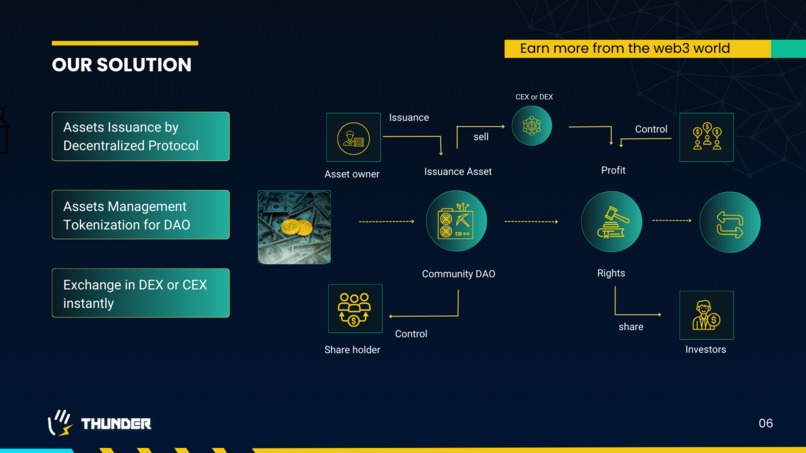
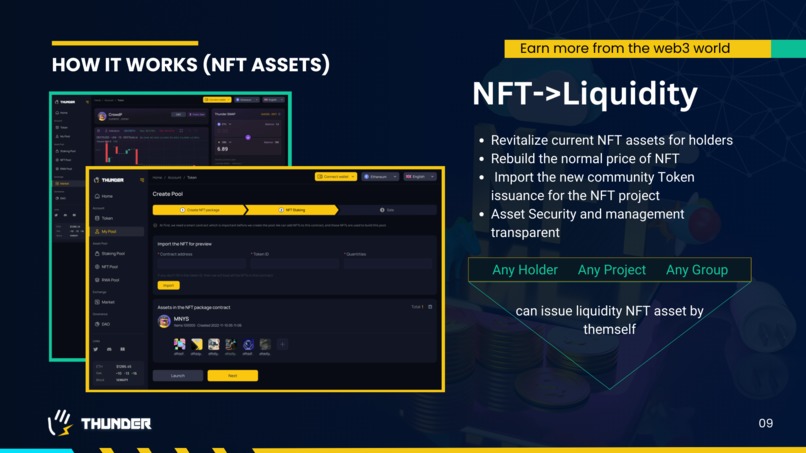
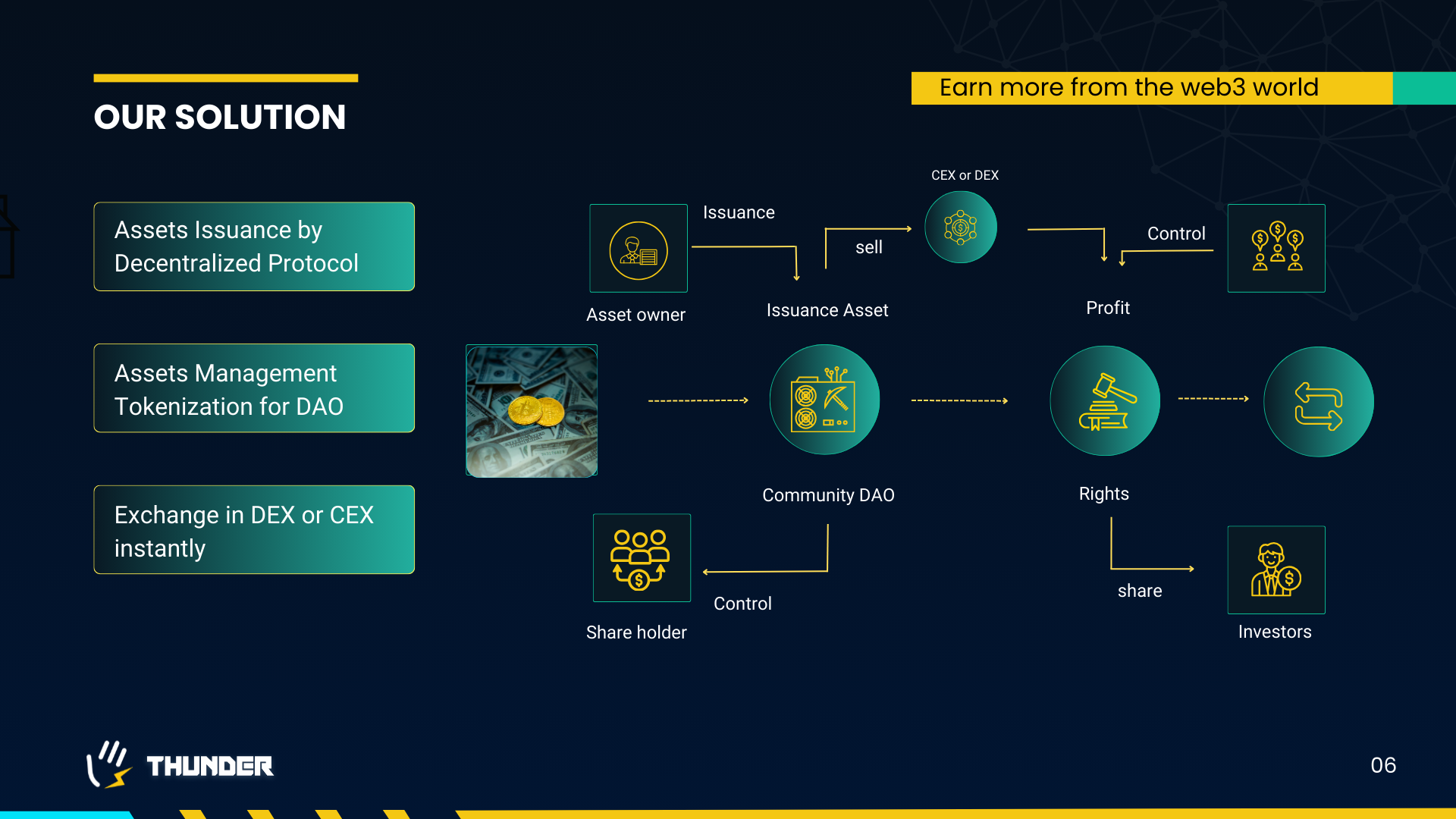
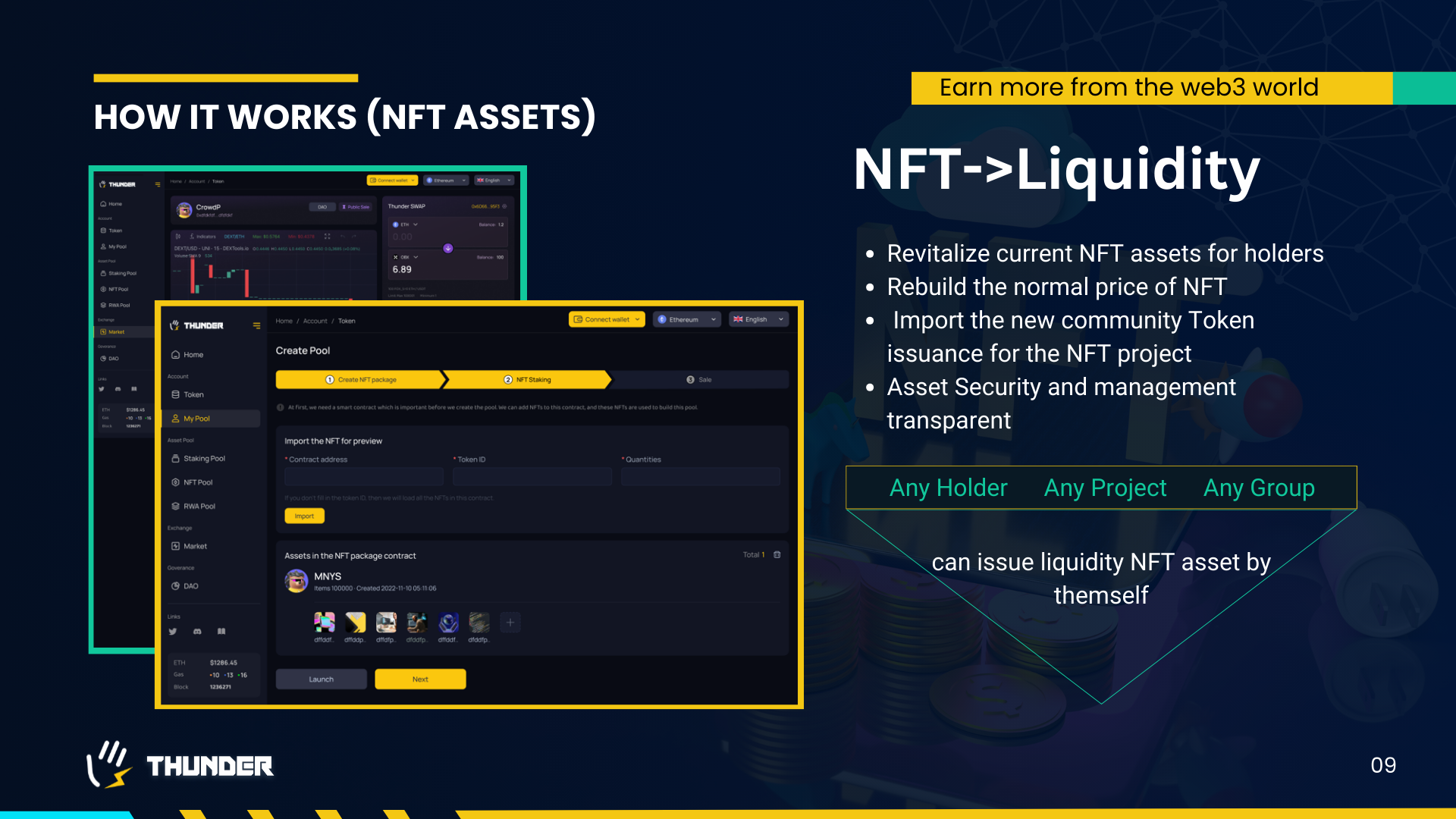
We aim to change the way NFTs are held and traded through a protocol. By collateralizing NFTs, either individually or as a group, in an asset pool, we can issue corresponding equity as FT Tokens. This not only grants ownership rights but also profit-sharing rights, effectively transforming NFT assets into liquid assets.
ThunderDAO manages these assets through decentralized protocols, including asset pool management, profit distribution, and DAO governance protocols. This change in ownership structure facilitates a more market-driven approach to determine transaction prices, promoting a more balanced and rational ecosystem.
The value and significance for issuers are as follows:
1)Introduces a new issuance and trading method: It allows for the issuance of a portion or the entirety of NFTs through an asset pool structure, providing an alternative approach to issuance and trading.
2)Immediate liquidity upon issuance: By leveraging the synergy between the primary and secondary markets, issuers can establish value and determine the total supply. This reduces issuance risks, particularly improving early-stage liquidity.
3)Enables flexible project operations: By introducing assets at different stages, the project's operations become more adaptable and flexible
4)NFT holders, especially those with high-value NFTs, are provided with market trading opportunities, reducing holding risks and improving cash flow.
Value and significance for investors or users:
1)Access to a greater opportunity to hold partial ownership of high-value NFTs and participate in their potential earnings.
2)Reduced investment risk while having the chance to engage in more promising projects.
3)Improved liquidity through secondary market trading, which lowers the associated risks and enhances personal liquidity.
How we built it
We provide on-chain asset management and issuance solutions, utilizing decentralized methods to enhance transparency in management and issuance processes. We will provide several different methods based on the issuance protocol. If project owners or individuals need to monetize their assets, they can utilize the on-chain asset management protocol. Through the current management protocol, the relevant assets can be pledged to issue secondary on-chain liquidity assets or for lending purposes.

The project owners who pledge assets for issuance on-chain can be either individuals or entities. The project owner can create their own asset package (SAV) by using a contract factory, which is a collection of smart contracts. The SAV can be automatically created and managed. It includes:
- Profit Locker Contract
The main role of a profit manager is to lock the value generated by assets through smart contracts. For example, the profits and value obtained from asset sales、loans, and other situations can be locked in the profit manager. According to the management agreement, investors can retrieve their assets based on the respective distribution agreements. Such as USDT or ETH.
- Staking Asset Contract
The most important aspect of this contract is to treat the issuer's assets as equivalents,use them as collateral and authorize them to be pledged in the smart contract as the subject matter for issuance.
- The issuance of liquidity assets.
The core purpose of issuing on-chain assets is to enhance liquidity,We provide the infrastructure for asset collateralization and issuance, automatically issuing valuable assets onto the blockchain,such as ERC-20, The project owner can customize the quantity, price, as well as the release stages and proportions of the issuance.
The contract toolkit can provide a visualized issuance method where the issuer can customize the liquid assets and the issuance process.
Private equity stage: The issuer can customize the private sale stages according to their needs. This includes pricing, quantity, purchase restrictions, whitelisting, and more.
Public sales stage:The issuer can transfer the liquidity tokens to a decentralized exchange (DEX) market and provide liquidity through LP (liquidity provider) injections for trading,The issuer can inject initial liquidity themselves to initiate the public sale of the token. Secondary trading can only take place after the LP initial liquidity injection has been completed for the public sale.
Liquidity issuance can be directly conducted through public sales, with the configuration solely determined by the issuer.

- Asset disposal
l The issued assets may not necessarily need to be disposed of in the end. Collateralized lending, debt obligations, and other similar activities require the final disposal and delivery of assets according to the issuance rules. As for assets issued solely for trading purposes, they can be traded indefinitely on secondary markets, such as through outright purchases or by placing orders in other markets. These disposal methods are relatively complex and require control through smart contracts to enable decentralized trading and governance. Additionally, the requirements and targets of these transactions should be governed and authorized through a DAO
- Community-based governance
The core of community governance is the equitable distribution of benefits. The core objective of community governance in SAV asset issuance is to achieve asset co-governance. Indeed, while this approach may be complex, it is worth exploring and experimenting with. The decentralized issuance method provided by this protocol is not only necessary for preserving and expanding benefits but also the most crucial approach. Community governance is indeed a complex process. Therefore, this protocol approaches asset governance and disposal with caution. The provided scalable framework can be continually extended to cover a wide range of aspects. Some aspects that need to be expanded in practice include:
- Governance of profit sharing:How to allocate and manage the profits obtained from the issued asset package.
Governance of asset disposal: The community can vote on how to sell all or a portion of the assets, including the methods, prices, and other relevant factors.
Setting of public rules: The basic parameters and governance requirements of the issuance should be determined by the community. Even if the platform initially establishes rules, it is important for subsequent decisions to be determined through voting by the community, including investors or users.
Challenges we ran into
The issuance of decentralized assets brings forth additional features of transparency and security, while also introducing:
- The complexity and security issues of technical contracts
The development and security of contracts are crucial issues within the blockchain. This issuance method increases the complexity of contracts and, consequently, introduces security concerns.
- The on-chain issues related to the assets themselves
The process of onboarding offline assets to the blockchain and the management of asset returns pose challenges that cannot be fully addressed by technology alone. They require appropriate legal and regulatory requirements to control and mitigate risks. As a result, certain types of assets may be restricted due to the need for risk control and compliance measures.
- Community-based Governance
Community-based governance is an essential direction and a manifestation of consensus values. Similarly, community-driven equity management is also highly complex.
Accomplishments that we're proud of
- Supports factory contracts for quick deployment of NFT asset pool-related contracts;
- The complete set of management contracts and simple governance contracts have been completed;
- On-chain private placement and DEX trading contracts have been completed, along with functional integration;
- Can flexibly connect to other DEX trading markets;
- Based on a universal asset management contract, it can not only manage NFT assets but also support the liquidity issuance of other types of assets in the future;
- Provides a complete UI and product features;
- Currently supports Polygon, Ethereum, and other EVM-compatible chains.
What we learned
We encountered many challenges during the development process, especially with contracts and factory contracts. We need to consider current requirements and future scalability demands. The overall architecture takes into account many modular components, while also providing significant interfaces and adaptability for multi-chain and cross-chain scenarios
What's next for ThunderDAO
- Issuance and management of cross-chain assets
- Enhancement and perfection of DAO governance contracts
- Support for integration with multiple DEX platforms


Log in or sign up for Devpost to join the conversation.