-
-
-
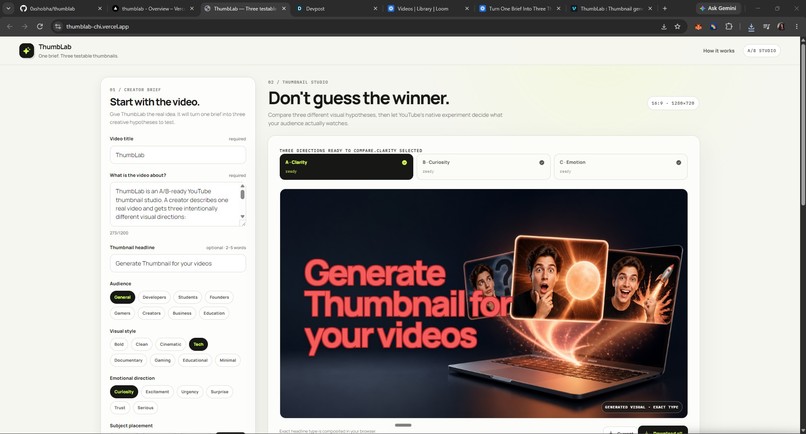
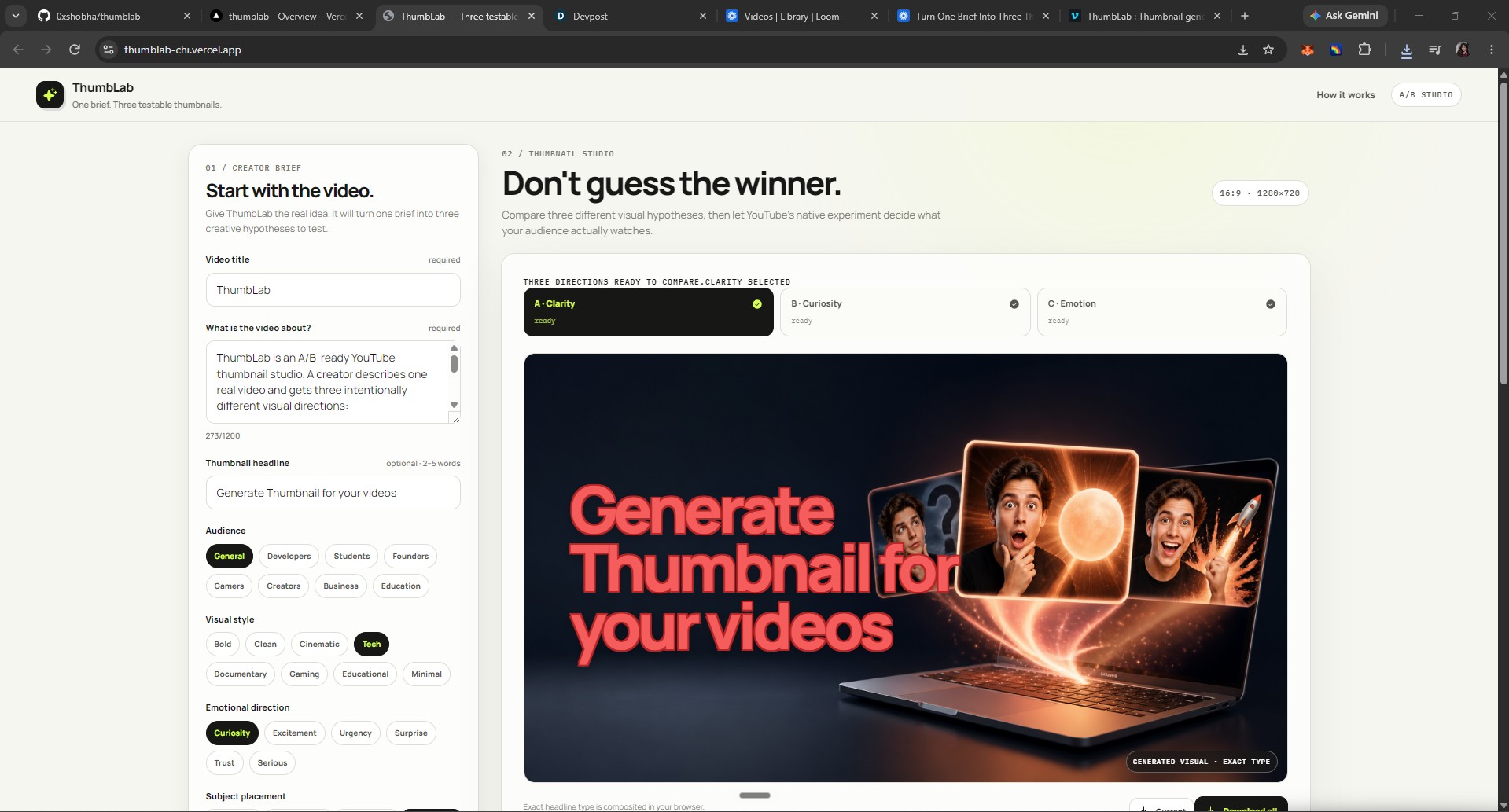
Thumblab interface
-
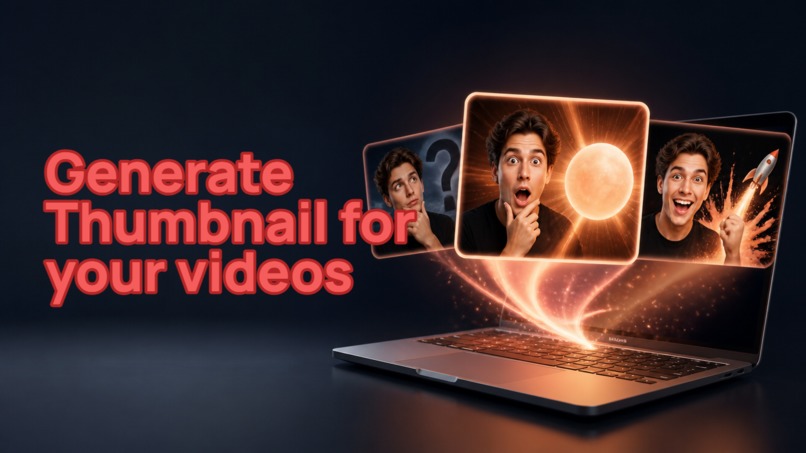
Thumblab outcome

Inspiration
Creating a thumbnail that performs often takes hours because creators jump between chat prompts, design tools, and manual edits. I wanted a single flow that keeps the high-variance creative part (visual concept) fast while keeping the creator fully in control of final copy and styling. ThumbLab was built to reduce that friction and make thumbnail experimentation practical for real workflows.
What it does
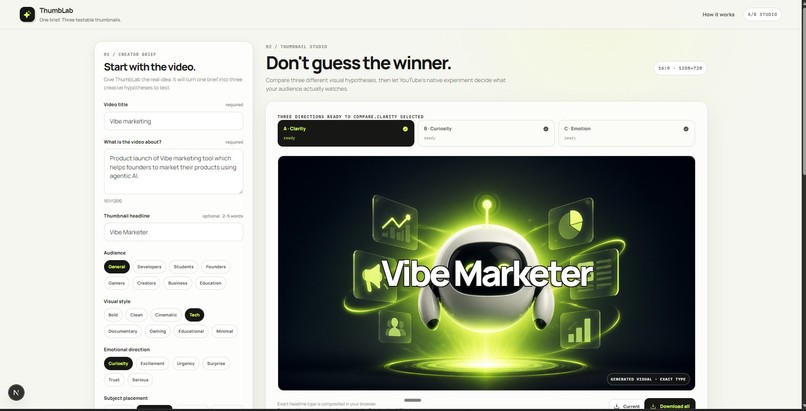
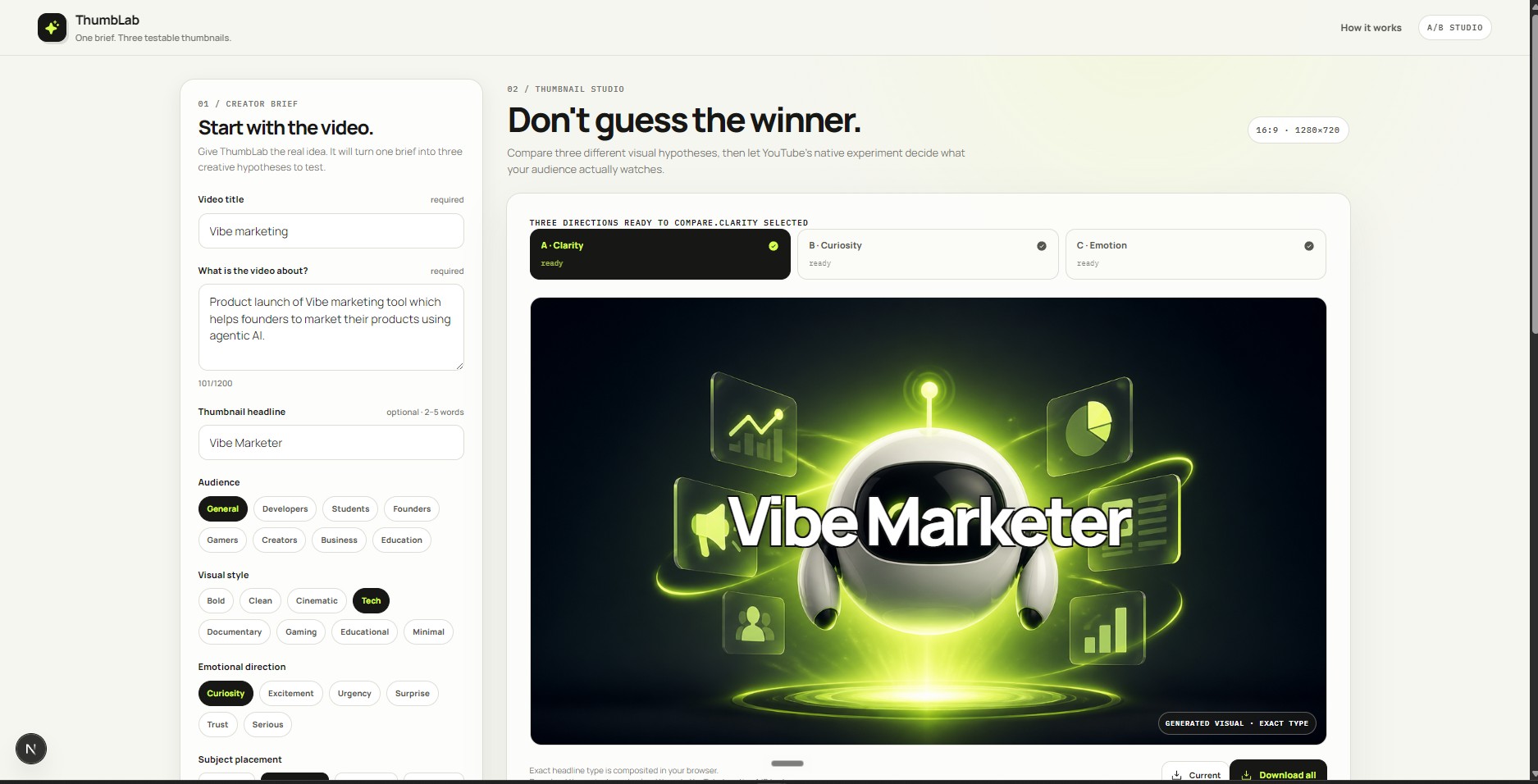
ThumbLab is a YouTube thumbnail studio that turns one creator brief into three different concept directions in one run:
- Clarity — direct, topic-first composition
- Curiosity — visual intrigue while staying truthful to the video
- Emotion — high-energy framing and stronger visual emphasis
After generation, creators can:
- edit headline text and style (size, position, color, outline) locally,
- preview the thumbnail in desktop and mobile feed contexts,
- regenerate one variant without losing others,
- export final 1280×720 PNGs with the headline overlay preserved.
All generation is powered through a real backend image call, and the preview/export pipeline is deterministic on the client.
How we built it
I built ThumbLab as a small Next.js App Router app with a strict boundary between UI and generation:
- Frontend is a React-based studio flow with brief input, three-variant generation state, live preview controls, and export.
- Server route
/api/generatevalidates requests with Zod, builds a structured prompt via shared prompt-builder logic, and calls GPT Image 2. - The final thumbnail image is composed with deterministic text layers in the browser so typography changes are instant and controlled by the creator.
- Validation and error handling are explicit for bad inputs, moderation, provider errors, and missing configuration.
The architecture intentionally avoids fake data paths and fake success states.
Challenges we ran into
- Reliability over polish: making generation feel responsive while handling slow/variable provider latency.
- Prompt discipline: keeping prompts consistent, non-deceptive, and truthful while still producing varied outputs across strategies.
- UX correctness: preserving successful variants when a single strategy fails or is retried.
- Export correctness: ensuring exported files remain 1280×720 with faithful overlay rendering and readable text at scale.
Accomplishments that we're proud of
- A complete end-to-end flow from one brief to three usable assets.
- Strategy-specific generation (three modes) with independent retry handling.
- Deterministic client-side headline composition for precise creator control.
- Clear and honest error states instead of mock fallbacks.
What we learned
I learned that for creator AI tools, the best product signal is less about “more AI features” and more about control + trust: fast ideation plus predictable local control. I also learned how important it is to keep the data boundary simple and transparent so users know what is generated and what is edited locally.
What's next for ThumbLab
- Add authentication and quota safeguards to better prevent abuse.
- Add creator identity/brand elements in thumbnails (avatar and style presets).
- Add local generation history and variant comparison analytics for creator teams.
- Improve mobile ergonomics for very small devices and high-resolution export workflows.


Log in or sign up for Devpost to join the conversation.