-
-
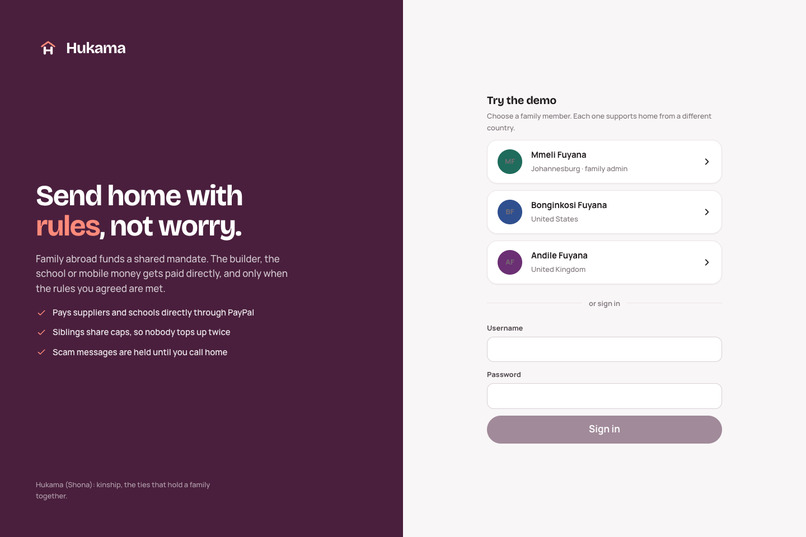
Try the demo as any family member
-
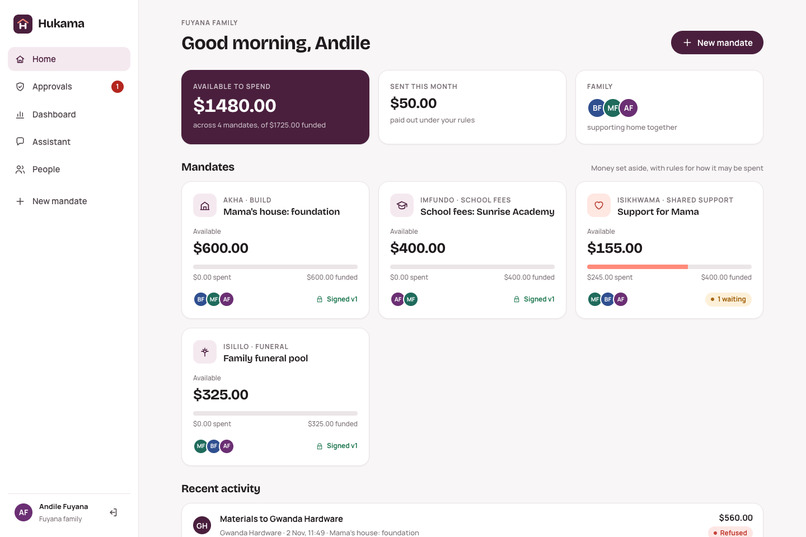
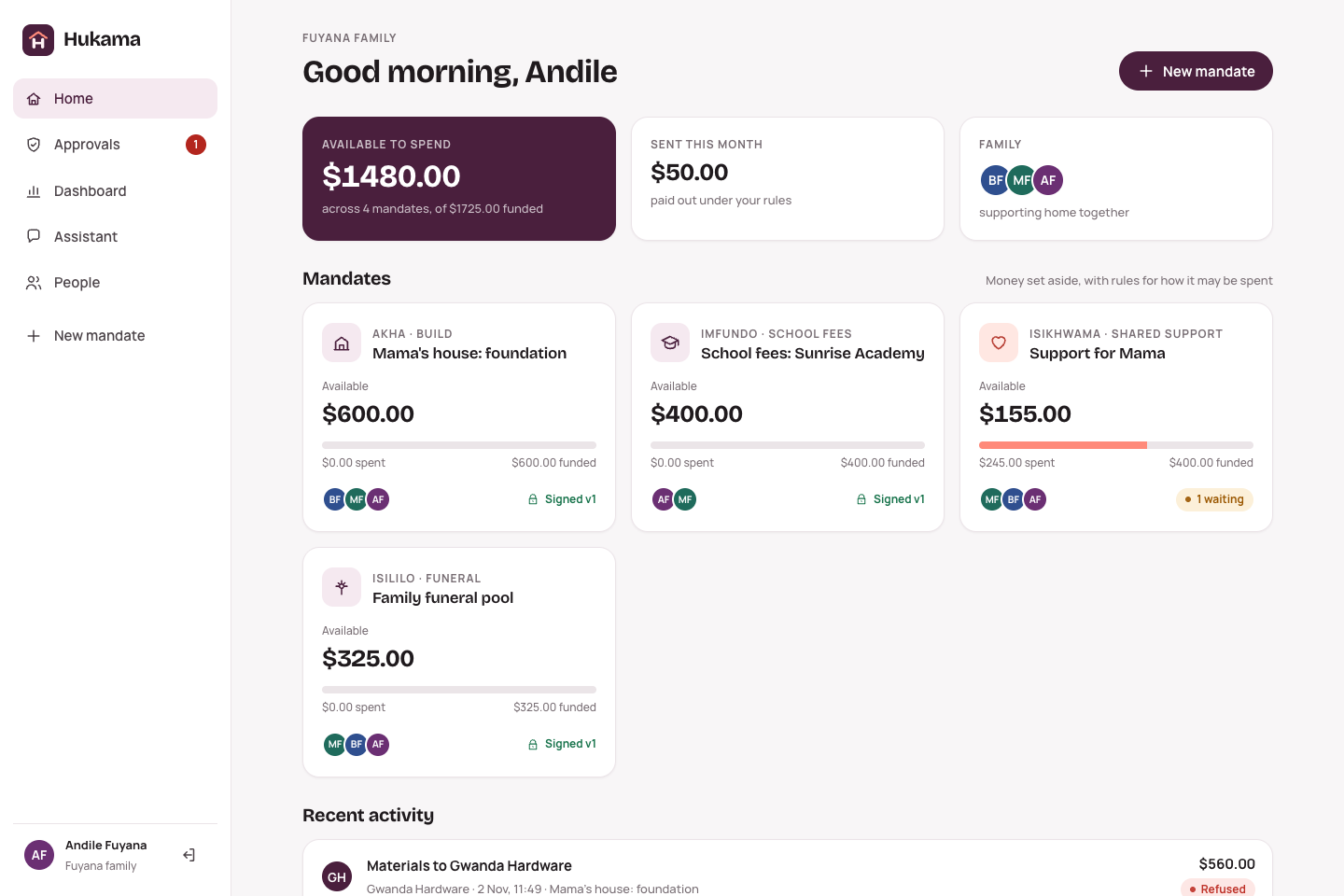
Home: what's available, what's been sent, and a scam held for the family
-
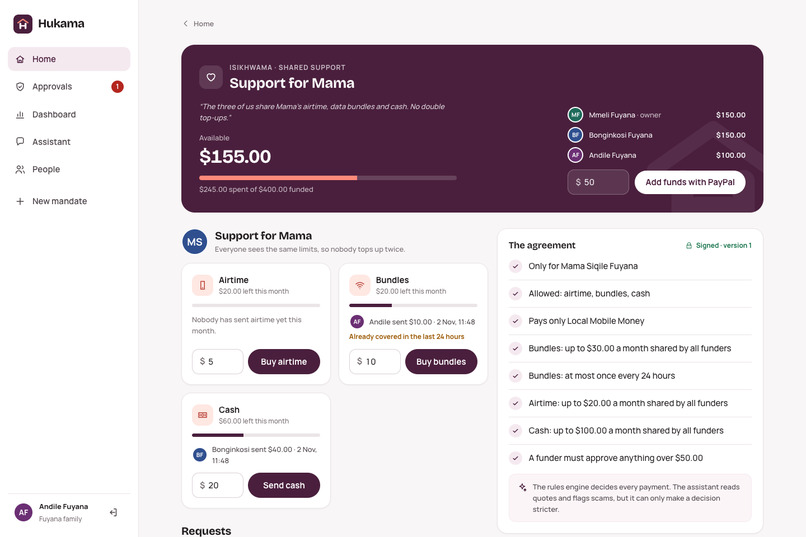
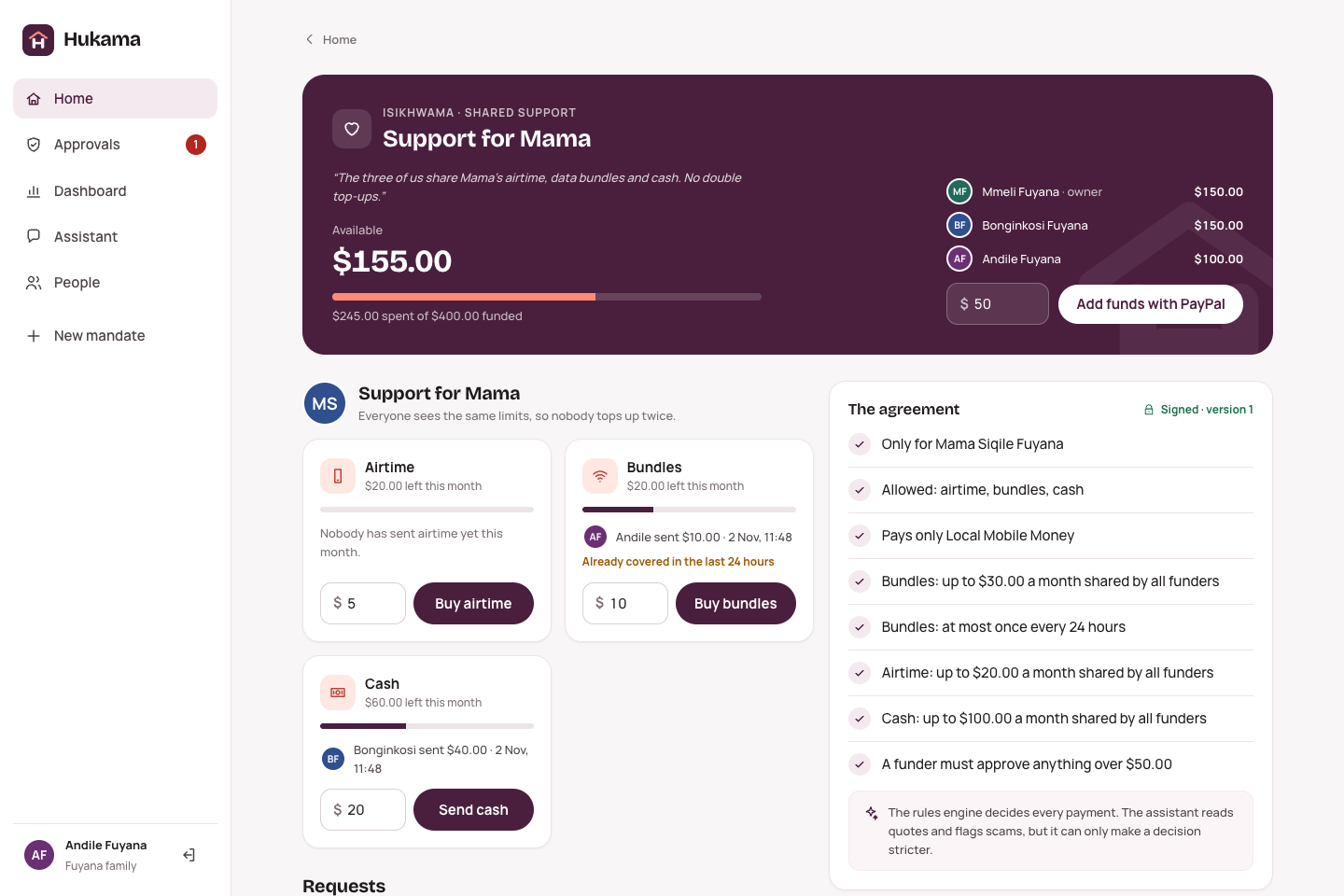
Shared support for Mama: siblings see the same limits and who already covered bundles today
-
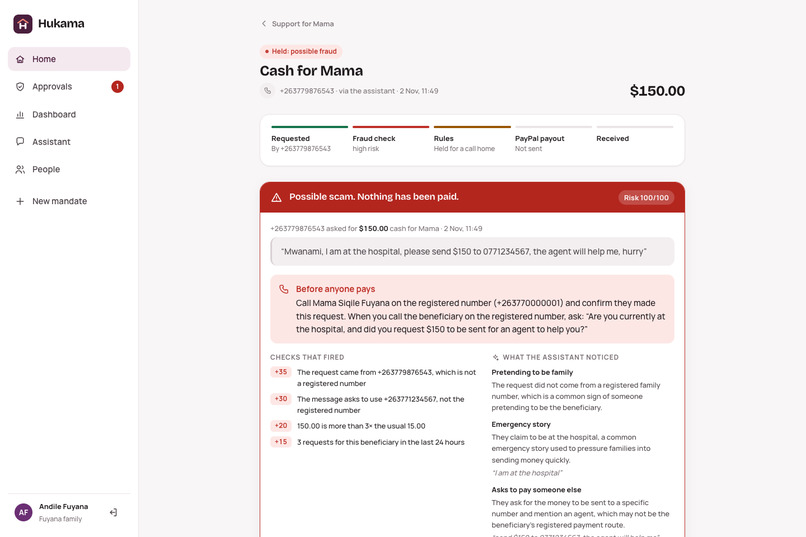
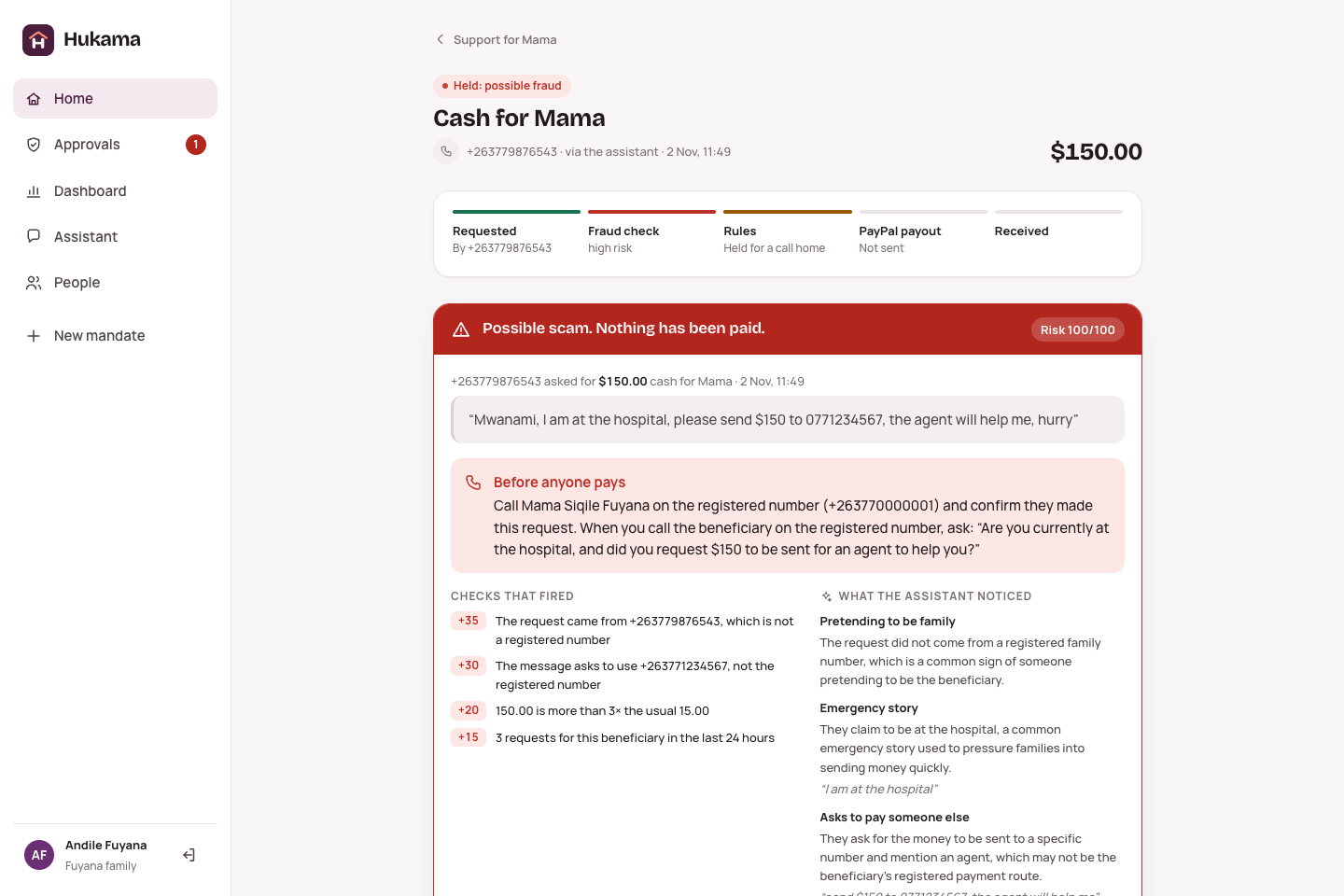
A "hospital emergency" scam from an unknown number: held at risk 100, with the call-home step first
-
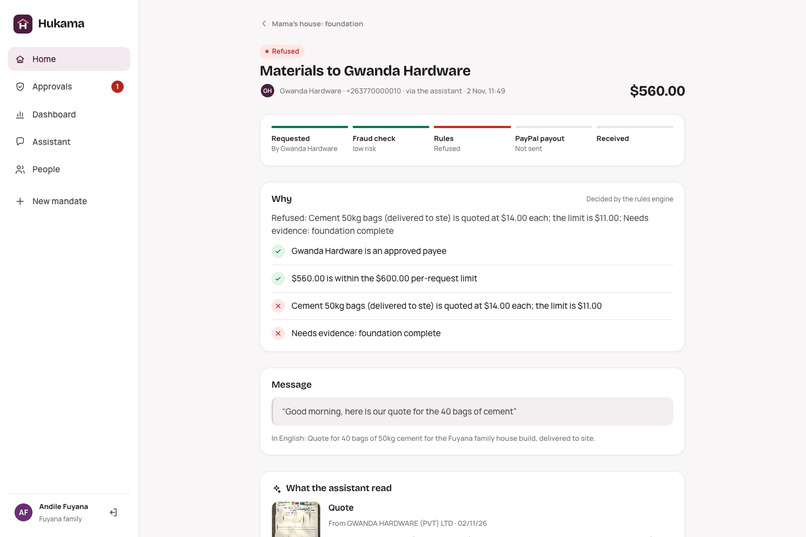
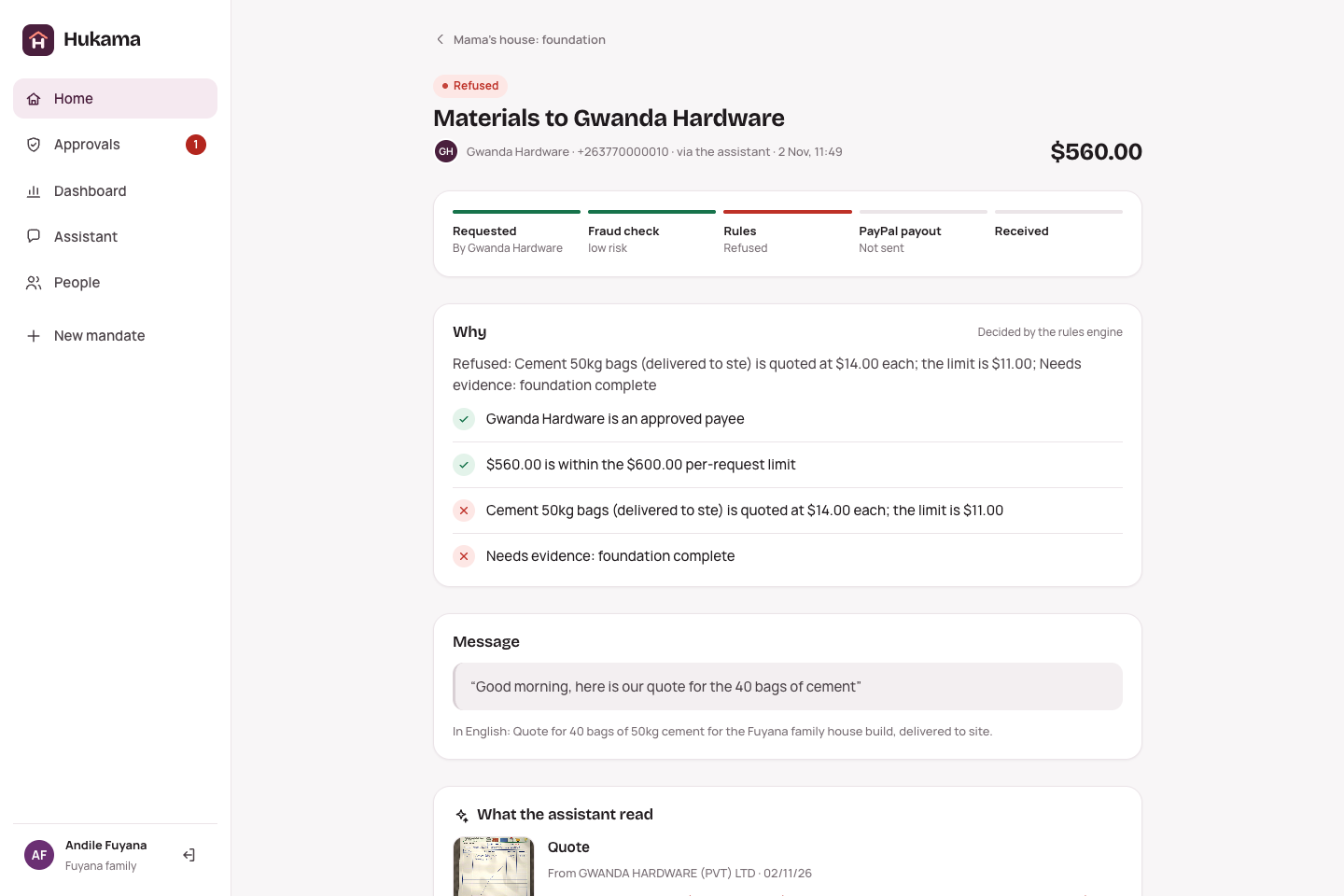
A handwritten quote read by AI and refused by the $11 price ceiling
-
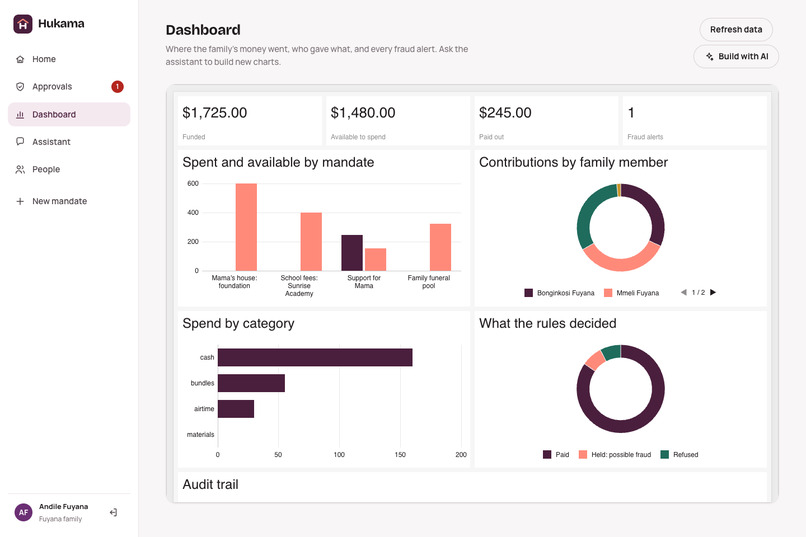
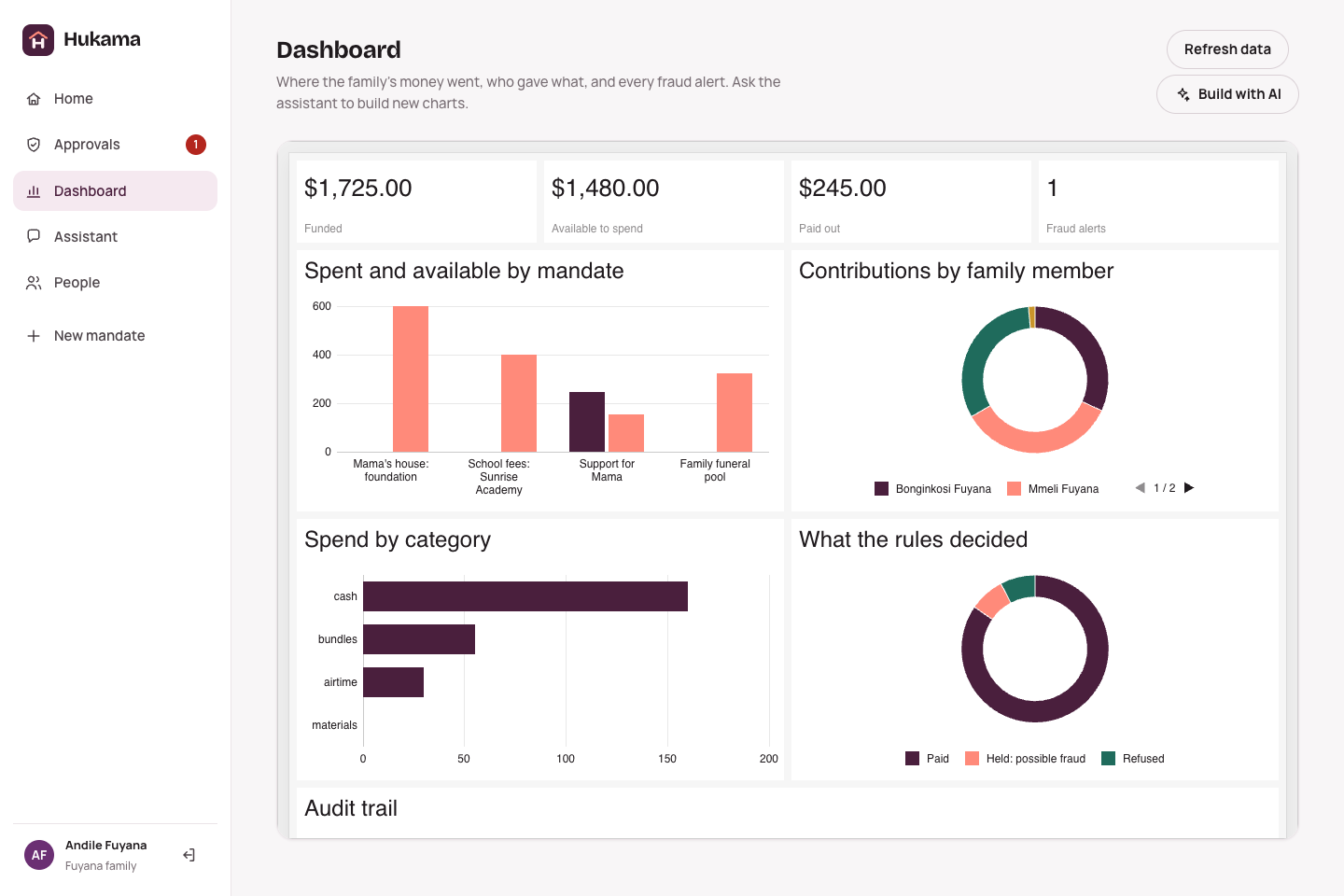
Family dashboard (AG Studio): where the money went, who gave what, every fraud alert
-
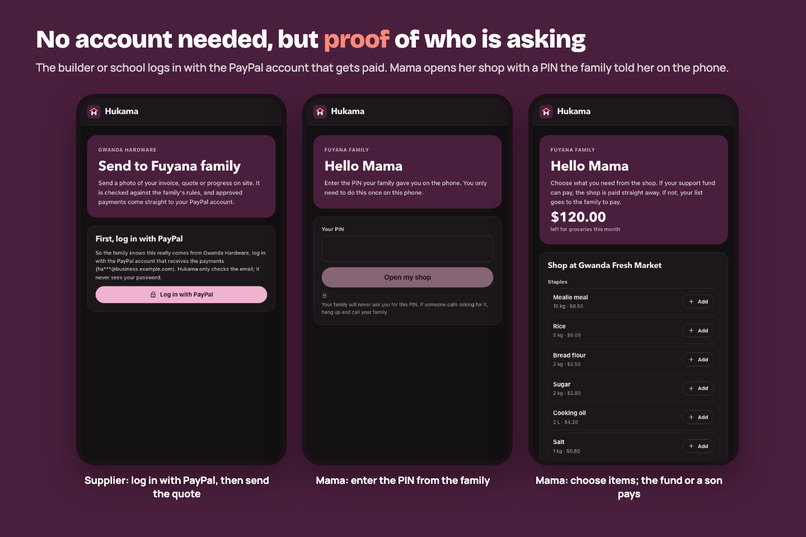
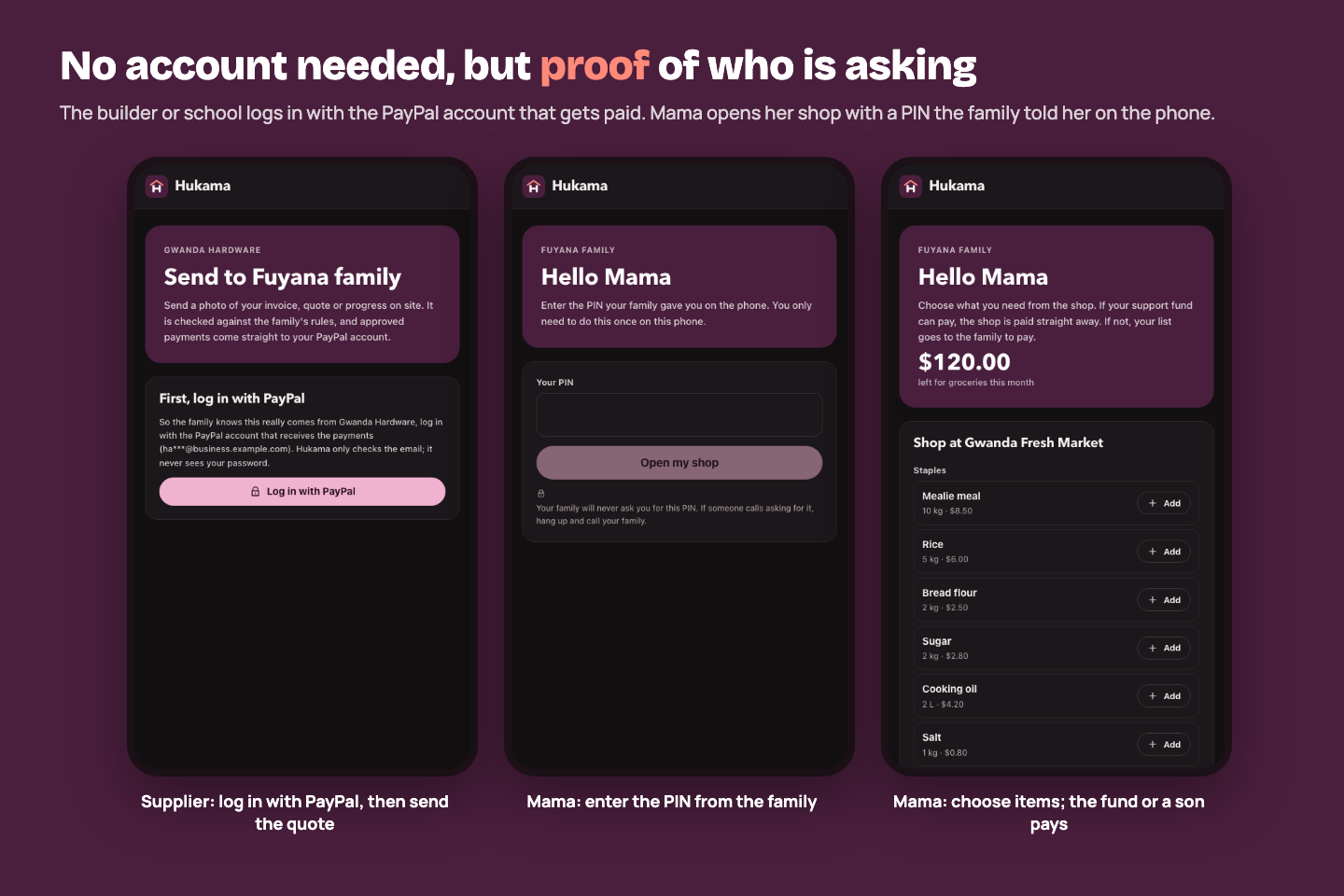
No account needed: a supplier logs in with PayPal to send a quote; Mama opens her shop with a PIN and picks groceries
Watch: the 3-minute demo on YouTube · Try it: live demo (pick a family member, no password) · guide for judges · code · API on Postman
Inspiration
Zimbabwe received about US$2.45 billion in diaspora remittances in 2025, more than 8% of GDP, and about US$1.86 billion in just the first eight months of 2026, up 22% (The Zimbabwe Mail, The Herald). The UK and South Africa are the biggest sources.
A lot of that money is sent for a purpose: school fees, cement for a house, groceries for a parent, a funeral. Yet:
- Once the money lands, the sender can't see whether it went to that purpose.
- Relatives in different countries support the same person without coordinating, so one thing gets paid twice while another waits.
- It's expensive: sending money to Sub-Saharan Africa costs about 8.5–9% on average, the most of any region, against a UN target of 3% (UN DESA).
- Scammers target exactly these families with fake emergencies: "I'm at the hospital, send $150 to this number, hurry."
I wanted to make sending money home easy and safe: pay the school, the builder or the shop directly, and only when the rules the family agreed are met.
To show how it works, Hukama comes with a demo family, the Fuyanas: three brothers in Johannesburg, the UK and the US supporting their mother in Gwanda. The family is fictional; the problem is real.
Hukama means kinship in Shona: the ties that hold a family together.
What it does
Family members abroad fund a mandate: money set aside for one purpose, with rules everyone agreed and signed. Then:
- An AI agent handles the requests. The person at home (Mama, in the demo), the hardware store, the school or anyone else messages the assistant in English, isiNdebele or Shona. It reads handwritten quotes, invoices and progress photos with vision, and turns the conversation into a payment request.
- A deterministic rules engine decides. Price ceilings ("cement no more than $11 a bag"), caps shared across siblings ("bundles up to $30 a month, not twice in 24 hours"), required evidence ("pay only after a photo shows the foundation is done"), approved payees and approval limits.
- PayPal moves the money. Approved payments go straight to the supplier, school or mobile money provider. Nobody in the middle holds cash.
- Schools, builders and shops don't need an account. Each gets a private upload link. They log in with the PayPal account that receives the money, so only the business that gets paid can ask for it, then send a photo of the quote or invoice.
- One front door for everyone without an account. The Hukama home page has Send an invoice (a school or shop logs in with PayPal and sees every family it can invoice, so nobody has to pass links around), Shop with your PIN (someone at home enters their registered phone number and the family's PIN) and Ask Hukama, a guide that answers questions in English, isiNdebele or Shona but can't see any family's money.
- The people at home can ask for themselves. In the demo, Mama gets her own shop link and picks groceries item by item. A PIN the family tells her on the phone proves it's her. If the support fund can pay, the shop is paid straight away. If it can't, her list goes to every son (or the one she picks). The first to pay with PayPal covers it, and the others are told.
- Every request is checked for fraud first. Deterministic signals (unregistered sender, a different number in the message, an amount spike, velocity, someone asking for a PIN) plus an AI read of intent (urgency pressure, impersonation, "pay someone else", emergency story). High risk means the request is held. Every funder sees a red card that says "Call Mama on her registered number first", and can report it, which blocks the scammer's numbers for the whole family.
The AI proposes, code decides, PayPal moves the money. The assistant has no tool that can pay, approve, change rules or change beneficiaries. AI can only make a decision stricter, never looser.
Mandate types (rule templates, not separate code)
| Mandate | What it's for |
|---|---|
| Akha (build) | Quotes are checked against a price ceiling, milestone photos are verified, then the supplier is paid |
| Imfundo (school fees) | Fees are locked to the school and paid against the school's own invoice |
| Isikhwama (shared support) | Siblings share caps for a parent's airtime, data, cash and groceries. Groceries are chosen item by item from a local store's price list, collected in store or delivered to the registered address only. No double top-ups, and the app tells you who already covered it |
| Isililo (funeral pool) | The family funds it, and anyone with the pool's link can give with PayPal, no account needed |
| Vikela (cover) | Funeral cover (including repatriation for family abroad) or medical aid, paid monthly by PayPal Subscriptions to the named provider |
What the video shows, and what it doesn't
The 3-minute video follows one payment from start to finish: a son adds $100 to Mama's house with PayPal checkout, the builder's quote and foundation photo are read by AI and checked against the signed rules, PayPal pays the hardware store directly, and a school with no Hukama account logs in with PayPal to send its own invoice and gets paid. Along the way you see a scam held at risk 100/100 and the family dashboard, and each PayPal call appears in PayPal's own developer log.
That's one path through Hukama. Everything below is also built, tested and live in the demo:
| Area | What Hukama does | Why it matters |
|---|---|---|
| Five mandates, one rule engine | Build, school fees, shared support, funeral pool and cover are rule templates and data, not separate code | A new purpose (rent, medical bills, farming inputs) is a new template, not a new app |
| Siblings share limits | Caps, "not twice in 24 hours", and a tile that says who already paid ("Andile already sent bundles at 08:50") | Three brothers on three continents never top up twice |
| Mama shops for herself | A shop link opened with a PIN the family tells her by phone; groceries item by item, collected in store with a code or delivered to her registered address only | The person being supported asks for herself, with no account and no smartphone skills beyond a link |
| Invoices between siblings | If the fund is short, her list becomes an invoice to every son (or the one she picks); the first PayPal payment covers it, the list is re-checked, the store is paid, and the others are notified | Nobody pays for the same list twice, and nobody is left out of the loop |
| Funeral pool | A share link anyone can give to with PayPal, no account needed; it pays only the funeral provider, on its invoice | Friends and church members can help without the money passing through anyone's pocket |
| Monthly cover | Funeral cover (with repatriation) and medical aid paid by PayPal Subscriptions; each premium funds the mandate once, then the rules pay the provider | Premiums never lapse because a transfer was forgotten |
| A multilingual agent | Chat in English, isiNdebele and Shona for family, suppliers and schools; mandates drafted from one plain sentence and signed | Older relatives and small businesses use the language they think in |
| Fraud before rules | Eight weighted rule signals plus nine AI intent flags; high risk is held until a funder calls the registered number; reporting a scam blocks its numbers for the whole family | Fake emergencies stop at the first message, not after the money is gone |
| Payees without accounts | An upload link, or Send an invoice on the home page, gated by Log in with PayPal as the account that gets paid | Only the business that receives the money can ask for it |
| Ask Hukama | A public guide on the home page that answers questions but has no tools and can't see any family's data | Curious visitors get answers without any risk to a family |
| A dashboard you can talk to | AG Studio with a custom money-flow widget; "chart cash paid out per month" builds the chart, through our own server | Every dollar is traceable: who gave, what it paid for, every alert |
| Families of their own | Start your family, invite relatives as admin, funder or viewer, a first-visit tour and a getting-started checklist | Any family can start using it today, not just the demo one |
| Payments-grade plumbing | HMAC-signed rules, an append-only ledger, payouts that can't be sent twice, forward-only status, refunds and chargebacks, verified webhooks, per-mandate locking | It behaves like a payments system, because it is one |
A week with the Fuyana family
Here is what happens on screen when we follow the demo family through one week, in the order the money moves.
1. A quote that's too expensive. Gwanda Hardware sends a photo of a handwritten quote: 40 bags of cement at $14 a bag. The assistant reads the photo into line items, and the request appears as refused, because the family's rule says cement costs no more than $11 a bag. The supplier is asked, in plain words, for a revised quote.
2. The revised quote is paid. A new quote arrives at $10.50 a bag, with a photo showing the foundation is finished. This time every rule passes, the request is approved, and Gwanda Hardware receives a real $420 PayPal sandbox payout within half a minute.
3. The school sends its own invoice. Sunrise Academy logs in with PayPal through its upload link and sends its invoice. The first try, at $300, is refused, and the screen says why: "The invoice total ($340.00) does not match the request." At $340 it's paid by PayPal Payout.
4. Two brothers, one top-up. Andile buys Mama's data bundles. An hour later Mmeli opens Support for Mama, taps Buy bundles, and is stopped by a message that names his brother: "Andile Fuyana already sent bundles ($10.00) at 08:50; wait 24 hours." Earlier in the week, a $48 grocery basket was paid to the store and delivered to Mama's registered address.
5. Mama shops for herself. Mama opens her shop link. Until she types the PIN the family told her on the phone, the page shows nothing but her first name; five wrong guesses would switch the link off and alert the family. She picks groceries item by item and sends the list. It's refused, because Andile's groceries from 3 November are still inside the family's 72-hour rule, and the screen tells her exactly that.
6. A scam is caught. A message arrives from an unknown number: Mama is "at the hospital" and someone must send $150 to a different number, quickly. It scores 100/100 risk and is held. The sender sees only that it's "held until the family confirms with her on her registered number". The sons see a red card on their Approvals page that says "Call Mama on her registered number first", listing every warning sign and the assistant's reasoning with quotes from the message, and a button to report the scam.
How I built it
- Backend: Django + Django REST Framework, PostgreSQL on Render. Every state change writes an append-only ledger entry, and mandate rules are signed with HMAC-SHA256: if anyone edits them in the database, nothing gets paid.
- AI: OpenAI models for chat with tool calling, structured outputs for drafting mandates from plain language, vision for quotes, invoices and photos, and fraud intent analysis. Every model call goes through one wrapper with retries, timeouts and a demo replay cache.
- PayPal, end to end: money comes in through PayPal checkout (Orders v2 via the APIMatic-generated PayPal Server SDK, JS SDK v6 buttons), for funders and for anyone with a pool's link. Funeral cover (including repatriation for family abroad) is paid monthly by PayPal Subscriptions; each premium is recorded once and then passed to the cover provider by the rules. Money goes out by PayPal Payouts to suppliers, schools, the grocer and the local mobile money provider, idempotently (
sender_batch_id=hukama-<request id>). PayPal webhooks update captures and payouts the moment they happen; every event is signature-verified with PayPal and applied once. - APIMatic: the PayPal integration was written in Claude Code with the APIMatic Context Plugin for PayPal, which supplied the SDK's exact models, endpoints and idempotency parameters.
- Frontend: React + TypeScript + Vite, served by Django on one Render service. Mobile-first, light and dark modes, with its own design system and logo.
- Dashboard: AG Studio (built on AG Grid and AG Charts) shows funds by mandate, each sibling's contributions, spend by category, fraud alerts and the full audit trail. Its Agent Framework lets you say "chart cash paid out per month" and the chart appears. The agents' model calls go through the app's own server, so the API key never reaches the browser.
- Links instead of accounts: a funeral pool's link lets anyone give with PayPal. A payee's upload link uses Log in with PayPal: the logged-in PayPal email must be the account the payout goes to. A person at home gets a shop link opened with a PIN. Whatever arrives through a link can only pay that link's payee or the family's store, and still goes through the fraud check and the rules.
- Invoices between siblings: when the support fund can't cover a shopping list, it becomes an invoice to the family. The first son's PayPal payment is captured, the list is re-checked against every rule and the store is paid. A late second payment simply stays in the fund. Everyone sees in-app notifications.
- Hardening: an audit closed real loopholes. Only payees Hukama has verified can be paid. Decisions on one mandate are serialised so two siblings can't spend the same limit at once. Refunds and chargebacks reduce the balance. Payout status only moves forward, and webhooks are stored and applied in one transaction.
- Onboarding: anyone can start a new family. A first-visit tour and a "Getting started" checklist walk them to their first payment.
- Postman: A public workspace with the whole API (47 requests) and folders that replay the demo against the hosted app with assertions (21 requests, 33 checks, passing).
- Quality: 279 automated tests (every rule, fraud signals, payout idempotency, the loopholes, payee and shop links, invoices, and the five demo scenarios end to end with PayPal and the model mocked). GitHub Actions runs them on PostgreSQL on every push.
Challenges I ran into
- Keeping the AI on a leash without making it useless. The answer was architecture rather than prompts: the model can only create requests and read. Fraud analysis can add risk but never remove it, and a funder's approval re-checks every hard rule.
- Sending money to Zimbabwe. Zimbabwean PayPal accounts have historically been send-only, so the last mile goes through a local mobile money provider's PayPal business account. Airtime, data and cash delivery to the beneficiary's phone are clearly labelled Simulated rail in the app, because no public sandbox exists for them.
- Proving who is asking, without accounts. Suppliers and schools already have PayPal, so Log in with PayPal proves the request comes from the account that gets paid. Mama has no PayPal, so her shop link needs a PIN the family tells her on a phone call, never in the same message as the link. The family is also told about every list paid from the fund.
- Scam messages that look exactly like family. Deterministic signals catch the mechanics, such as an unknown number or "send to this other number". The model catches the story, such as urgency, impersonation or an emergency. Neither alone was enough.
Accomplishments that I'm proud of
- A refusal always explains itself in plain words, names who already covered something, and suggests what would work.
- Siblings on three continents see the same limits, so nobody tops up twice.
- The person who sent a scam never learns why it was held; the family sees everything.
- An append-only ledger and signed rules mean every dollar has a trail.
- Mama can shop for herself, and her sons never pay for the same list twice.
What I learned
AI is most powerful when it's boxed in. The model reads handwritten quotes, understands requests in isiNdebele and Shona, spots the emotional pressure in a scam, and drafts rules from one plain sentence: things I could never have hand-coded in a month. The breakthrough was architectural: the AI only proposes and reads, a deterministic engine decides, and PayPal moves the money. That split made the system both smart and trustworthy, and it's a pattern I'll use in every AI product I build.
An AI coding partner changed how fast I can build. Working in Claude Code, I went from an empty repository to a deployed, tested payments app (279 automated tests, CI on PostgreSQL, live on Render) in about two weeks. Its value was review as much as speed: a full audit found loopholes I hadn't seen, like two siblings spending the same limit at the same moment, refunds after the money was spent, and payment webhooks arriving out of order.
Payments engineering is about the unhappy paths. Idempotency keys, signature-verified webhooks, statuses that only move forward, refunds and chargebacks: PayPal's sandbox let me test every one of them safely before any real money would move.
APIMatic made the PayPal SDK predictable. The Context Plugin gave me the SDK's exact models and parameters, so the Orders and Subscriptions code worked against the real SDK first time. It also told me clearly what the SDK doesn't cover (Log in with PayPal, catalog products), so I called those APIs directly instead of guessing.
Postman turned my API into something anyone can run. Every endpoint is in a public collection, with folders that replay the demo against the live app with assertions (21 requests, 33 checks). I ran it after every deploy as a regression check, and it caught real breakages. It's also the fastest way for a judge or developer to understand the API without reading the code.
Rules people can read are the real product. Families don't want an app that sends money; they want one that keeps a promise. The hardest and most valuable work was turning that promise into rules a mother, a school and a machine all understand: "Cement: no more than $11.00 each."
What's next for Hukama
- Real mobile money last-mile partners in place of the simulated rail
- PayPal's marketplace product with delayed disbursement, so family money is held by PayPal for the payee rather than in the platform's own account (pooling it ourselves is regulated)
- WhatsApp and SMS: links, invoices and notifications where families already talk
- More languages, and voice notes for older relatives
Built With
- ag-charts
- ag-grid
- ag-studio
- apimatic
- django
- django-rest-framework
- github-actions
- log-in-with-paypal
- openai
- paypal
- paypal-js-sdk
- paypal-orders
- paypal-payouts
- paypal-server-sdk
- paypal-subscriptions
- paypal-webhooks
- postgresql
- postman
- python
- react
- render
- typescript
- vite
