-
-
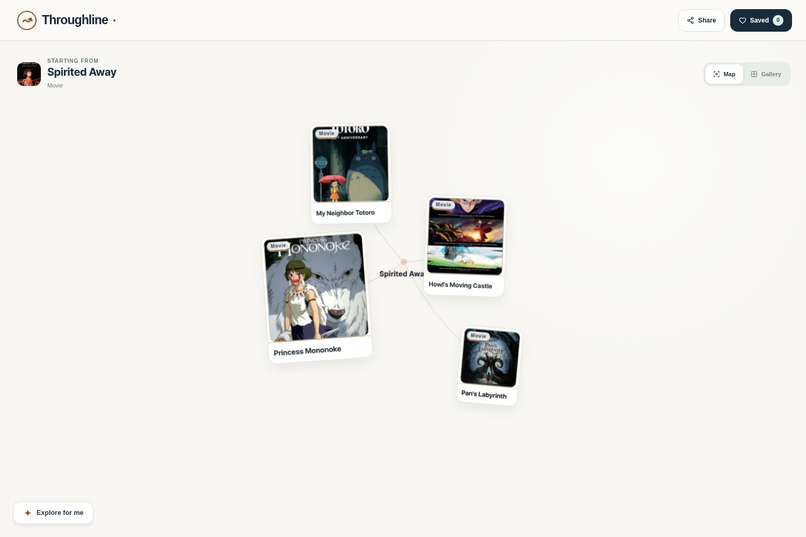
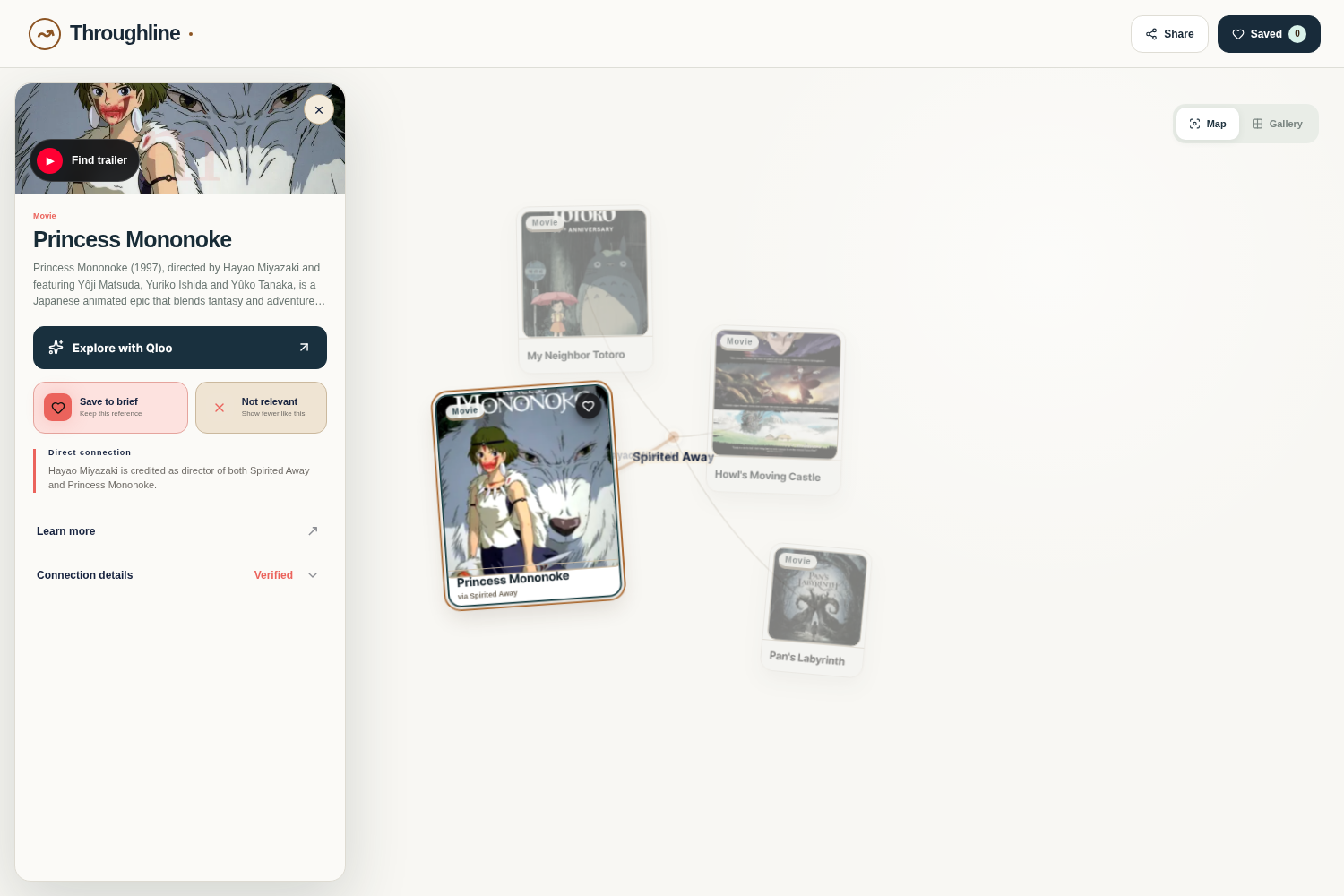
Graph
-
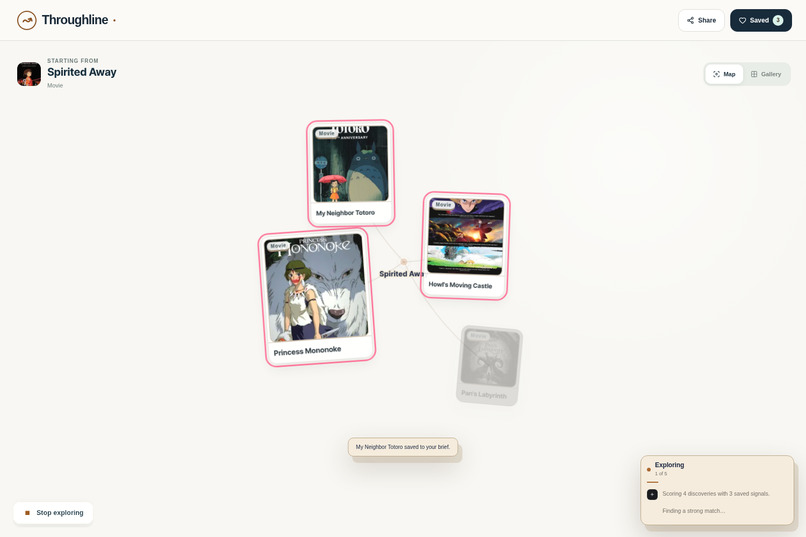
Explore for me
-
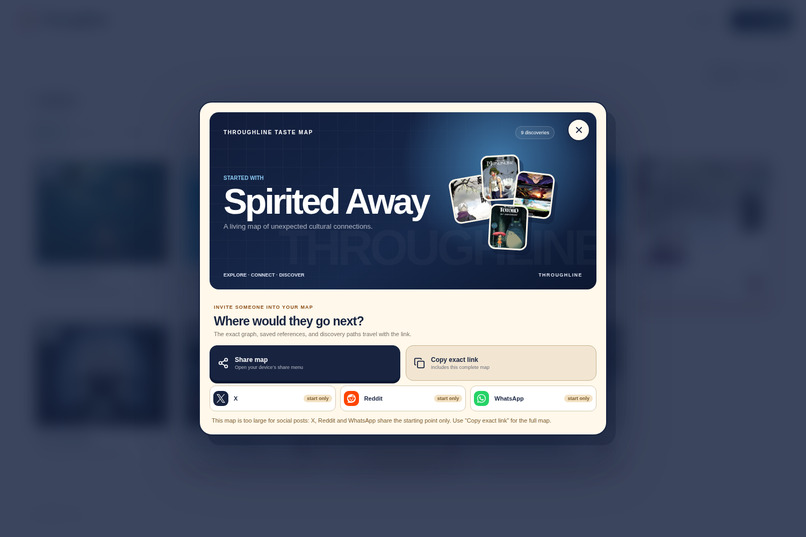
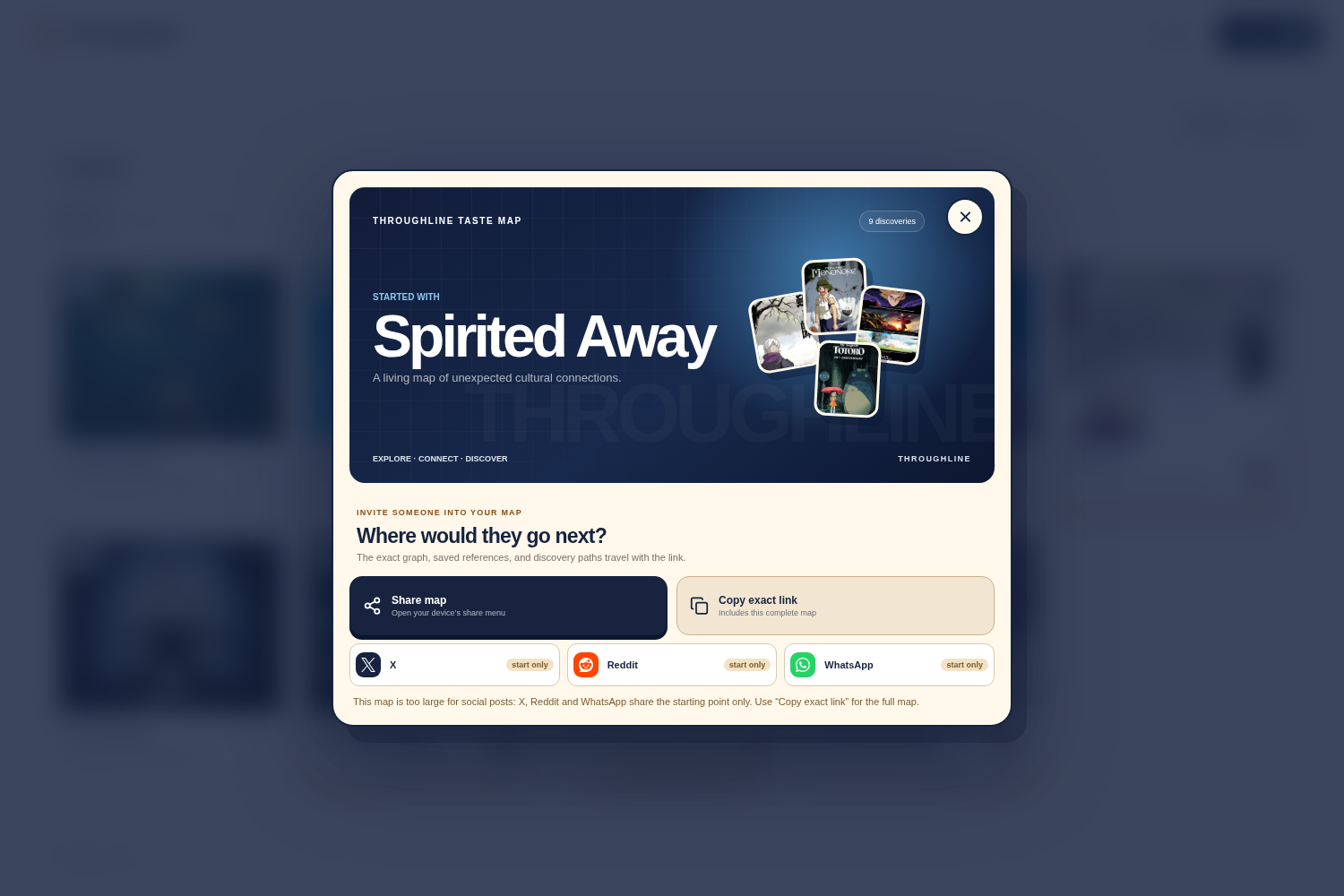
Share Preview
-
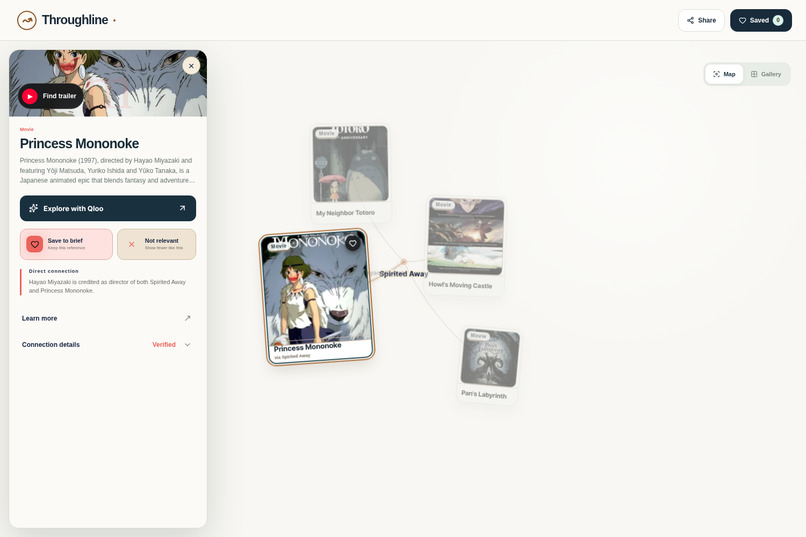
Selected card
-
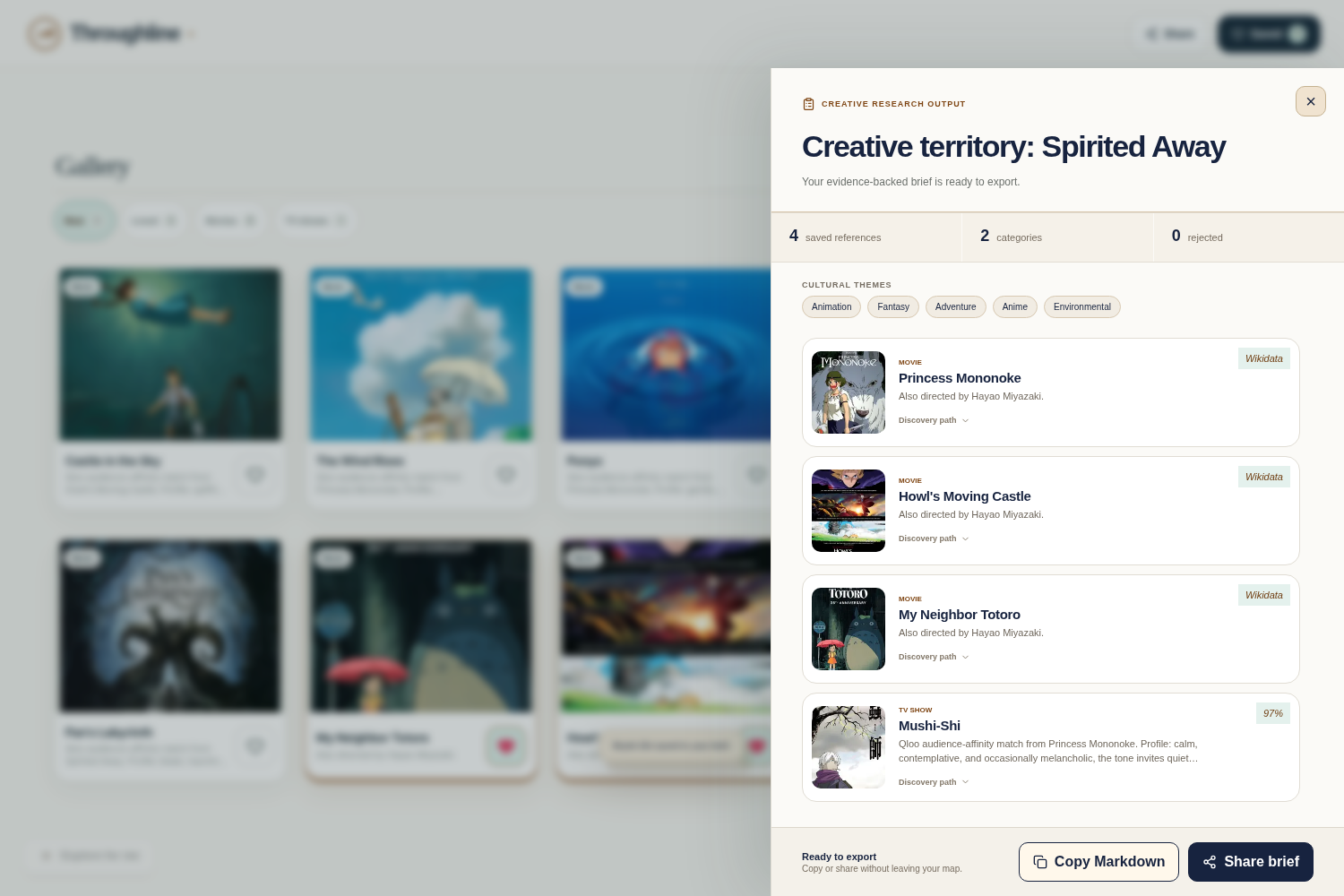
Saved Brief
-
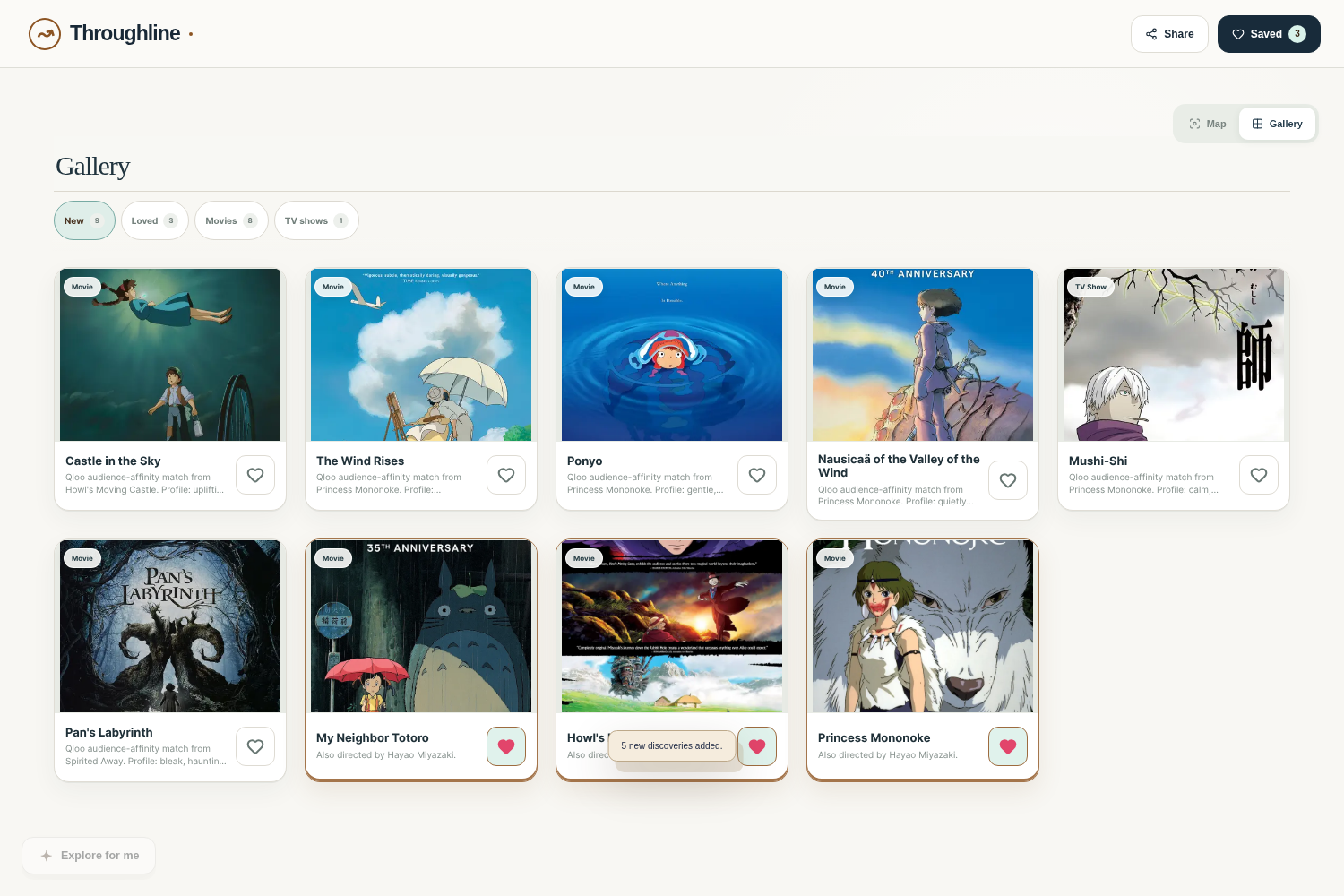
Gallery
Inspiration
What it does
How we built it
Challenges we ran into
Accomplishments that we're proud of
What we learned
What's next for Throughline
The problem
Creative discovery is fragmented.
A strategist beginning with one film, artist, book, place, or brand typically jumps between search engines, streaming platforms, social media, moodboards, and spreadsheets. Interesting references get collected, but the reasoning connecting them disappears. Generic AI can accelerate the search, yet it can also invent plausible-sounding cultural connections without defensible evidence.
Our solution
Throughline turns one trusted cultural reference into an explainable creative territory.
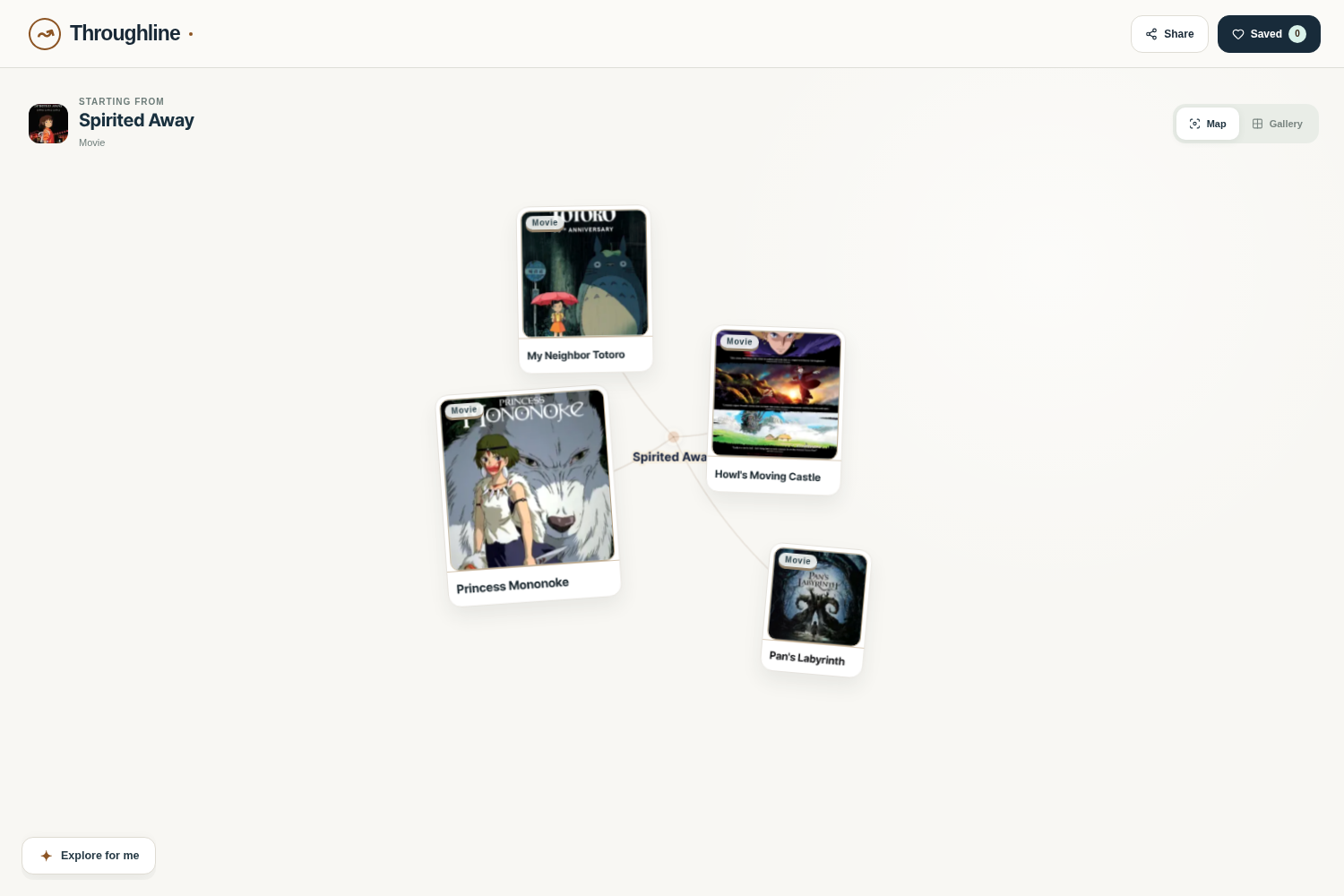
Start with something you love. Throughline resolves the exact entity, establishes verified factual context, and builds an interactive graph of connected films, music, books, television, people, places, games, brands, and other cultural signals.
Every discovery retains a visible path back to the starting reference.
Users can:
- Explore an interactive cultural graph
- Inspect why every reference appeared
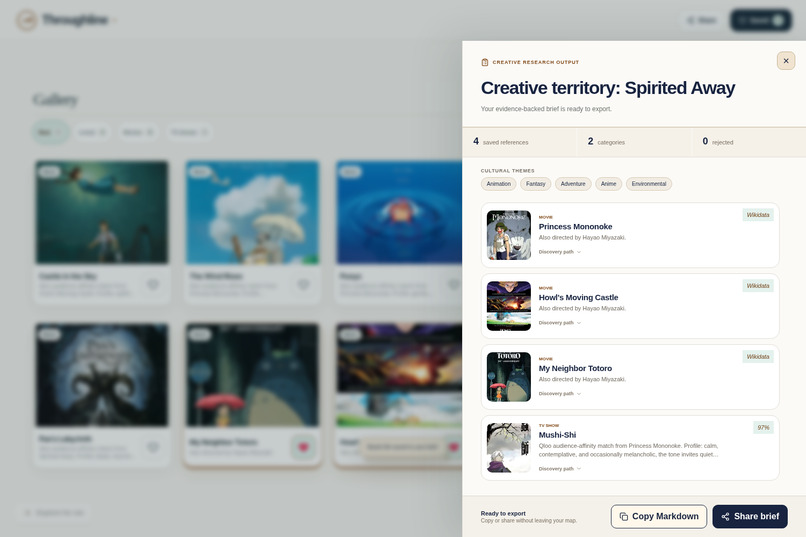
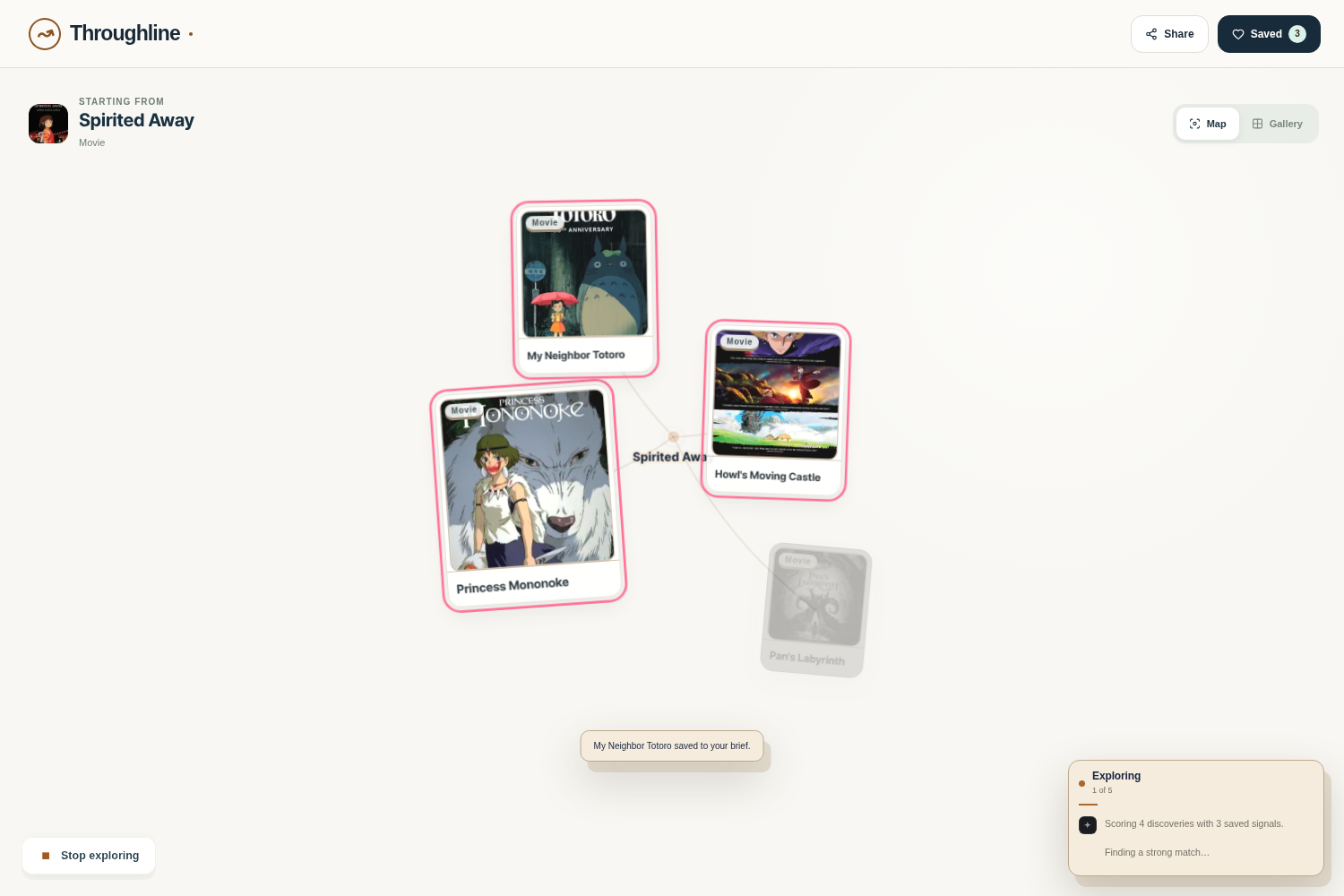
- Save strong discoveries to a creative brief
- Reject irrelevant results and improve future exploration
- Ask the agent to expand the most promising branches
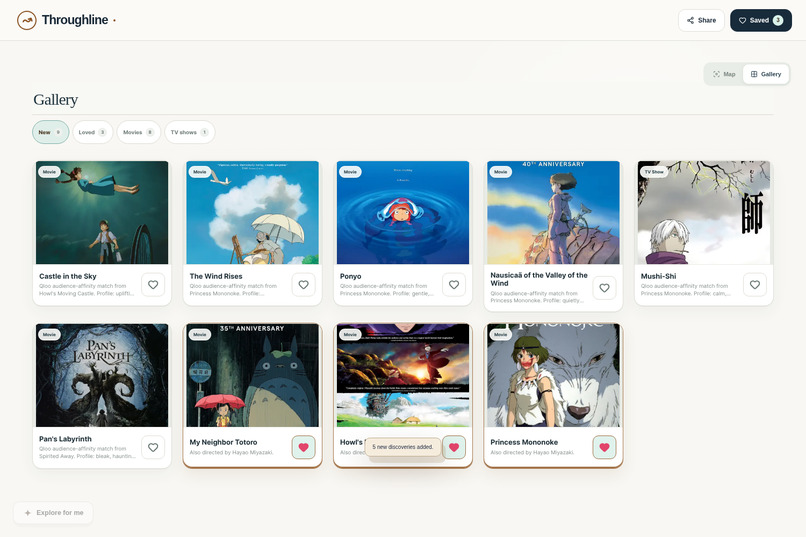
- Switch between visual Map and organized Gallery views
- Share the resulting territory with collaborators
Why Qloo matters
Qloo is not a decorative API integration—it is the cultural intelligence layer that makes Throughline possible.
Qloo resolves real entities and provides cross-domain audience affinities. This allows Throughline to move beyond simple credits or keyword similarity and answer a more valuable question:
If this is our starting signal, what else genuinely belongs in its cultural neighborhood?
The agent evaluates Qloo candidates against the user's evolving intent, saved references, rejected references, category coverage, and prior exploration paths. Weak candidates are discarded instead of being forced into the graph.
When evidence is insufficient, Throughline says so. It never invents a connection merely to fill the screen.
How it works
Entity resolution
The starting query is matched to the correct cultural entity. Ambiguous searches present explicit choices instead of silently guessing.Verified context
Factual relationships—such as creators, works, adaptations, and subjects—establish what the starting reference actually is.Qloo audience intelligence
Qloo supplies affinity-ranked candidates across cultural categories.Agentic relevance filtering
The agent evaluates specificity, evidence, user feedback, category diversity, and the path already taken.Local GraphRAG memory
Entities, relationships, saves, rejections, and exploration events are stored locally in the browser. Only a compact evidence packet is retrieved for each request.An inspectable result
Every accepted card keeps its relationship, reason, evidence, and route back to the original signal.
What makes Throughline different
Most recommendation products deliver a feed. Throughline delivers a reasoned map.
It separates three things that are often mixed together:
- What is factually connected
- What audiences are culturally drawn toward
- What is relevant to this particular creative direction
That makes the result useful for campaign development, entertainment strategy, audience research, programming, treatments, partnerships, and creative briefs.
Challenges we faced
The hardest problem was not retrieving more recommendations. It was deciding what deserved to survive.
Ambiguous names, unsupported Qloo anchors, missing artwork, duplicate entities, broad genre similarity, and weak cross-domain matches all created opportunities for misleading output. We built explicit controls for each case:
- Disambiguation before exploration
- Strict relevance and evidence gates
- Deduplication across sources and categories
- Honest unsupported-result states
- Bounded graph growth
- Graceful artwork fallbacks
- Rate limits, request-size limits, and server-side secret handling
We also designed the interface so a complex graph remains usable: semantic zoom, highlighted paths, Gallery view, evidence inspection, and controlled five-result expansion.
What we learned
Reliable cultural discovery needs both machine intelligence and product restraint.
Qloo provides the audience layer that ordinary search cannot. The agent adds planning and contextual judgment. The graph preserves provenance. User feedback turns exploration into an evolving creative territory rather than a disposable recommendation list.
The most important behavior is sometimes refusing to recommend. A smaller graph of defensible connections is more valuable than a large graph of plausible noise.
What we are proud of
Throughline is a working, deployed product—not a static prototype.
It combines:
- Real Qloo entity and affinity data
- Agent-directed multi-step exploration
- Explainable graph retrieval
- Persistent browser-local taste memory
- Save and rejection feedback
- Map, Gallery, brief, and sharing workflows
- Production safeguards and tested failure states
What's next
The next step is collaborative creative territories: shared briefs, team feedback, export integrations, and organization-level cultural memory.
The broader vision is a trusted discovery layer for the creative economy—helping studios, agencies, brands, investors, programmers, and artists find unexpected connections without losing the evidence behind them.
Built With
- agentic
- ai
- amazon
- amazon-web-services
- api
- caddy
- docker
- ec2
- ecr
- graph
- graphrag
- indexeddb
- knowledge
- next.js
- node.js
- qloo
- react
- rest
- typescript
- vite

Log in or sign up for Devpost to join the conversation.