Inspiration
A doorbell assumes you can hear who's there and understand what they say. For a deaf resident, or for someone at home in a city where the delivery rider speaks Hindi and they don't, every ring is a guess. Opening the door to find out is exactly what scammers count on: "I'm from the electricity board, I need to come inside."
What it does
When someone rings a Ring doorbell, Threshold:
- Transcribes what the visitor said, and works out the language itself (Hindi or Indian English today). The visitor never picks one.
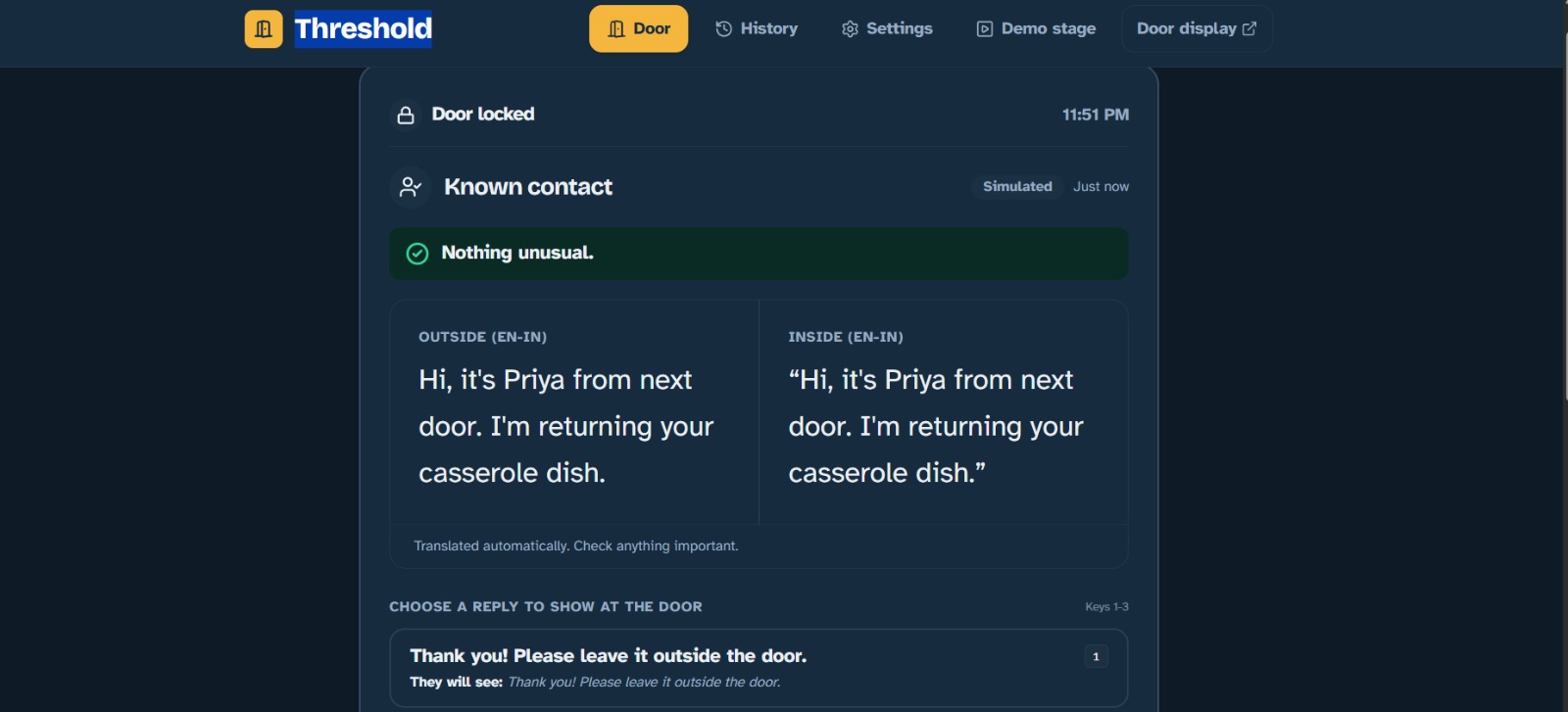
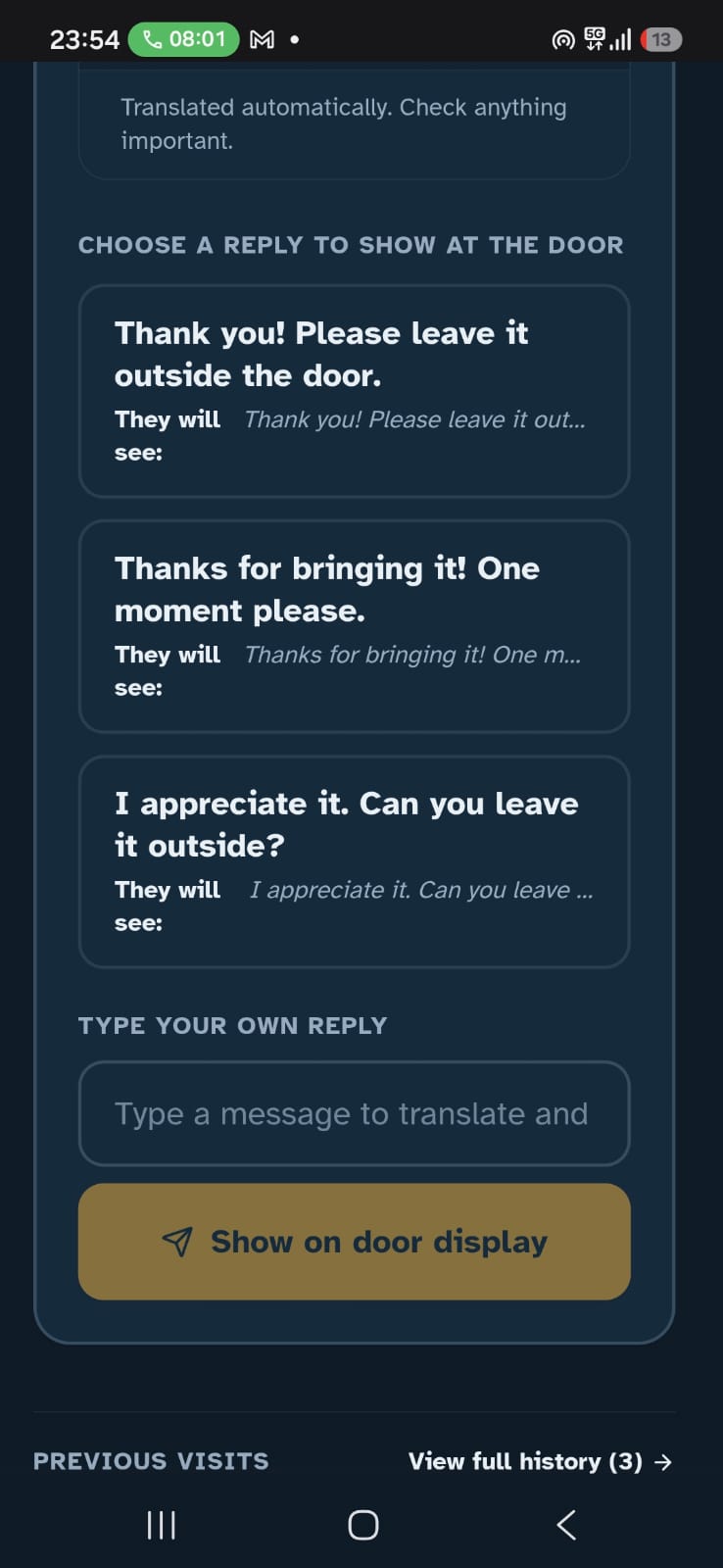
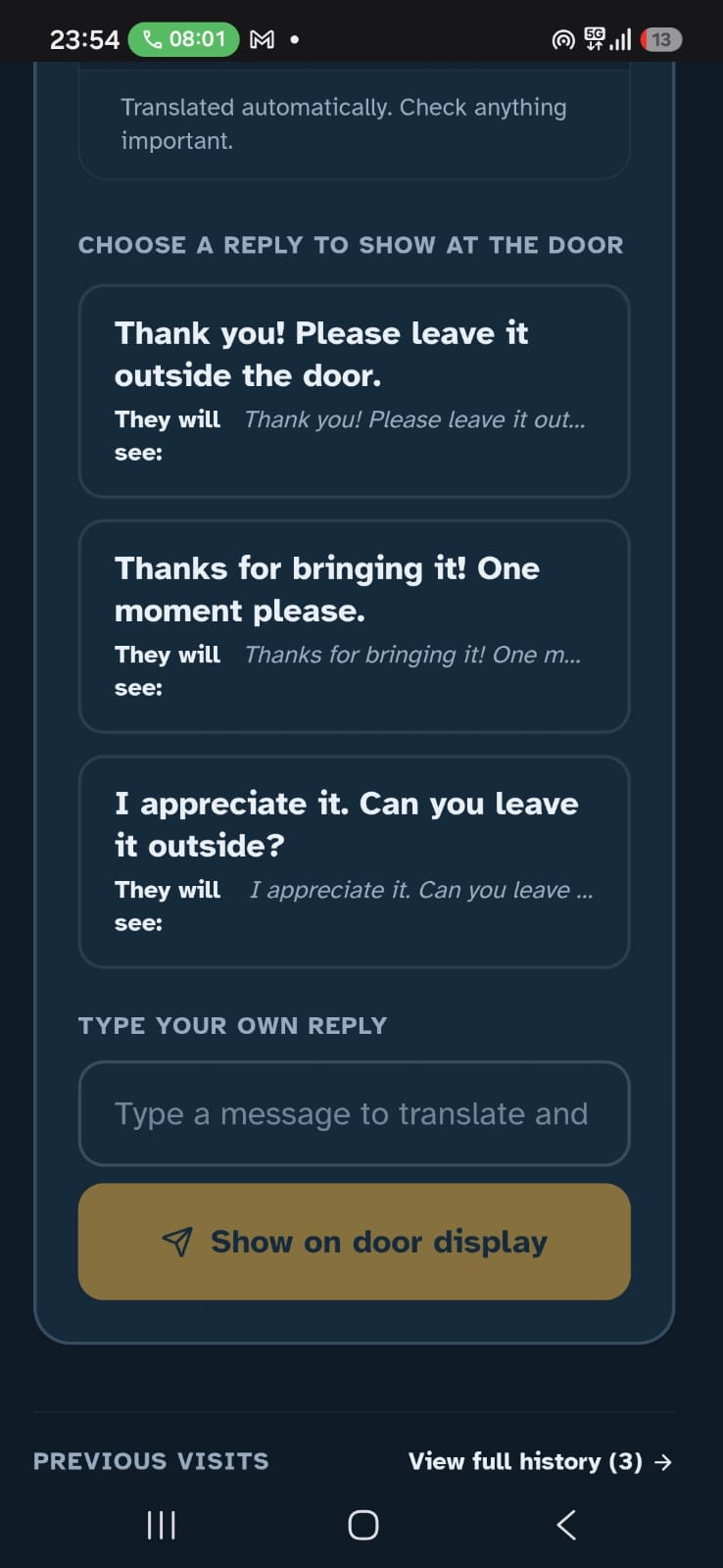
- Translates it into the resident's language and shows a visitor card: who it probably is (delivery, service, neighbour, salesperson, unknown, emergency), what they want, a risk banner, and three safe suggested replies.
- Checks the claim against the resident's own facts: is there a booked visit, is it the middle of the night, did they ask to come in, for a code, or for money?
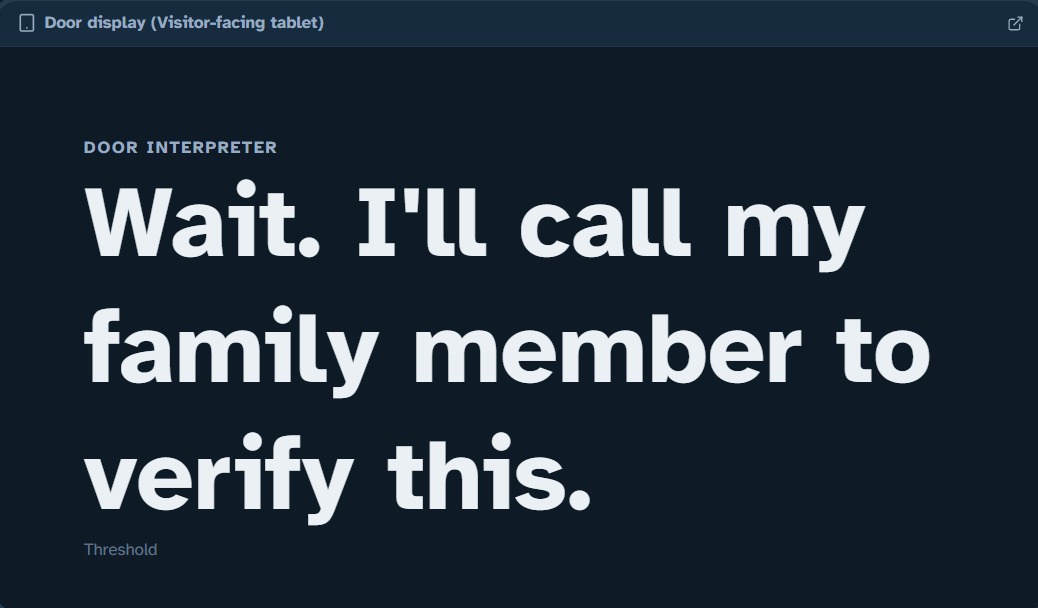
- Replies for the resident. They tap a reply or type one, and it's translated into the visitor's language and spoken on a Door Display, a tablet in the window. Ring has no API to speak through the doorbell, so we say that plainly and ask Ring for one.
- Escalates high-risk visits to a trusted contact (by SNS), and offers a call-emergency-services button when a visitor reports smoke or fire.
- Never unlocks anything. No unlock capability exists anywhere in the code, and a test fails if one appears.
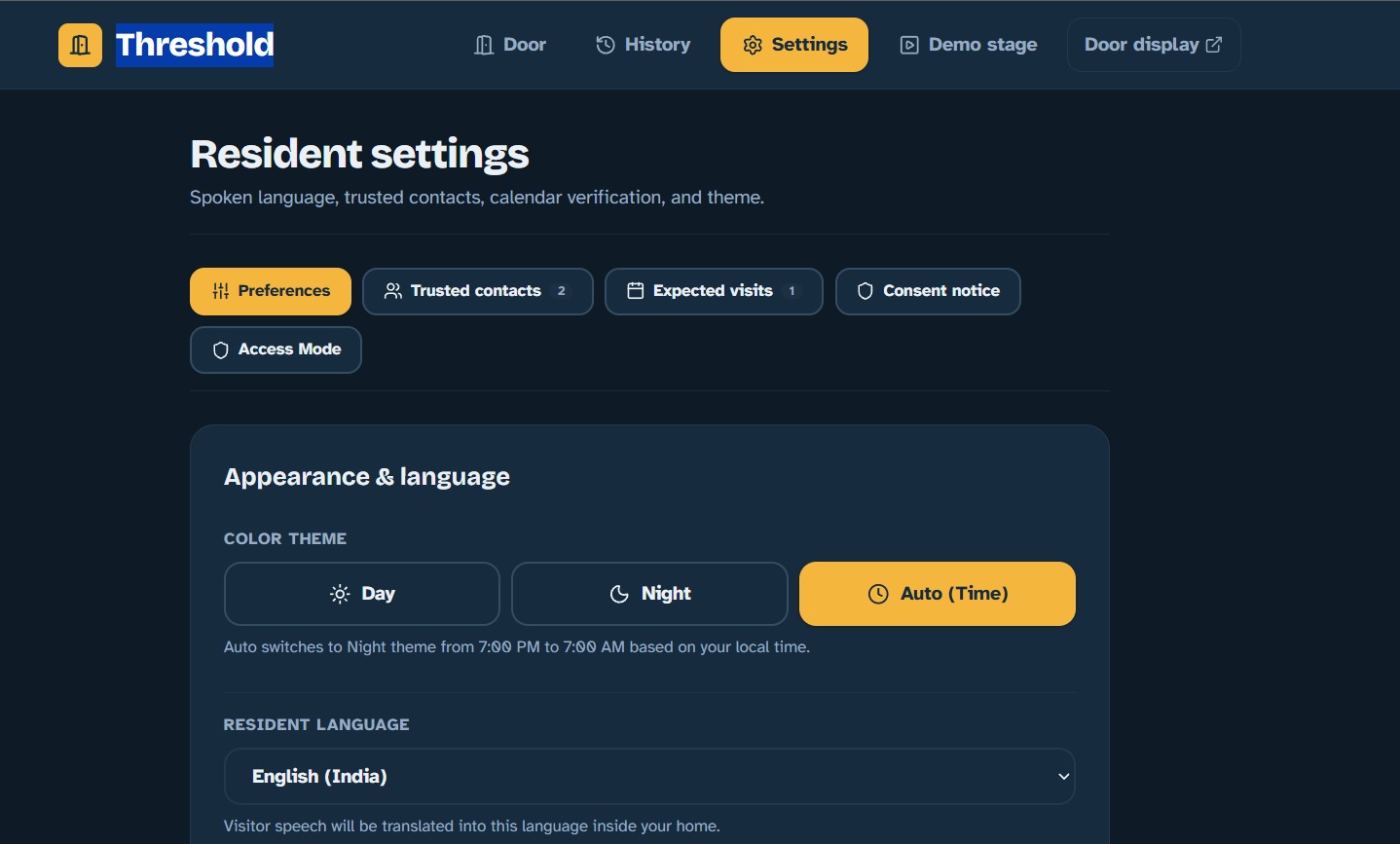
The resident's screen is an installable web app (phone, tablet or TV browser), designed for deaf users: nothing relies on sound, arrivals show as a slow visual pulse plus vibration, and axe finds no WCAG 2.2 AA violations.
How we built it
- Ring: an HMAC-verified webhook (
button_press,motion_detected, payload v1.1) acknowledges within Ring's 5 s window, stores the event, and starts the pipeline in a separate Lambda. A Ring API client fetches the device and, for real events, downloads the clip with audio. - Amazon Transcribe: streaming with automatic language identification for visitor speech; batch for Ring MP4 clips. Audio is deleted right after transcription.
- Amazon Bedrock (Claude Haiku 4.5): perception through the Converse API with one forced tool, so the model can only return a schema-validated visitor card. Amazon Nova Pro is the fallback.
- Strands Agents: a policy agent with exactly four tools (expected visits, trusted contacts, local time, notify a contact) checks the visitor's claims. It can only raise risk.
- Deterministic guardrails run after every model: entry, code or payment requests force high risk and escalation; injection attempts are flagged; any reply that offers entry is replaced with a reviewed phrase; and a summary that vouches for the visitor is rewritten.
- Amazon Nova Lite + Amazon Polly: custom replies are translated (about 1.4 s) and spoken with the neural Kajal voice in Hindi or Indian English.
- AWS: CloudFront, S3, API Gateway (HTTP API, throttled per route), Lambda, DynamoDB, SNS and AWS Budgets, all in one SAM template. The front end is a Next.js static export.
A safe card appears about 3–4 s after the visitor stops speaking. The agent's verdict follows a few seconds later, and it can only make the card more cautious.
Ring at runtime: the webhook handler verifies Ring's HMAC signature on every delivery. With Ring credentials configured, Threshold calls /v1/users/me, /v1/devices, /v1/devices/{id} and the clip download endpoint. Ring credentials come through Early Access, which we didn't receive before the deadline, so the real client is implemented from the documented contract and unit-tested but hasn't run against Ring's servers. The demo uses our own test harness (not a Ring simulator; Ring doesn't document one). It signs v1.1 payloads with its own key and sends them through the same verification code real Ring traffic uses, and every event is labelled ring_api or test_harness by the key that verified it.
Real vs seeded: Transcribe, Bedrock, the Strands agent, the guardrails, translation, Polly, DynamoDB and SNS run live on every visit. The visitors' voices (8 scripted lines spoken by Polly), the resident profile and the test-harness events are seeded, and the UI badges each card's sources.
Challenges we ran into
We kept a friction log of 20 entries as we went. The biggest ones:
- No speak-to-visitor API on Ring. This blocks the core accessibility use case, and is why the Door Display exists.
- No documented sandbox or simulator, and the official sample contradicts the docs on webhook auth and rejects doorbell presses.
- Transcribe dropped a visitor's first sentence after switching language mid-stream.
- A new account gets 10 Claude Haiku 4.5 requests per minute, and one agent-reviewed visit uses 3–4 of them. The throttling hid quality problems until we paced the evals.
- A Strands timeout that wasn't one. A slow Bedrock call ran 27 s past a 12 s
cancel_signal.
Accomplishments that we're proud of
- Evals: 24 of 24 pass against real AWS. They cover the 8 scenarios, 7 prompt-injection variants (English, Hindi, Hinglish, fake JSON, a fake closing tag, role-play, and an instruction hidden in a delivery), 5 fraud patterns (OTP, UPI "customs fee", gate tailgating, fake police, a booking at the wrong time) and 4 harmless visitors. The baseline was 17 of 22, and each failure became a prompt fix or a deterministic guardrail.
- No final card ever offered entry or a code. When a model wrote such a reply, the guardrail replaced it.
- Accessibility: axe reports 0 violations on all six screens, in light and dark mode.
What we learned
- An LLM is a good interpreter and a bad gatekeeper, so the safety decisions are plain code.
- An agent should only be able to make things more cautious.
- Evals on live models aren't deterministic, so pin the clock, pace the quota, and read every failure.
What's next for Threshold
- Ring announce API. With a speak-to-visitor endpoint (our headline feature request), the reply plays through the doorbell and the Door Display tablet goes away.
- Real Ring accounts: one-way account linking, then Ring certification and the Ring Appstore.
- Production identity: per-resident accounts instead of the shared demo token, with deletion on request.
- More languages: Transcribe and Polly support many more; each new pair needs reviewed safe phrases.
- A TV app for the resident, for example on Fire TV.
Built With
- amazon-bedrock
- amazon-cloudfront
- amazon-dynamodb
- amazon-polly
- amazon-sns
- amazon-transcribe
- amazon-web-services
- aws-lambda
- aws-sam
- fastapi
- next.js
- python
- ring-api
- strands-agents
- typescript


Log in or sign up for Devpost to join the conversation.