-
-
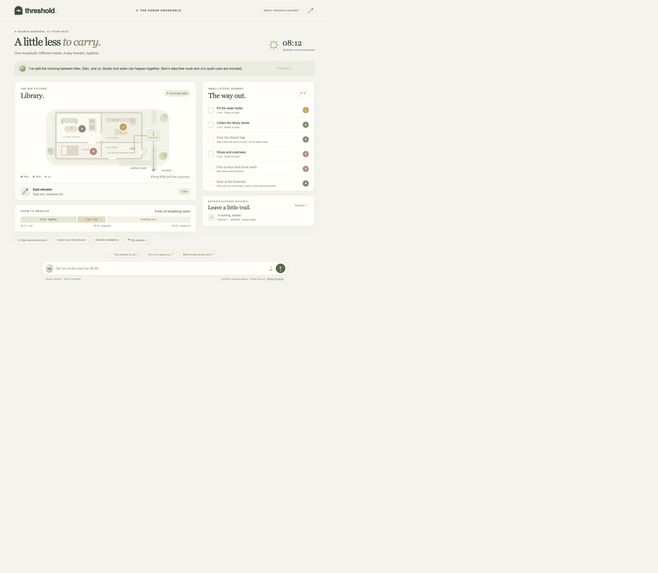
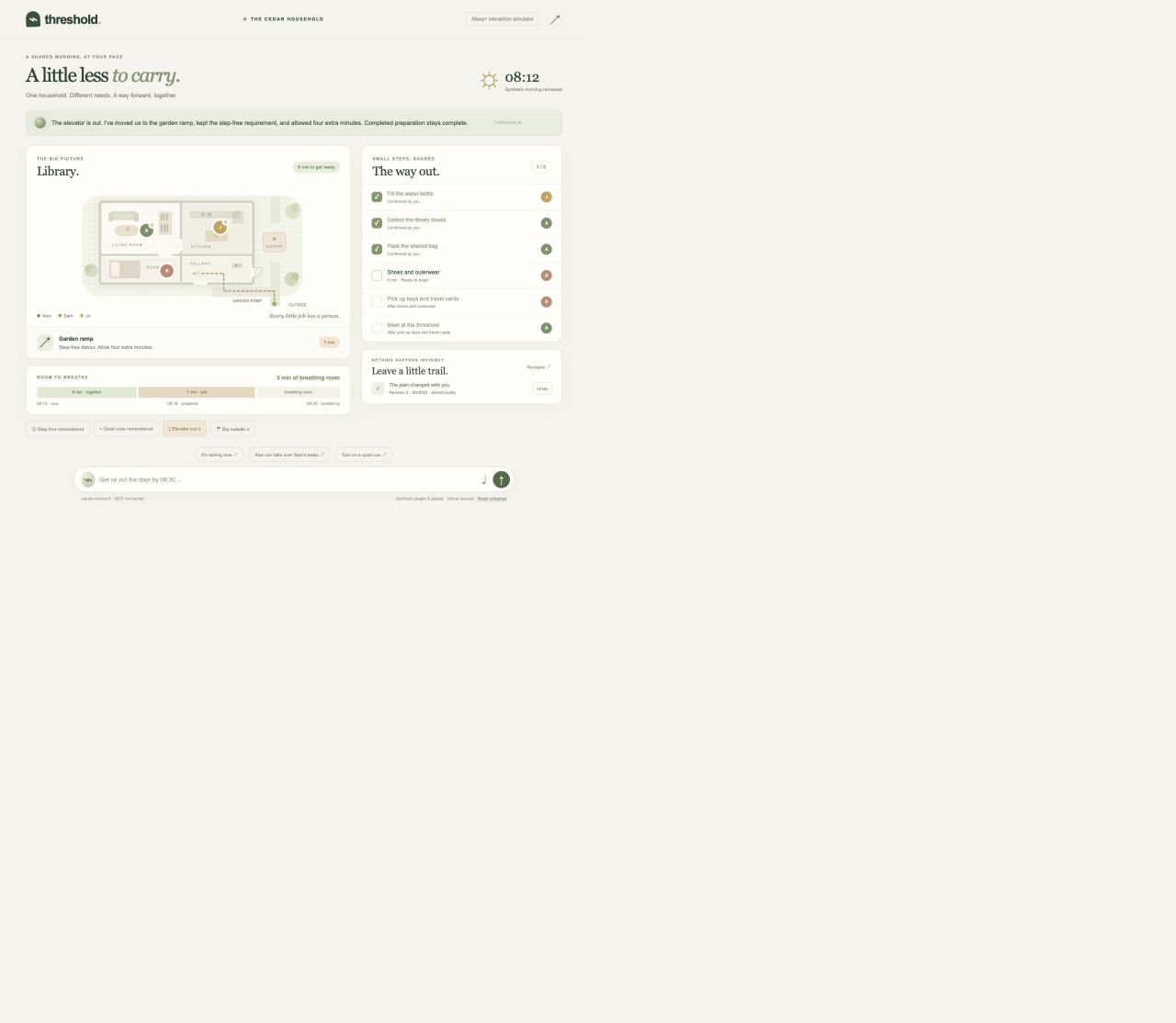
Actual household simulator: accessibility preferences, task ownership and dependencies remain visible as the plan changes.
-
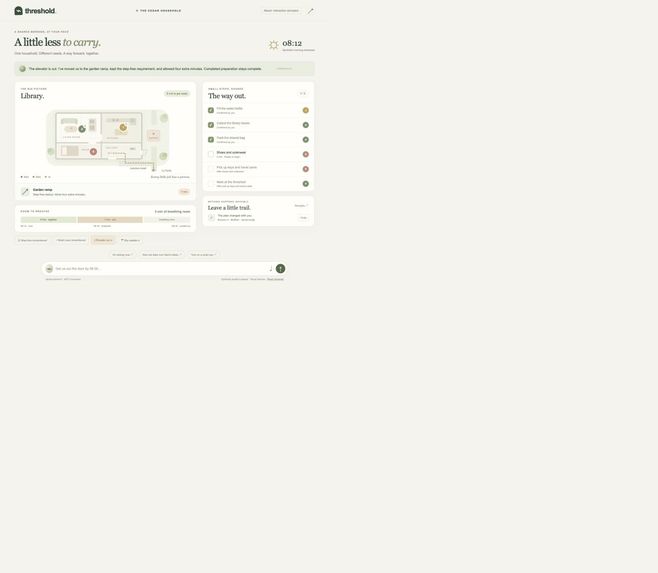
A shared departure plan for Alex, Sam and Jo; synthetic household, illustrative clock and virtual devices.
-
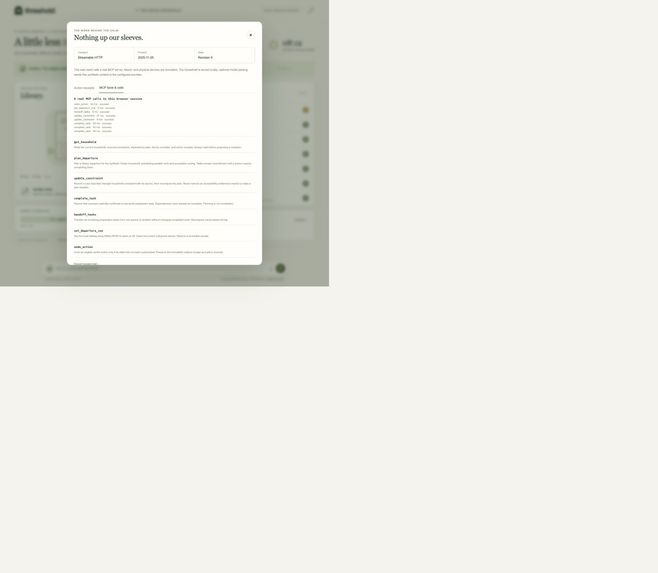
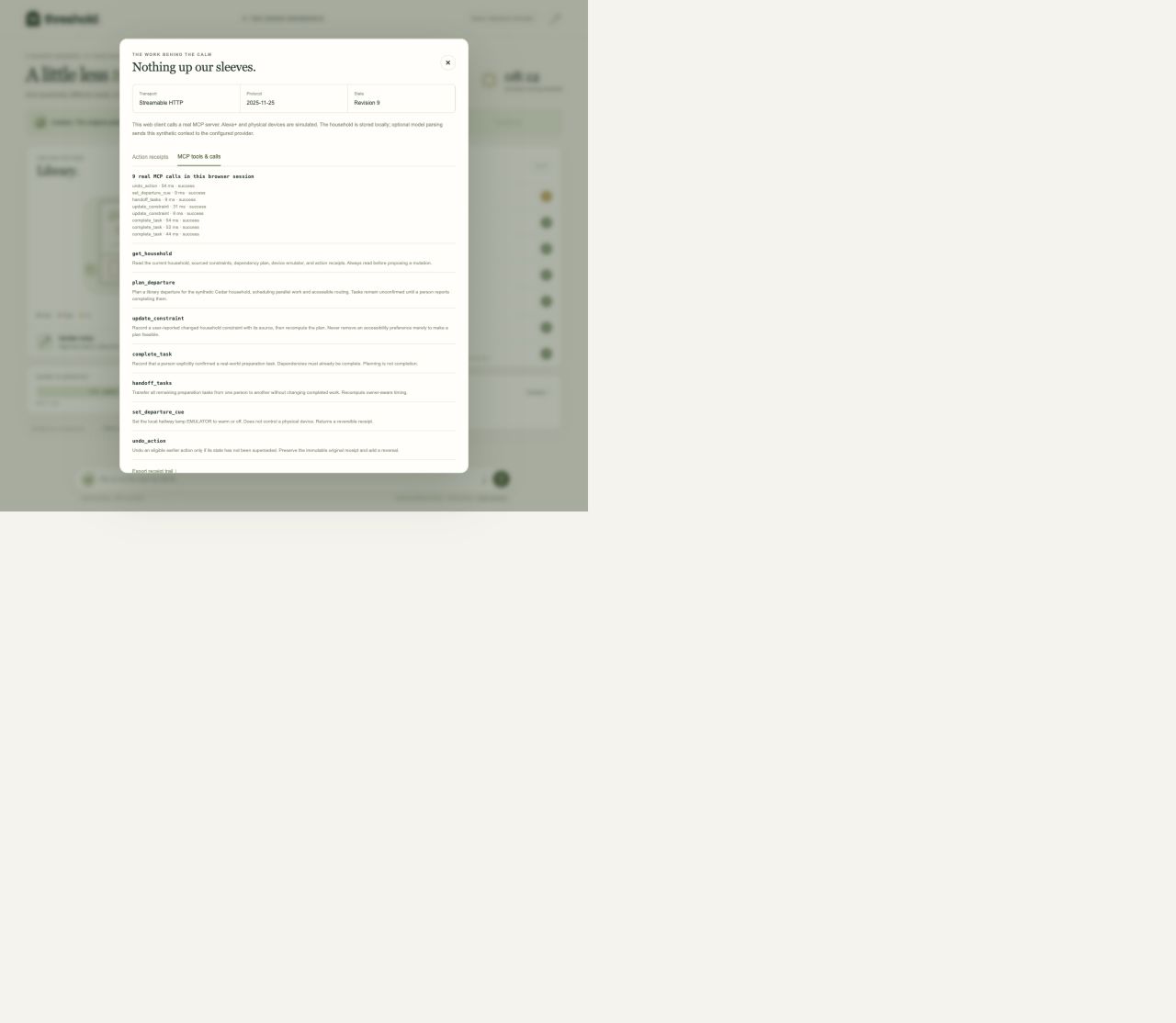
Actual MCP integration and tool receipts: a real server behind the explicitly simulated Alexa+ experience.
Inspiration
The hardest part of a shared routine is often invisible: one person remembers who needs what, which step depends on another, and what changed since yesterday. Repeating that context during a handoff adds more work. A household assistant should carry the context forward and leave the family in control.
What it does
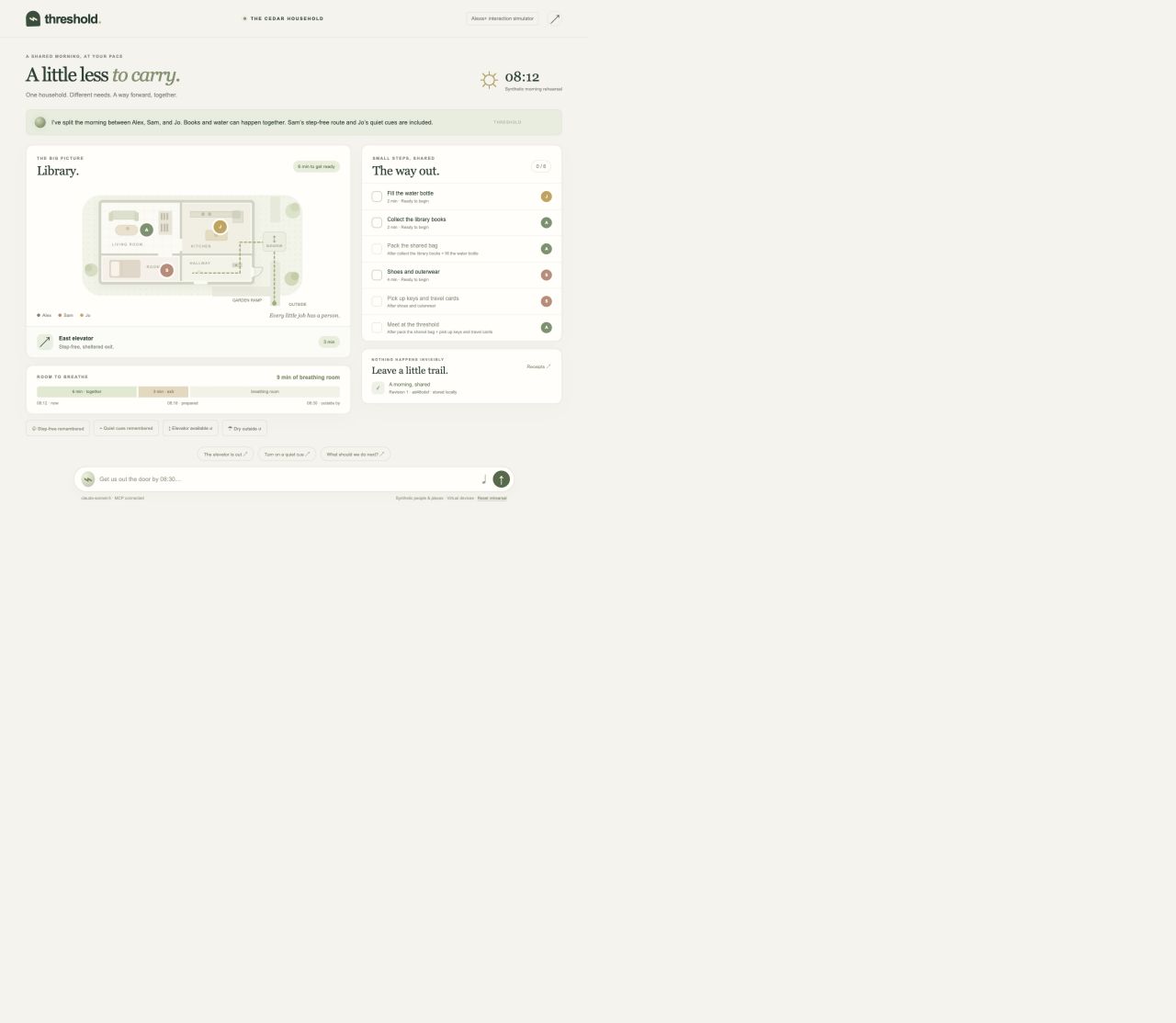
Threshold creates a dependency-aware library-departure plan for a synthetic household. Alex, Sam, and Jo have individual tasks, a step-free route, and a quiet cue preference. When the elevator fails, Threshold selects the garden ramp without dropping the accessibility requirement. When rain arrives, it adds a cover task before departure. A handoff reassigns only unfinished work and recalculates the schedule around each person's availability. People confirm completed physical tasks. A virtual hallway lamp can be set and undone, with a receipt for both actions.
How we built it
The original web interface uses a calm illustrated household map, a shared task list, and a changing preparation timeline. Every action goes through a real MCP server built with the official TypeScript SDK, using Streamable HTTP and tested protocol 2025-11-25. Household state persists locally. Zod validates schemas; expected revisions reject stale actions; idempotency keys prevent duplicate effects; hash-linked receipts preserve application history. An optional Anthropic tool-selection adapter understands natural language. A visibly labeled local parser supports a free, reproducible demo without credentials.
Accomplishments and checks
Thirteen automated tests cover scheduling, dependencies, accessible-route failure, new prerequisites, safe undo, retries, persistence, completion-report rejection, Origin/Host checks, and actual official-client MCP interoperability. The filmed browser demonstration completed five real optional model requests and nine actual MCP tool calls, including elevator outage, rain, caregiver handoff, a virtual visual cue and undo. These are scoped integration checks, not a claim of real-world safety or broad language accuracy.
What is simulated
This entry uses the permitted Alexa+ web-simulation path and also supplies a working MCP server. It is not connected to a live Alexa account. The household, building status, weather, and lamp are synthetic. There is one library departure template. The clock and durations are illustrative; the target time is outside the building, not arrival at a destination. No physical device or safety system is controlled.
What's next
Test the interaction with families and caregivers, add more user-authored routine templates, and connect a consented physical visual-cue device. Validate host authorization and multi-household isolation before production deployment. Measure whether handoffs actually reduce repeated explanations and missed prerequisites.
Built with and AI disclosure
TypeScript, JavaScript, HTML, CSS, SVG, Node.js, Express, Zod, the official MCP TypeScript SDK, Anthropic Messages API with Claude Sonnet 5 (optional tool selection), Git and GitHub. OpenAI Codex assisted design, implementation, tests and documentation. Python/Pillow and FFmpeg produced the demonstration; ElevenLabs stock synthetic narration is used in the video. No real family data or live physical device is used.
Try and verify
Source and local setup · 106-second demonstration with English captions · Observed product feedback. Thirteen local tests pass. Hosted CI is not verified.
Built With
- anthropic
- css
- elevenlabs
- express.js
- ffmpeg
- html
- javascript
- mcp
- node.js
- openai-codex
- typescript
- zod

Log in or sign up for Devpost to join the conversation.