Inspiration
We started with a feeling we couldn't quite name.
Both of us use AI constantly! For research, writing, analysis, problem-solving... you name it. And somewhere along the way, we noticed something uncomfortable: we couldn't always tell which ideas were still ours.
Then we found a 27-year-old philosophy paper that had already asked the question. Clark & Chalmers (1998) wrote: "Where does the mind stop and the rest of the world begin?" We couldn't stop thinking about what that meant in 2026, when the "rest of the world" answers back in fluent, confident prose.
Then we found the MIT Media Lab study. Kosmyna et al. (2025) put electrodes on people's heads and measured what four months of AI-assisted writing does to brain connectivity. LLM users showed the weakest neural networks, the lowest linguistic diversity, and (the line that haunted us!!!) many could not accurately quote their own essays.
Two papers. Twenty-seven years apart. Pointing at the same gap. Nobody had built the tool that fills it. So we set out a challenge to do it!
What it does
THRESHOLD introduces a new sense: Cognitive Proprioception: the continuous awareness of where your thinking is.
Just as physical proprioception tells your body where it is in space without looking, cognitive proprioception tells your mind which thoughts are yours — without having to stop and audit every prompt.
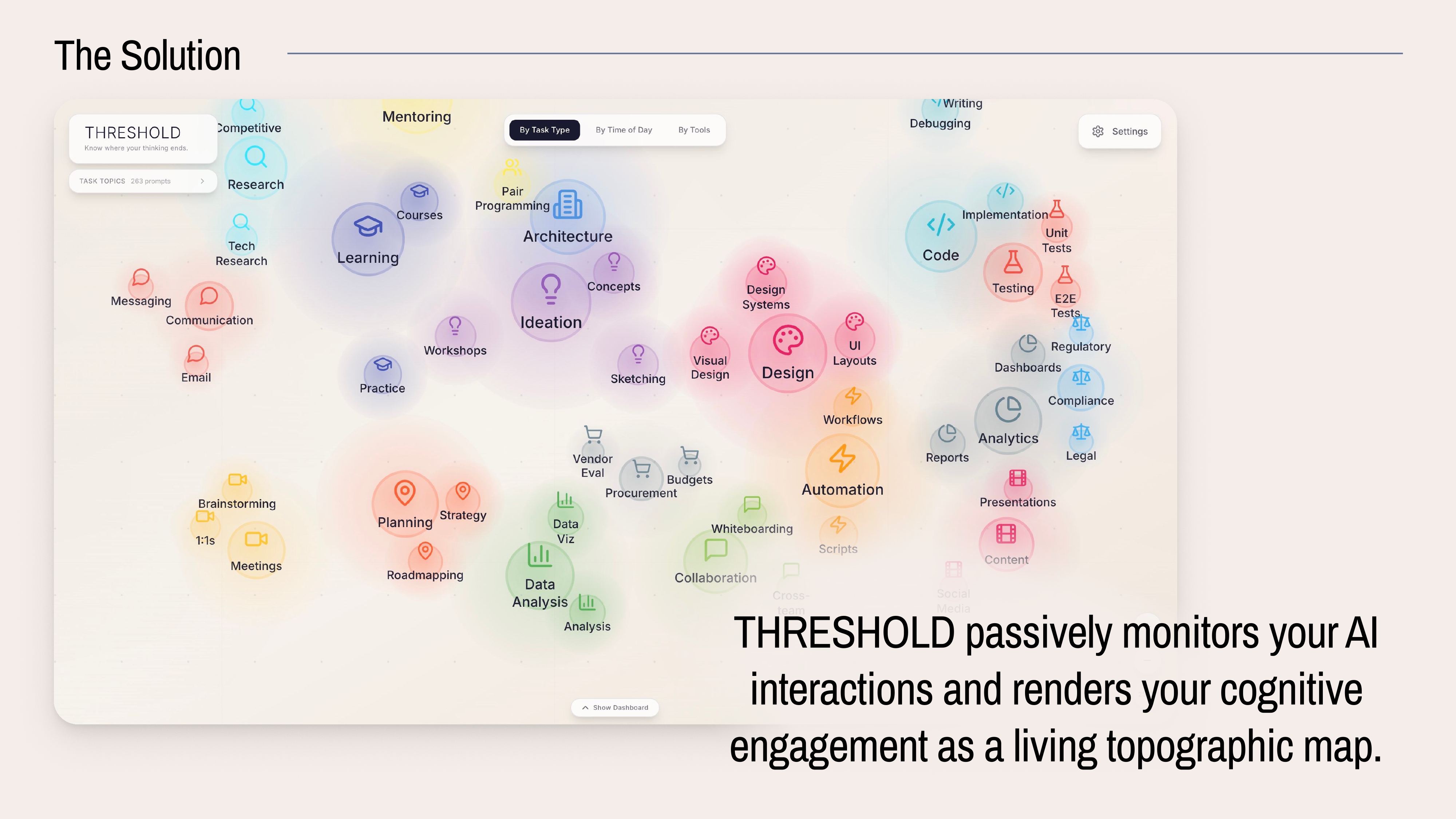
THRESHOLD passively monitors your AI interactions and renders your cognitive engagement as a living topographic map. Every zone of your work (Writing, Design, Analysis, Ideation, Code, and more) is tracked across three states:
- Engaged >> high-friction, iterative thinking. You are steering.
- Coasted >> low-friction delegation. You accepted without deep intervention.
- Offboarded >> complete handoff. The zone has gone quiet.
Zones where you think deeply grow. Zones you delegate shrink. Your intellectual landscape, made visible for the first time.
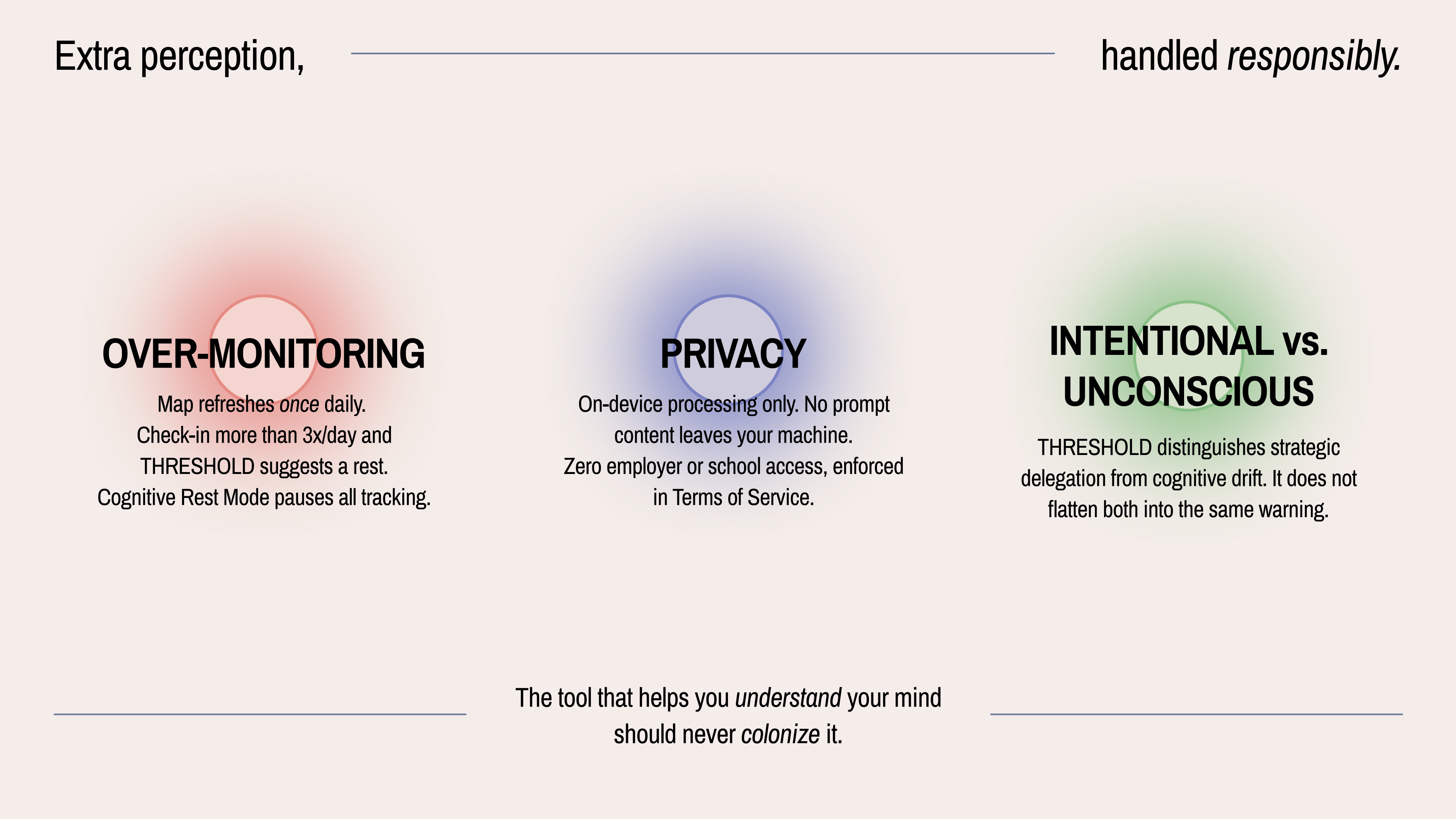
One insight surfaces per week. No streaks. No scores. No shame. THRESHOLD is an observatory, not a judge.
How we built it
We built THRESHOLD over a weekend at FigBuild 2026, starting from the research and working outward into design.
The academic foundation came first. We mapped four converging research streams (MIT Media Lab's EEG study, Clark & Chalmers' Extended Mind thesis, Synthese's Extracted Mind counter-hypothesis, and MDPI's Cognitive Atrophy Paradox framework) and used them to define the product's core vocabulary and measurement logic.
The interface was built entirely in Figma, with the cognitive zone map as the central design challenge. We used Figma Make to build interactive prototype flows covering the full user journey: zone exploration, the weekly insight card, and the drift detection alert system. The visual language is clean and not dauting as much as this topic can be bubble scaling by engagement volume, warm-to-cool color temperature, glassmorphic overlays. It was designed to feel like a scientific instrument rather than a productivity app.
The proprioception analogy drove every design decision. Conscious vs. unconscious proprioception maps directly onto THRESHOLD's macro (weekly) and micro (zone-level) views. The interface reveals what you choose to look at, and it never pushes data at you unsolicited.
Challenges we ran into
The anti-gamification constraint was harder than expected. Every instinct in consumer app design pulls toward streaks, scores, and progress indicators. Building a product that is genuinely non-judgmental is hard!
Built With
- figma
- react


Log in or sign up for Devpost to join the conversation.