-
-
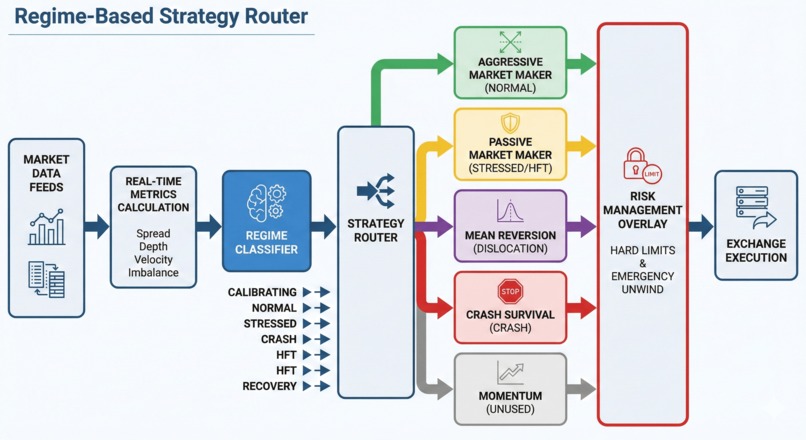
An overview of the Decision Pipeline
Inspiration
We took inspiration from biological adaptability. We wanted to build a system that acts like a seasoned trader: aggressive when conditions are clear, passive when uncertainty rises, and purely defensive when the market breaks.
What it does
Our bot functions as an autonomous Regime-Based Strategy Router that operates on a high-frequency loop:
- Diagnoses: It calculates real-time metrics (velocity, imbalance, spread ratios) to classify the market into one of 6 regimes (e.g.,
NORMAL,STRESSED,CRASH). - Routes: It dynamically switches between specialist agents. It runs an Aggressive Market Maker in calm markets, a Mean Reversion sniper for statistical anomalies, and a Passive strategy during high volatility.
- Survives: In extreme events, a Crash Protocol overrides all logic to aggressively flatten inventory and preserve capital.
How we built it
The system is built in Python with a modular architecture separating signal detection from execution.
- The Brain: The
RegimeClassifieruses compound signal detection (e.g., Spread Ratio > 2.0 + High Velocity) to prevent false positives. - The Math: We implemented Inventory Skew (adjusting quotes by
-0.0002 * inventory) to naturally unwind positions and Z-Score analysis to identify entry/exit points for mean reversion. - The Safety: A global Risk Overlay acts as a final gatekeeper, intercepting every order to enforce hard inventory limits (4,500 shares) regardless of the active strategy.
Challenges we ran into
Signal Noise vs. Lag: Tuning the classifier was difficult. If it was too sensitive, the bot flickered between strategies; too slow, and we reacted to crashes after the damage was done. We solved this by requiring multiple concurrent weak signals to confirm a regime change.
The "Falling Knife": Early versions of our Mean Reversion strategy tried to "buy the dip" during crashes. We fixed this by implementing a strict hierarchy where the CRASH regime overrides all profit-seeking logic.
Accomplishments that we're proud of
The Architecture: We successfully implemented a state machine that switches strategies in sub-second time without dropping orders or losing state.
Zero-Loss Survival: We are most proud of the crash_survival.py module. Watching it kick in during a simulated flash crash to dump inventory—while competitors kept buying—was a definitive validation of our "Survival First" philosophy.
What we learned
Microstructure is King: We learned that order book depth and imbalance are often faster predictors of price movement than the price itself.
Survival > Profit: The biggest lesson was that long-term victory isn't about winning every trade; it's about avoiding the one trade that wipes you out.
What's next for Three Bayesians
ML Integration: We plan to replace hard-coded thresholds with lightweight Machine Learning models to detect market regimes dynamically.

Log in or sign up for Devpost to join the conversation.