
🛡️ ThreatMind AI — Project Report
🌟 Inspiration
Cybersecurity is becoming one of the biggest challenges for organizations worldwide. Every day, security teams receive a huge amount of vulnerability reports, threat alerts, and security data. Manually analyzing these reports requires significant time, expertise, and resources.
The inspiration behind ThreatMind AI came from the need to make cybersecurity analysis faster, smarter, and more accessible.
We wanted to build a platform where Artificial Intelligence could assist security analysts by automatically understanding threats, identifying risks, and providing actionable recommendations instead of relying completely on manual analysis.
Our goal was to combine the power of AI with cybersecurity intelligence to create a tool that helps people respond to cyber threats more efficiently.
💡 What It Does
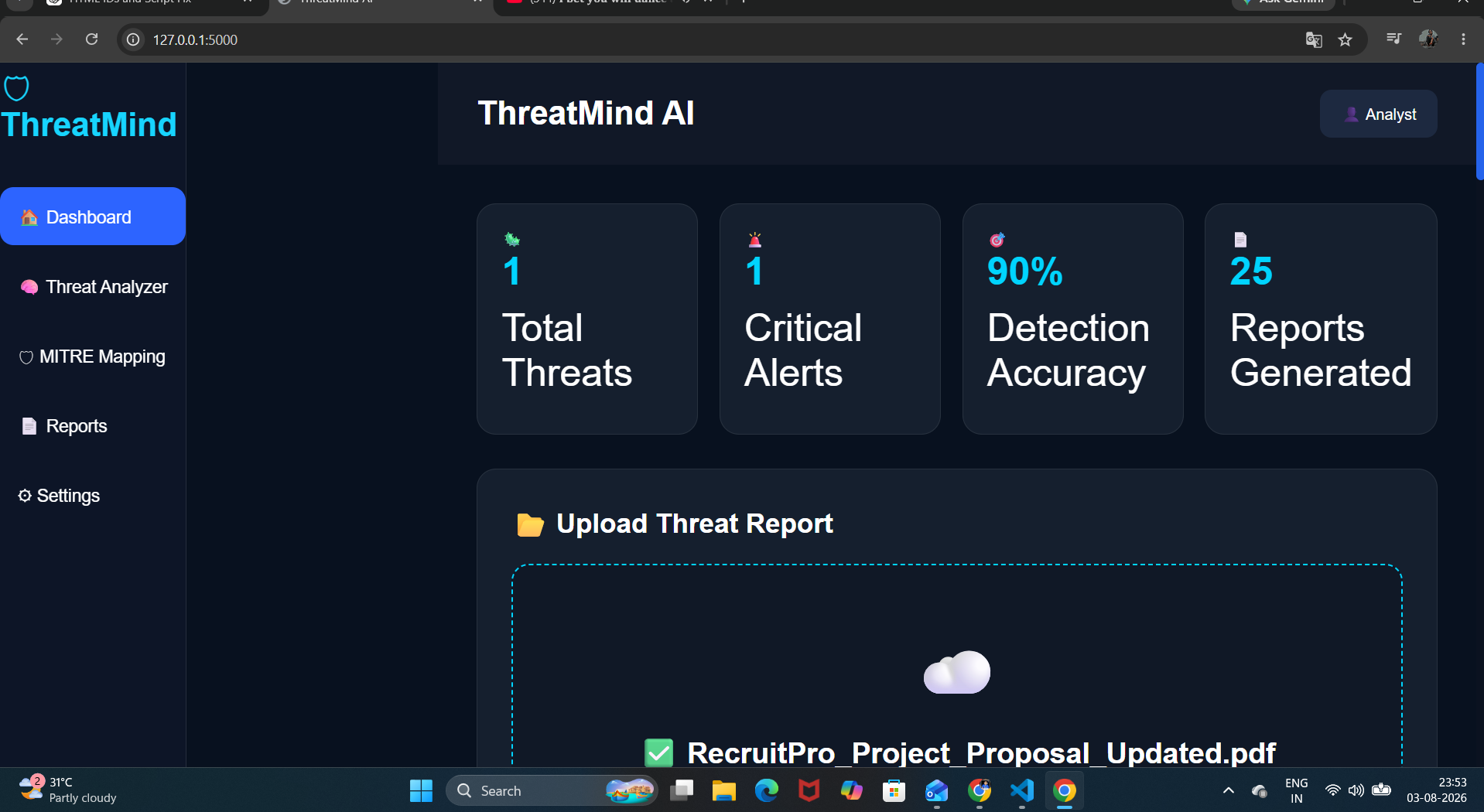
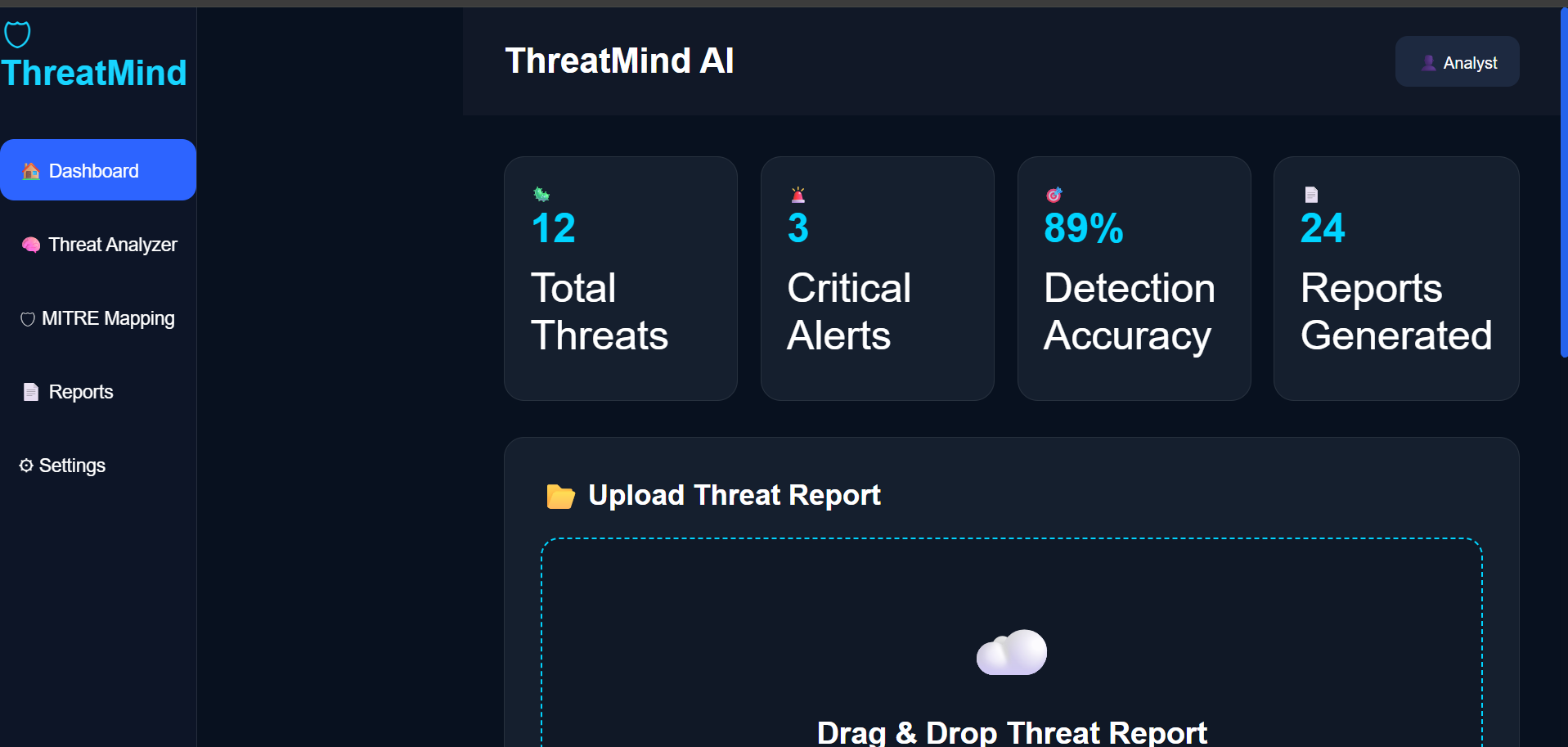
ThreatMind AI is an AI-powered cybersecurity threat analysis platform that helps security teams analyze and understand cyber threats.
The platform allows users to upload security reports in different formats including:
- CSV
- TXT
- LOG files
After uploading a report, ThreatMind AI:
- Extracts important threat information
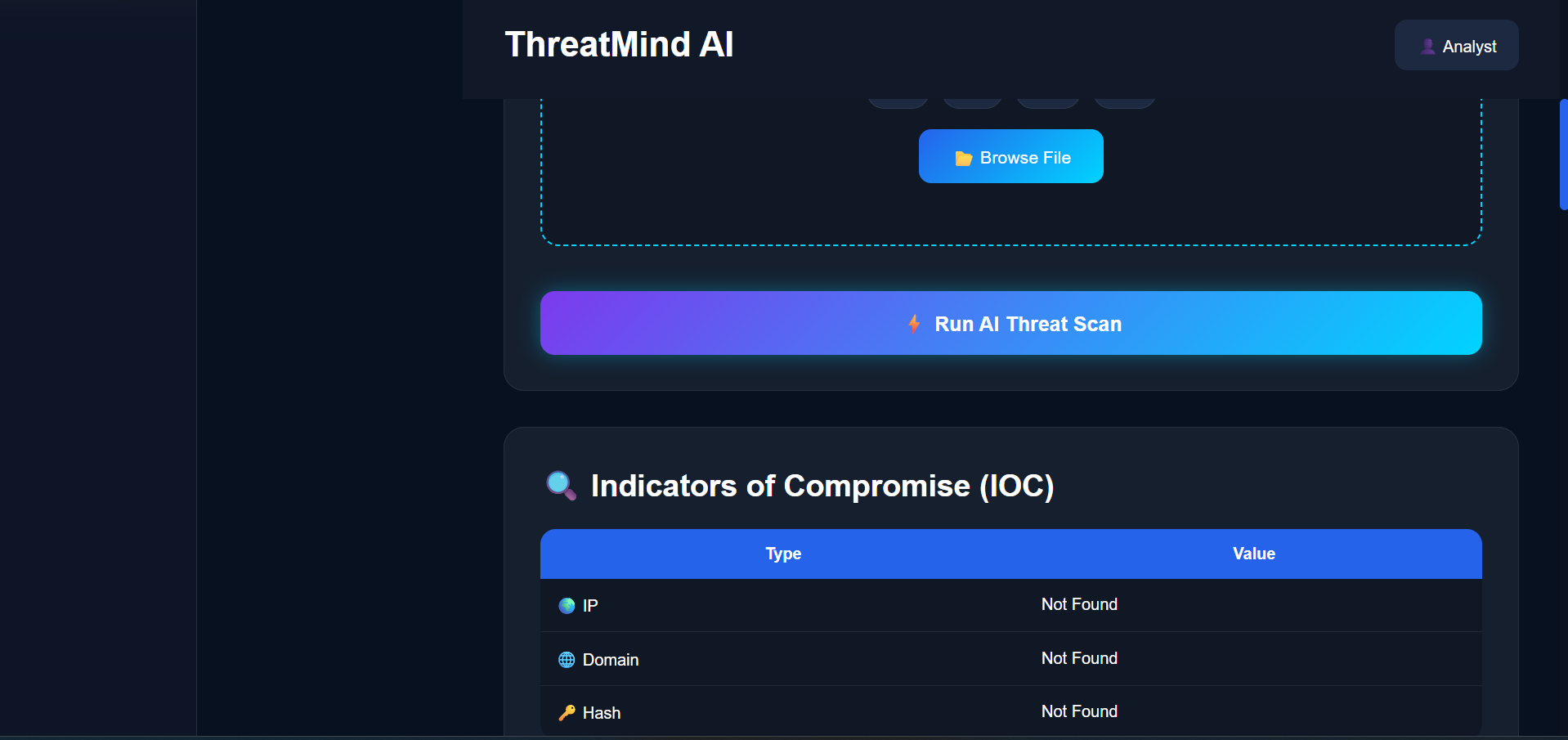
- Identifies vulnerabilities and Indicators of Compromise (IoCs)
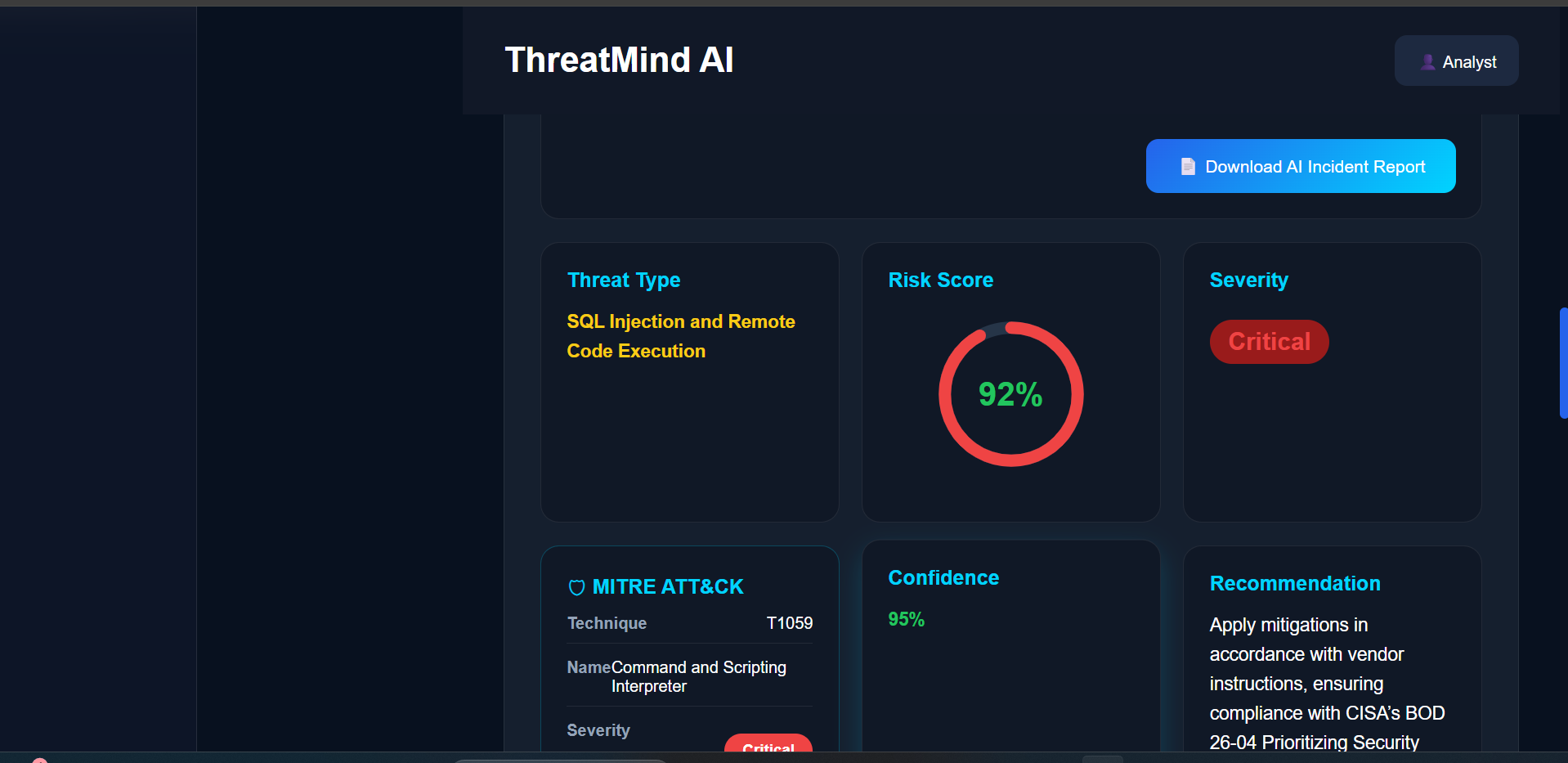
- Classifies threat severity
- Calculates risk scores
- Maps threats to MITRE ATT&CK techniques
- Generates AI-powered executive summaries
- Provides security recommendations
- Creates downloadable PDF incident reports
The platform also includes:
- 📊 Security dashboard
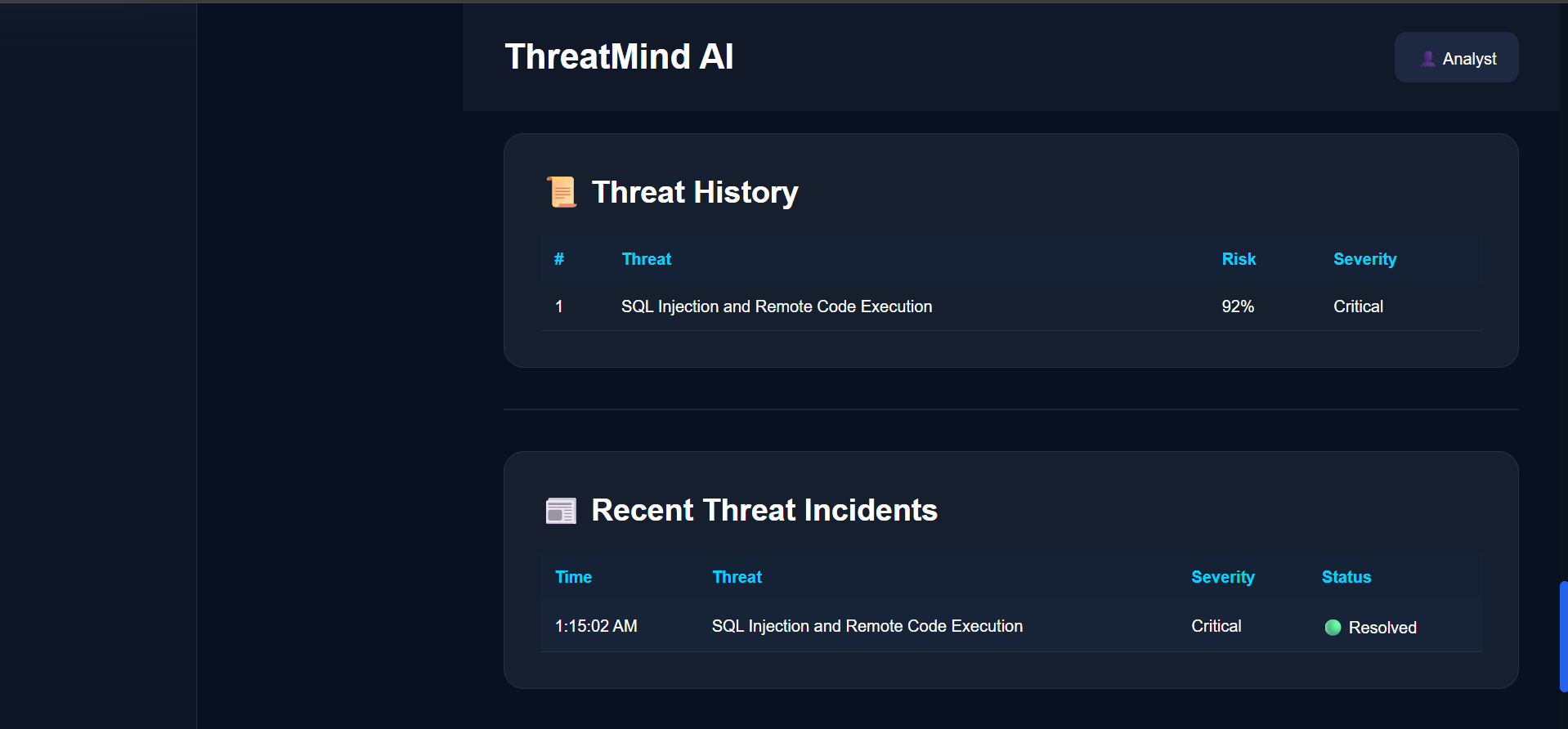
- 📜 Threat history tracking
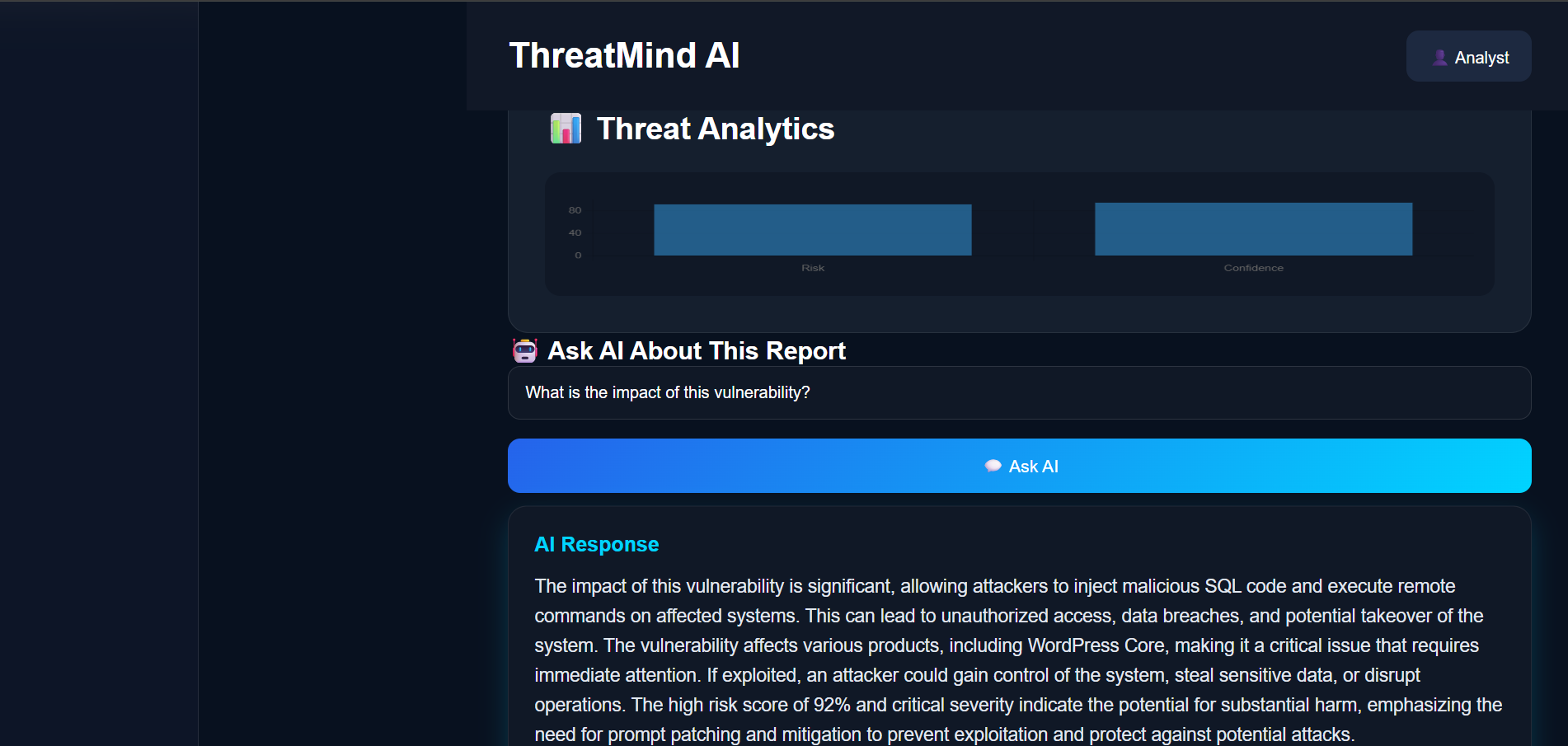
- 💬 AI cybersecurity assistant
- 📈 Threat analytics
By using real-world cybersecurity data such as the CISA Known Exploited Vulnerabilities (KEV) catalog, ThreatMind AI provides practical threat intelligence analysis.
🛠️ How We Built It
ThreatMind AI was built by combining Artificial Intelligence, cybersecurity frameworks, and full-stack development.
Backend Development
We used:
- Python for core logic
- Flask framework for backend APIs
- AI APIs for intelligent threat analysis
- PyPDF for document processing
- ReportLab for automated PDF report generation
Frontend Development
The user interface was developed using:
- HTML
- CSS
- JavaScript
A dashboard-based design was created to display:
- Threat statistics
- Risk levels
- Security reports
- Analysis results
Cybersecurity Integration
We integrated cybersecurity concepts including:
- MITRE ATT&CK Framework for attack technique mapping
- CISA KEV dataset for real vulnerability intelligence
The complete workflow:
User Upload → Data Extraction → AI Analysis → Risk Assessment → MITRE Mapping → Security Report Generation
🚧 Challenges We Ran Into & Our Pivot
Building ThreatMind AI came with several challenges.
1. Understanding Cybersecurity Data
Cybersecurity reports contain complex technical information. Converting this raw information into meaningful insights required careful data processing and structured analysis.
Solution: We created a structured analysis flow where AI converts technical data into understandable security insights.
2. AI Response Accuracy
One challenge was ensuring AI-generated responses were useful and relevant for cybersecurity scenarios.
Solution: We improved prompts and structured AI outputs to focus on:
- Threat identification
- Risk explanation
- Security recommendations
3. Managing Multiple File Formats
Threat reports can exist in different formats, making extraction difficult.
Solution: We implemented support for multiple formats including PDF, CSV, TXT, and LOG files.
4. Project Scope Management
Initially, we planned to build a larger cybersecurity monitoring system with multiple advanced integrations.
Due to limited development time, we focused on creating a stable MVP with the most valuable features:
- AI threat analysis
- Risk scoring
- MITRE mapping
- Report generation
This helped us deliver a working and reliable product.
📚 What We Learned
During the development of ThreatMind AI, we learned:
- How AI can solve real-world cybersecurity problems
- Importance of structured data processing
- Building AI-powered applications using APIs
- Integrating cybersecurity frameworks into applications
- Creating user-friendly dashboards
- Managing project scope during hackathons
We also learned that a successful solution is not only about adding more features, but about solving a real problem effectively.
🏆 Accomplishments That We're Proud Of
We are proud of building a complete AI-powered cybersecurity platform within a hackathon environment.
Key achievements:
✅ Built a functional AI threat analysis system ✅ Integrated real-world CISA KEV vulnerability data ✅ Implemented MITRE ATT&CK threat mapping ✅ Created automated security report generation ✅ Developed an interactive cybersecurity dashboard ✅ Added AI assistant functionality ✅ Converted complex security information into actionable insights
ThreatMind AI demonstrates how Artificial Intelligence can support cybersecurity professionals and improve threat response.
🚀 What's Next for ThreatMind AI
Future improvements planned for ThreatMind AI include:
🌍 Live Threat Intelligence
Integration with real-time threat feeds for continuous monitoring.
🔍 Advanced Malware Analysis
Adding deeper analysis capabilities for suspicious files and indicators.
🛰 VirusTotal Integration
Allowing users to analyze suspicious domains, IPs, and files.
🔐 User Authentication & Database
Adding secure accounts, saved reports, and cloud storage.
📊 Advanced SOC Dashboard
Building a Security Operations Center style monitoring dashboard.
🗺 Attack Visualization
Creating visual attack maps to understand threat patterns.
🤖 More Advanced AI Agents
Developing specialized AI cybersecurity agents for investigation, detection, and response.
🛡️ Vision
ThreatMind AI aims to make cybersecurity intelligence faster, smarter, and accessible by combining Artificial Intelligence with modern security practices.
AI + Cybersecurity = Smarter Defense
Built With
- ai
- analysis
- api
- att&ck
- cisa
- css3
- cybersecurity
- data
- flask
- framework
- generative
- github
- html5
- integration
- javascript
- kev
- mitre
- natural-language-processing
- prompt
- python
- threat

Log in or sign up for Devpost to join the conversation.