-
-
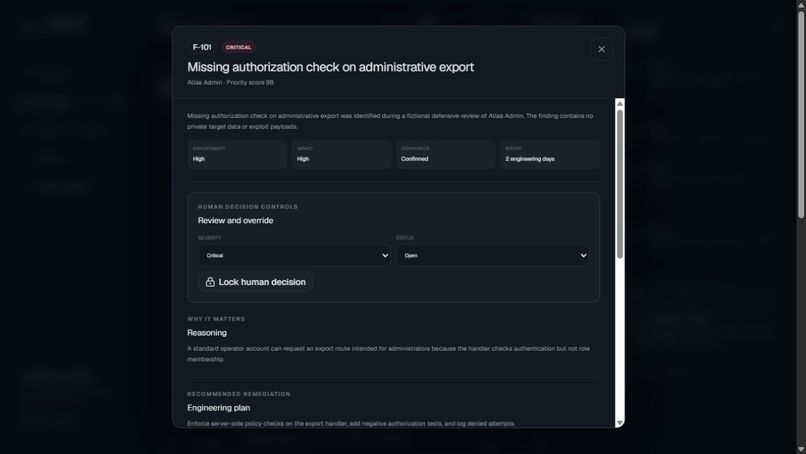
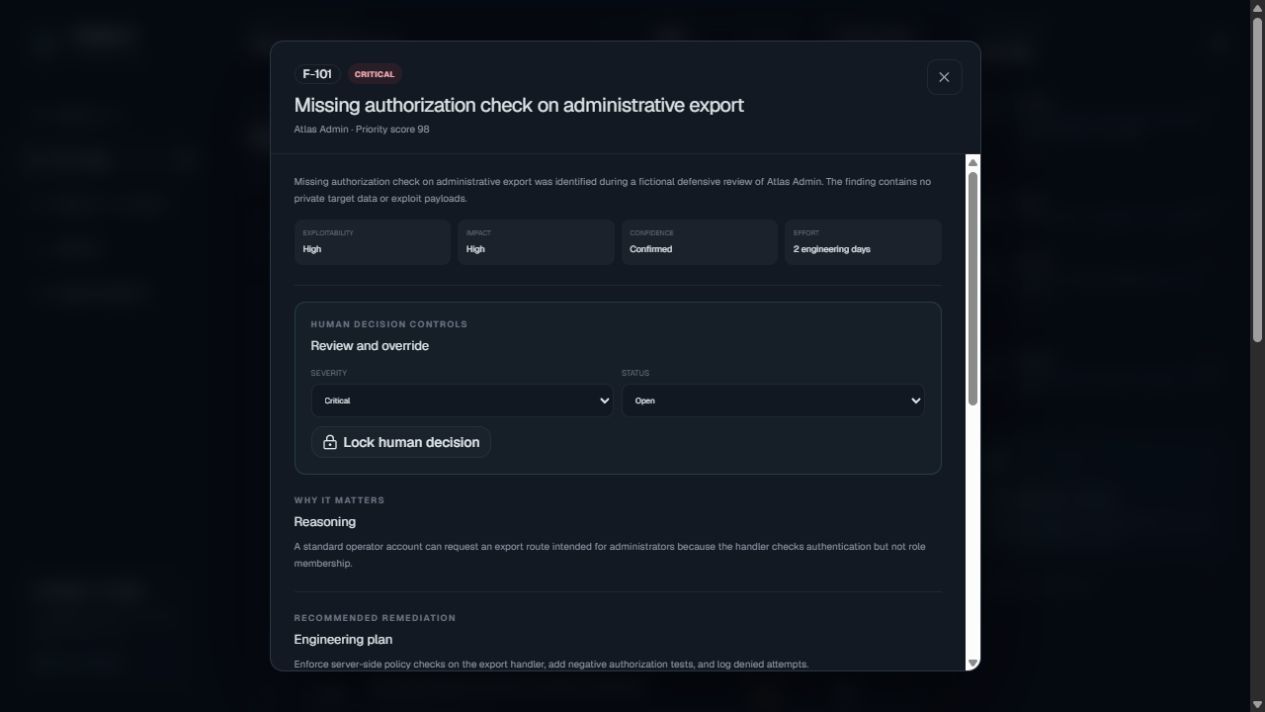
Outpost finding detail with defensive evidence, transparent scoring, notes, and a human lock.
-
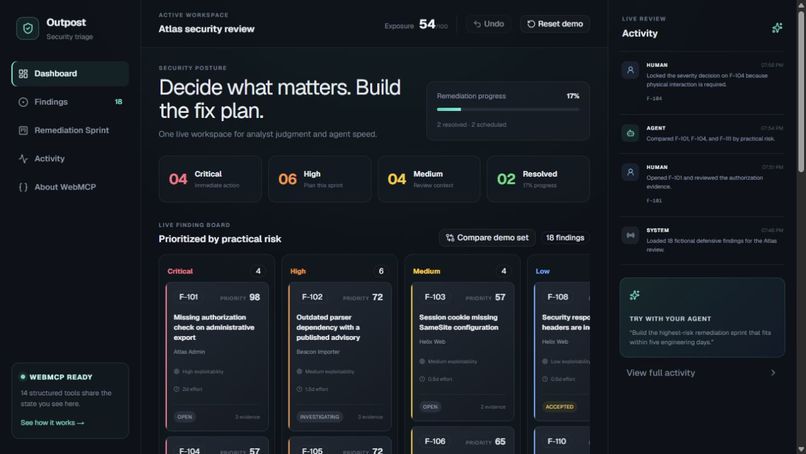
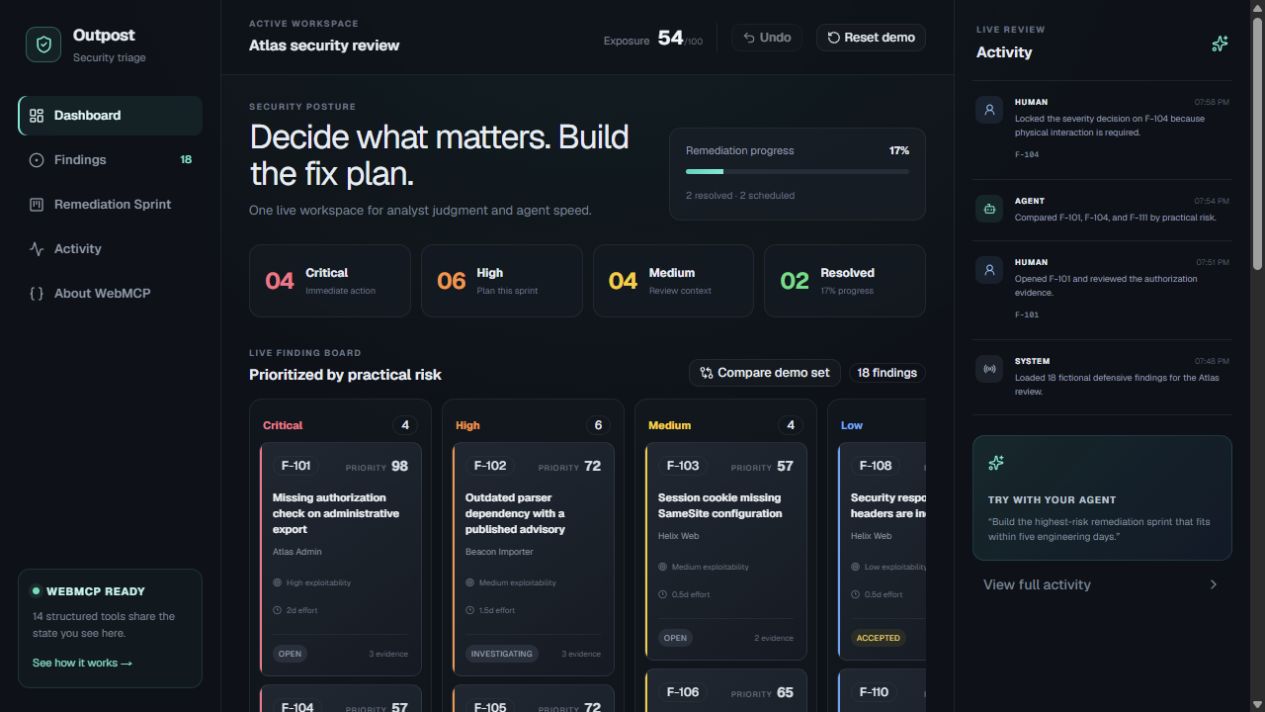
Outpost dashboard with risk summary, finding queue, and shared agent-visible state.
-
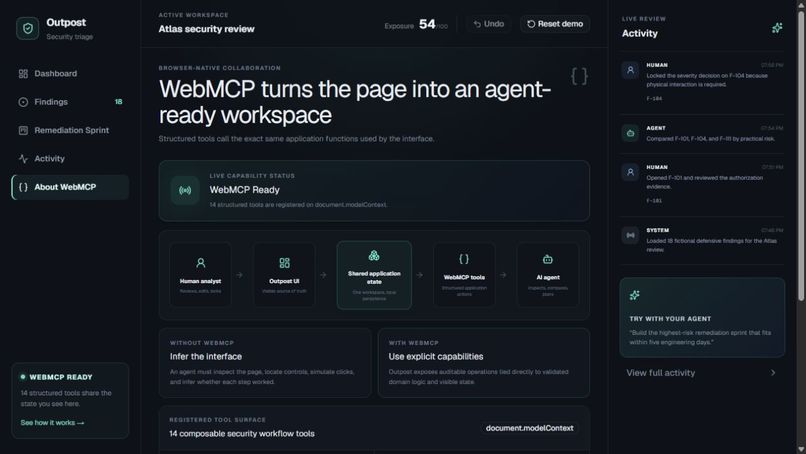
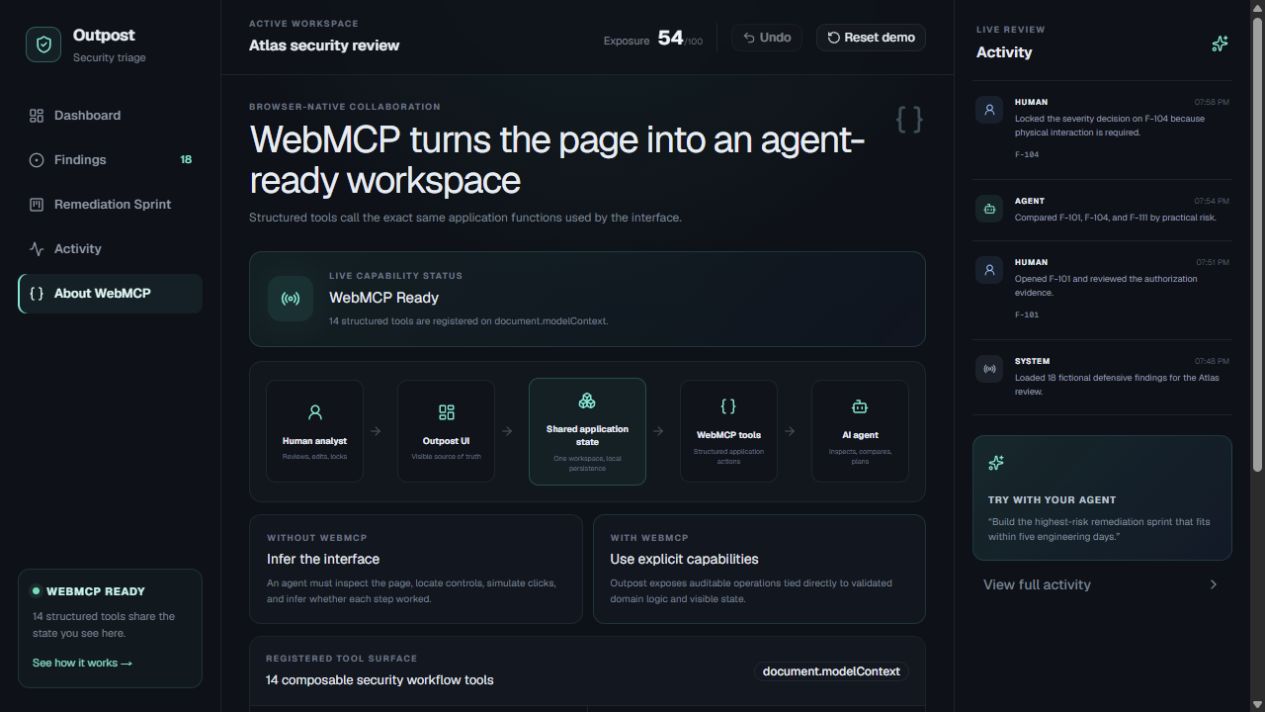
Outpost WebMCP inspector showing fourteen schema-validated browser-native tools.
-
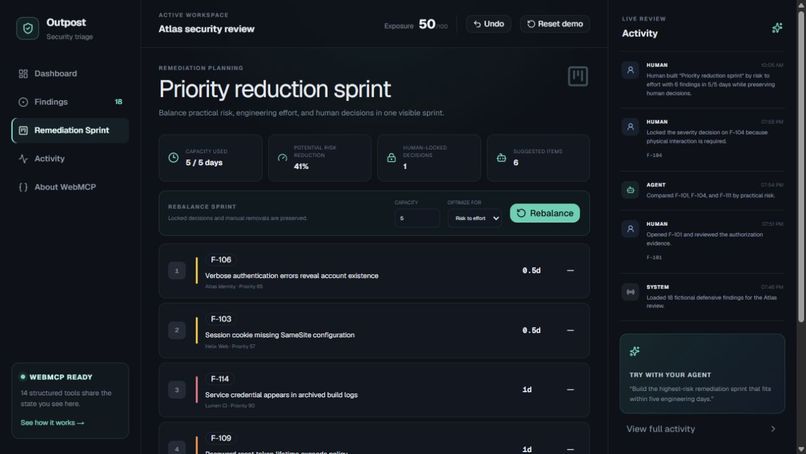
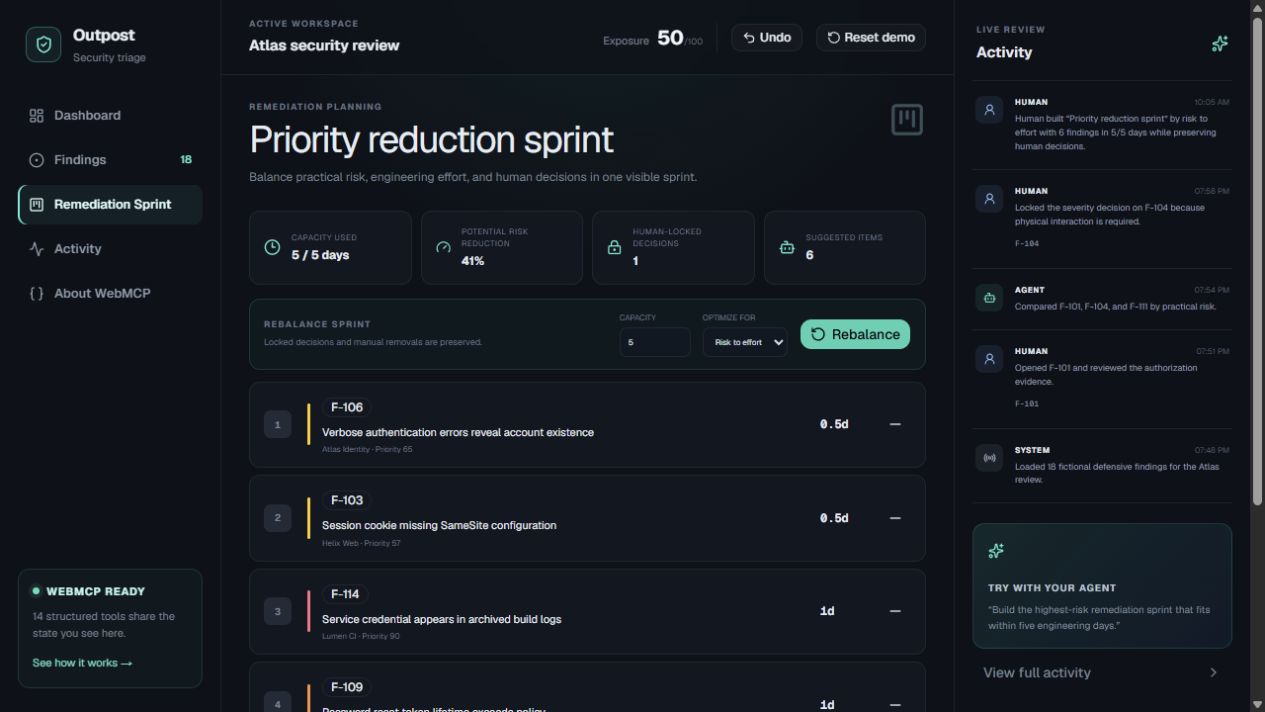
Outpost capacity-aware five-day remediation sprint with risk-to-effort planning.
-
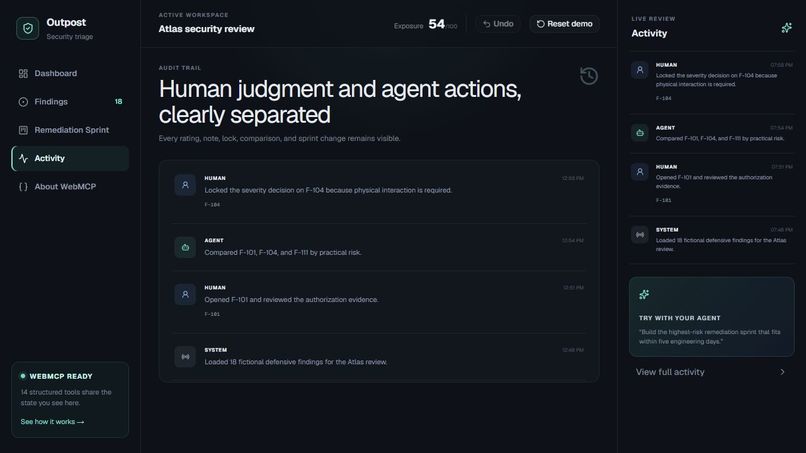
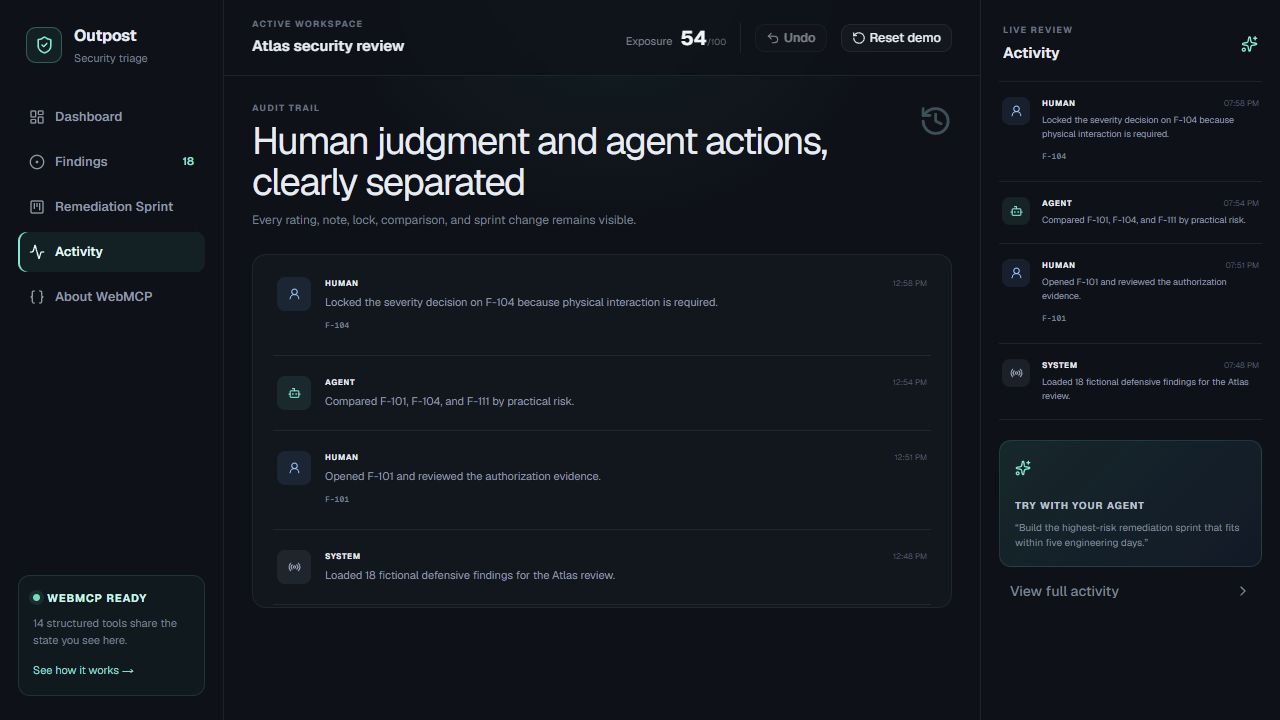
Outpost provenance-rich activity trail separating human, agent, and system actions.
Inspiration
What it does
How we built it
Challenges we ran into
Accomplishments that we're proud of
What we learned
What's next for Outpost
Inspiration
Security review creates a familiar bottleneck: plenty of findings, limited engineering time, and decisions that depend on context no scanner can fully own. Agents can accelerate comparison and planning, but a black-box assistant that silently changes severity or closes work creates a new trust problem. Outpost uses a stronger division of responsibility: agents accelerate structured analysis; analysts retain consequential judgment.
What it does
Outpost is a polished security triage workspace with 18 fictional defensive findings across authorization, identity, sessions, dependencies, browser controls, APIs, configuration, secrets, uploads, rate limiting, and logging.
Analysts can review evidence and remediation guidance, edit severity and status, add notes, lock decisions, compare findings, shape a remediation sprint, remove scope, undo changes, and inspect a provenance-rich activity trail.
Through WebMCP, agents can list and inspect findings, compare and reprioritize a set, calculate the workspace risk summary, add notes, propose workflow changes, build a capacity-aware sprint, rebalance it by risk or effort, and summarize activity. Human controls and agent tools always modify the same visible state.
How we built it
Outpost is a React 19 application built with Vinext, TypeScript, Tailwind CSS, and accessible shadcn primitives, deployed through OpenAI Sites on Cloudflare infrastructure.
The page feature-detects document.modelContext and registers 14 imperative WebMCP tools with JSON Schema inputs. We use read-only and untrusted-content annotations, bound input sizes, enums, strict finding IDs, capacity ranges, and an AbortController registration lifecycle.
The key architectural choice is a shared WorkspaceApi. Both React controls and WebMCP handlers call the same immutable domain operations. A mutation updates browser-persisted state, rerenders the interface, and appends a human, agent, or system provenance event. This avoids the failure mode where a demo tool returns success but changes separate or invisible state.
Our transparent project-specific priority score combines severity, exploitability, impact, and confidence. The full arithmetic is shown to the analyst and is explicitly not CVSS.
How WebMCP improves the experience
Without WebMCP, an agent must inspect the DOM, infer which controls matter, simulate clicks, and guess whether every step succeeded. Outpost exposes explicit operations with typed arguments and meaningful results. A user can ask one intent-level question—such as “build the highest-risk sprint that fits in five days”—and receive a validated plan that is immediately visible and editable.
WebMCP also makes the safety boundary clearer. Read operations are distinguishable from mutations; user-authored content is marked untrusted; and descriptions state exactly when each capability is appropriate.
Human and agent responsibilities
Agents are well suited to search, comparison, calculation, evidence synthesis, and capacity optimization. Humans own business context, rating acceptance, risk acceptance, and sprint scope.
Outpost enforces that split. A human lock blocks automatic severity, status, and priority changes in the shared domain layer. A manual sprint removal becomes a persistent exclusion during later agent rebalancing. Creating a sprint schedules work; it never silently resolves a finding. Every action remains visible and attributable.
Challenges we ran into
The hardest part was not registering tools—it was making browser-native actions honest. We needed one durable state path for humans and agents, deterministic validation, visible effects, provenance, undo, and safeguards that survive every entry point. Capacity planning added another constraint: the optimizer must fit within a hard engineering budget while preserving human inclusions and exclusions.
We also designed the app to degrade gracefully. In a browser without WebMCP, Outpost remains a complete manual workspace and explains how to enable the agent tool surface.
Accomplishments that we're proud of
- 14 real, schema-validated page-side WebMCP tools
- One shared visible state for human controls and agent actions
- Domain-enforced human locks and preserved sprint exclusions
- Transparent score arithmetic and evidence rather than an opaque confidence badge
- Capacity-aware remediation planning that never overstates completion
- 18 varied, fictional, defensive findings with no private target data
- Automated tests for scoring, immutability, provenance, locking, capacity, filters, and rebalancing
- Complete public documentation, MIT license, judge path, and demo prompts
What we learned
WebMCP is most compelling when it exposes real product capabilities instead of mirroring buttons. Good tools are narrow and composable, but the product still needs a strong domain model underneath them. Human control is more credible when encoded as a testable invariant rather than a sentence in the interface.
What's next
The next version would add opt-in encrypted team workspaces, adapters for common defensive scanners, organization-specific policy profiles, pull-request remediation evidence, and signed audit exports. Those integrations would remain subordinate to the same model: structured agent assistance, visible state, and human authority for consequential decisions.
Built With
- cloudflare
- css
- node.js
- openai
- react
- shadcn
- sites
- tailwind
- typescript
- vinext
- vite
- webmcp
- workers

Log in or sign up for Devpost to join the conversation.