-
-
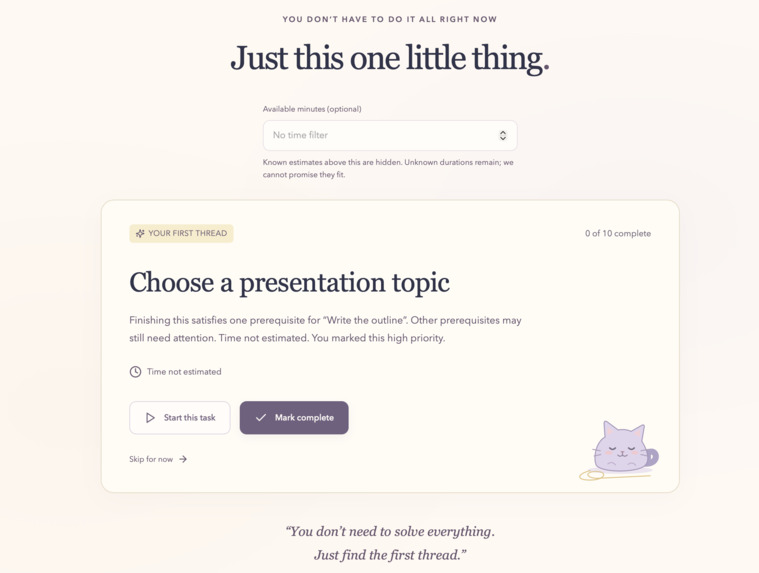
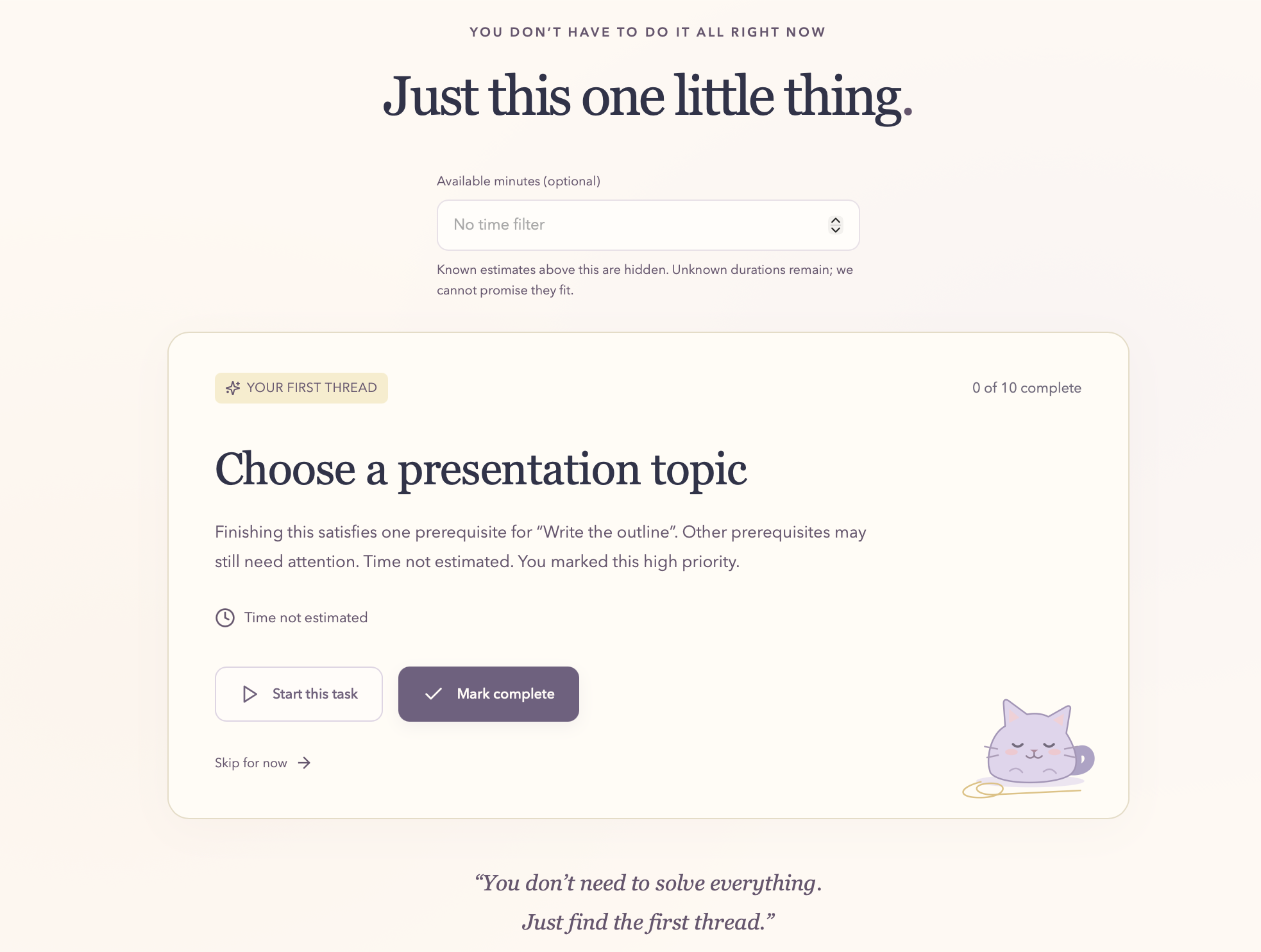
ThreadZero finds your next actionable step and explains why it matters. Less overwhelm, more progress, with Pip!
-
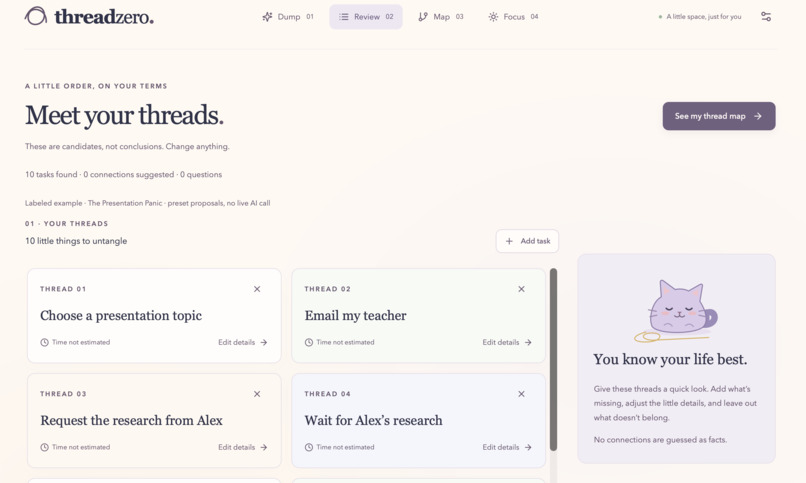
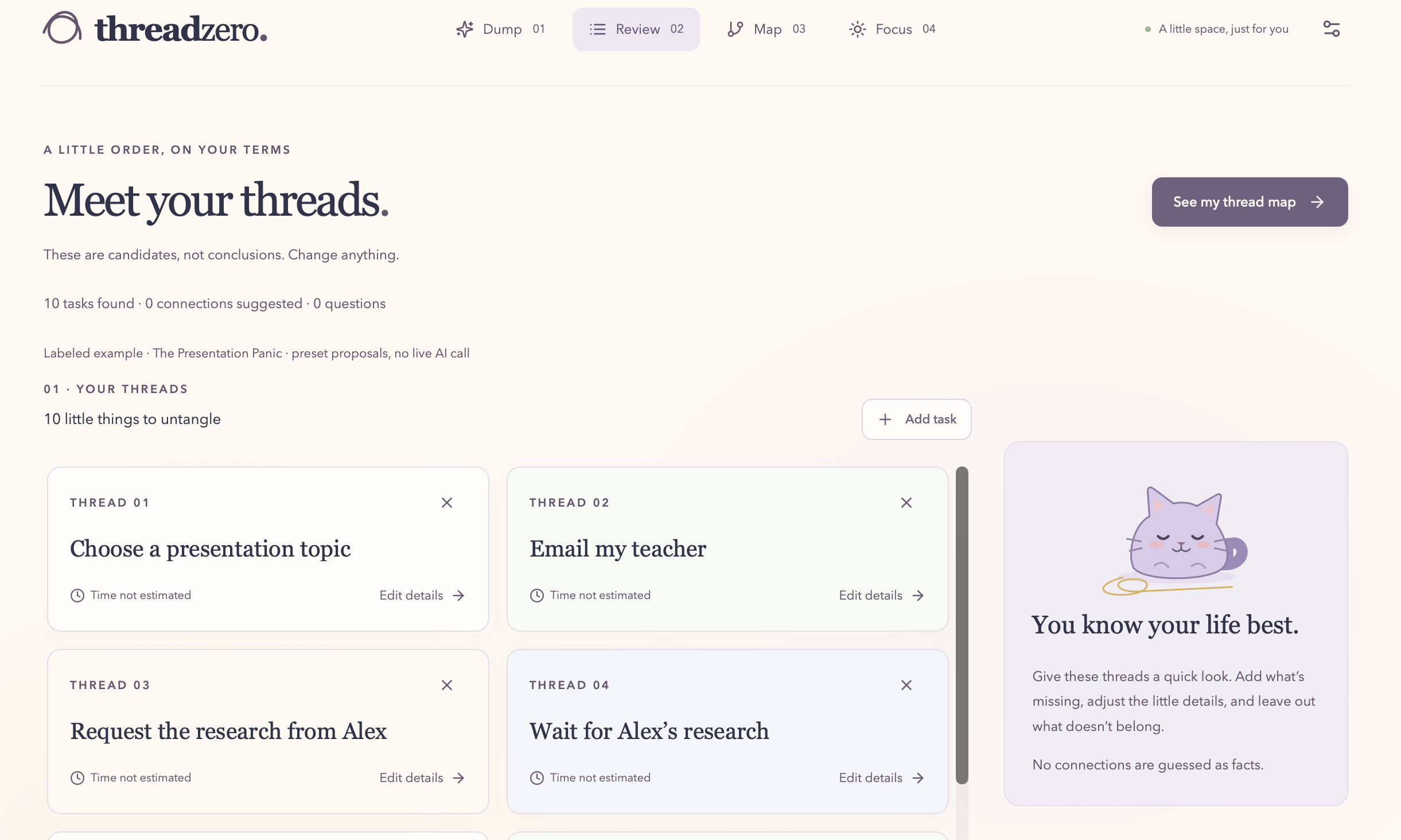
Watch scattered thoughts become organized, editable tasks! Review, refine, and let Pip guide you toward clarity.
-
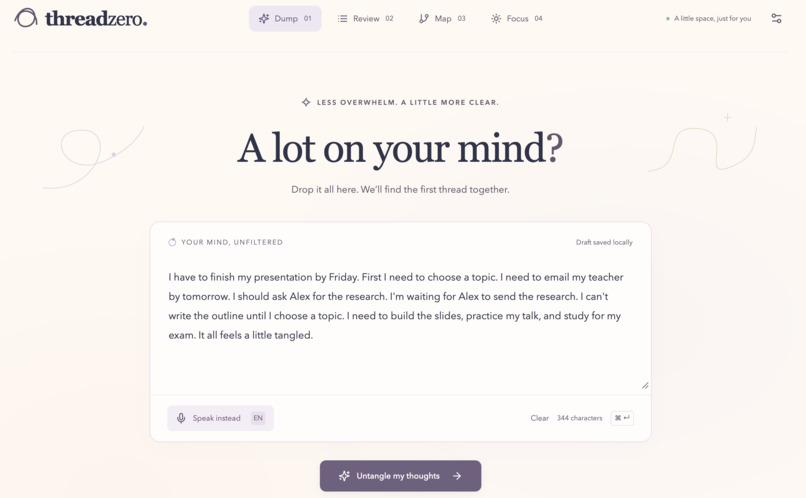
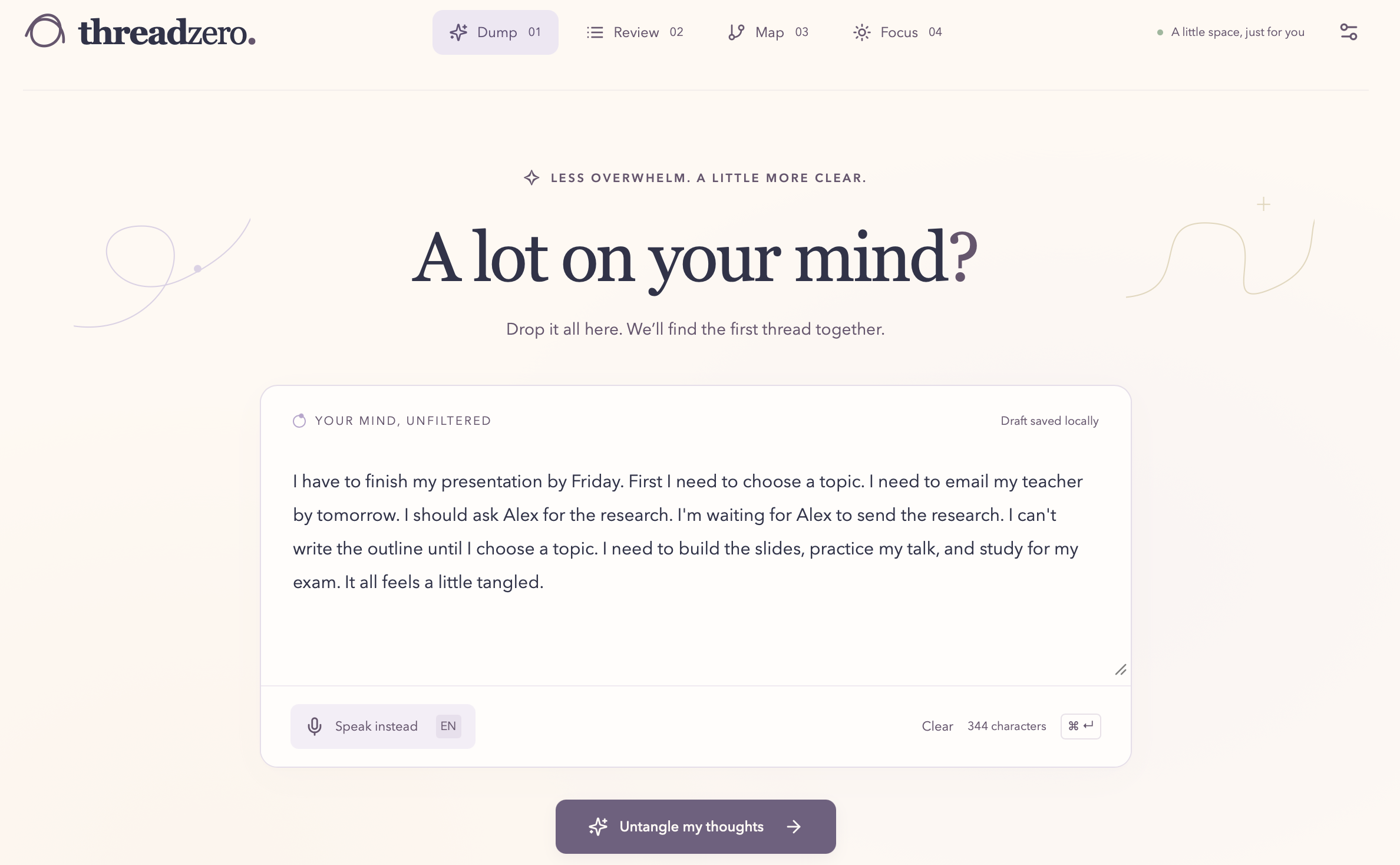
Speak or type freely! No pressure, no perfect lists—just your thoughts finding a place to begin
-
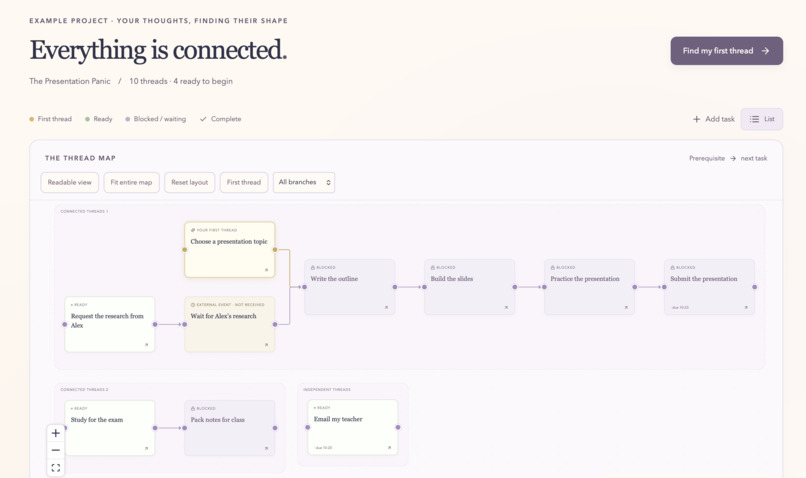
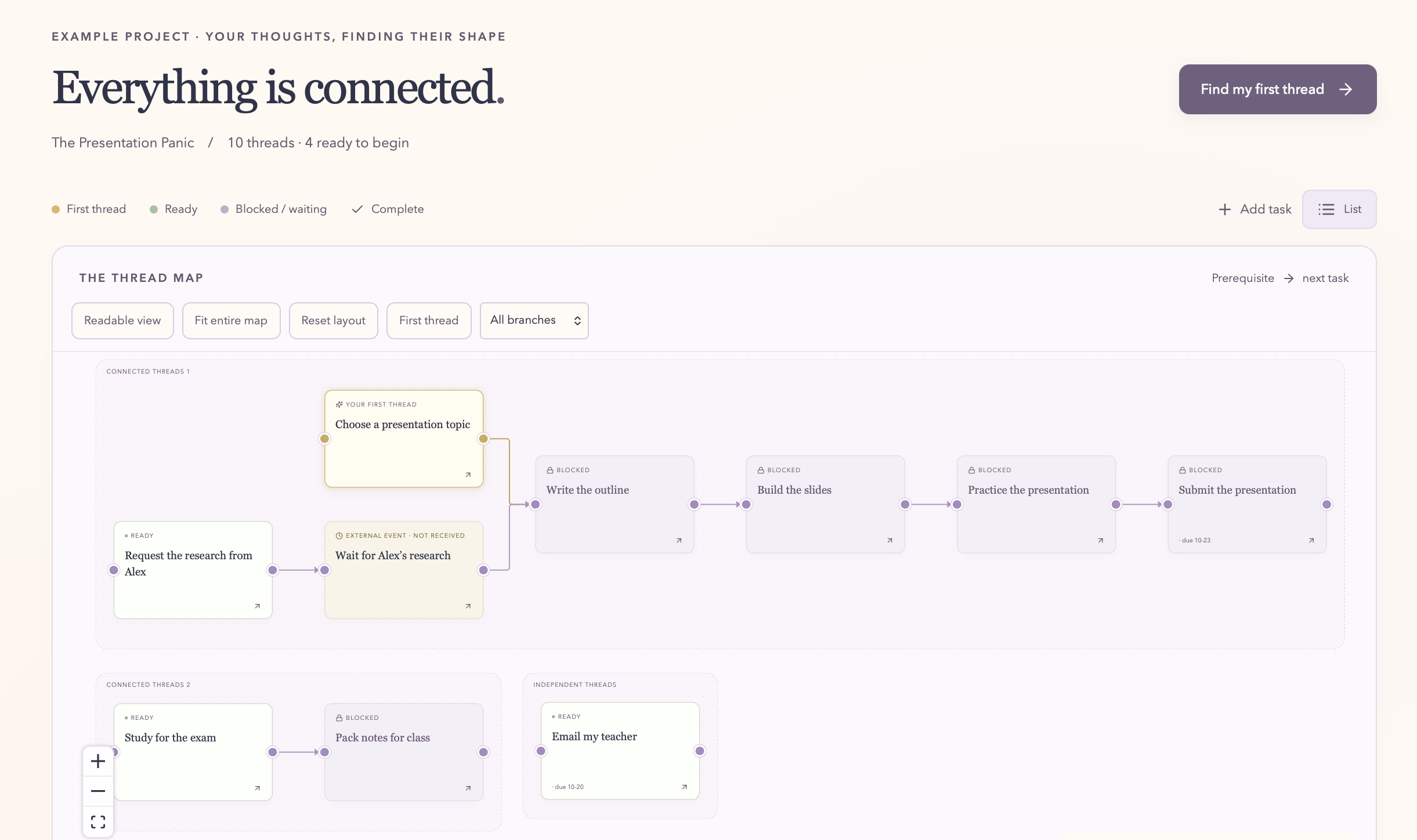
Explore an interactive map of tasks, blockers, and dependencies! See how every completed thread unlocks new possibilities.
Inspiration 💭🧵
Ever had so much to do that you couldn't figure out where to begin?
You open your notes, see a dozen unfinished tasks, remember five more things, and suddenly even making a to-do list feels like another task.
That feeling inspired ThreadZero.
We realized that traditional productivity tools are great at remembering what needs to be done, but not always at helping people understand what needs to happen first.
A task might depend on an approval, a missing document, or another unfinished task. When everything appears equally urgent, it's easy to feel stuck.
We wanted to create something different: a productivity companion that doesn't demand organization from someone who's already overwhelmed.
Something that welcomes messy thoughts, finds meaningful connections, and gently offers a place to begin.
And because productivity tools can sometimes feel cold and demanding, we gave ThreadZero a cozy personality, soft pastel colors, and a tiny cat companion named Pip. 🐱💜
Our guiding idea became:
"Every tangled thought has a first thread."
What it does ✨
ThreadZero transforms a chaotic brain dump into an intelligent, interactive map of tasks and dependencies, helping users find their next actionable step.
Instead of manually organizing everything, users can simply speak or type whatever is on their minds.
Here's how the experience unfolds:
- 🎙️ Brain Dump: Type freely or use voice input to capture scattered thoughts without worrying about formatting.
- 🪄 Magic Untangle: Groq-powered AI identifies actionable tasks, larger goals, potential blockers, and meaningful dependencies.
- 🧩 Smart Review: Users can edit extracted tasks and accept or reject suggested connections. AI doesn't get the final say.
- 🕸️ Interactive Thread Map: A visual dependency graph reveals which tasks are ready, which are blocked, and how everything connects.
- 🎯 Focus Mode: A deterministic recommendation engine identifies a useful next action and explains why it was selected.
- 🔮 What If? Simulator: Explore how completing or delaying a task could affect the rest of the plan without changing the actual workspace.
- 🌱 Gentle Progress: Completing tasks unlocks new possibilities, with little moments of encouragement from Pip.
ThreadZero isn't trying to make people do more every minute.
It's trying to make starting feel easier.
How we built it 🛠️
We built ThreadZero as a lightweight web application that combines AI-powered interpretation with deterministic graph algorithms.
🎨 Frontend and experience
We used React, TypeScript, Vite, and Tailwind CSS to create a responsive interface with a warm, storybook-inspired aesthetic.
The design uses soft lavender accents, cream backgrounds, rounded components, delicate connections, and subtle interactions.
Pip, our little cat mascot, makes the application feel more welcoming without distracting from its purpose.
🧠 AI-powered understanding
We integrated Groq's LLM inference API to power Magic Untangle.
When a user submits their brain dump, the model produces structured suggestions for tasks, goals, and dependency relationships.
For example, it can recognize that buying a sensor must happen before building a prototype, while studying calculus and buying groceries are completely independent activities.
The resulting suggestions pass through application-side validation before entering the graph workflow.
We deliberately separate AI interpretation from deterministic decision-making.
The LLM proposes relationships. The user confirms them. The graph engine calculates what those relationships mean.
🕸️ Dependency graph engine
We modeled task prerequisites as a directed graph.
The graph engine handles dependency validation, cycle prevention, blocked-task detection, and the identification of actionable tasks.
Our ranking logic then considers confirmed dependencies and task priorities to recommend a starting point.
The interactive map makes these relationships visible, while Focus Mode turns the analysis into a concrete next action.
🎙️ Voice-first capture
We added voice input so users don't always need to type or structure their thoughts.
Spoken input becomes editable text that can enter the same Magic Untangle workflow as a typed brain dump.
This helps make the initial capture experience more natural.
☁️ Deployment and infrastructure
We deployed the application on Vercel, using a server-side API endpoint to communicate securely with Groq.
We also integrated Upstash Redis for shared API rate limiting, helping protect our free-tier inference quota from excessive requests.
Task workspace data is stored locally in the browser, while users are informed when they choose to send their text to Groq for AI processing.
The architecture avoids a traditional database server and keeps infrastructure lightweight.
Challenges we ran into 🧶
1. Understanding tasks versus understanding meaning
Our earliest version relied on deterministic text parsing.
It could recognize tasks and explicit patterns, but it struggled to understand the difference between related activities and genuine dependencies.
At one point, we tested it with a deliberately absurd goal: helping a cat win a Nobel Prize. 🐱🏆
The system connected unrelated tasks into one long chain, as though buying tuna were an essential step toward scientific greatness!
It was funny, but it revealed a serious weakness.
We introduced Groq-powered interpretation so the application could propose more meaningful task relationships, while keeping human review and deterministic validation.
2. Handling unreliable AI assumptions
AI-generated output isn't automatically correct.
The model sometimes suggested unrealistic task durations, unnecessary relationships, or confused an actionable reminder with an external waiting condition.
For example, reminding someone to send a document is something you can do. Receiving the document is something you have to wait for.
We addressed these problems by refining task classification, preserving unknown estimates, strengthening relationship validation, and keeping users in control of inferred dependencies.
3. Making graphs understandable
A technically correct dependency graph isn't necessarily a useful one.
Early layouts produced tiny nodes, awkward chains, and too much empty space.
We worked on making the map more readable, emphasizing actionable tasks, separating unrelated branches, and allowing users to inspect relationships.
The challenge was balancing visual beauty with actual clarity.
4. Getting Groq working in production
Magic Untangle initially worked locally but failed after deployment to Vercel.
We had to resolve differences between the local development server and production serverless routing.
After resolving the endpoint issue, we encountered another problem: our API rate-limiting protection required shared Redis configuration.
We configured Upstash and the necessary Vercel environment variables, then verified that live Magic Untangle requests worked.
5. Making productivity feel gentle
We didn't want another application filled with aggressive alerts, streaks, or intimidating dashboards.
Finding the right balance between powerful features and a calm, inviting interface took deliberate design choices.
Pip, the pastel palette, Focus Mode, and the idea of untangling one thread at a time all helped reinforce that philosophy.
Accomplishments that we're proud of 🏆
🌟 Turning an idea into a deployed application. ThreadZero evolved from a simple brainstorming concept into a working web experience with AI-assisted task organization and interactive dependency visualization.
🧠 Combining AI with explainable algorithms. Instead of letting an LLM make every decision, we use it for interpretation and rely on deterministic logic for graph validation and task availability.
🕸️ Making dependencies visible. The Thread Map provides a different way to understand productivity: not as a flat checklist, but as a network of actions, blockers, and opportunities.
🎙️ Supporting natural thought capture. Users can begin with spoken or typed thoughts rather than immediately organizing everything into predefined fields.
🎨 Creating a distinctive visual identity. We're proud of the soft, cozy atmosphere, delicate thread metaphor, and Pip the cat. We wanted ThreadZero to feel approachable from the very first screen.
🚀 Deploying the AI workflow successfully. After resolving production routing and rate-limiting issues, we tested Magic Untangle successfully on the hosted application.
Most importantly, we're proud that ThreadZero doesn't just display tasks.
It helps answer the question: "What can I actually do next?"
What we learned 📚
Building ThreadZero taught us several lessons.
AI is most useful when its responsibilities are clear. Language models can help interpret unstructured thoughts, but correctness still requires validation, explicit rules, and user oversight.
A dependency is not the same as a relationship. Two tasks can belong to the same project without one necessarily blocking the other. Modeling that distinction is essential to meaningful recommendations.
Unknown information should remain unknown. A confident-looking but invented time estimate can be worse than no estimate at all. We learned to prioritize transparency over artificial precision.
Deployment is part of engineering. Code that works locally isn't automatically production-ready. Serverless routing, secret management, rate limiting, and graceful failures are important parts of building a reliable AI application.
Accessibility and emotional design matter. A productivity tool should reduce cognitive friction rather than introduce more of it. Good UX isn't separate from functionality; it directly influences whether people can use the product effectively.
And perhaps our favorite lesson:
Sometimes the most useful feature isn't helping someone accomplish ten things. It's helping them begin one. 🌱
What's next for ThreadZero 🚀
There's plenty more we'd love to explore.
🧠 Smarter personalization: Adapt recommendations to user-provided available time, preferences, and working patterns without introducing guilt-driven productivity metrics.
🎙️ Better voice experiences: Improve local speech transcription compatibility, support more languages, and make voice capture even more accessible.
🕸️ More powerful graph exploration: Introduce clearer project groupings, improved visual layouts, and better handling of complex dependencies.
📅 Optional calendar integration: Help users understand how confirmed deadlines and real availability affect their plans.
🤝 Collaborative threads: Explore privacy-conscious shared dependency maps for students, teams, and small projects.
📱 Offline-first improvements: Make the core task workflow increasingly resilient to poor connectivity, with AI enhancements remaining optional.
🧩 Better task intelligence: Improve how ThreadZero distinguishes actions, goals, external events, and uncertainty using real user feedback.
But throughout these improvements, we want to preserve what makes ThreadZero special.
It should always feel like a quiet, helpful companion—not a manager demanding more productivity.
🧵 A final thought
We built ThreadZero around a simple belief:
You don't have to figure out everything before you can begin.
Sometimes, all you need is one small, clear step.
And maybe a tiny cat cheering you on. 🐈💜
Built With
- css3
- gpt-oss-20b
- groq
- html5
- javascript
- node.js
- react
- react-flow
- tailwind-css
- typescript
- upstash-redis
- vercel
- vercel-serverless-functions
- vite
- web-speech-api


Log in or sign up for Devpost to join the conversation.