Inspiration
Personally, I find online clothing shopping overwhelming with so many options across numerous brands. Even harder is shopping sustainably. Unfortunately, the industry is responsible for a range of negative environmental and societal issues.
Fast fashion refers to the "business model characterized by the rapid design, production, and marketing of inexpensive clothing" [1]. The result is an overproduction of cheap, low-quality clothing that is discarded more quickly. Such production is also often accompanied by poor, exploitative labor practices and wasteful production practices [2]. In fact, 10% of total global carbon emissions come from the fashion industry [1].
Therefore, it is key that consumers hold companies accountable and support sustainable practices through their purchasing power. Sustainable practices include minimizing waste consumption, using better materials, and promoting quality working conditions. In addition, buying from secondhand shops keeps clothing out of the landfill and reduces the consumption of fast fashion [3]. Finding sustainable clothing options, however, can be difficult as many brands greenwash or obscure their production and labor practices. threadsense addresses this by consolidating sustainable options in one platform and providing personalized recommendations for consumers looking to build their style more sustainably.
What it does
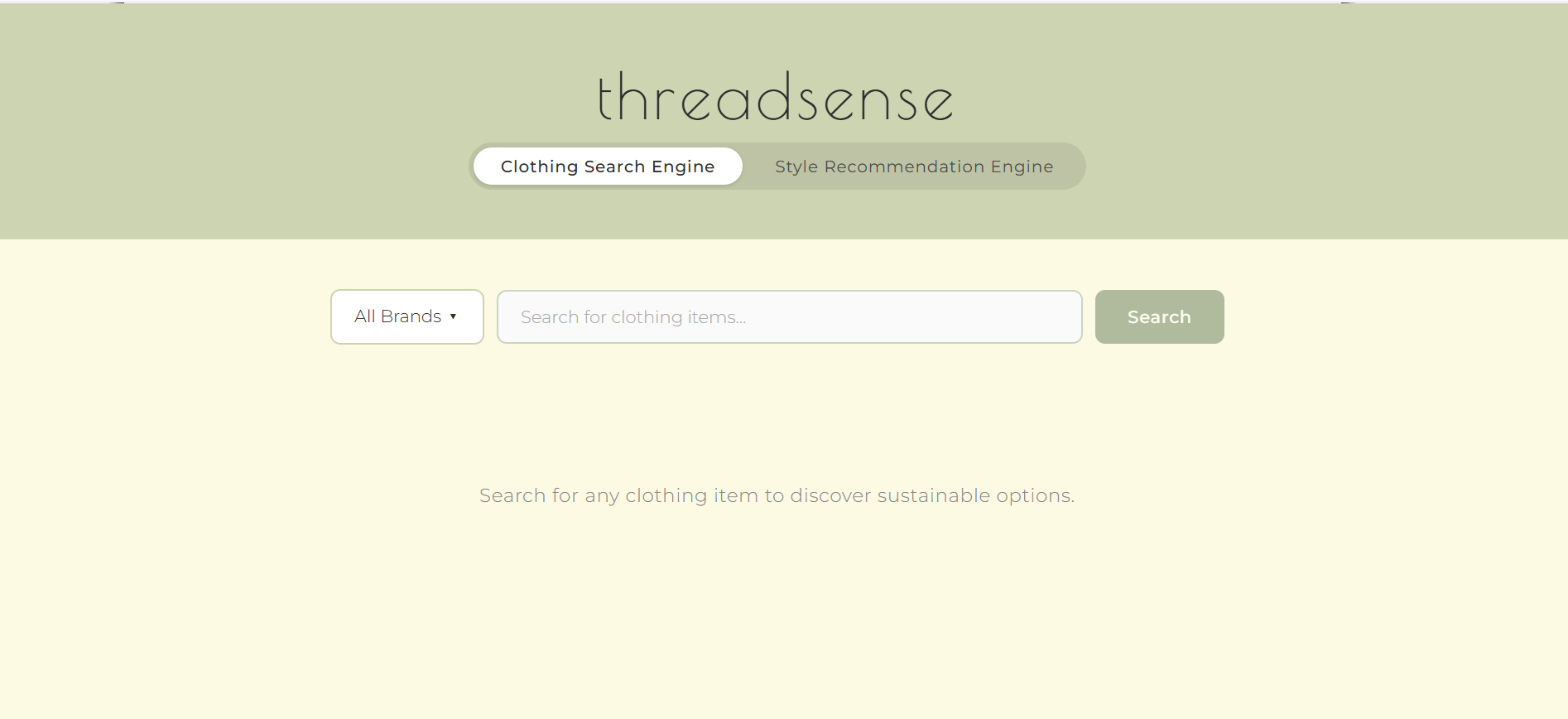
threadsense is a web application designed to allow users to easily find sustainable clothing options across various online platforms. These platforms include second-hand shops (Etsy, eBay, ThreadUp, Poshmark, Depop) as well as well-rated sustainable brands (according to Good On You).
threadsense has two main components:
1) Sustainable clothing search engine: Users can simply search for a desired clothing item and find options from various sustainable sources.
2) Style recommendation engine: Users can receive product recommendations based on their style preferences. Users upload their fashion inspiration images and ask queries such as "give me ideas for an interview." The engine will then provide a tailored recommendation along with product listings from the curated list of sustainable sources.
How we built it
Frontend: React
Backend: FastAPI
Integrations:
- SerpAPI: API for retrieving product lists from Google Shopping. Queries are dynamically scoped to a curated list of sustainable brand domains using site: filters, so results are pre-filtered before they hit the client.
- Used a curated list
- Second-hand shops: Etsy, eBay, Poshmark, Depop, ThreadUp
- Small set of rands with Good/Great ratings from Good On You (https://goodonyou.eco/)
- Used a curated list
- Google Gemini (gemini-3-flash-preview): Powers the style assistant. Accepts multimodal input (user text query + uploaded inspiration images encoded as base64), returns a structured JSON outfit recommendation, and then concurrently searches for each outfit item via SerpAPI
Deployment:
- Vercel for frontend
- Render for backend
- Custom domain from GoDaddy
Challenges we ran into
Identifying sustainable clothing: It isn't clear whether a brand is sustainable unless one thoroughly investigates it. There's also a range of certifications (e.g., Global Organic Textiles Standard, OEKO-TEX) and considerations (e.g., materials used, labor practices, etc.). Fortunately, Good On You provides ratings on a range of brands based on a set of metrics. However, Good On You doesn't encompass every potential brand. In the future, I may consider aggregating other measures to display more comprehensive information. In addition, I'd like to broaden the range of products.
Finding product listings from various sources: Another challenge was retrieving data based on a user's search query. Initially, I aimed to be as broad as possible and aggregate as many as I could. However, given that 1) not all brands have ratings on Good On You and 2) trying to manually aggregate product listings would be unwieldy, I had to pivot my approach. To address the first issue, I narrowed my scope to a set of brands, including well-known second-hand retailers and a subset of brands that had Good/Great ratings on Good On You. For the second, I used SerpAPI, which retrieves results from Google Shopping.
Accomplishments that we're proud of
I'm particularly proud of the recommendation engine. It was an idea I've been meaning to implement for a while for my personal usage, so I'm glad I was able to get a proof-of-concept working to build off of!
I'm also happy with the UI. As someone who is not particularly strong in frontend, I'm pleased with how it looks. I aimed to be intentional with the color palette, fonts, and layout to ensure the site has an earthy and inviting aesthetic.
Overall, I'm proud I was able to create a working MVP on my own!
What we learned
- Setting up a custom domain
- Environmental/societal impacts of unsustainable fashion practices
- Considerations for identifying sustainable clothing
- UI/UX design
What's next for threadsense
- Increased personalization (e.g., ability to favorite items)
- Aggregating more brands
- Collecting sustainability data
References
[1] https://earth.org/fast-fashions-detrimental-effect-on-the-environment/ [2] https://www.bbc.com/news/articles/cdrylgvr77jo [3] https://news.climate.columbia.edu/2021/06/10/why-fashion-needs-to-be-more-sustainable/ [4] https://serpapi.com/google-shopping-api [5] https://goodonyou.eco/

Log in or sign up for Devpost to join the conversation.