Inspiration
Raised in the city, we’ve been exposed to a mix of cultures — particularly in school, where cultural performances brought students together to celebrate dances across the world. Many of these performances often required access to traditional garments, which created stress for students trying to find a balance of authenticity with affordability. From this pain point, we wanted to see if this issue could reflect a broader need for cultural sustainability. Through user research, that was when we saw the opportunity to design something that would not only help foster cultural identity but also remain relevant to educate the generations to come.
What it does
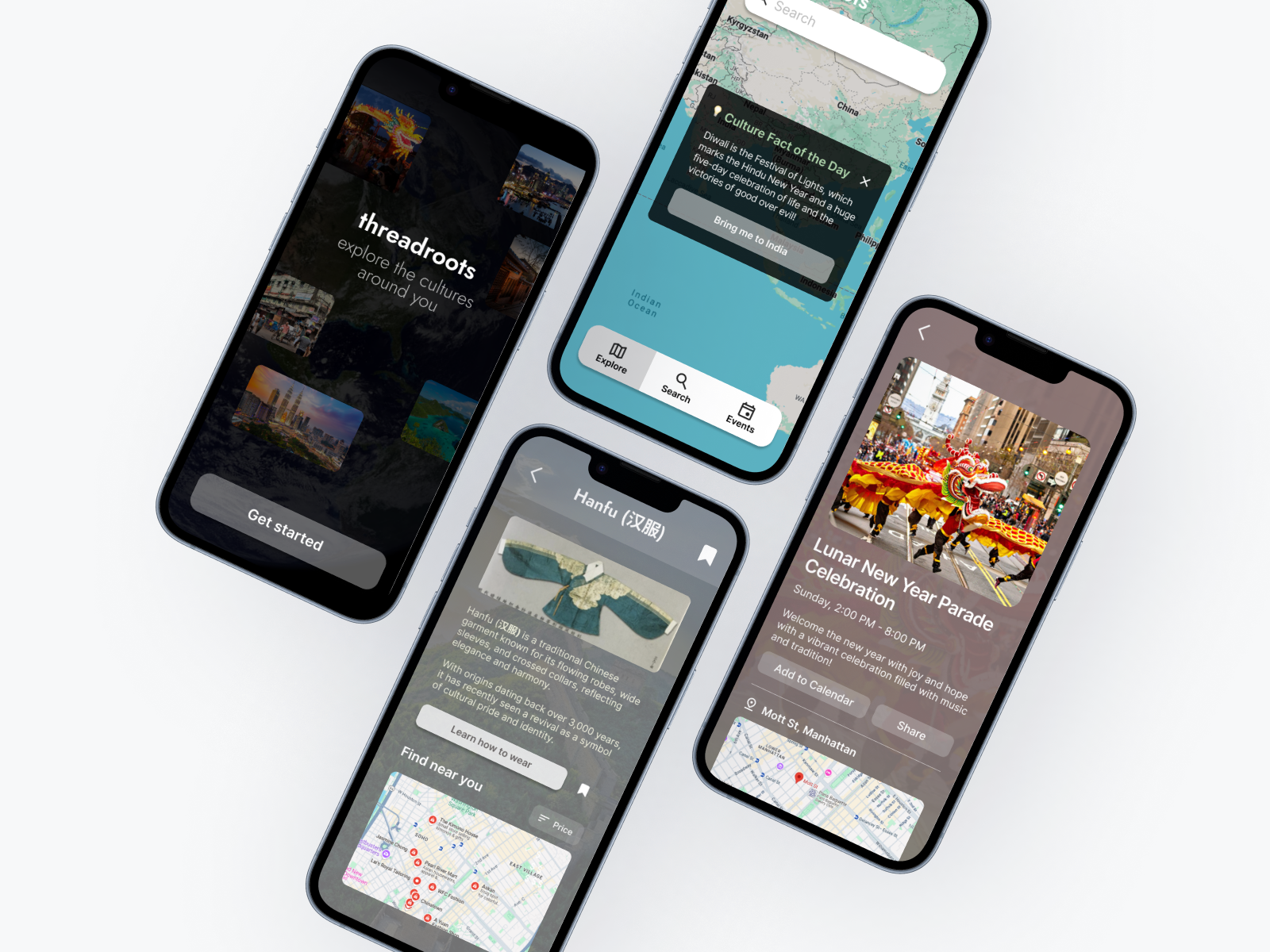
Our app, threadroots, helps users reconnect with their cultural roots through authentic garments, educational content, and local events making cultural learning accessible, inclusive, and fun.
How we built it
The entire process — from low fidelity wireframes, high fidelity mockups, to prototyping — was done on Figma. With the help of online pictures and information, we were able to bring our app to life.
Challenges we ran into
Since one of the members was on the west coast, it was somewhat difficult to coordinate meetings to discuss our project. Had all of us been from the same school, we would’ve been able to brainstorm more in depth and design more efficiently. We had to work remotely for all parts of the design process which was difficult in brainstorming and wireframing as it all had to be done virtually on a Figjam. This opened problems in visualizing ideas during brainstorming and difficulty communicating ideas especially for our app, as it has functions not typically found in existing apps and mental models. Considering this was also the majority of the team’s first designathon, we were unfamiliar with how to pace ourselves within the limited timeframe.
Accomplishments that we're proud of
Our team brought together an interesting mix of experiences: A designer with no prior Figma experience A designer with roughly 2 months of Figma experience A designer collaborating remotely from across the country in California
Despite the odds, we’re proud to have taken our idea and turned it into an interactive prototype in less than 48 hours. For many of us, considering that this was our first designathon, getting the experience of seeing our product come to life in such a short space of time was rewarding enough.
What we learned
We learned how to collaborate effectively despite our different experience levels and time zones as well as dividing up responsibilities to adapt to the time constraints given. We also learned to prioritize specific features as the users would need them because our app is complex and solves a couple of different problems. We did this by using our interviews to specify the specific desires and needs of our users and seeing which ones to keep and prioritize.
What's next for Threadroots
We hope to conduct user testing and observe if any parts of the app aren't as intuitive as needed. By interviewing people, we can understand more about what aspects and features to prioritize, especially in the learning and events sections. We can also focus on what aspects of culture the user might want to see more of or less of while making sure they are represented authentically. If given more time, we would also like to see how much our users follow our event flow and how we can improve that understanding for their ease of use.
Built With
- figma

Log in or sign up for Devpost to join the conversation.